Century Egg & Lean Pork Congee
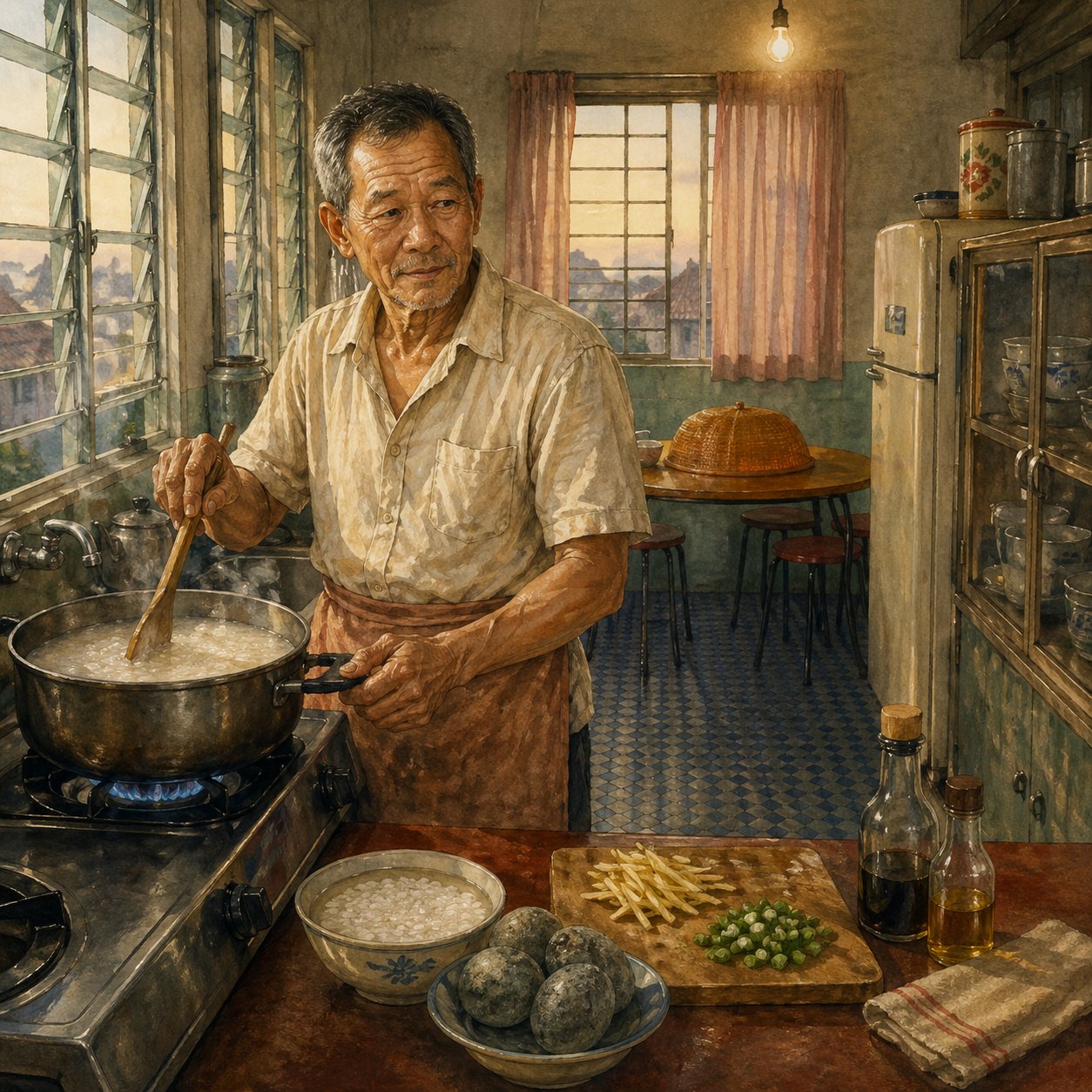
This is the dish you eat when you are sick, when you are tired, when you are hungover, when your mother says "drink some porridge."
Congee (粥, jook in Cantonese, zhou in Mandarin) is older than civilisation in southern China — it began as the food of poverty (one cup of rice could feed a family) and over centuries became the food of comfort, health, and hospitality. Hong Kong took plain congee and made it an art form, and the Cantonese diaspora brought that art to Singapore.
The Singapore version draws from Hong Kong style — clean white congee base, smooth and silky, topped with various ingredients: century egg + lean pork is the classic combination, but you'll also find fish, frog, abalone, beef, peanut, chicken. Well-regarded congee stalls include Mui Kee Congee, Holland V Tian Tian Porridge, and Siong Hee at Yishun.
The two technique debates in Singapore congee:
- Old method: boil rice with water for 1.5+ hours until grains break down naturally
- New method: soak rice, freeze rice, then boil for 30 minutes — same silkiness, faster
Both are valid. I will give you the slow traditional method because that is what I taught my apprentices. The freeze trick is in the notes.
The "century egg" (皮蛋, pidan) is a duck egg preserved in a mixture of clay, ash, salt, quicklime, and rice hulls for about 100 days — not 100 years. The yolk turns creamy and dark green. The white turns translucent amber-brown jelly. It is delicious and harmless. Tell your customers this — many foreigners are scared of it.
🛒Ingredients
Two rices, plenty of stock, century egg done two ways — half melted into the pot, half on top.
For the Congee Base
| Long-grain jasmine rice | 1 cup (~200 g) | Or short-grain Calrose for extra creaminess. |
| Glutinous rice | 2 tbsp (~30 g) | Heritage trick — adds creaminess. |
| Water | 3 L | Or chicken stock for richer version. |
| Pork or chicken bones | 500 g | Optional but highly recommended. |
| Salt | 1 tsp | |
| Neutral oil | 1 tbsp | Prevents bubbling-over and helps silkiness. |
Rice Pre-Treatment heritage step
| Soak rice in water | 1 hour | |
| Drain, rub with salt + oil | ½ tsp each | |
| Rest before cooking | 15 min |
Toppings per bowl
| Lean pork (loin or tenderloin) | 80 g | Sliced thin against the grain. |
| Century egg (preserved duck egg) | ½ | Peeled and quartered. |
| Fresh ginger, julienned fine | 1 tsp | |
| Spring onion, chopped | 1 tbsp | |
| Coriander leaves | a few sprigs | |
| White pepper | a generous sprinkle | |
| Sesame oil | a few drops | |
| Light soy sauce | a drizzle |
Pork Marinade per 4 bowls
| Light soy sauce | 1 tsp | |
| Shaoxing wine | 1 tsp | |
| Cornflour | 1 tsp | |
| Neutral oil | 1 tsp | |
| White pepper | ¼ tsp | |
| Sugar | a pinch |
To Serve
| Freshly fried you tiao (Chinese fried dough) | torn into pieces | |
| Pickled cucumber or pickled mustard greens | to taste | |
| Tieguanyin or Pu-erh tea | a pot |
🌶️Shifu's Lift
choose one path — see "Shifu's Secret" chapter for the philosophy- Old-school path: ½ tsp MSG in the cooked congee
- Modern hawker path: 1 tsp chicken stock powder
- Heritage purist path: Cook congee with 500 g chicken bones (already in recipe — heritage)
👨🍳Method
Seven stages. Patience is the technique. Stir every fifteen minutes.
Pre-Treat the Rice
Wash both rice varieties together. Soak in water for 1 hour. Drain.
Toss drained rice with ½ tsp salt + ½ tsp neutral oil. Let stand 15 minutes. This treatment helps the grains break down into the silky-smooth texture.
[Optional Freeze Trick]: After this treatment, place rice in a zip-lock bag and freeze 8+ hours. Frozen rice cooks in 25–30 minutes instead of 1.5 hours. Cell walls rupture during freezing → faster breakdown.
Build the Stock (if using bones)
Blanch pork/chicken bones in boiling water 3 minutes. Drain. Rinse.
In a stockpot, combine bones + 3 litres fresh water. Simmer 1 hour. Strain. You'll have ~2.5 litres of stock for the congee.
Cook the Congee
In a heavy-bottomed pot, bring 2.5 litres of stock (or water) to a boil. Add the salted-oiled rice. Add 1 tbsp neutral oil. Bring back to boil, then reduce to gentle simmer.
Simmer with lid slightly askew for 1.5 hours (or 25–30 minutes if using frozen rice).
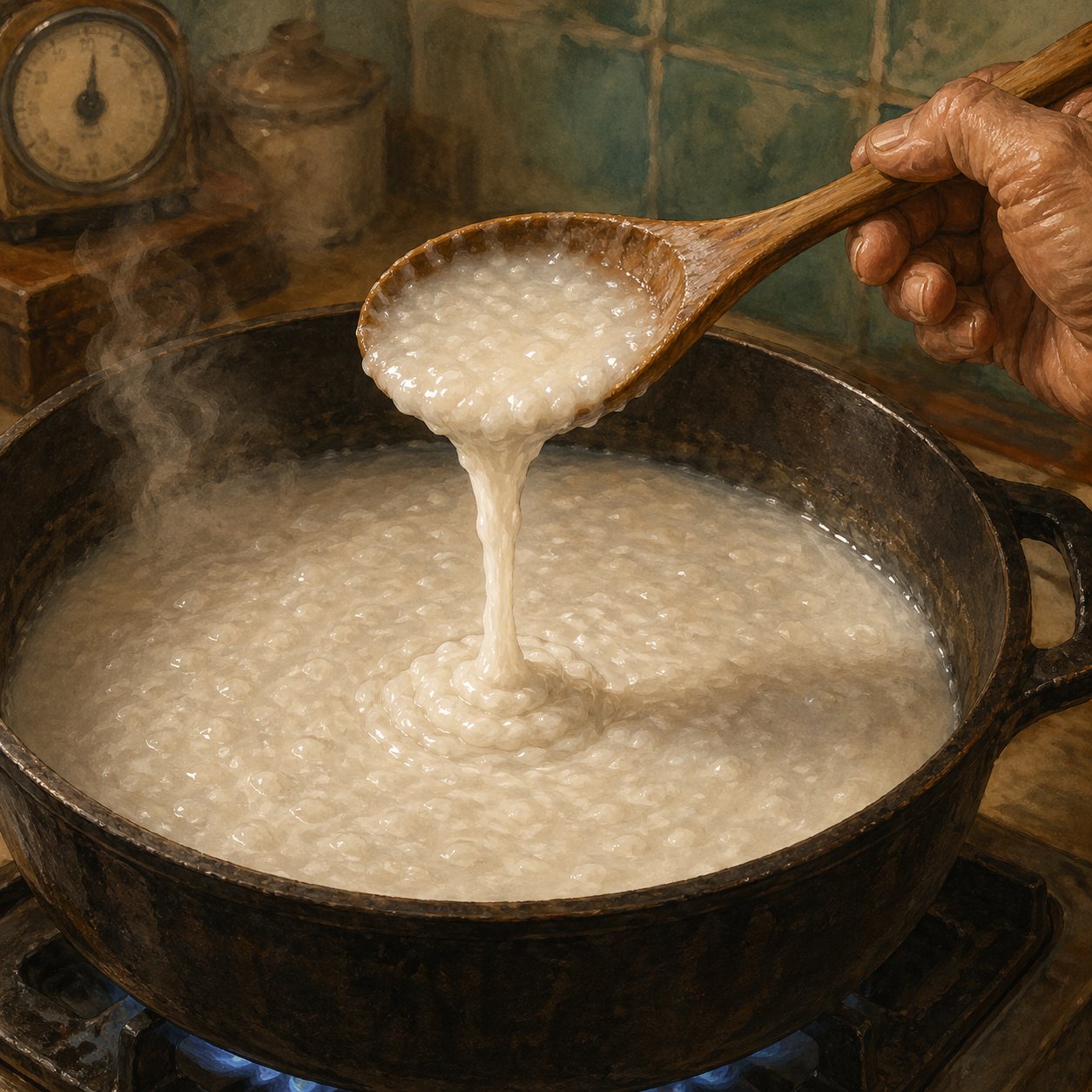
Stir every 15 minutes with a long wooden spoon — scrape the bottom to prevent sticking. The rice grains will gradually break down: from intact grains → splitting open → blooming → fully broken.
The finished congee should be smooth, slightly thick, like thick cream. If too watery, simmer uncovered to reduce. If too thick, add water.
Adjust salt at the end. Important: season lightly — the toppings (especially century egg) carry strong salt.
Marinate Pork
Slice lean pork against the grain into 3 mm slices. Toss with marinade ingredients. Rest 15 minutes.
Prep Century Eggs
Crack century eggs gently — the shells are brittle. Remove shell completely. Rinse under cold water. Quarter each egg.

Cook Pork & Add Eggs
Bring congee back to a simmer.
Add half the century egg directly into the pot (this is a heritage trick — the egg melts slightly into the congee, infusing the whole pot with its umami). Stir gently. Simmer 3 minutes.
Add marinated pork slices. Stir gently to separate. Cook 2 minutes — pork should be just opaque. Do not overcook. The slices stay tender if added at the end.

Plate Each Bowl
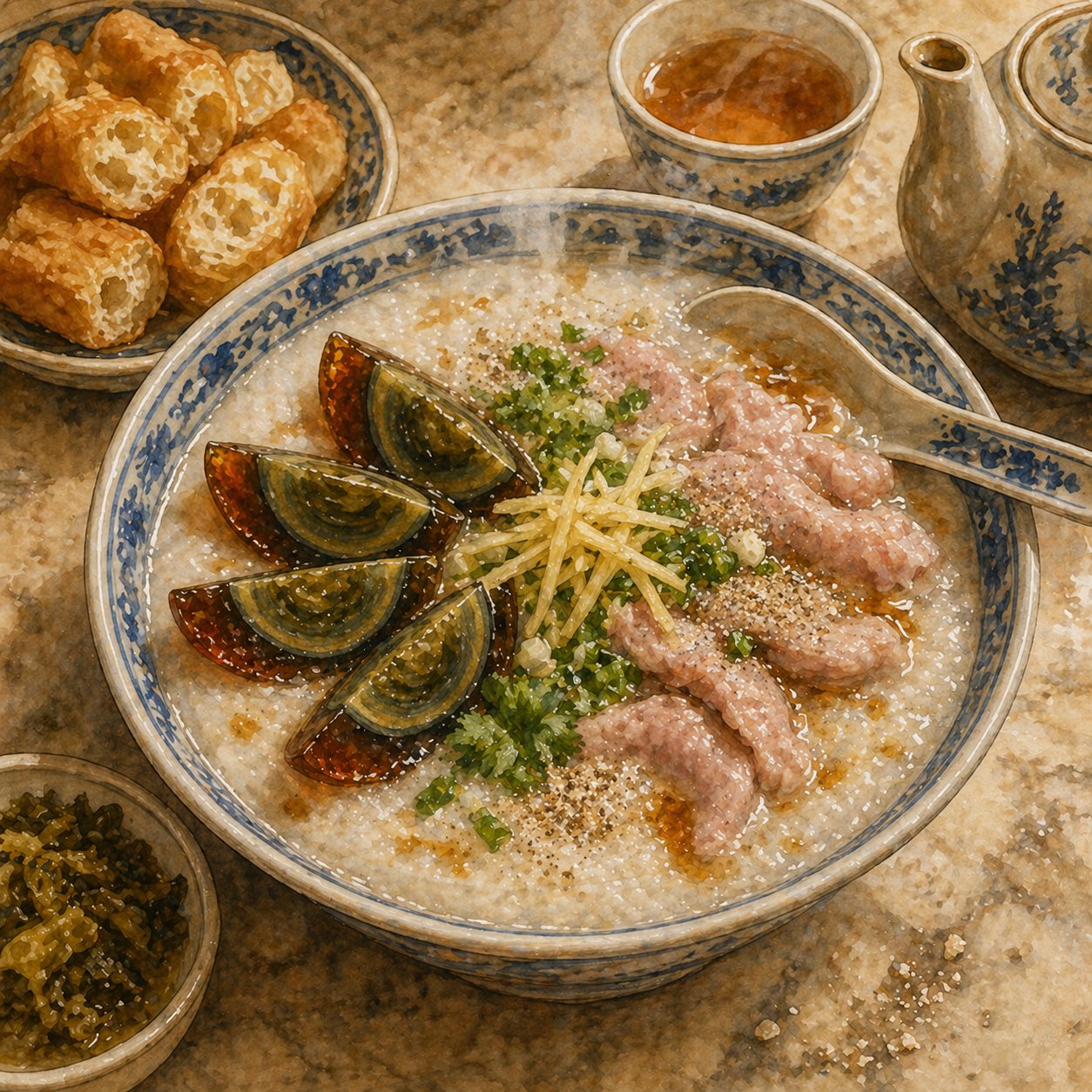
Ladle congee into a deep bowl. Top with:
- 2–3 quarters of fresh century egg
- Julienned ginger (a small mound)
- Chopped spring onion
- Coriander leaves
- Generous sprinkle of white pepper
- Drizzle of sesame oil
- Drizzle of light soy sauce
Serve hot with fresh you tiao on the side.
🎯The Three Tips
Heritage. Master's. Mistake.
🏛 Heritage Note
Pepper, Tea, Tradition
The custom of adding white pepper liberally to congee comes from southern Chinese tradition where pepper was believed to "warm the stomach" and "drive out cold dampness." Even on hot Singapore mornings, the pepper is essential — it lifts the otherwise mild congee into vibrancy.
The Tieguanyin tea pairing is also functional — Cantonese tea-drinking culture believes oolong tea aids digestion of rice and the yolk fat in century eggs. Whether or not it's medically true, it's tradition, and tradition matters.
👨🍳 Master's Tip
The Two Tablespoons of Glutinous Rice
The single technique that elevates Singapore Cantonese congee from "rice porridge" to "silky restaurant congee" is mixing in 2 tbsp of glutinous rice with the regular rice.
The glutinous rice has more amylopectin (the starch responsible for stickiness and creaminess). When it breaks down, it acts like a natural thickener — giving the congee that luxurious, lip-coating mouthfeel you get at heritage stalls.
This is a heritage trick used by Mui Kee Congee and other top stalls in Hong Kong.
The other technique: velvet the pork. The cornflour + oil + soy marinade creates a protective coating that keeps the pork tender even in hot congee. Without it, the pork goes from raw to overcooked in 90 seconds.
⚠ Common Mistake
Watery or Lumpy Congee
Three failures:
- Watery congee = ratio off, or didn't simmer long enough. Fix: 1 cup rice : 12 cups water (or stock) is the heritage ratio for thick Cantonese congee. Simmer until grains visibly broken.
- Lumpy congee = didn't stir bottom regularly, rice stuck and clumped. Fix: stir every 15 minutes from the bottom. Use a heavy-bottom pot.
- Bland congee = under-seasoned. Fix: stock instead of water. Salt at the end. Generous white pepper at serving. Soy sauce on top is not optional.
📈 Scaling for Hawker Service
For a Cantonese congee stall
- One large pot at a time: 8 L of congee made fresh at 5am, holds optimally for 4 hours. Make a second pot at 11am for lunch trade.
- Topping bar: Pre-marinated pork, sliced fish, prawns, century eggs prepped, chicken shreds, peanuts, dried scallop — all small bowls for fast custom assembly.
- You tiao supplier: Build relationship with a soy milk stall — they fry you tiao all morning.
- Cost (Singapore 2026): Per bowl ~SGD 1.20 (rice 0.20 + stock amortised 0.30 + topping protein 0.50 + aromatics 0.20). Sells SGD 4–7 standard, SGD 8–12 with abalone/fish slices. Margin: 70–85% — congee is one of the highest-margin hawker categories.
Congee is the dish a mother makes when her child is sick. The dish a wife makes when her husband comes home tired. The dish a hawker makes when a stranger walks in shivering at 6am. It is generosity, in a bowl.