Char Siew & Siew Yoke Rice
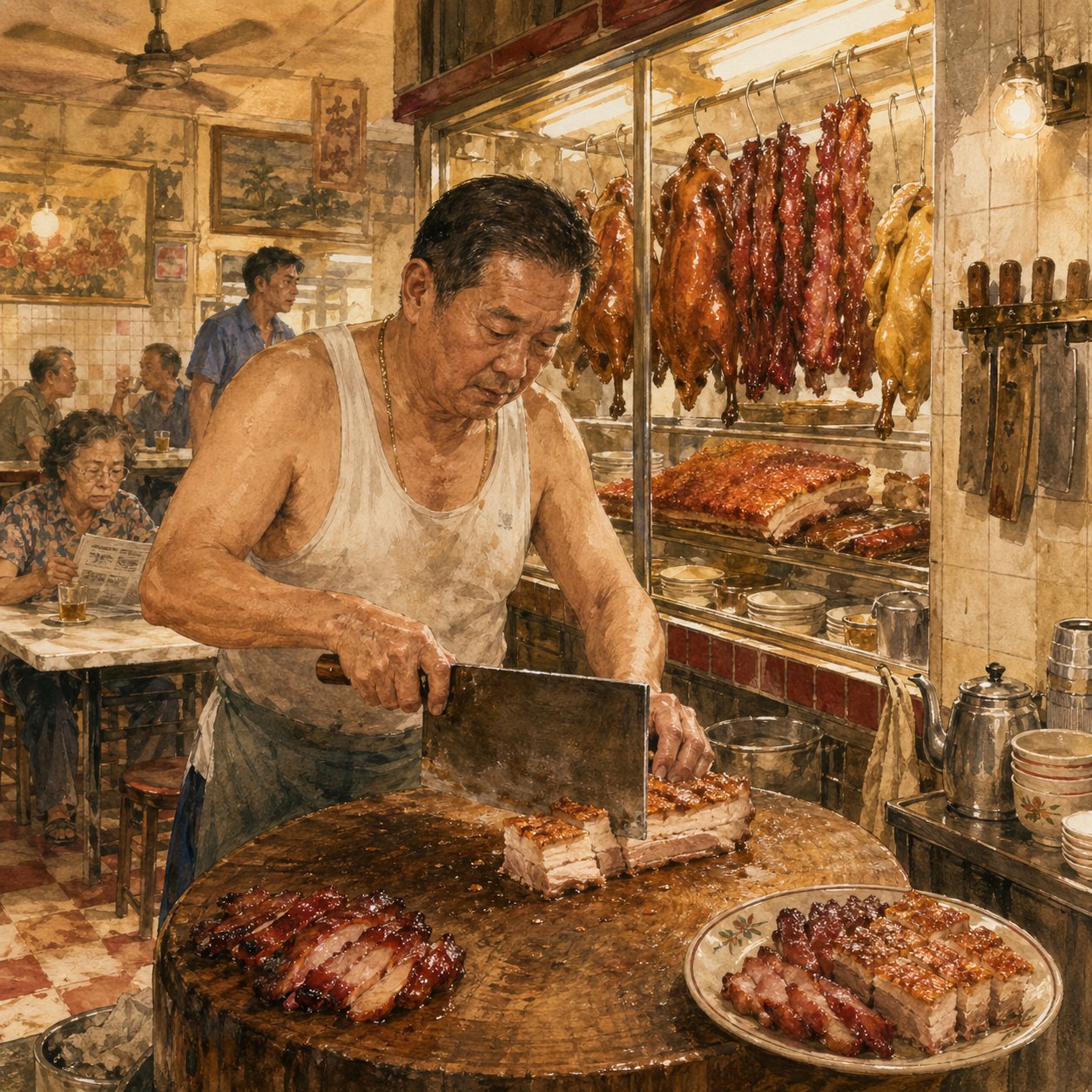
The Cantonese siu mei plate is the everyday king of Singapore lunch.
You can find this at every other coffee shop and every fourth hawker centre stall: the siu mei (roast-meat) tradition — Cantonese roast meats hung in glass display cases, chopped to order, served on rice with a single ladle of dark soy on top. Char siew + siu yoke (roast pork belly) is the most common combination. Add roast duck or soy chicken and you have a "double" or "triple roast" plate.
The siu yoke half of this dish is what I want you to focus on — it is the hardest Cantonese roast meat to perfect, and the one that most stalls get wrong. The skin must be crackling-glass-shattering crisp, the meat layer underneath must be juicy and tender, the fat layers must be rendered but not melted away.
I'm giving you the recipe for both meats. The char siew is from Recipe 11 — refer back to that. Below is the siu yoke and the rice + sauce platform that ties them together.
🛒Ingredients
Siu yoke is the focus here. Char siew is from Recipe 11. Rice and sauces tie the plate together.
For the Siew Yoke crispy roast pork belly
| Pork belly with skin on | 1 kg | Single rectangular slab, ~3–4 cm thick. Ribs removed but skin on. Ask wet market butcher for "sio bak" cut. |
Skin Treatment
| Coarse salt | 2 tbsp | For exfoliating skin. |
| White vinegar (or apple cider) | for brushing | |
| Coarse sea salt | ~1 cup | For the salt crust. |
Meat Marinade meat side only — not the skin
| Shaoxing wine | 2 tsp | |
| Salt | 2 tsp | |
| Sugar | 1 tsp | |
| Five-spice powder | ½ tsp | |
| Ground white pepper | ¼ tsp | |
| Nam yu (red fermented bean curd) | 1 cube, mashed | Optional, traditional Cantonese. |
| Garlic powder | ½ tsp | Optional. |
For the Rice Platform
| Long-grain jasmine rice | 3 cups | Uncooked. |
| Water | 3 cups | |
| Pork lard or chicken fat | 2 tbsp | Rubbed in after cooking. |
| Salt | a pinch |
Drizzle Sauce per plate · mixed at service
| Premium dark soy sauce | 2 tsp | |
| Light soy sauce | 1 tsp | |
| Sugar | ½ tsp | |
| Sesame oil | a few drops | |
| Hot pork drippings or chicken fat | 1 tbsp |
The Two Dips
| Chilli-garlic sauce | per plate | 6 red chillies blended with 4 garlic cloves + 2 tbsp lime juice + 1 tsp sugar + 1 tsp salt + 4 tbsp hot stock. |
| Mustard sauce (traditional with siu yoke) | per plate | 2 tsp Colman's mustard powder + 2 tsp warm water (rest 5 min before serving). |
To Serve
| Char siew (from Recipe 11) | to taste | |
| Blanched choy sum (Chinese flowering cabbage) | a handful per plate | |
| Pickled green chillies | to taste |
🌶️Shifu's Lift
choose one path — see "Shifu's Secret" chapter for the philosophy- Old-school path: ¼ tsp MSG in meat marinade
- Modern hawker path: ½ tsp chicken stock powder
- Heritage purist path: Already covered with red fermented bean curd
👨🍳Method (Siew Yoke)
Six stages. The skin prep starts a day ahead. The crackling is six steps that must all be right.
Skin Preparation (Day Before)
Rinse pork belly, pat dry. Use a sharp knife to scrape the skin to remove any hairs or impurities. Rub 1 tbsp of coarse salt all over the skin like exfoliating — this removes loose film. Rinse, pat dry.
Boil a kettle of water. Hold the pork skin-side up over the sink. Pour the boiling water over the skin slowly, all over. The skin will tighten and turn white. This step softens the skin enough to poke holes through it.
Pat absolutely dry.
Now poke the skin. Using a metal skewer (or a meat mallet with sharp pins), systematically poke holes all over the skin. Hundreds of holes. More holes = better crackling. The holes let moisture escape during roasting and create the bubble pattern. Do not gouge — just pierce.
Flip pork meat-side up. Score the meat with shallow 1 cm-deep cuts in a crosshatch pattern.

Marinate the Meat
Mix all marinade ingredients. Rub generously into the meat side and into all the cuts. Keep the skin completely clean and dry — no marinade touches the skin.
Place pork on a wire rack on a tray, skin-side up, uncovered in the fridge for 12–24 hours. The longer the dry, the better the crackling. Some heritage stalls dry for 36 hours.
Salt-Crust Roast
Preheat oven to 200°C / 400°F.
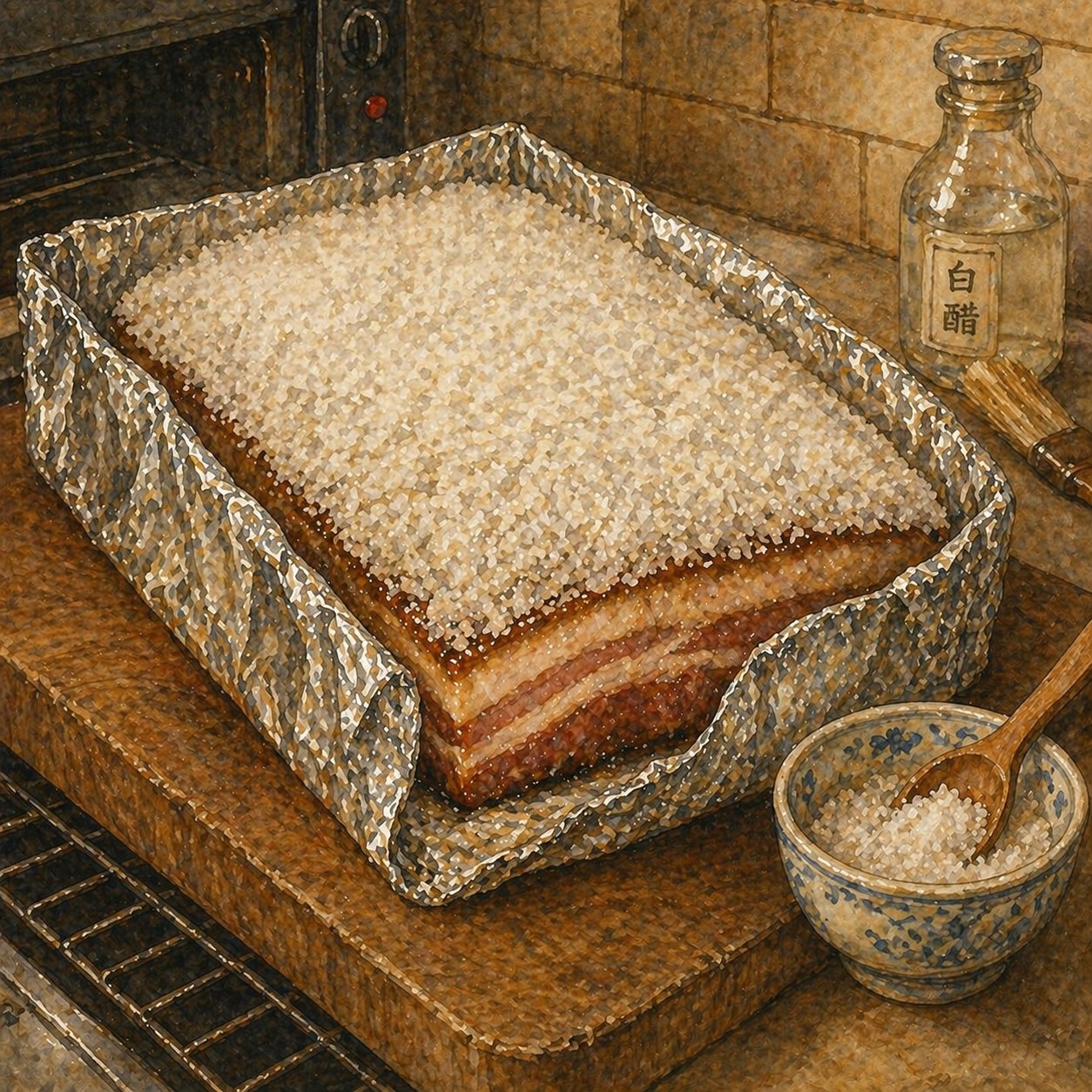
Place the pork on a piece of heavy-duty aluminium foil. Fold the foil up around the meat like a low-walled box, exposing only the skin. The foil walls must be ~1 cm taller than the skin level — this contains the salt crust.
Brush the skin with white vinegar (a thin layer).
Pour 1 cup of coarse salt evenly over the skin to form a 1 cm-thick salt crust. This is the key technique — the salt draws moisture from the skin during the first roast.
Place on the lowest oven rack. Roast for 70 minutes.
Crackle the Skin
Remove pork. Carefully lift off the salt crust (it should come off as a hard sheet). Brush off any residual salt with a pastry brush.
Brush the skin with a thin layer of vinegar (this neutralises any remaining surface salt).
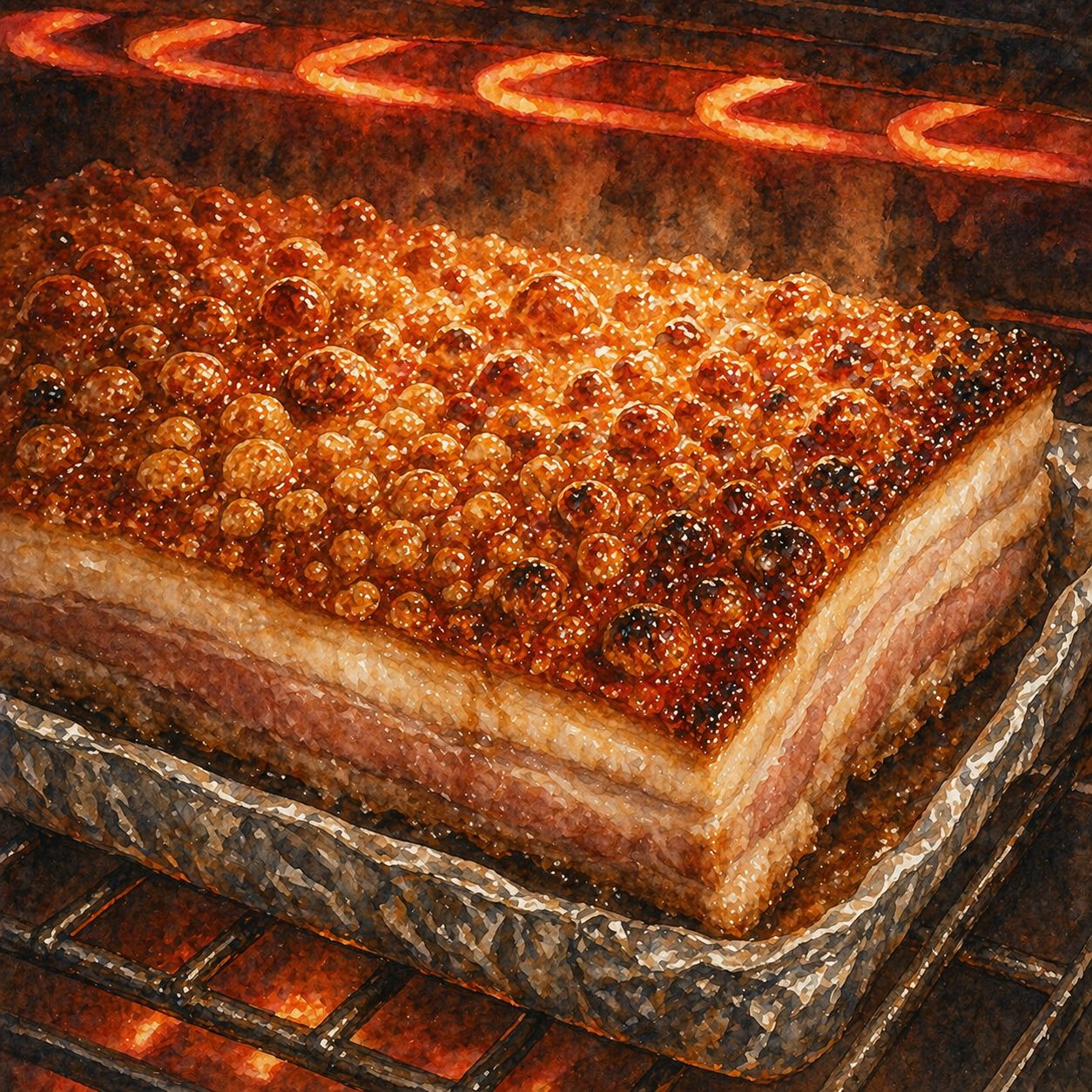
Now turn oven to high broiler / grill setting (~240°C / 460°F top heat), position pork at the upper-middle rack.
Broil for 8–15 minutes, watching every 2 minutes. The skin will:
- Hiss and bubble (3–5 min)
- Pop and crackle (5–8 min)
- Turn golden, then mahogany, then dark amber (8–15 min)
Pull when the entire skin is bubbled, brown, and audibly crispy. If parts char too dark, rotate or shield with foil.
Rest, Scrape, Slice
Rest 15 minutes. The crackling will set.
If parts of the skin look too dark or charred, scrape lightly with a serrated knife — the burnt bits come off, revealing clean crackle underneath. This is the heritage trick from ieatishootipost — the secret of thin, even crackling.
To slice: place the pork skin-side down, slice through the meat with a heavy cleaver. Then with the cleaver flipped over, chop straight down through the skin in a single motion. Dragging the knife through the skin shatters it. Use a heavy cleaver and chop, don't saw.
The Rice & Plating
Cook rice with pork lard / chicken fat / pinch of salt. Once cooked, fluff and let stand 5 minutes.
For each plate:
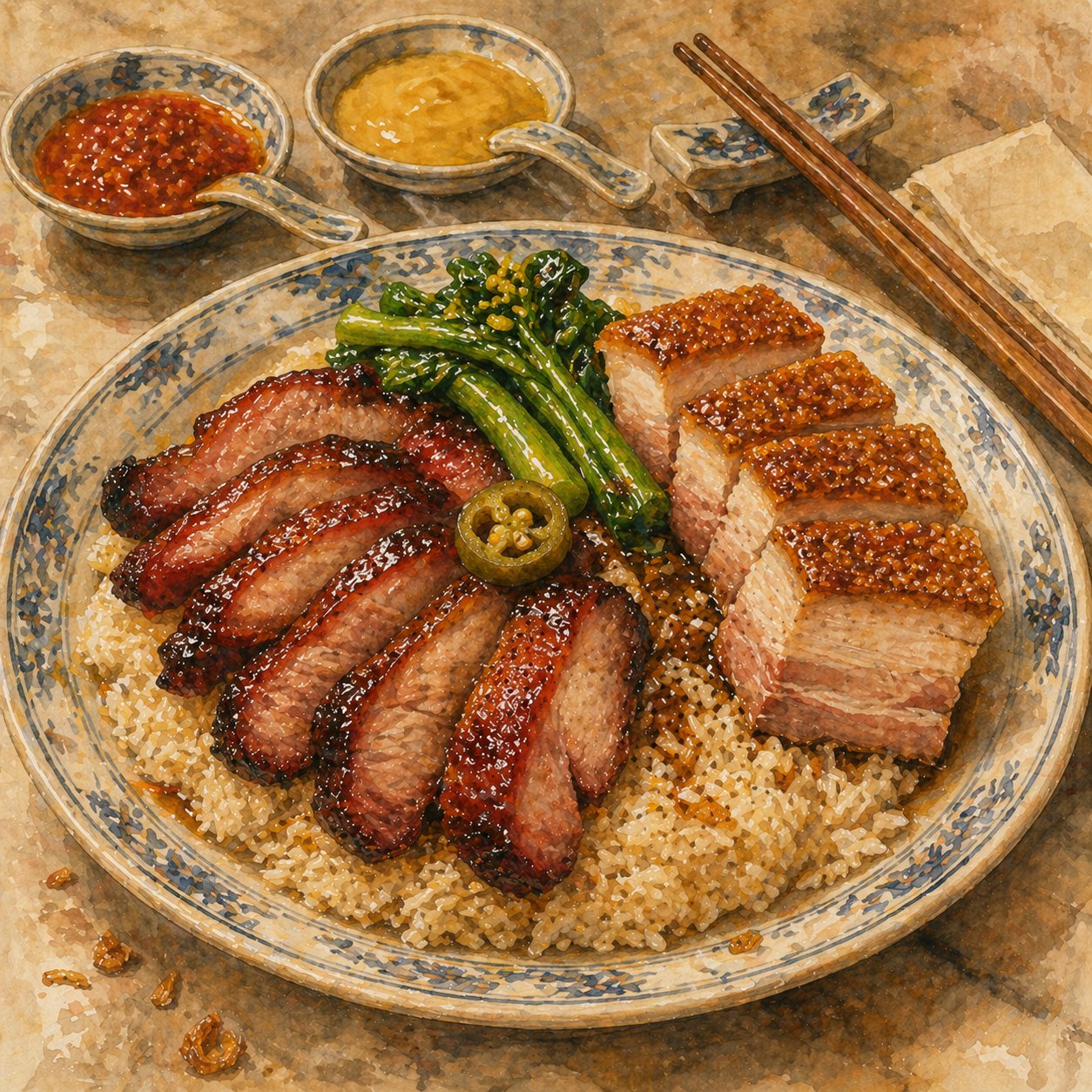
- Mound rice in centre
- Lay 6–8 slices of char siew on one side
- Lay 4–5 pieces of siew yoke on the other side
- Garnish with blanched choy sum
- Drizzle the dark soy sauce mixture over the meats
- Serve chilli-garlic sauce + mustard in two small saucers on the side
🎯The Three Tips
Heritage. Master's. Mistake.
🏛 Heritage Note
The Mustard Dip
The mustard dip with siu yoke is a British colonial-era addition — adopted by Cantonese roast meat stalls during the colonial era when British residents would eat siu yoke and request "English mustard." It stuck. Today, it is part of the heritage and most old-school siu mei stalls keep a small dish of yellow Colman's mustard on the counter.
👨🍳 Master's Tip
The Three Techniques for Perfect Crackling
There is no single trick — there is a sequence of three that all must be done:
- Boiling water scald — softens skin enough to poke
- Hundreds of skewer holes — moisture escape routes
- Air-dry uncovered 12+ hours — surface moisture removal
Then in cooking:
- Salt crust on first roast — draws out remaining surface moisture
- Vinegar wipe before broil — neutralises salt, helps even browning
- High broiler heat at the end — explosive moisture vaporisation creates the bubble pattern
Skip any one and your crackling will be partial, rubbery, or tough. This is why siu yoke is genuinely hard — six steps must all be right.
⚠ Common Mistake
Soggy or Rubbery Crackling
The three failure modes:
- Skin not dry enough before roasting = no crackle, rubbery sheet. Fix: longer fridge dry, or use a hairdryer on cold setting for 30 minutes before roasting.
- Oven not hot enough on the broiler stage = skin browns but never crackles. Fix: maximum broiler heat. If your home oven can't go above 220°C, this is genuinely difficult.
- Cutting too soon after broil = juices migrate, skin softens. Fix: Always rest 15 minutes.
📈 Scaling for Hawker Service
For a Cantonese roast meat stall
- Twice-daily roasting: 6 kg pork belly + 8 kg char siew, roasted in cycles before opening at 11am and again at 2pm for dinner trade.
- Crackling refresh: Some stalls re-broil a few seconds before serving to refresh the crackling on each plate.
- Char siew turnover: Char siew has a 4-hour optimal eating window after slicing — it gets dry. Slice to order from the hanging strip.
- Cost (Singapore 2026): Per plate ~SGD 3.50 (siu yoke 1.50 + char siew 1.00 + rice 0.30 + sauces 0.20 + amortised charcoal/gas 0.50). Sells SGD 7–12. Margin: 60–70%.
The crackling is the test. If you hear it shatter when the cleaver hits, the customer hears it too. That sound is the sound of a master.