Hakka Salt-Baked Chicken
The Hakka brought a mountain technique to a coastal city — and the chicken came out tasting like the mountains.
Salt-baked chicken — Yan Guk Gai 盐焗鸡 in Hakka — is one of the most quietly extraordinary heritage techniques in the Hakka kitchen. The dish was not invented in Singapore. It was carried here, like mei cai and like yong tau foo, by the Hakka migrations from the Guangdong-Fujian highlands in the nineteenth century.
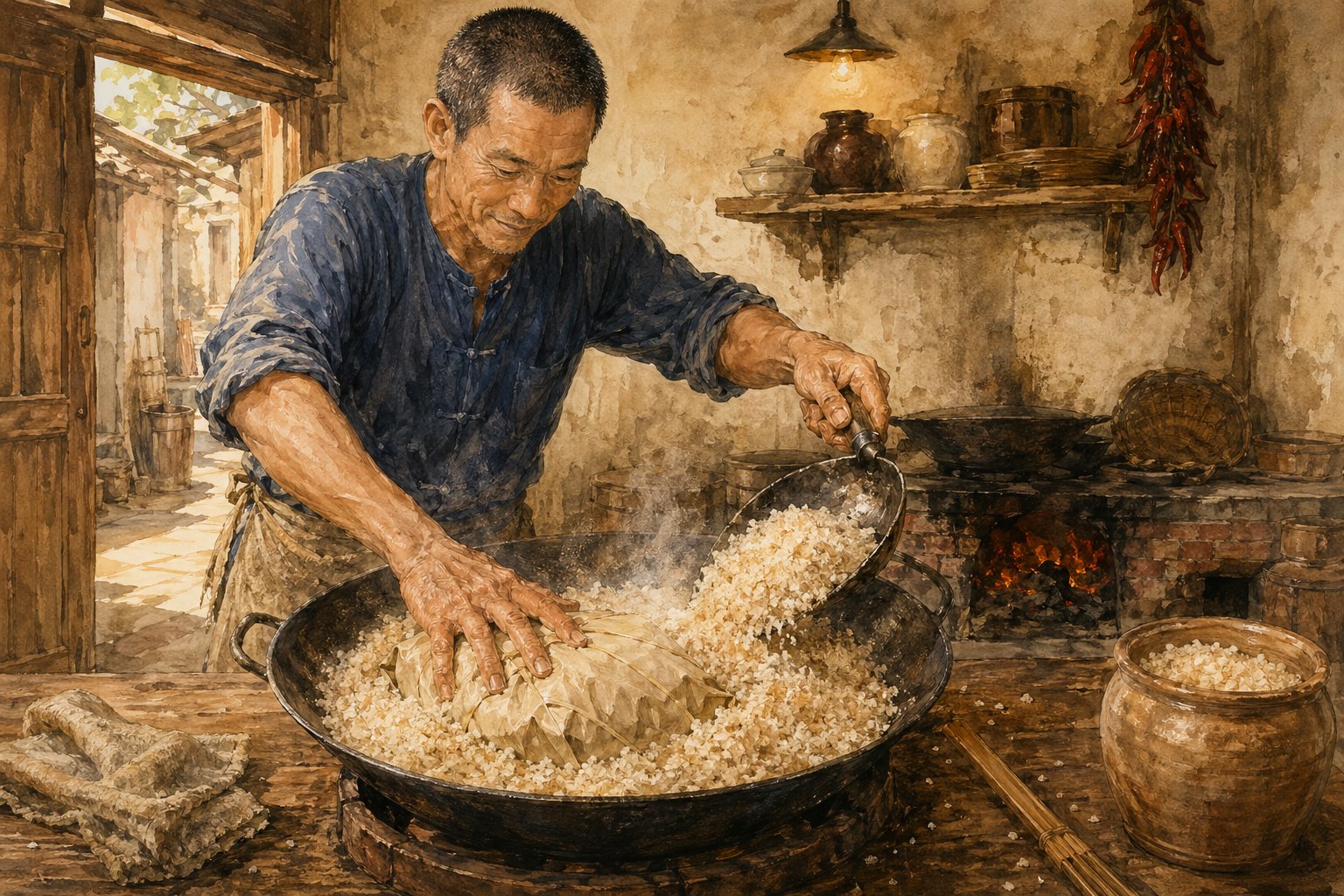
The technique is direct in its logic. A whole chicken is rubbed with sand-ginger, salt, and Shaoxing wine; wrapped in lotus leaf and heritage parchment paper; buried inside a wok of pre-toasted hot rock salt; and baked in the salt's residual heat for 40–50 minutes. The salt does not penetrate the wrap — the lotus-and-paper acts as a seal — but the heat of the salt is even and dry and surrounding, which is what cooks the chicken slowly and gently, infusing the flesh with the lotus-leaf's earthy fragrance and the dry-roasted depth that no oven can quite replicate.
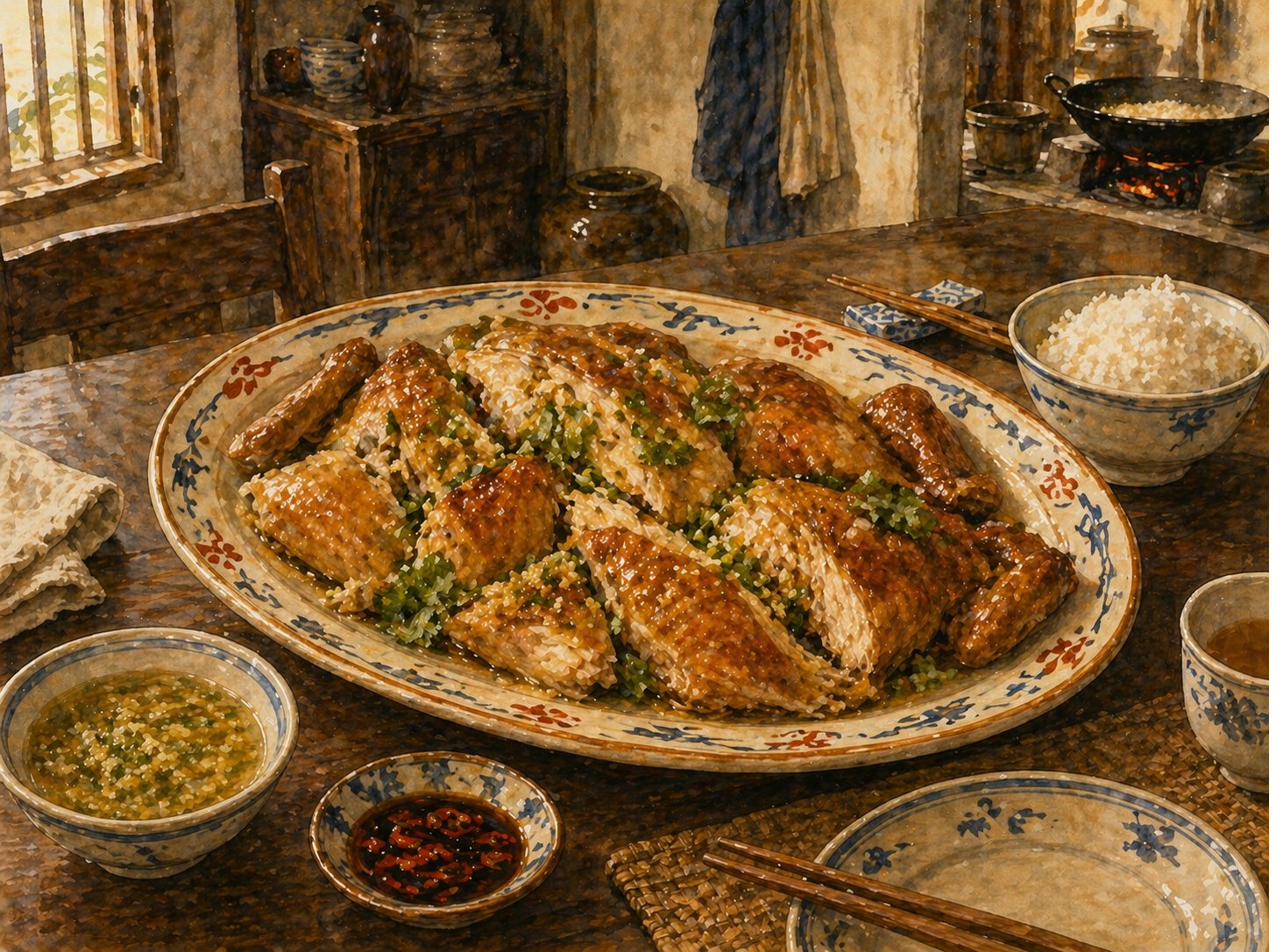
The result is a chicken with dry-amber-gold-mahogany skin (NOT the wet-glossy pale-cream of poached chicken — heritage Hakka salt-bake skin is its own distinct register), tender white-and-yellow flesh that slips off the bone along the natural muscle seams, and a faint sand-ginger-and-lotus aroma that opens the moment the wrap is torn. Heritage Hakka cooks hand-tear the chicken — never cleaver-carve — pulling the pieces apart along the seams, one drumstick, one thigh, two wings, breast strips. The hand-tear is not laziness or lack of refinement: it is the heritage technique, the way the dish has always been served, the way that lets each diner see exactly which part of the bird they are receiving.
The salt — 3 to 4 kg of coarse rock salt for a single chicken — is the heritage technique's most dramatic feature. The salt is pre-toasted in the wok over high heat for 20–25 minutes, until it reaches a temperature in the range of 200°C and takes on a soft warm pale-amber tint. The chicken bundle is then buried in the centre of the hot salt, with more hot salt heaped over the top to seal in the heat. The wok is covered, set on low residual charcoal heat (or off-heat entirely, depending on the cook's judgement), and the salt cooks the chicken from all sides simultaneously.
The salt is reusable for many bakes — a heritage Hakka salt-bake stall keeps the same wok-of-salt for months, replenishing only when the salt darkens excessively from accumulated chicken juices and aromatics. The salt actually improves with age: the residual flavour-infusion deepens.
In Singapore, heritage Hakka Salt-Baked Chicken appears most reliably at:
- Pow Sing Restaurant (Serangoon Garden Way) — Hainanese-style restaurant historically known for Hainanese chicken rice but also reportedly serves a Hakka-influenced salt-baked chicken; cross-community Singapore heritage form
- Tang's Hakka Restaurant — heritage Hakka establishment with Salt-Baked Chicken on the standing menu (reportedly running for several decades)
- Moi Lum Restaurant — the Hakka heritage restaurant on South Bridge Road, reportedly running since 1965
- A handful of clan-association banquet kitchens where the dish is prepared on order for major occasions
The dish is less labour-intensive than Recipe 23 kou rou — there is no 2-day rhythm, no inversion-flip discipline, no skin-side-down-then-flipped construction. A skilled cook can prepare and salt-bake a chicken in under 90 minutes. That is why salt-baked chicken survives at hawker-restaurant scale where kou rou cannot — the labour-cost economics work.
I am giving you the heritage countryside-cook version here, the way it was made by my Hakka neighbour-uncle's family at the heritage Hakka restaurant where his cousin worked. The proportions are scaled for a whole chicken (1.6–1.8 kg), serving 4–6 as a main dish.
🛒Ingredients
A whole chicken. Sand-ginger marinade. Lotus leaf and parchment. Three to four kilos of coarse rock salt.
For the Chicken
| Whole chicken (skin-on, head-and-feet removed) | 1.6–1.8 kg | Free-range or kampong-style preferred. A free-range chicken with firm yellow skin and visible chicken fat under the skin is heritage-correct; commercial broiler chicken works but yields softer skin and milder flavour. |
| Sand-ginger powder (sha jiang fen, 沙姜粉) | 2 tbsp | Sand-ginger is the dish's defining spice — pale-yellow, woody-camphor aroma, distinct from common ginger. Available at Chinese medicinal-ingredient stalls and some heritage Hakka grocers. NOT a substitution-friendly ingredient. |
| Fine salt | 2 tbsp | For marinade rub. |
| Shaoxing wine | 3 tbsp | |
| White pepper | 1 tsp | |
| Sesame oil | 1 tbsp | |
| Fresh ginger | 30 g, sliced | For cavity. |
| Spring onion (whole) | 2 stalks, knotted | For cavity. |
For the Salt-Bake
| Coarse rock salt | 3–4 kg | Coarse rock salt — NOT fine table salt, NOT sea salt flakes. The crystals are the heritage size; fine salt heat-distributes wrong and risks burning the wrap. |
| Fresh lotus leaf | 1 large (about 30–40 cm diameter) | Fresh dark-green lotus leaf — available at heritage Hakka grocers, Chinese medicinal stalls, and sometimes Vietnamese herb stalls. If unavailable, dried lotus leaf can be used after soaking in warm water for 20 minutes. |
| Heritage parchment paper (sand-coloured kraft) | 1 large sheet (~50 × 50 cm) | Sand-coloured kraft parchment — NOT modern white parchment, NOT plastic-coated baking paper. The heritage paper provides the structural seal underneath the lotus leaf. |
| Cotton kitchen twine | 1 m | For tying the wrapped bundle. |
🌶️Shifu's Lift
choose one path — see "Shifu's Secret" chapter for the philosophy- Old-school path: ¼ tsp MSG mixed into the marinade rub
- Modern hawker path: ½ tsp chicken stock powder mixed into the marinade rub
- Heritage purist path: Already covered with sand-ginger + salt + Shaoxing wine + the salt-bake's intrinsic dry-roast depth
For the Sand-Ginger-and-Scallion Dipping Oil heritage Hakka primary condiment
| Fresh sand-ginger root, very finely minced | 1 tbsp | Or 1 tsp sand-ginger powder if fresh unavailable. |
| Spring onion (white parts), very finely minced | 2 tbsp | |
| Garlic, very finely minced | 1 tsp | |
| Fine salt | ½ tsp | |
| Neutral oil | 4 tbsp | Heated to just-smoking, poured over the aromatics. |
| Sesame oil | 1 tsp |
For the Light-Soy-and-Chilli Dip secondary condiment
| Light soy + sliced bird's-eye chilli + a few drops of black vinegar | to taste |
👨🍳Method
Six stages. Marinate, toast salt, wrap, bury, rest and tear, plate. The salt holds the heat. The leaf holds the aroma.
Prepare and Marinate the Chicken
Pat the chicken completely dry inside and out with kitchen paper. The dryness is non-negotiable — moisture under the wrap turns into steam during the bake, which makes the skin soft instead of dry-crisp.
Mix the marinade rub: 2 tbsp sand-ginger powder + 2 tbsp fine salt + 3 tbsp Shaoxing wine + 1 tsp white pepper + 1 tbsp sesame oil. The rub should be a thick paste.
Rub the marinade thoroughly over the chicken: the cavity first, then under the skin (gently loosen the breast skin with your fingers and rub a small amount underneath), then the entire exterior. The pale-yellow sand-ginger marinade should leave a fine even coat across the skin.
Stuff the cavity with the sliced ginger and the knotted spring onion.
Cover loosely and rest at room temperature for 30 minutes, or refrigerate for up to 4 hours.
Add the Shifu's Lift to the marinade if using.
Toast the Salt
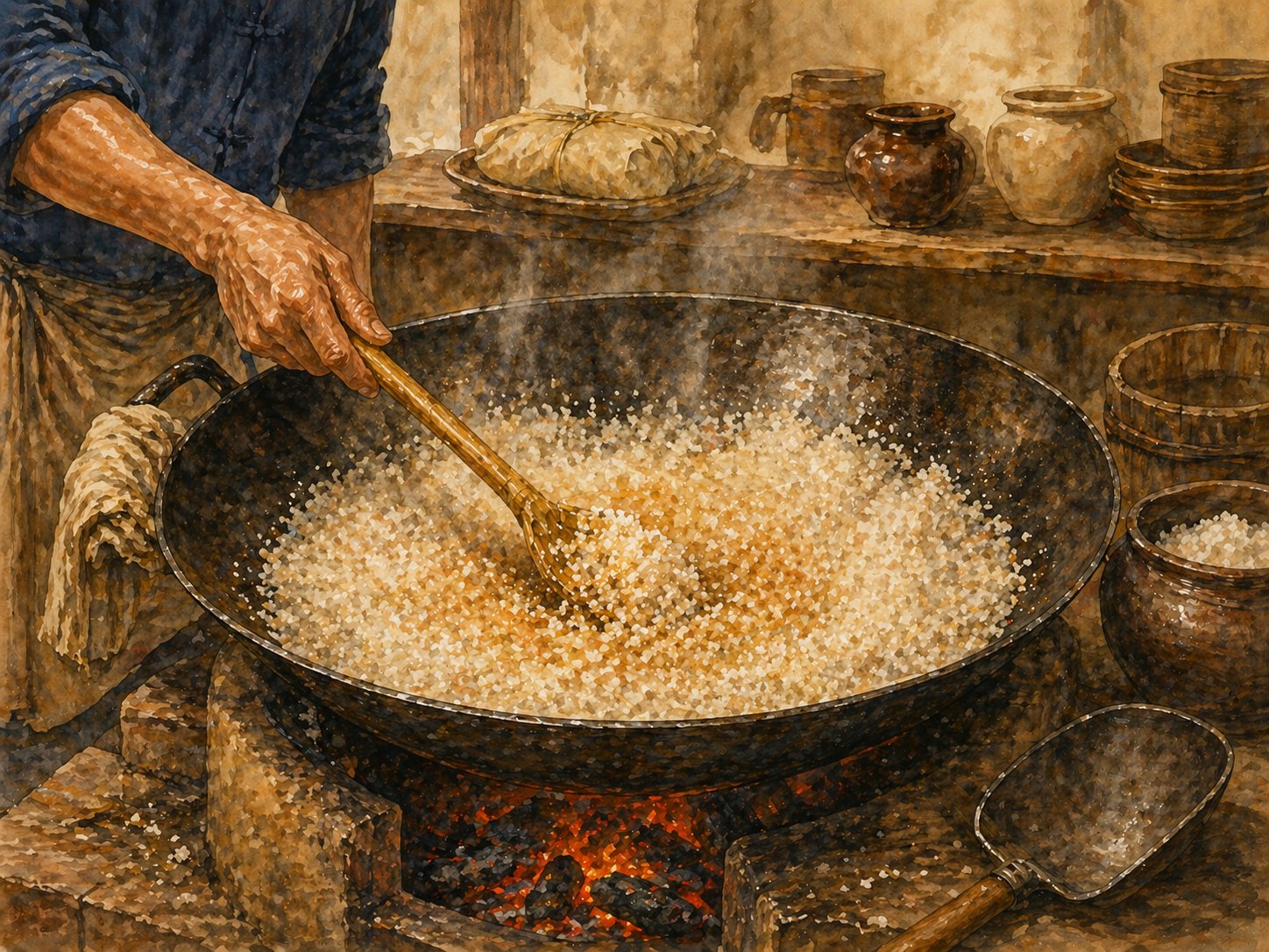
Place the 3–4 kg coarse rock salt in a heavy cast-iron wok (or the largest heavy heavy-bottomed pan available). Set over high heat — heritage technique uses charcoal-fired stoves, but a high-heat gas burner works for the home cook.
Toast the salt for 20–25 minutes, stirring occasionally with a long thin bamboo paddle (or a wooden spoon). The salt should reach a target temperature in the range of around 200°C — heritage cooks judge the temperature by the salt's colour (a soft warm pale-amber tint at the centre, cream-white at the edges) and by the audible-tickle of crystals against the wok wall (a high crisp ringing rather than a dull thud).
Test: a drop of water flicked into the salt should sizzle violently and evaporate immediately. If it merely hisses softly, the salt is not yet at temperature.
Critical risk: do NOT over-toast. If the salt darkens to a deep amber or browns, it has burned and will impart a bitter taste through the wrap into the chicken. Pull the salt OFF heat the moment it reaches the right colour-and-sound.
Wrap the Chicken
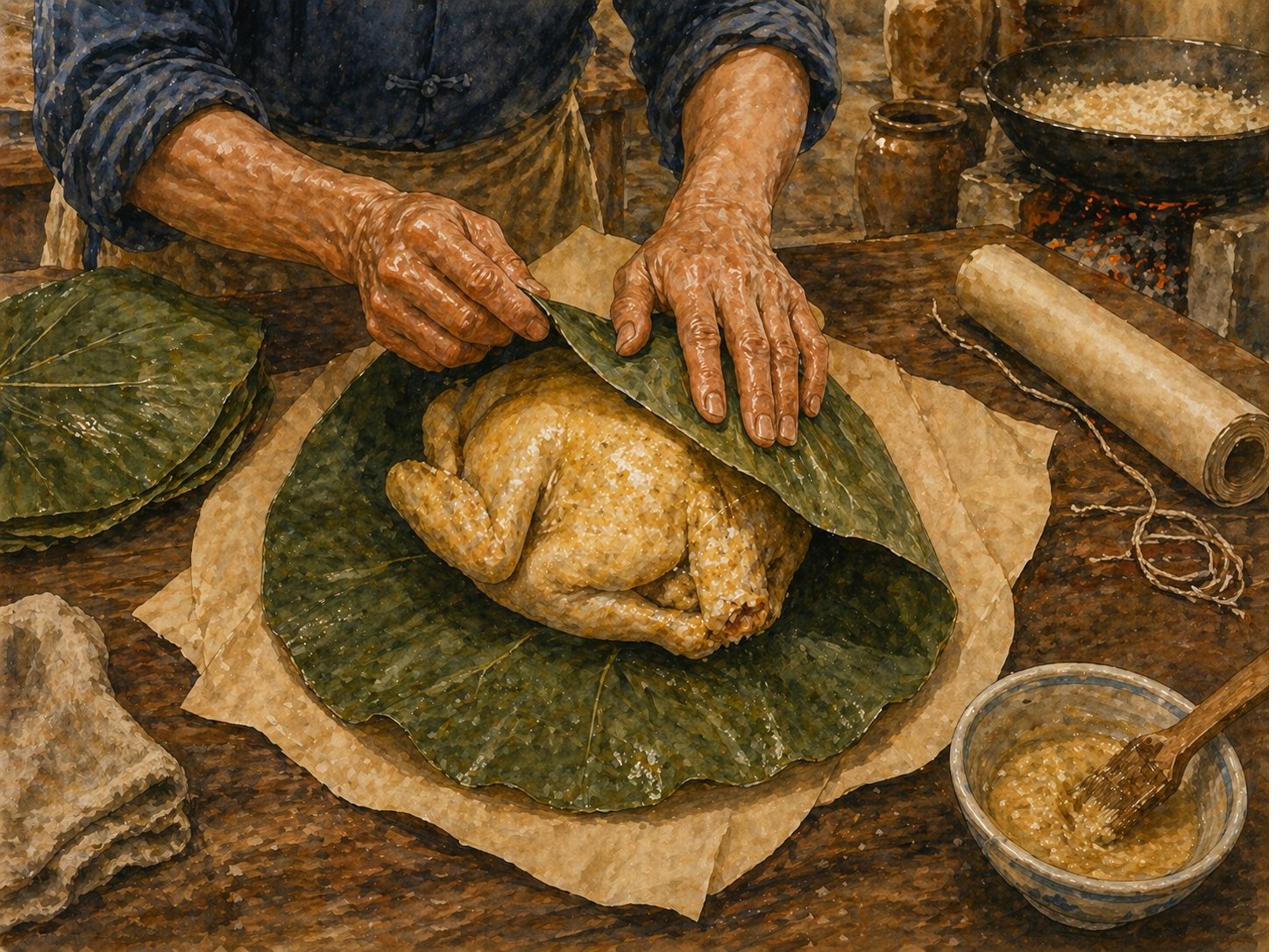
Lay the fresh lotus leaf flat on the heritage parchment paper. Place the marinated chicken breast-up at the centre of the lotus leaf, legs tucked. Fold the lotus leaf up and around the chicken, smoothing tight against the contour. Then fold the parchment paper around the lotus-leaf-wrapped bundle — the paper should overlap and seal completely, no leaf visible at the seal.
Tie the bundle securely with cotton kitchen twine: cross the twine over the breast, around the back, and knot at the base. The bundle should be firm enough to hold its shape during the burial-and-bake.
The Salt-Bake
Once the salt is at temperature, immediately bury the wrapped chicken. Use the iron salt-scoop to push aside the centre of the salt bed, creating a hollow about 15 cm deep. Place the wrapped chicken into the hollow. Heap the hot salt back over the top and sides of the bundle, completely covering it — the chicken should be invisible under the salt.
Cover the wok with a heavy lid. Reduce heat to LOW (or remove the wok entirely from heat and let the salt's residual heat do the cooking — heritage cooks vary on this; both work).
Bake for 40–50 minutes, undisturbed. Heritage cook judgement: a 1.6 kg chicken takes 40 minutes; a 1.8 kg chicken takes 50 minutes. Do NOT open the lid during the bake.
Test (at the end of the timing): use long iron tongs to gently lift the bundle from the salt. The bundle should feel firm and intact. Insert a thin bamboo skewer through the wrap into the thickest part of the thigh — the skewer should slide through without resistance and emerge clean (no pink juices). If pink juices appear, return to the salt for another 5–10 minutes.
Rest, Unwrap, Hand-Tear
Lift the bundle out of the salt with long iron tongs. Rest the bundle, still wrapped, on a cooling rack for 10 minutes. The rest redistributes the chicken's juices — heritage-correct.
Carry the rested bundle to a wooden chopping board. Cut the cotton twine. Carefully unwrap the parchment paper, then the lotus leaf — the chicken's amber-gold-mahogany skin should be visibly intact, glossy-but-dry (NOT wet), with the faint sand-ginger-and-lotus aroma rising on the steam.
Hand-tear the chicken into 12–14 pieces:
- Pull the drumsticks off the body — they should release at the hip joint with a firm pull
- Pull the thighs free along the natural muscle seam connecting to the back
- Detach each wing at the shoulder, then separate at the elbow joint into two pieces per wing (4 wing pieces total)
- Pull the breast off the keel bone in two halves, then tear each half into 2–3 strips along the muscle grain
Heritage Hakka cooks tear with the precision of someone who has done this thousands of times. The pieces should look like a rough disassembly, NOT a precise dissection.
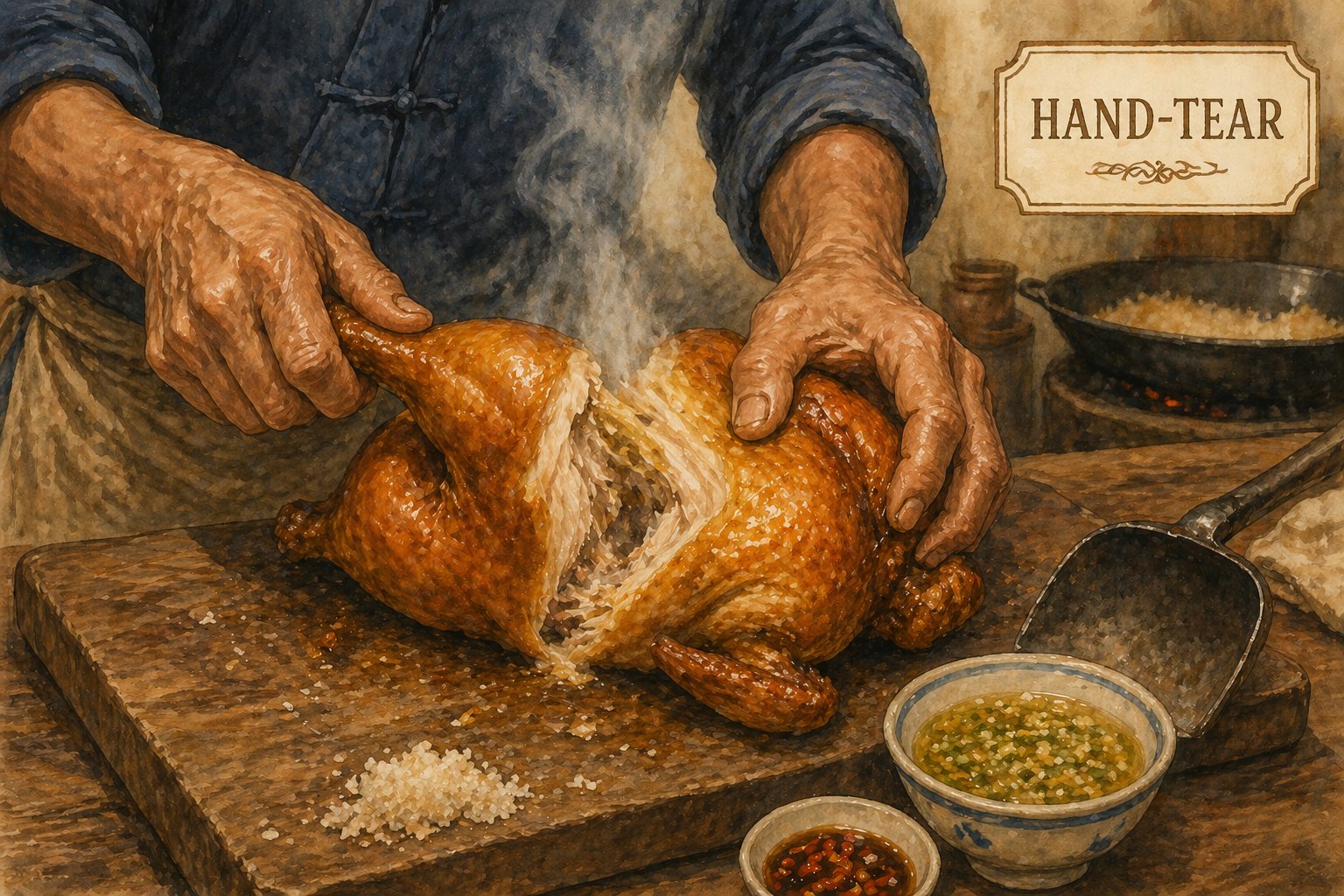
Plate and Garnish
Arrange the hand-torn pieces on the heritage Hakka oval ceramic platter (warm-cream with iron-red-and-cobalt-blue rural folk-art border) in a loose REASSEMBLED-CHICKEN pattern — NOT a precise mosaic, NOT a heap; the heritage rough-elegant style is a casual semi-reassembly, suggesting the original whole chicken without trying to perfectly reconstruct it. Drumsticks at one end, thighs flanking, wing pieces along the sides, breast strips arranged across the centre.
Garnish with:
- A scattering of finely-sliced spring onion greens across the top (restrained — heritage rural register, NOT a heavy herb pile)
- A small handful of fresh coriander leaves
- A drizzle of the sand-ginger-and-scallion oil across the chicken (just enough to gloss the skin — NOT a flood)
Serve immediately, while the chicken is still warm. Place the side condiments at the diner's reach: small dish of sand-ginger-and-scallion oil (primary), small dish of light-soy-with-bird's-eye-chilli (secondary), bowls of plain steamed white rice.
🎯The Three Tips
Heritage. Master's. Mistake.
🏛 Heritage Note
Why Hand-Torn, Not Cleaver-Carved
The single most-overlooked aspect of Yan Guk Gai presentation is that the chicken is HAND-TORN, never cleaver-carved. A young Singaporean cook trained in the cleaver-and-chopping-board tradition of Cantonese chicken (where the bird is carved into precise rectangles with skin-on-bone-in-meat in each piece) will instinctively reach for the cleaver — and produce a dish that LOOKS Cantonese, not Hakka.
The hand-tear is heritage technique. It does three things at once:
- It releases the chicken's aromatic steam at the table — when the cook tears each piece in front of the diners, the lotus-leaf-and-sand-ginger aroma blooms one piece at a time. A cleaver-carved presentation releases all the aroma at the chopping board, before the diners can smell it.
- It separates along the natural muscle seams, which makes the meat look and feel as nature constructed it — a drumstick is a drumstick, a thigh is a thigh, a breast strip follows the muscle grain. This is the heritage Hakka aesthetic: nature's lines, not the cleaver's geometry.
- It signals heritage technique to the heritage diner — a Hakka diner who sees a hand-torn salt-baked chicken knows the cook understands the dish. A cleaver-carved one signals that the cook has trained in another tradition and is approximating Hakka style.
When you serve this dish, tear it at the table if your guests will appreciate the moment, or in the kitchen if you prefer the quieter heritage approach. Either way: never reach for the cleaver. The heritage technique is your hands.
👨🍳 Master's Tip
The Salt-Temperature Window
The single technique that separates heritage Salt-Baked Chicken from a half-cooked or burnt-bitter version is the salt-temperature window during toasting.
The salt must reach the right temperature — hot enough to cook the chicken in 40–50 minutes through the wrap, but NOT hot enough to scorch the lotus leaf or impart a burnt-bitter taste. Heritage Hakka cooks judge by:
- Colour: a soft warm pale-amber tint at the centre, cream-white at the edges. NOT a deep amber-brown. Pull the salt off heat the moment the centre tints amber.
- Sound: a high crisp ringing when crystals strike the wok wall (the salt's water has fully evaporated). NOT a dull thud (under-toasted) and NOT a sharp crackle that smells smoky (over-toasted).
- The water-flick test: a drop of water flicked into the salt sizzles violently and evaporates in under 1 second. If it merely hisses softly for 2–3 seconds, the salt is not yet at temperature.
The other technique that separates good from great is DO NOT OPEN THE LID DURING THE BAKE. The salt's heat is finite — once the wok is covered and the heat is reduced, the chicken is cooking on the salt's residual reservoir. Each time the lid is opened, heat escapes and the bake-time has to extend. Heritage Hakka cooks bury and seal — and walk away. Trust the technique.
⚠ Common Mistake
Rubbery Skin, Salty Meat, Under-Cooked Chicken
Three failures:
- Rubbery skin (instead of dry-amber-gold). The chicken was not patted dry before marinating, or moisture leaked through the wrap during the bake. Fix: the dryness step is non-negotiable; the wrap must be tight; the lotus leaf's structural seal must be complete.
- Salty meat (instead of cleanly seasoned). The wrap had a tear or unsealed seam, allowing direct salt-to-meat contact. Fix: double-check the lotus-leaf-and-paper wrap before burial; if any edge is exposed, re-wrap. The wrap is non-negotiable.
- Under-cooked chicken (pink juices at the thigh). The salt was under-toasted, or the lid was opened mid-bake, or the bake time was too short for the chicken's weight. Fix: salt-temperature judgement is the highest-skill step (see Master's Tip); trust the timing for the chicken's weight; never open the lid; if the skewer test shows pink juices at the end of the bake, return to the salt for another 5–10 minutes.
📈 Scaling for Hawker Service
For a heritage Hakka restaurant or salt-bake-specialist hawker stall
The economic challenge of Yan Guk Gai is more forgiving than R23 kou rou: the labour rhythm fits a hawker-restaurant scale. A skilled cook can prepare and salt-bake 6–8 chickens per hour with two parallel woks of salt running. The dish appears at:
- Heritage Hakka restaurants — typically 40–60 minute lead time on order, since each chicken bakes from start of order
- Specialist salt-bake hawker stalls — pre-baked chickens kept warm, hand-torn to order (the salt-bake is done in batches at the start of service; the hand-tear is on demand)
- Clan-association banquet kitchens — multiple chickens baked in parallel for major occasions
Scaling notes:
- The salt is reusable for many bakes. A heritage stall keeps the same wok-of-salt for 2–3 months, replenishing only when the salt darkens excessively. Some heritage cooks claim the long-aged salt actually improves the dish — accumulated chicken-juice and aromatic infusions deepen the flavour.
- Wrap economics: lotus leaves cost SGD 0.50–1.00 each (single-use; the bake destroys the leaf's freshness). Heritage parchment paper is similar. Wrap cost per chicken ~SGD 1.50.
- Cost (Singapore 2026): Per whole chicken serving 4–6 ~SGD 12–15 (kampong chicken 8.00 + sand-ginger and aromatics 1.50 + lotus-leaf-and-paper wrap 1.50 + salt amortised across many bakes 0.50 + labour 1.50). Sells SGD 32–45 at heritage Hakka restaurants, SGD 25–32 at specialist hawker stalls. Margin: 60–70% — comparable to other heritage dishes.
The dish has remained a heritage-restaurant and specialist-hawker dish rather than a household one. The 3–4 kg of rock salt + the lotus leaf + the salt-temperature judgement put it just outside the casual home cook's confidence zone — though the technique itself, once learned, is forgiving and rewarding.
The salt holds the heat. The leaf holds the aroma. The hands do the rest. Heritage Hakka cooking is not complicated — it is patient. And the chicken comes out tasting of the mountains where the technique was born, even if you cooked it in a Singapore kitchen.