Wat Tan Hor
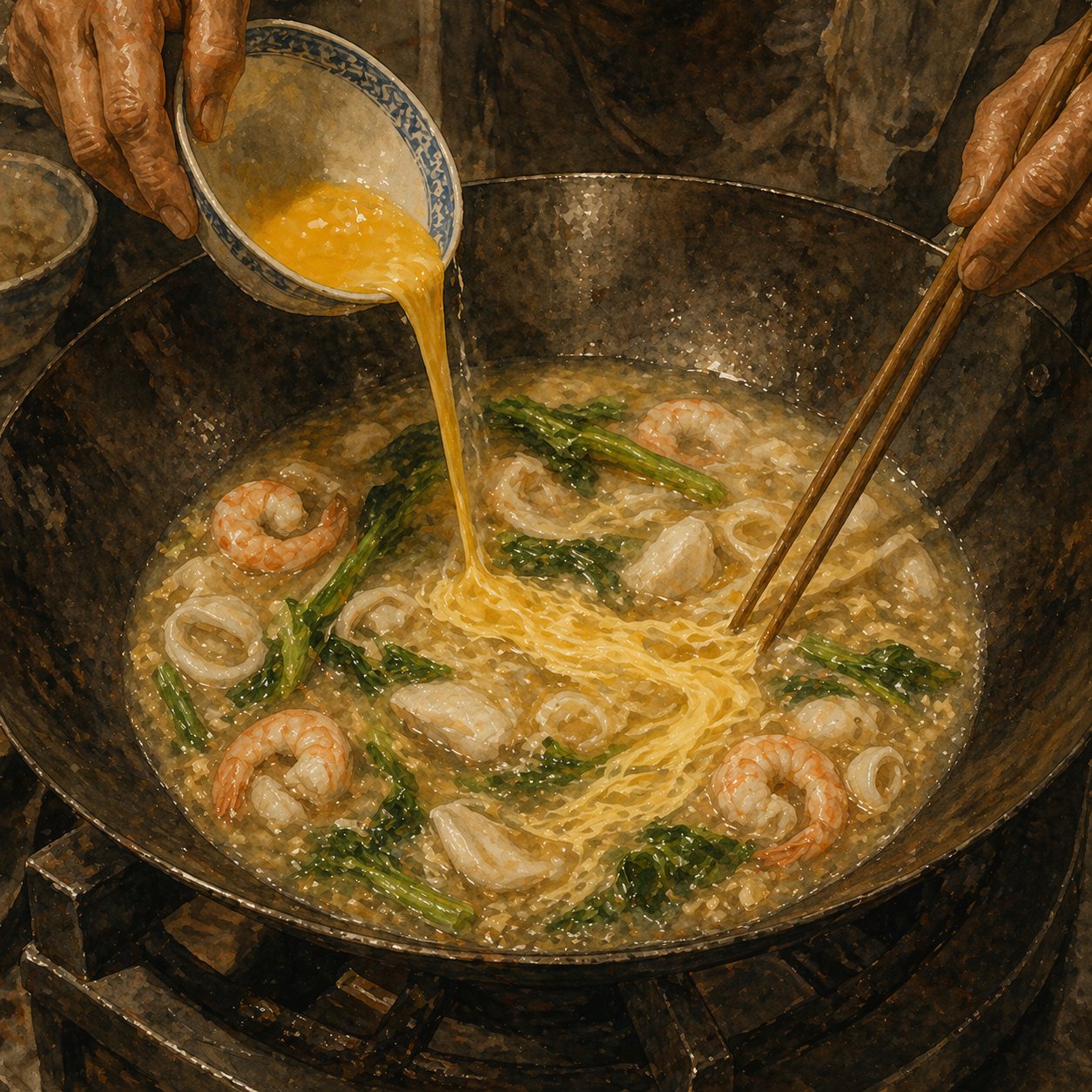
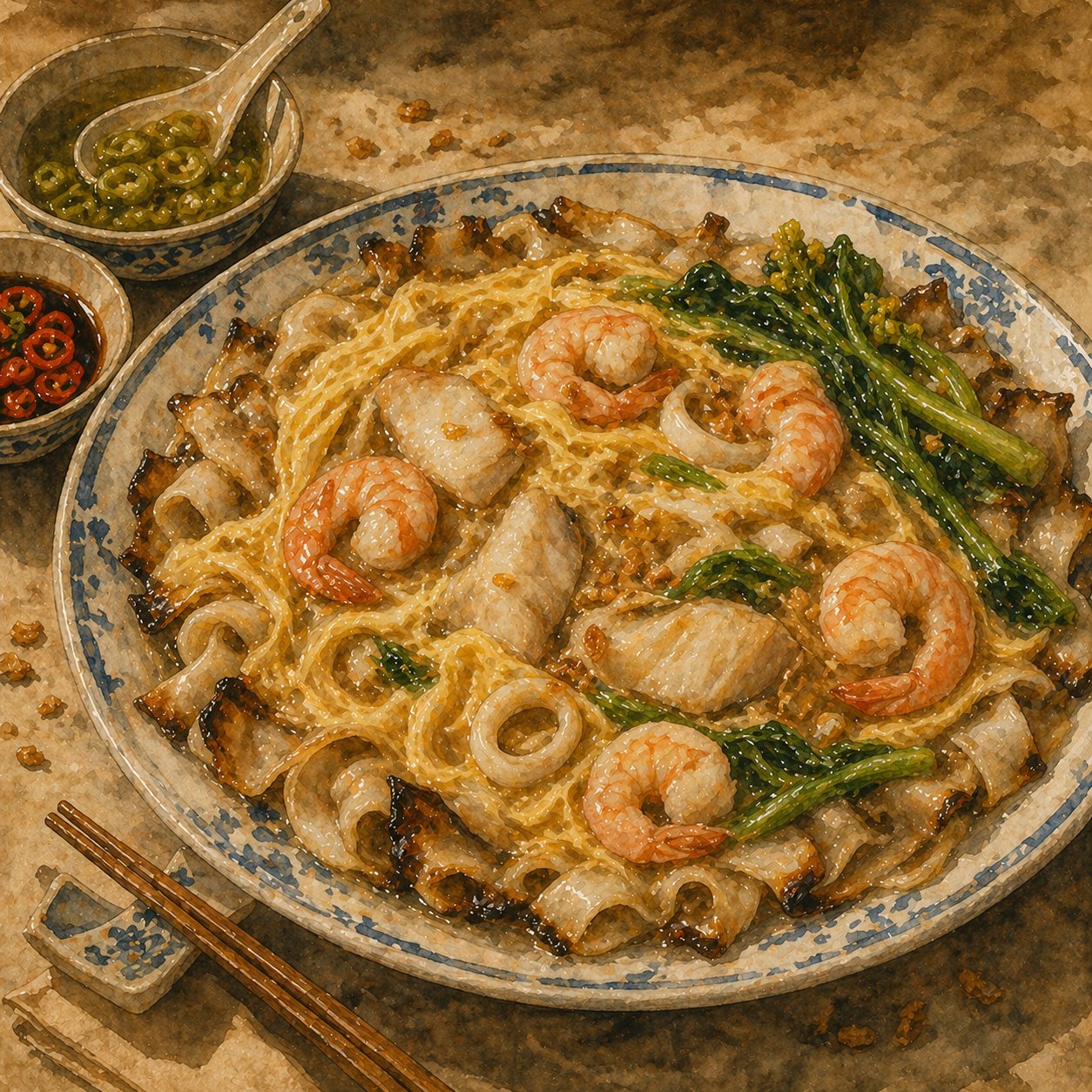
Wat tan hor — "smooth egg river" — is the dish that proves Cantonese cooking is about contrast.
The character "河" (hor, "river") refers to the broad flat rice noodles, and "滑蛋" (wat tan) means "smooth egg". Together: silky egg gravy poured over wok-charred rice noodles. The contrast is everything — the noodles must have wok hei (the smoky char of a screaming-hot wok), while the gravy must be silken-smooth, never scrambled.
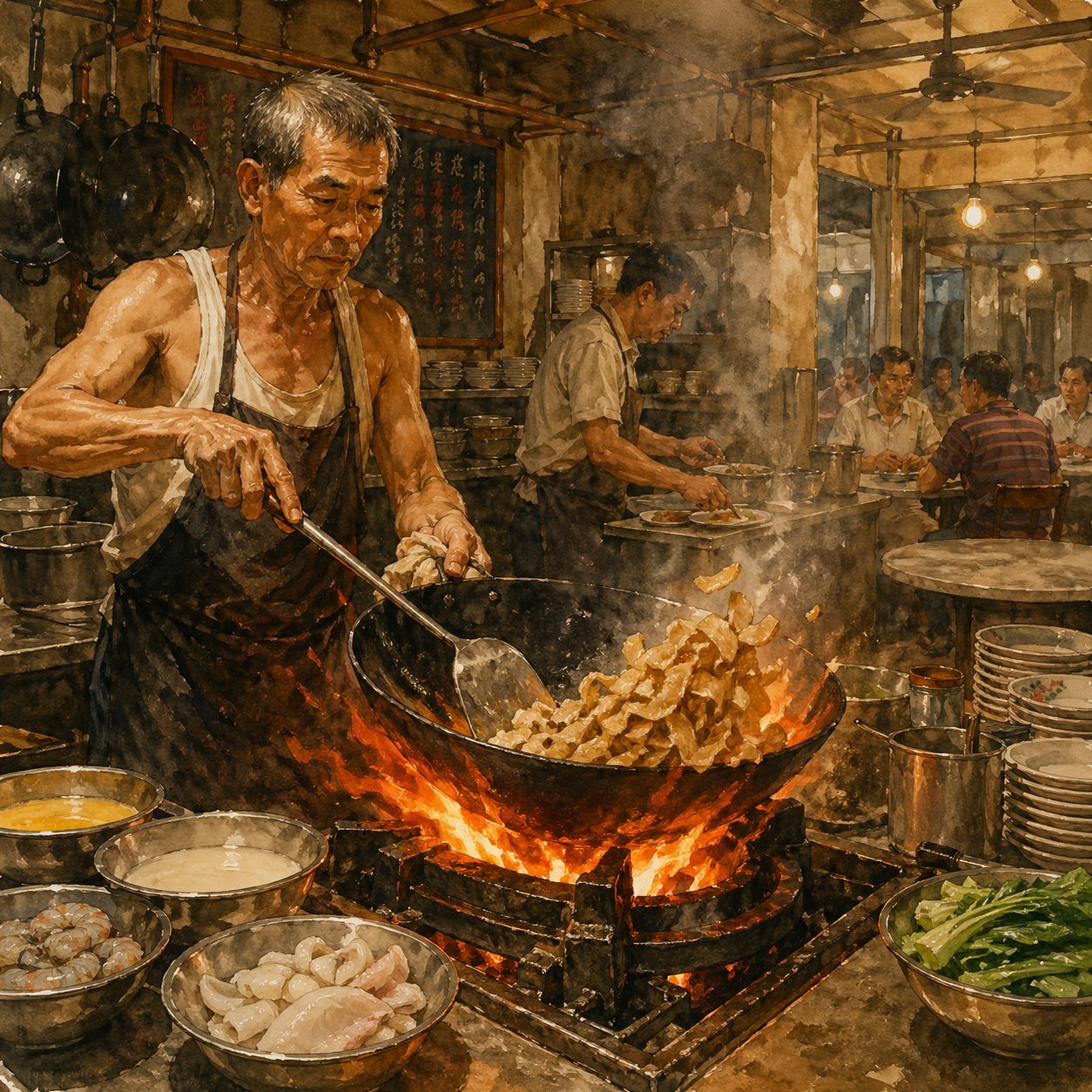
In Singapore, you will find this at almost every zi char (cooked-to-order) stall. It is one of the clearest examples of Cantonese wok mastery — the flame, the toss, the gravy timing. Heritage stalls like Sin Hoi Sai (Tiong Bahru) and the long-running zi char stalls in Geylang are where the technique is alive.
The dish has many cousins: Singapore Hor Fun (drier), Beef Hor Fun (with marinated beef), Moonlight Hor Fun (with raw egg yolk on top), Seafood Hor Fun (mixed seafood). I will give you the classic mixed wat tan hor — prawns, squid, fish slices, choy sum.
🛒Ingredients
Best cooked single-serve. Get every component within arm's reach before the wok is lit.
For the Noodles per 2 servings
| Fresh broad flat rice noodles (kway teow / hor fun) | 400 g | Buy fresh, not refrigerated. If refrigerated, microwave 30 sec or steam 1 min to soften before frying. |
| Dark soy sauce | 1 tsp | |
| Light soy sauce | 1 tsp | |
| Neutral oil | 2 tbsp |
For the Gravy
| Fresh prawns, peeled (tail-on) | 8 medium | |
| Squid, cleaned, sliced into rings | 100 g | |
| Sliced fish (batang or any firm white) | 150 g | Marinated — see below. |
| Choy sum or kai lan | 100 g | Cut to 5 cm. |
| Fish cake | 50 g | Sliced. |
| Garlic | 4 cloves | Finely minced. |
| Fresh ginger | 15 g | Julienned thin. |
| Eggs | 2 large | Lightly beaten. |
| Chicken stock | 500 ml | |
| Light soy sauce | 1.5 tbsp | |
| Oyster sauce | 1 tbsp | |
| Shaoxing wine | 1 tbsp | |
| Sugar | ½ tsp | |
| White pepper | ¼ tsp | |
| Sesame oil | 1 tsp | |
| Dark caramel (Cheong Chan) | ½ tsp | Optional, for colour. |
Fish Marinade
| Light soy sauce | 1 tsp | |
| Shaoxing wine | 1 tsp | |
| Sesame oil | ½ tsp | |
| Cornflour | ½ tsp | |
| White pepper | a pinch |
Slurry use potato starch — critical
| Potato starch (tai bai fen 太白粉) | 1.5 tbsp | Sunflower brand. Not cornflour. Potato starch gives the silky finish. |
| Cold water | 3 tbsp |
To Serve
| Pickled green chillies | essential | See condiments chapter. |
| Sliced red chilli in light soy | to taste |
🌶️Shifu's Lift
choose one path — see "Shifu's Secret" chapter for the philosophy- Old-school path: ⅛ tsp MSG into stock
- Modern hawker path: ½ tsp chicken stock powder
- Heritage purist path: Use homemade chicken stock simmered with old hen + dried sole fish (ti po)
👨🍳Method
Five stages, four to five minutes from raw to plate. The egg-stir is the make-or-break.
Get Everything Ready
Marinate fish slices, set aside.
Mix in a bowl: chicken stock, light soy, oyster sauce, Shaoxing wine, sugar, white pepper, sesame oil. Pre-mixing the gravy components prevents fumbling at the wok.
Mix slurry separately. Have eggs beaten in a third bowl. All proteins, vegetables, and aromatics in separate small bowls within arm's reach.
Char the Noodles — The Wok Hei Step
Heat wok over maximum heat until smoking. Add 2 tbsp oil — swirl to coat.
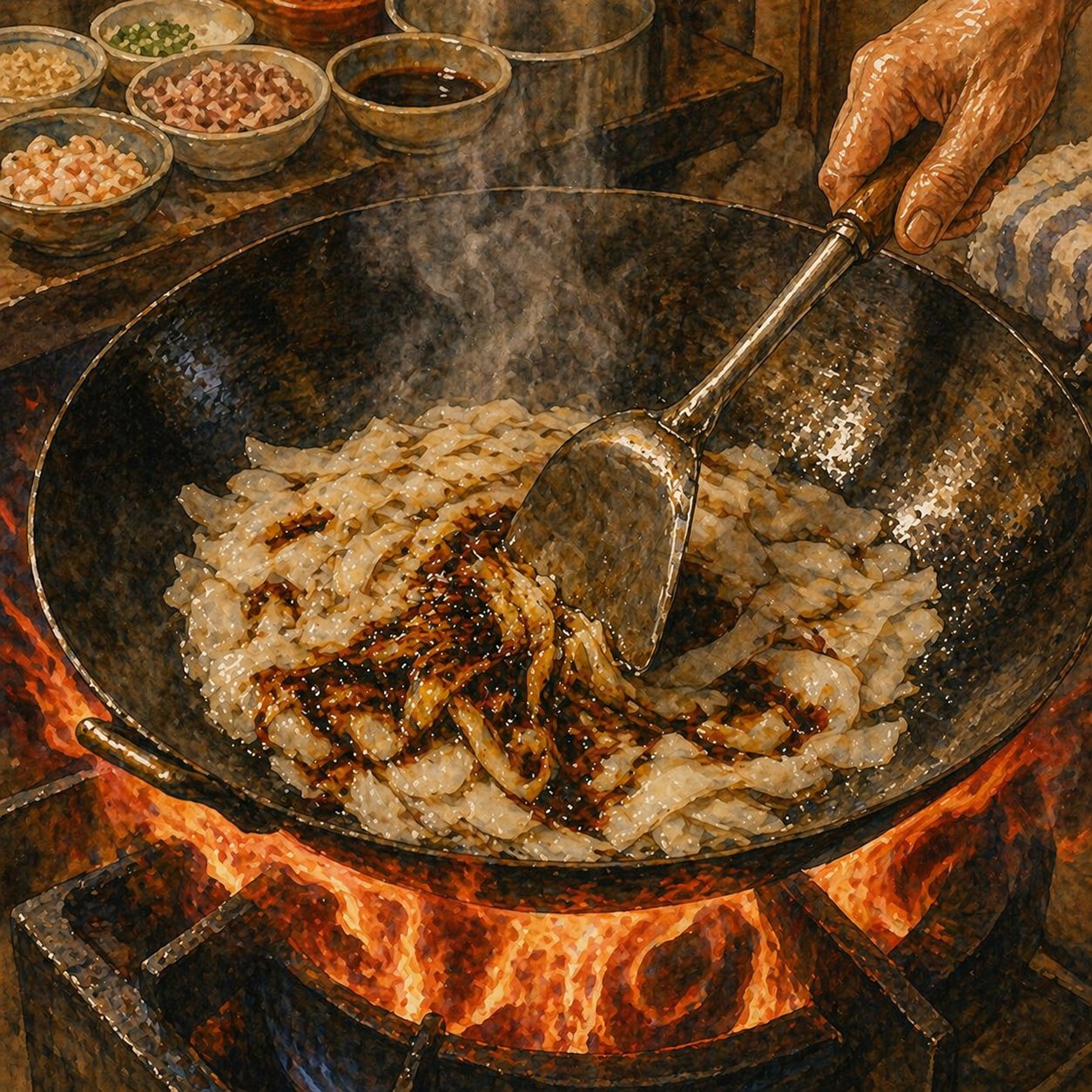
Add fresh kway teow. Spread in a single layer. Drizzle dark soy + light soy on top. Do not stir for 60 seconds — let the bottom char.
Flip with a spatula in 3–4 large sections. Let the other side char 30 seconds.
Drizzle a little more oil if dry. Toss gently, flipping a few more times. You want some charred edges, some pale soft noodles — the contrast is the flavour.
Transfer noodles immediately to serving plates (or a wide deep dish). Do not overcrowd.
Build the Gravy
Wipe wok clean, return to high heat. Add 2 tbsp oil. Add ginger and garlic, stir 10 seconds — just to fragrant, not brown.
Add prawns, squid. Stir-fry 30 seconds — they should turn 70% cooked. Push to one side of the wok.
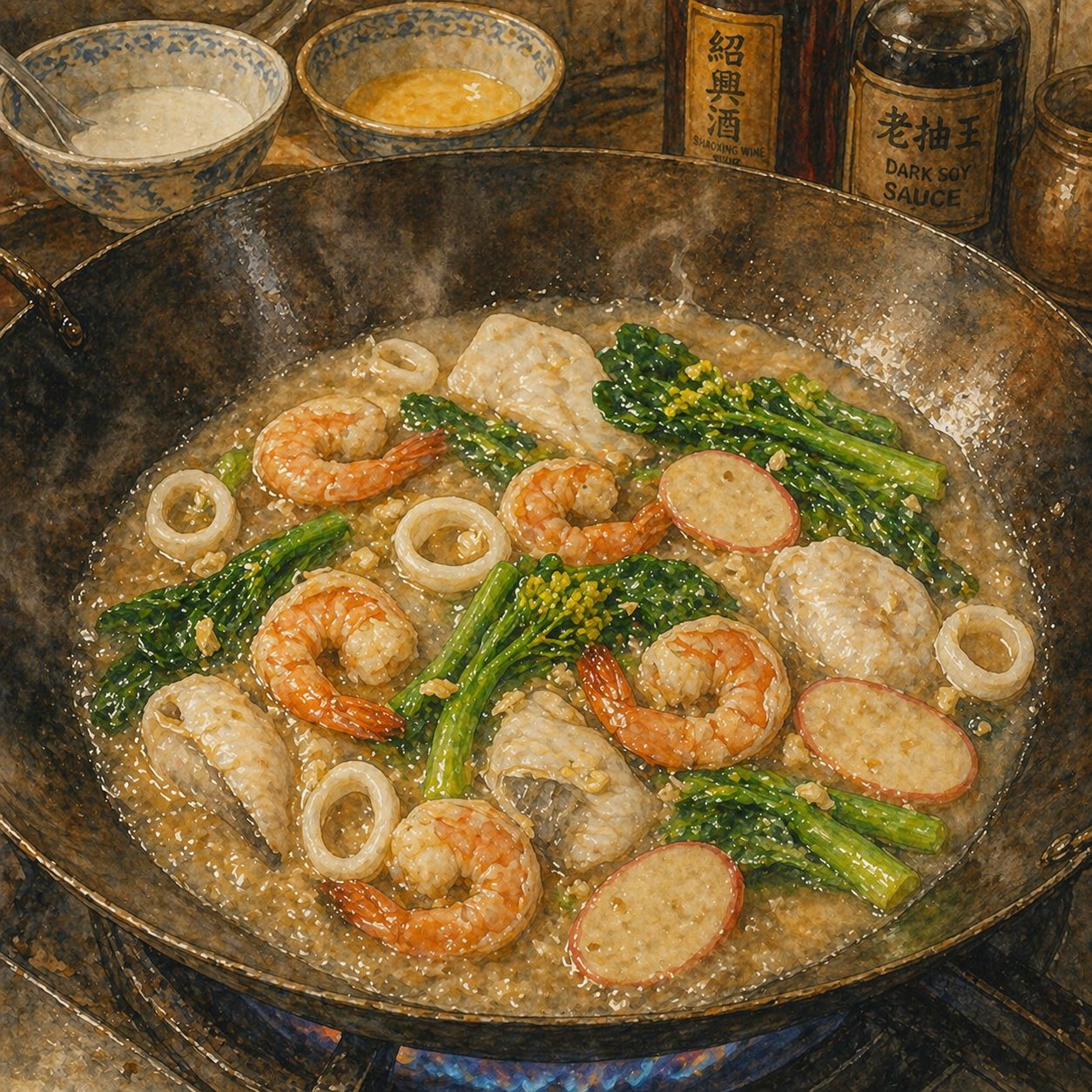
Add the pre-mixed gravy liquid. Bring to boil. Add fish cake and choy sum stems first (cook 30 sec), then leaves and fish slices. Cook 60 seconds — fish should turn opaque.
The Egg-and-Slurry — The Crucial Moment
Reduce heat to medium-low. Stir slurry once (the starch settles), then drizzle into gravy while stirring in one direction only. The gravy will thicken in 20 seconds.
Turn off the heat completely.
Now the magic — drizzle the beaten eggs in a thin ribbon over the surface. Stir gently in one direction with chopsticks for 5 seconds, then stop. The eggs should form silky strands, not scrambled lumps. Residual heat finishes the cooking.
Add a splash more Shaoxing wine and a drizzle of sesame oil.
Serve
Pour the gravy directly over the charred noodles on the plate. Serve immediately with pickled green chillies on the side. Eat fast — the noodles soften within 3 minutes once the gravy hits.
🎯The Three Tips
Heritage. Master's. Mistake.
🏛 Heritage Note
The Pickled Chillies Are Sacred
The pickled green chillies on the side are not a garnish — they are essential to the dish. The vinegar-pickled chilli cuts through the rich egg gravy and freshens the palate between bites. A wat tan hor served without pickled chillies is incomplete. Make a jar yourself: bird's-eye chillies + green chillies, sliced into rings, covered in white rice vinegar + sugar, refrigerated 24 hours minimum.
👨🍳 Master's Tip
Potato Starch, Not Cornflour
The single technical secret to silky wat tan hor is potato starch (太白粉) — not cornflour.
- Cornflour thickens but feels slightly chalky and breaks down with prolonged heat
- Potato starch gives a glossy, silky, almost-translucent finish that holds even under high heat
The Singapore brand most hawkers use is "Sunflower" (风车粉) or generic 太白粉. Use it for wat tan hor, sweet-sour pork glaze, and all "wet" Cantonese dishes where silkiness matters.
The other technique: off the heat before egg, stir only once or twice in one direction. The egg cooks gently in residual heat. Stir too much = scrambled. Stir not at all = raw lumps.
⚠ Common Mistake
Watery, Pale, No Wok Hei
Three failures kill wat tan hor:
- Cool wok — no wok hei, no charred noodles, no soul. Fix: wok must smoke before noodles hit. If your home stove can't get there, char in batches (200 g per batch).
- Over-mixing the egg — scrambled lumps instead of silky strands. Fix: stir 5 seconds maximum, in one direction, off the heat.
- Watery gravy — slurry was insufficient or you stirred while heat was on. Fix: 1.5 tbsp potato starch in 3 tbsp water for 500 ml stock. Heat off when egg goes in.
📈 Scaling for Hawker Service
For a zi char stall offering wat tan hor
- One wok per portion — wat tan hor cannot be batch-cooked. Each plate goes from raw to served in 4–5 minutes.
- Pre-portioned slurry containers — pre-measure starch + water in small cups, ready to grab.
- Stock made daily: 5 L of chicken-pork-sole-fish stock, simmered 4 hours, held warm.
- Cost (Singapore 2026): Per plate ~SGD 3.50 (seafood 2.00 + noodles 0.40 + stock/aromatics 0.60 + egg 0.30 + slurry 0.20). Sells SGD 8–12 standard, SGD 14–18 with premium prawns. Margin: 55–65%.
The plate of wat tan hor tells you everything about a wok master. The char on the noodles, the silk in the gravy, the curve of the egg ribbon, the timing of the toss. Five minutes from start to plate. There is no second chance.