Hakka Mei Cai Kou Rou
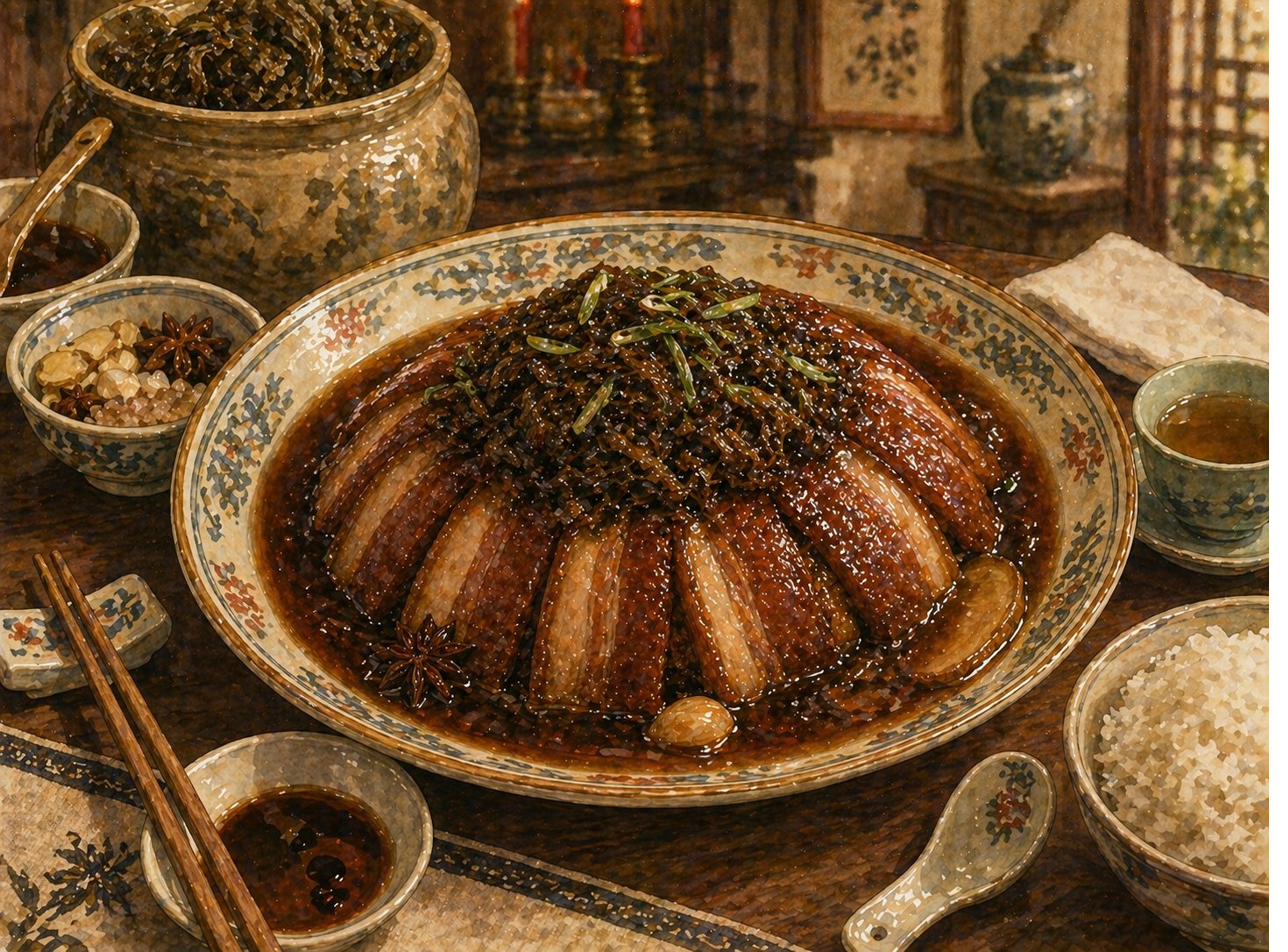
Five years of practice for one five-second flip. That is what kou rou asks of you.
Mei Cai Kou Rou 梅菜扣肉 is the heritage Hakka banquet centrepiece — a slow-braised pork belly layered with rehydrated mei cai (preserved mustard greens), built into a deep ceramic bowl, steamed for hours, and then flipped onto a serving plate in a single decisive motion to reveal an architectural dome of glossy-mahogany meat and dark-brown greens. The dish's name names the technique: kou 扣 means "to invert / to overturn." That is the dish.
The Hakka brought mei cai with them across the great migrations. Dried preserved vegetables travel; fresh ones don't. Mei cai — sun-dried, salt-cured mustard greens with a deep funk and a long sweetness — became the Hakka pantry's most travel-hardy vegetable. When the Hakka settled in Singapore in the nineteenth century, they brought mei cai with them, and they kept making kou rou the way their ancestors did: slowly, with patience, for occasions.
This is not an everyday dish. Even the home-Hakka grandmother does not make it on a Tuesday. Kou rou is a banquet dish, served at weddings, at major birthdays, at clan-association reunion dinners, at year-end banquets. The labour is the reason: the dish needs hours of work spread across a day or two, and the inverted-bowl technique requires the kind of practised hand that only banquet-cooks develop. The kou rou flip is the dish's signature moment — five seconds of judgement that decide whether the dome holds or collapses. A failed flip means re-plating into a casual stew register. A successful flip is what the diners came to see.
In Singapore, heritage Mei Cai Kou Rou appears most reliably at:
- Plum Village (now reportedly closed) — the Sin Ming Avenue Hakka heritage restaurant whose kou rou was reportedly the city's most-photographed
- Moi Lum Restaurant — the Hakka heritage restaurant on South Bridge Road, reportedly running since 1965; banquet-set ordering required
- Chuk Yuen Seafood Restaurant — Hakka banquet specialist in Bishan
- A handful of clan-association dinners and banquet-private-dining establishments where the dish is made on order (typically requiring 2-day advance notice)
The dish has remained almost exclusively a banquet dish, rarely sold at hawker scale. The hours of layered work — the dry-sear, the soy-blanch, the layered build, the long steam, the inversion-flip — cannot be amortised into a per-plate hawker price. That is why the Hakka banquet-cook is the primary keeper of this recipe — without him, the dish quietly disappears from Singapore tables.
I am giving you the heritage banquet version here, the way it was made by my Hakka neighbour-uncle's older brother — who cooked at clan-association banquets through the 1970s and 1980s. The proportions are scaled for an 8-person banquet portion. The flip is yours to practise.
🛒Ingredients
Skin-on pork belly, dry-seared and overnight-rested. Rehydrated mei cai. A long mahogany braise. Two days of patient layering.
For the Pork Belly Preparation
| Skin-on pork belly | 1.2–1.5 kg, single rectangular slab | About 25 cm × 12 cm × 4–5 cm thick. Ask the butcher to retain the skin — skin-on is non-negotiable; the blister-crisp skin is the dish's textural signature. |
| Light soy sauce | 2 tbsp | For skin coating during the dry-sear. |
| Shaoxing wine | 2 tbsp | |
| Salt | 1 tsp |
For the Mei Cai
| Dry preserved mei cai (梅菜, dried mustard greens) | 200 g | Use the heritage sweet-mei-cai variety (gam mui choi) — dark brown, slightly sweet-funky aroma. Soak overnight in cold water to rehydrate; rinse three times to remove excess salt. |
| Crystal sugar (rock sugar) | 30 g | For the mei cai's gentle sweetness — heritage Hakka technique. |
| Light soy sauce | 1 tbsp | |
| Pork lard or neutral oil | 2 tbsp | Heritage version uses pork lard for depth. |
For the Braising Sauce
| Light soy sauce | 4 tbsp | |
| Dark soy sauce | 2 tbsp | For colour depth. |
| Shaoxing wine | 3 tbsp | |
| Crystal sugar (rock sugar) | 50 g | Heritage Hakka braising sweetener; gives the glossy reduction its characteristic sheen. |
| Star anise | 2 pods | |
| Cinnamon stick | 1 small (5 cm) | |
| Bay leaves | 2 | |
| Fresh ginger | 30 g, sliced | |
| Garlic cloves | 4, smashed | |
| Spring onion (whole) | 2 stalks, knotted | |
| White peppercorns | 1 tsp, lightly cracked | |
| Pork or chicken stock | 400 ml | Use Recipe 21 clear broth if available; otherwise unsalted store stock. |
🌶️Shifu's Lift
choose one path — see "Shifu's Secret" chapter for the philosophy- Old-school path: ¼ tsp MSG dissolved in the braising sauce
- Modern hawker path: ½ tsp chicken stock powder
- Heritage purist path: Already covered with mei cai + pork-rendered fat + the long-braise reduction
For the Plating
| Spring onion, finely sliced (greens only) | 2 tbsp | For garnish. |
| Light soy with a few drops of black vinegar | side condiment | Hakka banquet-formal vinegar-cut variant. |
| Plain steamed white rice | side accompaniment | Heritage banquet expectation. |
👨🍳Method
Seven stages across two days. The flip is the dish's defining moment.
Heritage rhythm: Day 1 — pork preparation through the post-sear rest. Day 2 — layering, steaming, the flip. The overnight rest is non-negotiable; the seared skin firms during the rest and becomes more receptive to the steam-blister.
Dry-Sear the Pork-Belly Skin (Day 1, morning)
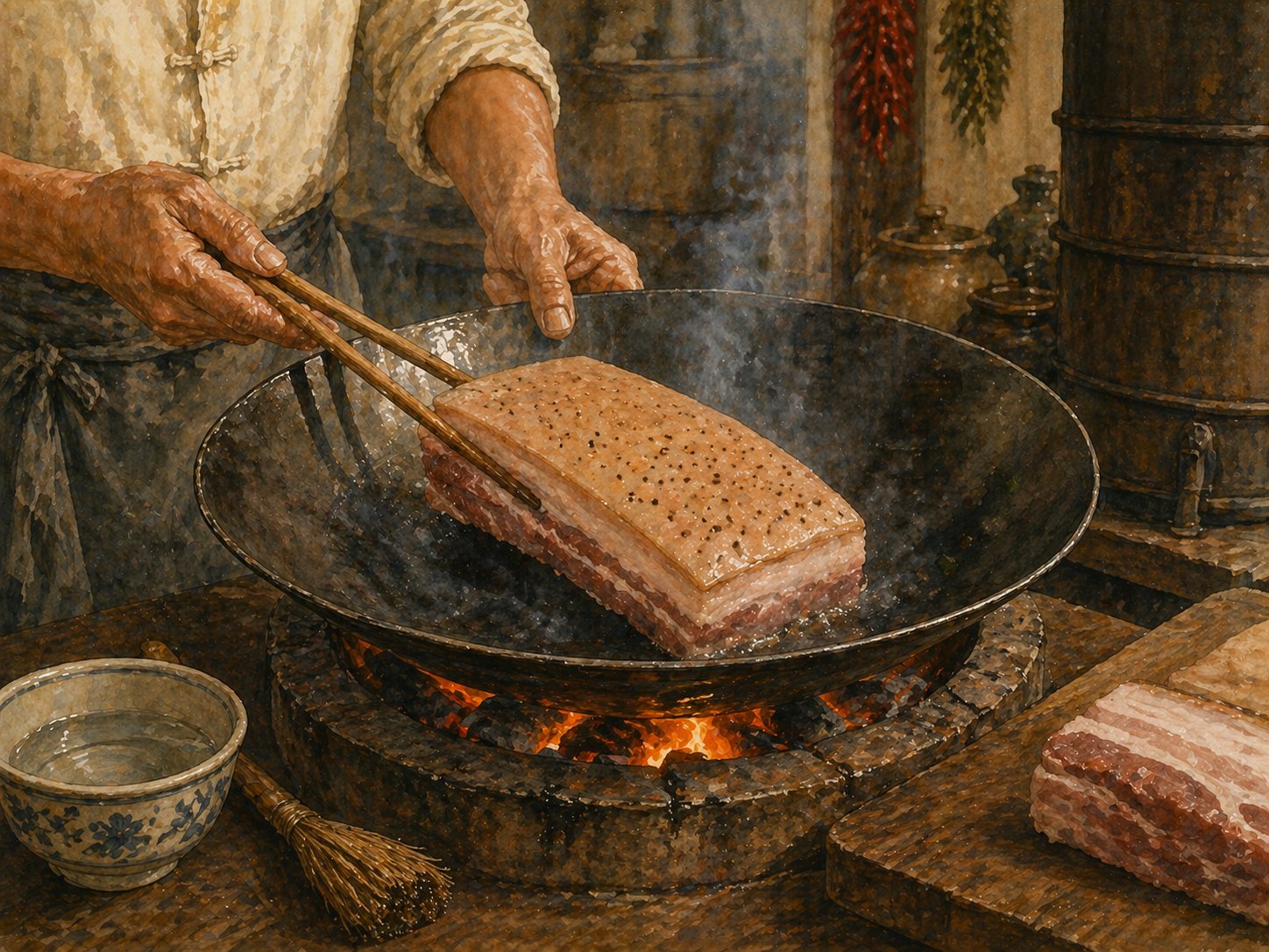
Pat the pork belly slab completely dry with kitchen paper. With a clean fork, poke the skin densely with holes — aim for 30–40 visible punctures across the skin's surface. The fork-poking is heritage-Hakka technique that allows the skin to blister evenly during the long steam; without it, the skin will swell unevenly into rough patches.
Heat a heavy carbon-steel wok over high heat until smoking. Add NO oil — this is a dry sear; the pork's own skin-fat is what renders.
Lower the slab into the wok skin-side-DOWN with a pair of long bamboo chopsticks gripping the meat side. Press gently with the back of a wooden ladle to ensure even contact. Sear undisturbed for 4–5 minutes, until the skin is uniformly golden-brown and noticeably blistered.
Remove and immediately plunge the slab skin-side-down into a basin of ice-cold water for 2 minutes — the cold-shock crisps the skin further, a heritage Hakka contrast technique.
Pause point: wrap the seared-and-cold-shocked pork belly in a clean cloth and refrigerate overnight (8–12 hours). The rest is non-negotiable — the skin firms and becomes more receptive to the steam-blister in Stage 5.
Soy-Blanch the Pork (Day 2, morning)
Slice the rested pork belly across the grain into thick slices (about 1 cm thick — heritage Hakka kou rou uses thick slices, NOT thin shavings). You should get 12–15 slices from a 1.2–1.5 kg slab.
Mix the 2 tbsp light soy with the 2 tbsp Shaoxing wine. Brush each slice with the soy-wine mixture on both sides — light coating.
Heat a wide pan over medium heat with 1 tbsp neutral oil. Working in batches, briefly sear each slice for 30 seconds per side — just enough to colour the soy coating and lock in moisture. The slices should be golden-brown, not deeply browned. Set aside on a tray.
Prepare the Mei Cai
Drain the overnight-soaked mei cai. Rinse three times in cold water, squeezing each rinse — the mei cai should taste pleasantly salty-sweet, not aggressively salty. Squeeze dry as thoroughly as possible.
Heat 2 tbsp pork lard (or neutral oil) in a wok over medium heat. Add the squeezed mei cai. Stir-fry for 4–5 minutes, allowing the mei cai to caramelise slightly and develop deeper colour.
Add the crystal sugar (30 g) and 1 tbsp light soy. Stir-fry for another 2 minutes until the sugar dissolves and the mei cai is glossy. Set aside.
Layer the Kou Wun
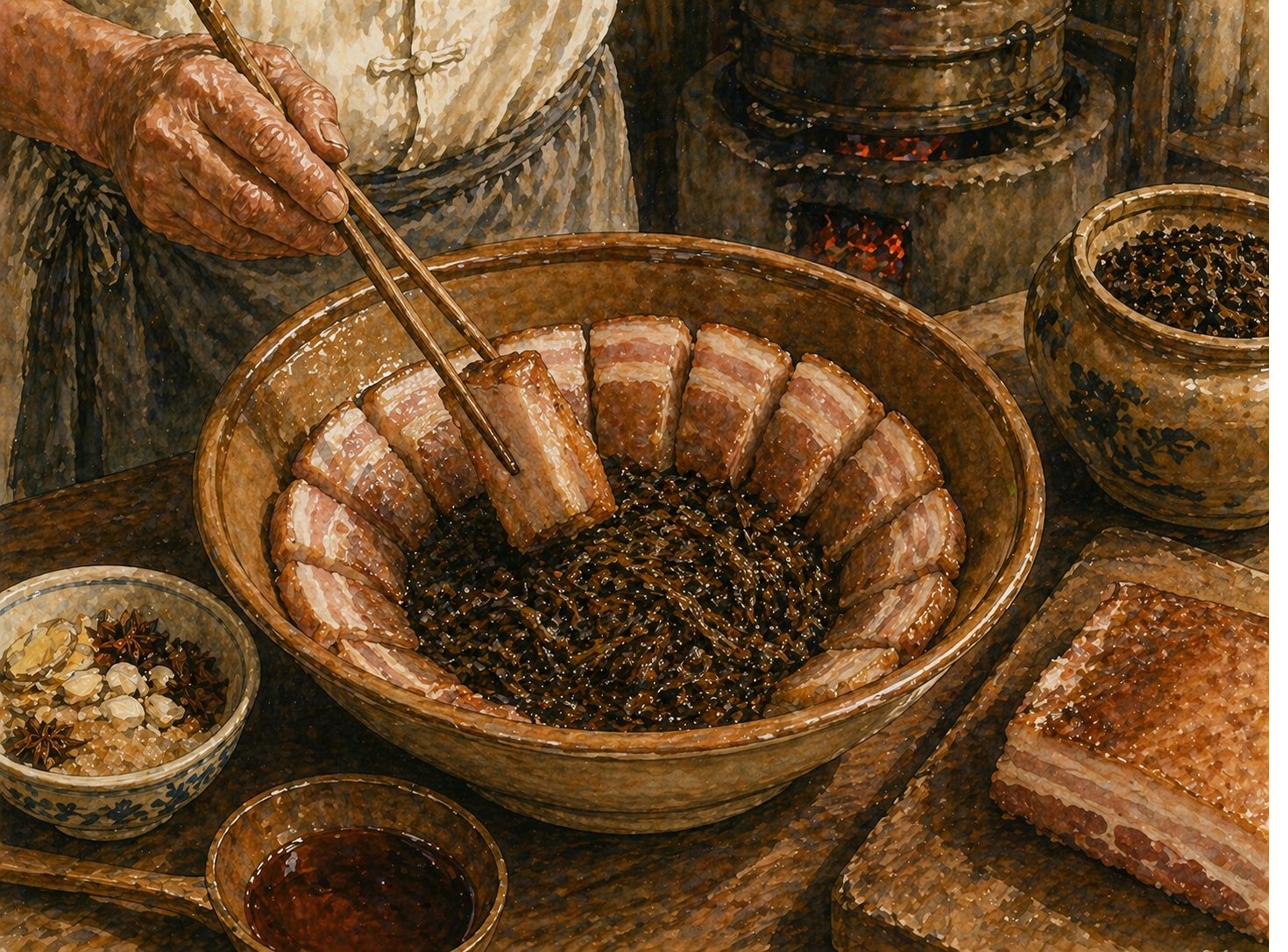
Take a deep round ceramic kou wun bowl (about 20 cm diameter at the rim, 12 cm at the base, with the heritage inward-curving rim). The bowl's shape determines the dome's shape — without an inward-curving rim the dome cannot form properly. The kou wun 扣碗 is the inverted-bowl-shaped vessel specifically used for kou rou.
Place 2–3 slices of ginger and 1 star anise pod at the very bottom of the bowl (these will sit at the top of the inverted dome).
Arrange the soy-blanched pork slices skin-side-DOWN against the bowl's interior — start at the centre of the base and work outward in a circular pattern, the slices overlapping like a fan. The skin must be against the bowl's interior surface (which becomes the underside of each slice after inversion). Continue the circular layering up the bowl's sides, overlapping slightly, until all slices are placed.
Critical: skin-side-DOWN means the skin faces the bowl interior. Get this wrong and the inverted dome shows the meat-side-up, which is wrong for both presentation and texture.
Top with the prepared mei cai, packing it firmly into the bowl's centre cavity and over the slices. The mei cai should fill the bowl to about 1 cm below the rim.
In a separate bowl, mix the braising sauce: 4 tbsp light soy + 2 tbsp dark soy + 3 tbsp Shaoxing wine + 50 g crystal sugar (warm slightly to dissolve) + remaining cinnamon, bay leaves, ginger slices, garlic cloves, spring onion knot, white peppercorns + 400 ml stock.
Pour the braising sauce slowly over the mei cai, allowing it to seep down through the layers. The liquid level should reach about 2 cm below the rim. Add the Shifu's Lift if using.
The Long Steam
Place the kou wun bowl in a deep steamer over rapidly boiling water. Cover with the steamer lid AND wrap the lid edge with a clean cloth (heritage technique to prevent condensation drips falling into the bowl and washing the braising-liquid colour out).
Steam for 3 to 3.5 hours, replenishing the boiling water every 45 minutes. The pork should become falling-tender but still hold its slice shape. The braising-liquid should reduce slightly into a glossy mahogany.
Test: a chopstick inserted into the centre of a pork slice should slide through with no resistance, but the slice should still hold its shape when lifted.
Remove the kou wun bowl from the steamer. Let it rest 5–10 minutes before the flip — the rest allows the dome's structure to settle.
The Flip (the dish's defining moment)
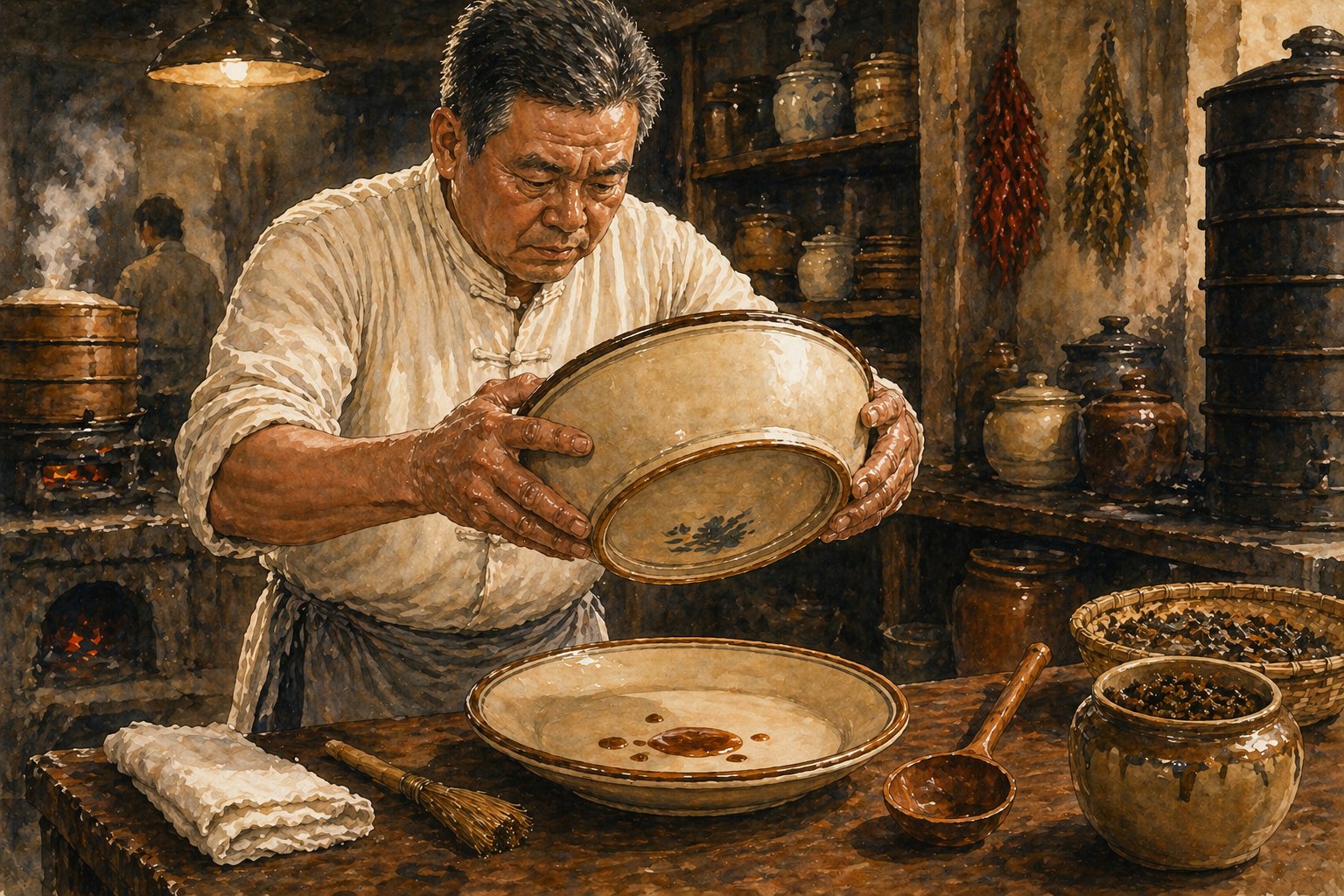
Place the serving plate (warm-cream ceramic with hand-painted blue-and-iron-red floral border, deep round, slight rim depth — Hakka banquet-platter family) directly on top of the kou wun bowl, rim-to-rim, plate face-down.
Grip both bowl-and-plate firmly with both hands. Lift slightly above the prep table.
In a single decisive motion: invert. Roll the wrist 180 degrees, ending with the plate now on the bottom and the bowl now upside-down on top.
Set the inverted bowl-on-plate down on the prep table. Wait 10–15 seconds for the dome's contents to settle onto the plate by gravity.
Slowly lift the bowl straight up — do NOT rock or tilt; lift vertically. The dome should release intact onto the plate, mei cai mounded on top, pork slices forming the inverted-bowl-shaped terrace beneath.
If a slice slips out of place during the lift, use bamboo chopsticks to nudge it gently back into the dome's curve. A perfect flip is rare; a recoverable flip is common; an experienced banquet-cook can recover a slipped flip in under 30 seconds without the diners noticing.
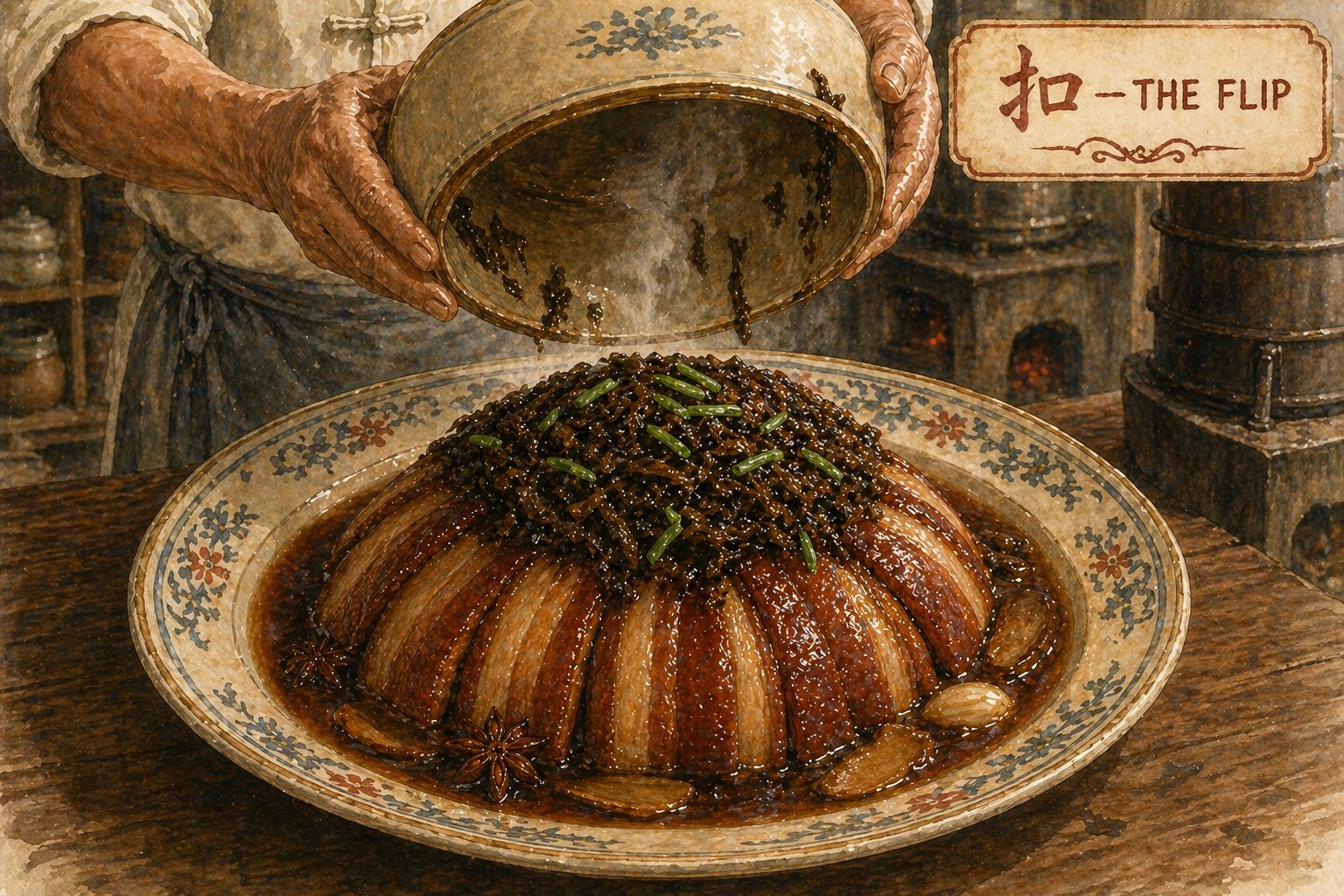
Plate and Garnish
Allow the braising-liquid to pool naturally around the dome's base on the plate. Garnish:
- Scatter the finely-sliced spring onion greens lightly across the top of the dome (restrained — heritage banquet register, NOT a heavy herb pile).
- Place a small porcelain spoon at the plate's edge for the braising-liquid.
Serve immediately, while the dome is hot and intact. Place the side condiments at the diner's reach: small dish of light-soy-with-vinegar, plain steamed white rice in individual bowls.
🎯The Three Tips
Heritage. Master's. Mistake.
🏛 Heritage Note
Why the Skin Faces Down
The single most-misunderstood aspect of kou rou construction is the orientation of the pork-belly slices in the bowl. The slices are arranged skin-side-DOWN against the bowl's interior — meaning the skin faces the ceramic, the meat faces the bowl's centre.
Why? Because after the inversion, what was "down" becomes "up" — and what was against the bowl becomes the under-surface of the dome on the plate. If the skin were face-up in the bowl, then after the flip, the skin would be on TOP of the dome, and the meat would be hidden beneath. Wrong texture, wrong presentation, wrong dish.
The skin-down arrangement means: after the flip, the skin sits at the bottom of each slice, in contact with the plate, where it absorbs braising-liquid and stays glossy. The meat-side faces upward, where it presents to the diner. Each slice becomes a small horizontal terrace, the mei cai blanket above, the skin-glossy underside below.
This is heritage Hakka banquet construction — once you understand the inversion logic, every step makes sense.
👨🍳 Master's Tip
The Flip Itself
The single technique that separates heritage kou rou from a casual home stew is the flip. Five seconds of judgement, and a confident dome.
Three things make the flip work:
- The bowl shape. A heritage kou wun with the inward-curving rim is non-negotiable. Without the rim curve, the dome cannot form. A straight-sided bowl produces a flat-sided cylinder; a flat-bottomed bowl produces a flat-topped pile. The kou wun's curve IS the dome's curve.
- The wrist motion. A single decisive 180-degree wrist rotation. NOT a tilt-and-lift, NOT a slow inversion. Hesitation tears the dome before it has settled. The heritage rhythm is: grip, lift, rotate-in-one-second, set down, wait-15-seconds, lift bowl vertically.
- The settle. After the inversion-and-set-down, do NOT lift the bowl immediately. Wait 10–15 seconds. The dome's contents need that pause to settle onto the plate by gravity. Lift too early and the dome collapses; wait the full settle, and the dome holds.
The other technique that separates good from great is the dry-sear on poked skin in Stage 1. Most home cooks skip this step — they think the long steam will do enough. It will not. Without the dry-sear-on-poked-skin, the cooked skin is rubbery, not blister-crisp. Heritage Hakka kou rou is ALWAYS dry-seared first.
⚠ Common Mistake
Collapsed Dome / Watery Sauce
Three failures:
- Bowl lifted too early after inversion. The dome has not had time to settle — contents collapse onto the plate as a heap, not a dome. Fix: the 10–15-second settle is non-negotiable.
- Mei cai not stir-fried before layering. Raw rehydrated mei cai releases its water during the long steam and turns the braising-liquid into watery, pale-coloured broth instead of a glossy mahogany reduction. Fix: the mei cai must be stir-fried in pork lard with crystal sugar and light soy in Stage 3, BEFORE going into the kou wun. Heritage Hakka technique.
- Pork-belly slices arranged skin-side-UP. After the flip, the skin sits on top of the dome instead of underneath each slice. Wrong texture, wrong presentation. Fix: skin-side-DOWN against the bowl interior, every time. Read Heritage Note above — once the inversion logic clicks, this never goes wrong again.
📈 Scaling for Banquet Service
For a heritage Hakka banquet restaurant or clan-association banquet kitchen
The economic challenge of kou rou specifically: the 2-day labour cycle and the per-flip risk make hawker-scale impossible. That is why the dish appears almost exclusively in (a) banquet-restaurant private-dining rooms with 2-day advance ordering, (b) clan-association reunion-dinner kitchens, and (c) heritage-home cooking for major occasions.
For a banquet-restaurant that serves it:
- Pre-order requirement: 24–48 hours minimum advance notice, the dish cannot be cooked à la minute. Day 1 prep happens the day before the banquet; Day 2 finishing happens during the banquet's earlier courses.
- Batch capacity: a heritage banquet kitchen with one dedicated steamer-tower can produce 4–6 kou rou bowls in parallel. Beyond this, the capacity is steamer-bound.
- Per-flip skill cost: the inversion is performed at the moment of plating, by a banquet-cook with practised technique. Average failure rate (visible-collapse) for an experienced banquet-cook: 1 in 30–40 flips. For a novice: 1 in 5–8 flips. Restaurants typically prep a "backup" kou wun for an 8-banquet service in case the primary flip fails publicly.
- Banquet-set context: kou rou appears as one of the centrepiece dishes in a heritage Hakka banquet of 8–10 dishes — the banquet pricing absorbs the dish's labour. Single-dish ordering is rare and expensive.
- Cost (Singapore 2026): Per banquet portion ~SGD 18–22 (pork belly 9.00 + mei cai 3.00 + braising aromatics and stock 2.50 + crystal sugar 0.50 + labour amortised 4.00). Sells SGD 60–90 at heritage Hakka banquet restaurants. Margin: 65–75% — high, reflecting the labour-and-skill premium.
The Lunar New Year, weddings, milestone-birthday banquets, and clan-association reunion dinners remain the dish's most reliable cultural anchors. A young Hakka cook who masters the kou rou flip has acquired a banquet-skill that few outside the Hakka heritage-restaurant world possess.
The flip is the dish. Five seconds of practised judgement, and a dome holds. Five seconds of hesitation, and a heap. Heritage Hakka cooking is the long patience of preparing the work, and the short bravery of the inversion. A successful kou rou is the cook's signature on the banquet.