Foochow Red Wine Chicken Mee Sua
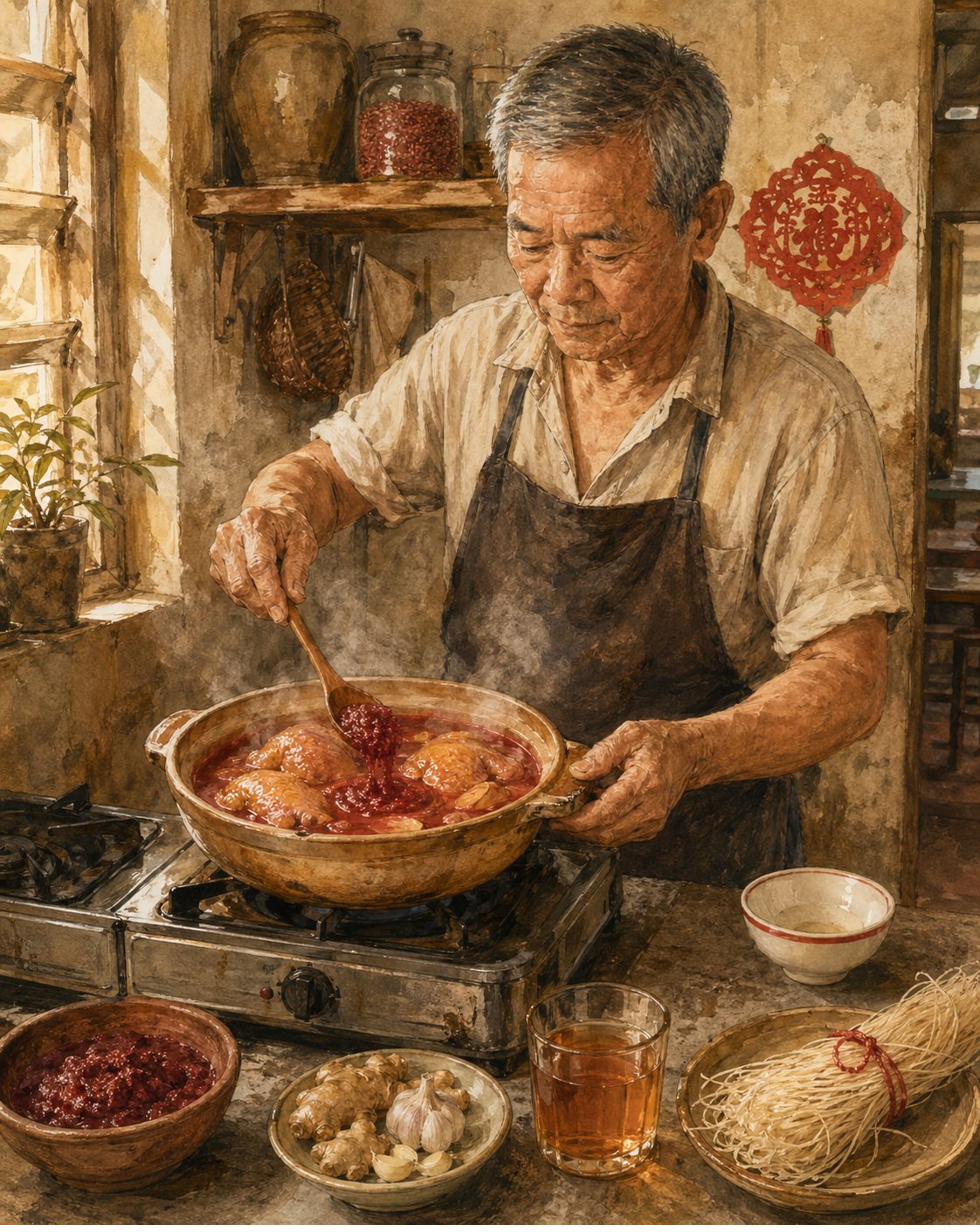
This is the dish my mother made on the first morning of every Lunar New Year. Then it became the dish I made on the first morning of every Lunar New Year. It is the only dish in this book I cook only at home. I have never sold a single bowl.
Foochow red wine chicken mee sua — hóngzāo jī miànxiàn in Mandarin, ang chao kay mee sua in the Foochow tongue — is the Foochow community's ceremonial dish. It is eaten on the first day of Lunar New Year before any visitors arrive, on birthdays, at weddings and engagements, at the birth-month and subsequent annual birthdays of a baby, and during the one-month confinement period after a Foochow mother gives birth. This constellation of occasions is documented across multiple Foochow-Malaysian and Foochow-Singaporean sources, including Sibu and Sitiawan community accounts and the Periuk.my heritage-cuisine archive. The mee sua at the centre of the bowl is the heritage longevity noodle — the noodle is left long, never cut, because the length of the strand carries the wish for the length of the diner's life.
A useful piece of heritage-positioning my mother taught me, and that I have since seen confirmed by Foochow writers: this tradition is a Nanyang Chinese tradition, not a mainland Fujian one. Foochow descendants in Sibu, Sitiawan, Singapore, Penang, and Bintulu all observe this Lunar New Year first-morning breakfast custom; Foochow writers visiting their mainland-Fujian relatives have repeatedly noted the same dish exists there but is not particularly tied to Lunar New Year or birthdays. The diaspora ritualised it. My mother arrived in Singapore from Sitiawan in the 1950s, and the dish came with her — first the wine, then the lees, then the noodles, in the same cardboard box every year.
Two heritage products from one fermentation, both used in this dish, often confused:
- ang jiu (红酒) — Foochow red rice wine. The amber-rose liquid wine pressed from the fermentation. Sweet, fruity, low-alcohol. Used as the cooking liquid in the broth.
- ang chao (红糟) — red wine lees (also sometimes called ang zhao in different romanisations). The dark-rose grainy paste that settles at the bottom of the fermentation jar after the wine is pressed off — the same paste that appears across this Foochow chapter in R31, R32, R34, and as the foreground hero of R35. Used to bloom in oil and flavour the broth.
You need both. Reportedly some modern recipes substitute Shaoxing wine or Mei Kuei Lu Chiew when authentic Foochow red rice wine is hard to source — those substitutes work for a passable approximation but they are not the same dish. The Foochow red rice wine has a sweet-fruity-pear character no other Chinese wine carries; the ang chao lees has a deep umami-fermented note no other paste carries. Without one or the other, you have made a sesame-oil chicken soup with mee sua — a perfectly fine dish, but not this dish.
The third heritage anchor is sesame oil + old ginger — the warming foundation that gives the dish its TCM "heaty" register. Reportedly the combination of sesame oil, old ginger, and red rice wine is the classic Foochow confinement-diet trio, traditionally used to support new-mother recovery in the month after childbirth. But the dish escaped the confinement room long ago — every Foochow family eats it on Lunar New Year morning regardless of who has just given birth. The men in our family, my mother used to say, fight over the wine-soaked thighs.
I cook this on Lunar New Year morning. I cook it on my children's birthdays. I cook it on the day after a long week. It is the only dish in this book that is purely mine and my family's — not Sai Sook's in Chinatown, not Auntie Lim's in Sibu, not Uncle Lau's in Geylang. The recipe is my mother's. The kitchen is my own.
🛒Ingredients
Bone-in chicken thighs, ang chao paste bloomed in sesame oil, ang jiu wine for the broth, mee sua at the last minute. Forgiving once the bloom is right.
For the Chicken
| Bone-in skin-on chicken thighs | 6 thighs (about 800 g) | The heritage standard cut — the bone gives the broth body, the skin renders fat into the broth. NOT chicken breast (too lean), NOT boneless thighs (loses the bone-broth depth). |
Marinade
| Ang chao (red wine lees) | 1 tbsp | |
| Light soy sauce | 1 tsp | |
| Sesame oil | 1 tsp | |
| Ginger, finely grated | 1 tsp |
For the Broth Base
| Sesame oil (toasted) | 3 tbsp | Do NOT substitute — toasted sesame oil is non-negotiable for the heritage flavour. |
| Old ginger, peeled and sliced thick | 1 large thumb (about 30 g) | |
| Garlic cloves, lightly crushed | 5 | |
| Ang chao (red wine lees) | 3 tbsp | |
| Ang jiu (Foochow red rice wine) | 250 ml | |
| Hot water or unsalted chicken stock | 700 ml | |
| Salt | 1 tsp, to taste | |
| White sugar | 1 tsp | Balances the wine's natural sweetness — the dish is meant to read sweet-savoury, not sour. |
🌶️Shifu's Lift
choose one path — see "Shifu's Secret" chapter for the philosophy- Old-school path: ¼ tsp MSG in the marinade
- Modern hawker path: ½ tsp chicken stock powder in the marinade
- Heritage purist path: reportedly the Sibu-Foochow grandmothers simmer the dish in a clay double-boiler for 90 minutes instead of 30 — the slower extraction gives a deeper-bodied broth without changing any ingredient. If you have a clay double-boiler and the time, this is the form.
For Serving per bowl
| Dry mee sua (fine wheat vermicelli) | 80 g | Handmade Sibu-Foochow mee sua if you can find it; supermarket pack is acceptable. |
| Hard-boiled egg, peeled and halved | 1 | The heritage Sibu Lunar New Year garnish — the egg signifies completeness and good fortune. |
| Spring onion, finely chopped | 1 tsp | |
| Additional Foochow red rice wine to finish optional | a drizzle | The heritage flourish, splashed in by the diner at the table. |
Condiment traditional
| Additional Foochow red rice wine | on the side | For the diner to add to taste at the table. |
👨🍳Method
Five stages. Marinate, bloom, simmer, blanch the noodle, assemble. The bloom decides everything.
Marinate the Chicken
Combine the marinade ingredients in a bowl. Add the chicken thighs and turn to coat each piece. The ang chao should be massaged into the skin and into any cuts in the meat. Cover and rest 30 minutes at room temperature, or up to 4 hours in the fridge.
The marinade does two things: it stains the chicken skin a beautiful warm-rose ahead of cooking, and it lets the ang chao umami penetrate the meat before searing.
Bloom the Ang Chao + Sear the Chicken
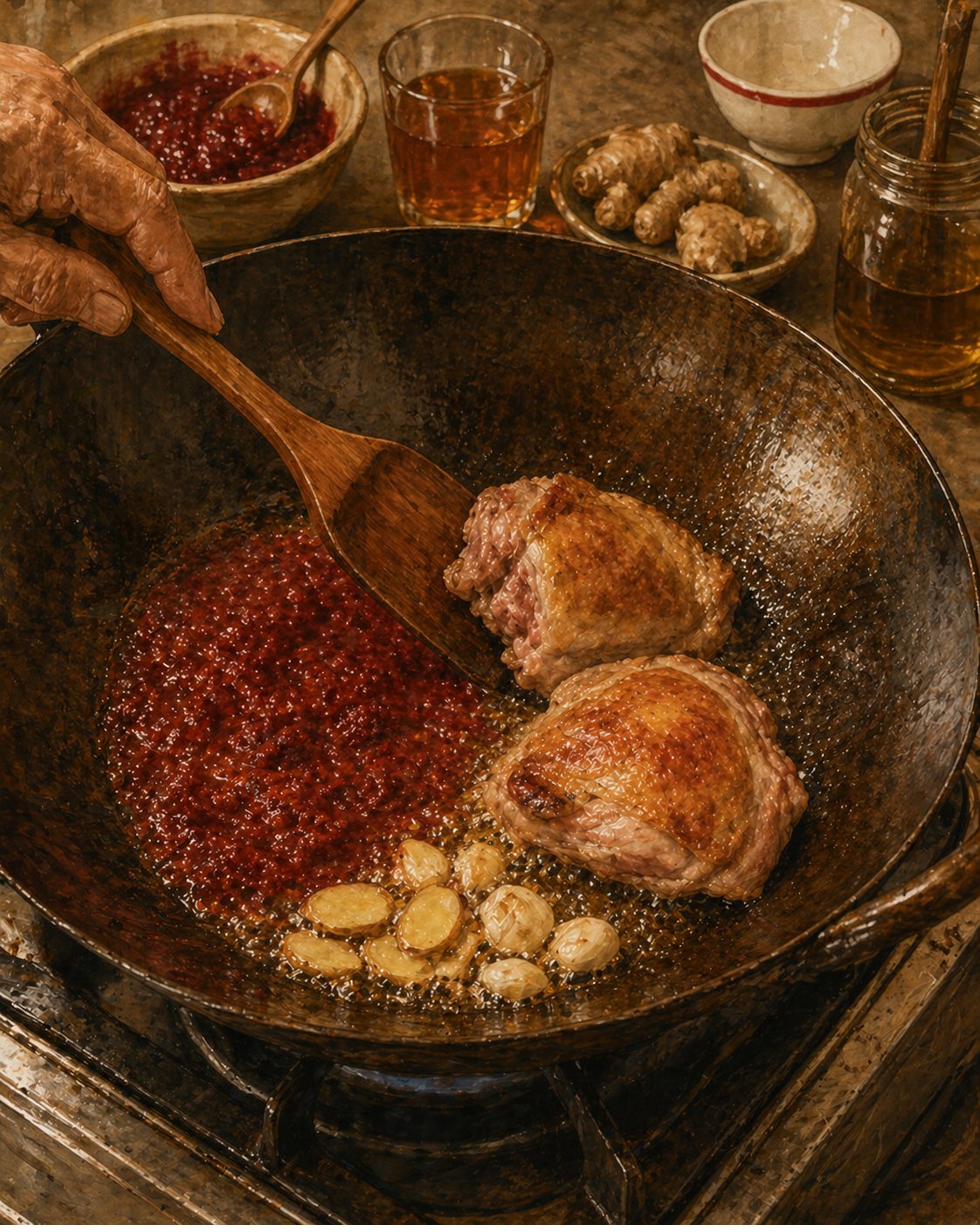
Heat 3 tbsp toasted sesame oil in a heavy iron wok or claypot over medium heat. Add the sliced ginger and crushed garlic. Fry the ginger until the edges curl and turn golden — about 2 minutes. The ginger should release its sharp aroma and the oil should turn a pale gold.
Push the ginger and garlic to one side of the wok. In the cleared space, add the 3 tbsp of ang chao. Bloom the lees in the hot sesame oil for 60–90 seconds — the colour will visibly transform from raw-deep-red to a cooked warm-red-amber, and the air will fill with the deep fermented-fruity aroma that is the dish's signature.
This is the cartouche moment of R33: BLOOM. Get it wrong (oil too cold, lees added too soon, the bloom rushed) and the dish never recovers — the ang chao tastes raw and sour throughout. Get it right and the rest of the recipe almost cooks itself.
Now add the marinated chicken thighs, skin-side down, into the cleared space of the wok. Sear the skin for 3 minutes without moving the thighs. Flip and sear the other side for 1 minute. The skin should now be golden-mahogany at the edges.
Pour the Wine + Simmer
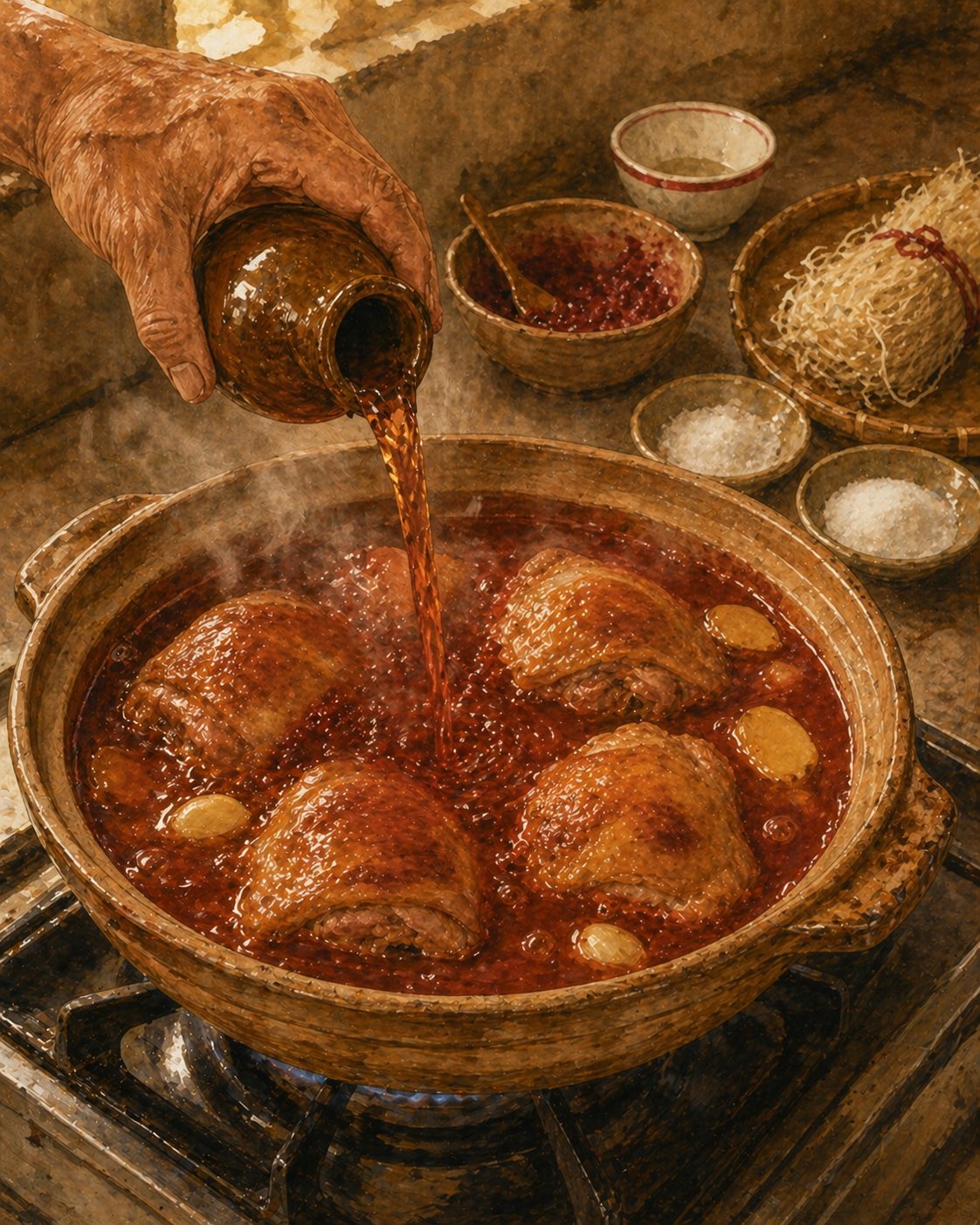
Now the dish's signature transformation. Pour the 250 ml of ang jiu (Foochow red rice wine) in a steady stream into the wok — the wine hits the hot oil and bloomed ang chao, the surface deepens from warm-red-amber to a richer rose-red, and a fragrant cloud of wine-steam rises. Do not flinch from the steam — that is the alcohol cooking off, leaving the wine's sweet-fruity character behind.
Add the 700 ml of hot water (or unsalted chicken stock if you have it). Stir to combine. Add the salt and sugar. Bring to a gentle simmer — NOT a rolling boil; the boil tightens the chicken and clouds the broth.
Cover and simmer 25 minutes over low heat. The chicken finishes cooking through; the broth absorbs the wine and the lees; the colour settles into the warm-red-amber that defines the finished dish.
Taste and adjust at the 25-minute mark. The broth should be sweet-first, then savoury, then warming-from-within from the ginger. If too sharp, add a pinch more sugar. If too flat, a splash more wine. If too sweet, a splash more hot water and a few grains of salt.
Blanch the Mee Sua do this LAST
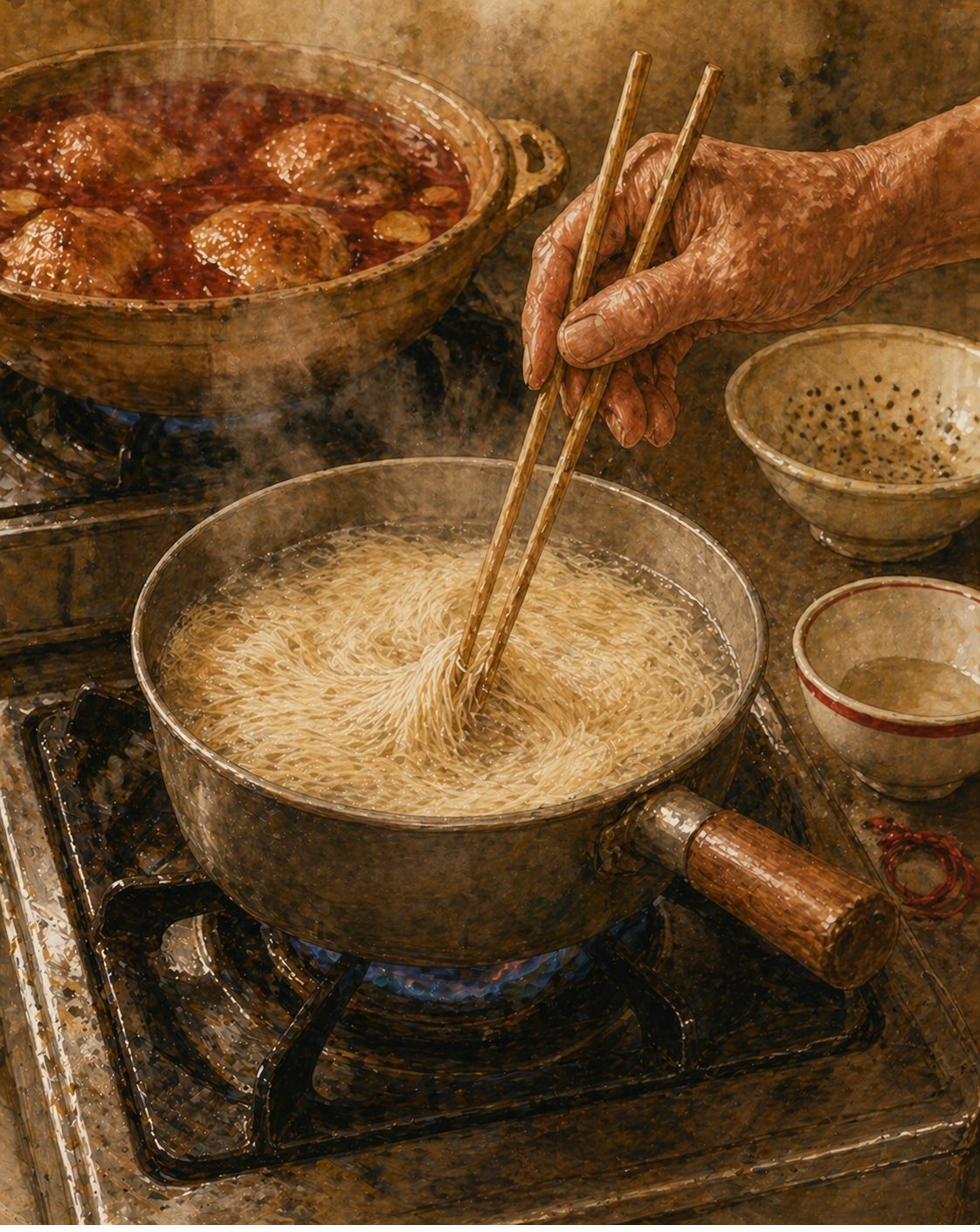
In a separate pot, bring clear water to a gentle simmer — NOT a rolling boil. Mee sua softens fast.
Drop the mee sua bunches into the simmering water. Use a pair of long bamboo cooking chopsticks to gently tease the bunch apart so the strands separate and don't clump.
Cook 30–45 seconds maximum. The noodles should be JUST cooked, springy, with the slightest residual firmness. Drain immediately into a small ceramic colander. Do not rinse.
The mee sua finishes cooking in residual heat as you assemble the bowls — that is why you stop short of fully done.
Assemble
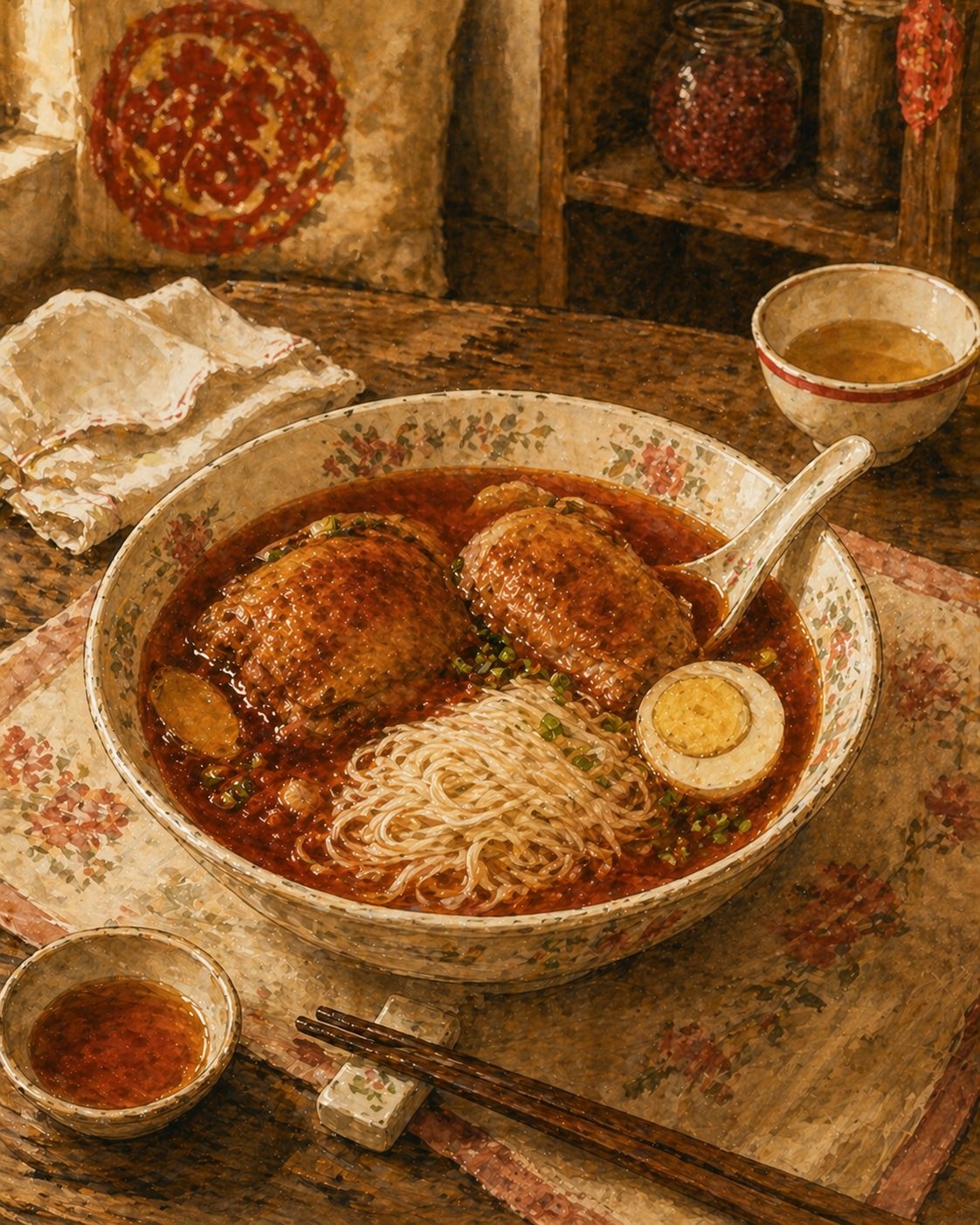
Into each heritage Chinese ceramic soup bowl: a generous nest of just-cooked mee sua at one side, 2 bone-in chicken thighs from the simmering claypot, a generous ladle of warm-red-amber broth with the ginger slices, a halved hard-boiled egg perched at the edge of the noodle nest. Scatter chopped spring onion across the broth surface. Drizzle a final teaspoon of Foochow red rice wine across the top — the heritage flourish that wakes the dish up at the table.
Serve immediately. The diner stirs the wine through the broth at the first spoonful.
🎯The Three Tips
Heritage. Master's. Mistake.
🏛 Heritage Note
The Diaspora Ritualised It
The Foochow red wine chicken mee sua tradition is a Nanyang diaspora invention as a Lunar New Year and birthday ritual — reportedly the dish exists in mainland Fujian but is not particularly tied to celebratory days there. The Foochow communities of Sitiawan (Perak), Sibu (Sarawak), Bintulu, Penang, and Singapore all share this first-morning-of-Lunar-New-Year breakfast tradition.
The mee sua at the centre of the bowl is the longevity noodle — the noodle is left long and uncut because the strand carries the wish for the diner's long life. To cut a Foochow mee sua strand on Lunar New Year morning is, reportedly, the worst kind of bad luck. Eat the noodles whole, suck them in, slurp them up. Do not chop.
For young hawkers thinking about Foochow stalls: this dish is almost never sold at hawker stalls in Singapore. It is a domestic dish, made at home for family. A handful of restaurants — Seow Choon Hua at 33 Sultan Gate is documented as one — do serve a version, but the Singapore Foochow community is small enough that the dish has stayed largely private, eaten among kin, not sold to strangers.
👨🍳 Master's Tip
The Bloom Decides Everything
The single moment that separates a great bowl of this dish from a flat one is the bloom of the ang chao in hot sesame oil:
Oil hot enough. The sesame oil must be properly heated — when you drop in a small fleck of ang chao, it should sizzle immediately. If it just sits in cold oil, the bloom is a no-go and the lees will taste raw all the way through cooking.
Bloom long enough. 60 to 90 seconds. The colour visibly changes from raw-red to warm-red-amber. The aroma changes from "sour fermented mash" to "deep umami fruit." If you only bloom for 20 seconds, the lees never wakes up.
Bloom NOT burnt. If the lees scorches and turns dark-brown-black, the dish is bitter throughout. There is no rescue. Start over.
The bloom is also where the kitchen smells like a Foochow Lunar New Year morning. Reportedly every Foochow child who ever lived in a Sibu or Sitiawan home will tell you the same thing: that smell is the first day of the year.
⚠ Common Mistake
The Three Failure Modes
Substituting Shaoxing for Foochow red rice wine. Shaoxing is dry-sharp; Foochow red rice wine is sweet-fruity. The substitution gives you a perfectly drinkable Chinese chicken soup, but it is not Foochow red wine chicken. If you cannot find ang jiu, please make this dish another day. There is no shortcut around the wine.
Boiling the broth instead of simmering. A rolling boil tightens the chicken (chewy, not falling-off-the-bone) and clouds the broth (milky, not clear-warm-amber). Gentle simmer always. Cover the pot, low heat, 25 minutes, leave it alone.
Cooking the mee sua too long, or too early. Mee sua softens to mush in 90 seconds at full boil. The heritage discipline is 30 to 45 seconds at gentle simmer, then drain immediately, then assemble immediately. If the mee sua sits in hot broth for 5 minutes before serving, it is rice porridge by the time it reaches the table. Cook the mee sua LAST, in the final minute before assembly.
📈 Scaling for Hawker Service
This is the only dish in this book I cannot honestly scale for hawker service
The dish is a domestic Lunar New Year breakfast, not a stall item. The handful of Singapore restaurants that serve it (Seow Choon Hua at 33 Sultan Gate is the documented anchor) make small daily batches in the morning and run out by mid-afternoon. The economics are real: imported ang jiu and ang chao are not cheap; the chicken thighs are heritage-cut, not the cheap parts; the dish does not benefit from batching beyond a domestic claypot's worth.
For a small heritage restaurant stall, reportedly serving 30–50 bowls a day is realistic — three claypot batches across the morning, the dish best within an hour of each batch finishing. Cost (Singapore 2026): per bowl ~SGD 4.20 (chicken 1.80 + wine and lees 1.20 + mee sua 0.40 + sesame oil and aromatics 0.50 + egg and garnishes 0.30). Sells SGD 10–14. Margin: 55–65%.
But if you are reading this and thinking about a Foochow stall, my honest advice: make the fishball soup (R31) for the stall, and make this one for your family at home.
Cook this on the morning of every birthday in your family. Cook it on the first day of every Lunar New Year. Cook it on the day after a long week. Make it the dish your children remember the smell of when they grow up and move out. Some dishes you sell. This one you keep.