Hakka Lei Cha
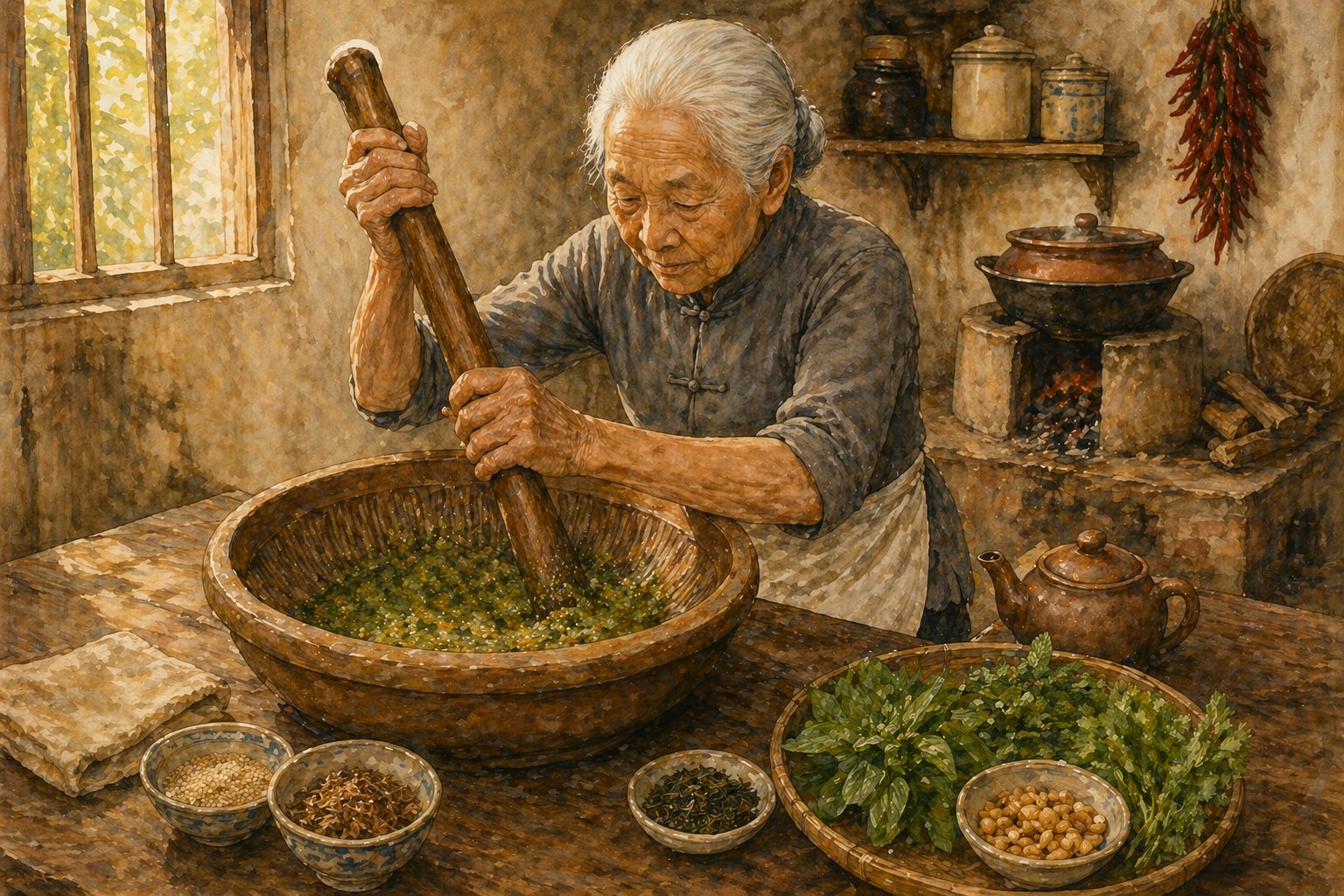
The Hakka grind their tea into a bowl of seven treasures and call it a meal. It is the most genuinely Hakka of all the dishes in this chapter — and the rarest.
Lei Cha 擂茶 — Thunder Tea Rice in English, named for the rumbling sound the heritage lei pun mu (擂盆木, the long wooden pestle) makes against the lei pun (擂盆, the heritage Hakka grinding mortar) — is the most distinctly Hakka dish in the Singapore Hakka kitchen. Where Yong Tau Foo and Mei Cai Kou Rou borrow techniques and ingredients that other Chinese cuisines also use, Lei Cha is unmistakable: nobody else in Chinese cuisine grinds fresh tea leaves with herbs and toasted nuts into a sage-green broth and pours it over a bowl of brown rice surrounded by seven small piles of finely-chopped vegetables.
The dish is ancient. It is variously described in heritage sources as a Hakka soldier's marching food (the seven treasures stretched the rice; the herb broth carried medicinal value), a Hakka grandmother's weekly cleansing meal (the herbs are diuretic, digestive, and gently cooling — heritage reading), and a ceremonial occasion dish (Lunar New Year, weddings, ancestral-veneration meals — though less universally than Recipe 22 Abacus Seeds). What unifies the readings is the dish's ceremonial character: Lei Cha is not eaten in haste. The seven treasures are prepared separately. The broth is ground fresh. The bowl is assembled at the table. The diner pauses, sees the still-life, then pours.
The technique is the dish's defining feature. Heritage Lei Cha is ground in the lei pun mortar — the deep, wide-mouthed, ceramic bowl with fine deep ridges scored into its inner surface — using a long thick wooden pestle. The grinding is physical work; a Lei Cha bowl for four people takes 20–30 minutes of grinding by an experienced grandmother. The mortar's incised ridges are technique-essential: they shred the herb leaves as the pestle grinds, releasing oils and aromatics that no electric blender can replicate. A Lei Cha made in an electric blender is the dish's death — the heritage cooks I have spoken with are unanimous on this. The blender's fast spinning blades chop the leaves rather than shred-and-press them; the resulting broth has a flatter, harsher, less integrated character.
The herb mix varies by household and season. Heritage standard ingredients include:
- Fresh green tea leaves (the foundation — green tea, not black, not oolong)
- Thai basil (the dominant aromatic)
- Fresh mint (the cool note)
- Fresh coriander (the herbal lift)
- Toasted peanuts (the body-and-fat — gives the broth its slight creamy character)
- Toasted sesame seeds (the depth)
- Sometimes: fresh perilla, fennel leaves, sweet basil, or other regional herbs depending on what the grandmother's garden has
The herb paste is ground fresh, then thinned with brewed green-tea water (the second component of the broth: a separately brewed green tea that thins the paste into a pourable broth). The result is a bright sage-green slightly-opaque liquid — distinctly NOT a clear soup, NOT a clear tea — the colour and texture are the heritage marker.
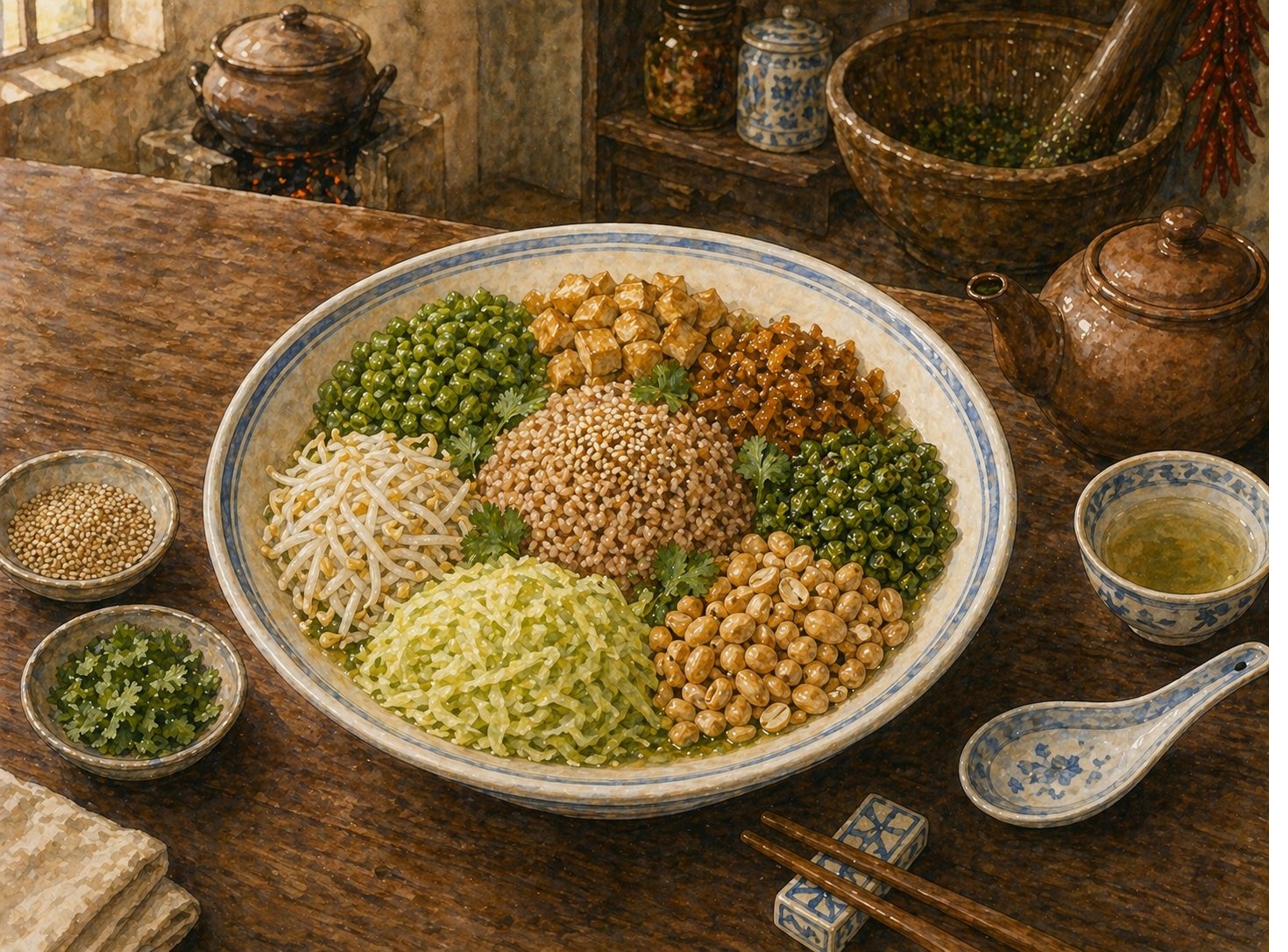
The seven treasures (七宝 qi bao) are the bowl's surrounding components. Heritage standard is:
- Finely-chopped french beans (or other green beans)
- Diced firm tofu, pre-fried
- Finely-chopped chye poh (preserved sweet radish)
- Diced long beans (or snake beans)
- Toasted peanuts
- Finely-shredded cabbage, lightly blanched
- Bean sprouts, raw and crisp
Variations exist: some heritage cooks substitute one of the components for finely-chopped pickled mustard greens, blanched water spinach, or fried small dried shrimp. The seven-component principle is the heritage rule; the specific seven within the principle vary.
The rice is brown rice — NOT white rice. The brown grain is the heritage marker; modernised commercial Lei Cha uses white rice for cost reasons but the heritage form is brown.
In Singapore, heritage Hakka Lei Cha appears at:
- Thunder Tea Rice at Thomson Plaza — reportedly the most accessible heritage Lei Cha for non-Hakka Singaporeans; the stall has reportedly run for several decades and serves both the soup-bowl form and a "dry" form (broth on the side)
- Hakka Eating House — a heritage Hakka establishment with Lei Cha on the daily menu
- Selected Hakka heritage restaurants for ceremonial or pre-ordered service
- A small number of clan-association lunch kitchens where the dish is prepared for monthly heritage gatherings
- Moi Lum Restaurant — the Hakka heritage restaurant on South Bridge Road, reportedly running since 1965
The dish has remained a heritage dish almost entirely — at home (Hakka grandmother's weekly preparation), at clan-association ceremonial gatherings, and at a handful of dedicated heritage stalls. The lei pun mortar requirement, the 20–30-minute grinding, the seven-treasures preparation, and the ceremonial pre-pour still-life all resist hawker-scale economics. That is why the Hakka grandmother is the primary keeper of this recipe — without her, and without the lei pun mortar handed down across generations, Lei Cha quietly disappears from Singapore tables.
I am giving you the heritage grandmother version here, the way it was made by my Hakka neighbour-uncle's mother — who lived to her 90s and made Lei Cha every Sunday for the family until she could no longer grip the pestle. Her lei pun mortar now sits in her grandson's kitchen; he uses it once a month, on the Sunday closest to her birthday. The dish keeps her alive in the family.
🛒Ingredients
Fresh herbs ground with toasted nuts into a sage-green broth. Brown rice. Seven small piles, each prepared separately.
For the Lei Cha Herb Paste makes broth for 4 bowls
| Fresh green tea leaves | 30 g (~1 cup loosely packed) | Heritage form uses fresh tea leaves grown in the Hakka regions; in Singapore, use dried green tea leaves rehydrated in warm water OR fresh tea leaves from a Chinese herbal supplier. NOT black tea, NOT oolong. |
| Fresh Thai basil | 50 g (~1.5 cups loosely packed) | The dominant aromatic — heritage Hakka Lei Cha is Thai-basil-forward; Italian basil is a poor substitute (different volatile-oil profile). |
| Fresh mint | 25 g (~¾ cup loosely packed) | The cool note. |
| Fresh coriander | 25 g (~¾ cup loosely packed) | Leaves and tender stems. The herbal lift. |
| Toasted peanuts | 80 g | Toast in a dry pan over medium heat until fragrant and golden, about 5–7 minutes. Heritage technique: medium-amber, NOT dark-amber (over-toasted goes bitter). |
| Toasted white sesame seeds | 30 g | Toast in a dry pan until just-golden and fragrant, about 2–3 minutes. |
| Fresh perilla leaves (optional) | a small handful | Heritage variation — adds depth. |
| Fine salt | 1 tsp | |
| Hot brewed green tea | 600–800 ml | Brewed separately at the start: steep 2–3 tbsp green tea leaves in 800 ml just-off-the-boil water for 5 minutes, strain. The brewed tea is what thins the ground paste into a pourable broth. |
For the Seven Treasures prepared in parallel during the lei pun grinding
| French beans, finely chopped (3–4 mm cubes) | 100 g | |
| Firm tofu, pre-fried and finely diced | 100 g | Pre-fry small cubes in a wok with 2 tbsp oil over medium heat until golden-brown on all sides. Drain on paper. Heritage form uses pressed firm tofu, not silken. |
| Chye poh (菜脯, preserved sweet radish), finely chopped | 60 g | Heritage Hakka pickle, adds sweetness-and-saltiness anchor. |
| Long beans (or snake beans), finely diced | 80 g | |
| Toasted peanuts | 80 g | Separate from the herb-paste peanuts above — these are the bowl's whole-peanut crunch component. |
| Cabbage, finely shredded and lightly blanched | 100 g | Blanch 30 seconds in boiling water, drain, squeeze. |
| Bean sprouts, raw | 80 g | Heritage form uses raw bean sprouts for crispness; some cooks blanch briefly. |
For the Bowl Base
| Brown rice, cooked | 4 generous cups (~600 g cooked) | Heritage marker. Use brown long-grain or short-grain rice; the BROWN grain is distinct from white rice. Cook in advance so it's ready at the bowl-assembly step. Slightly cooler-than-piping-hot is heritage-correct (the broth heats it back up). |
| Toasted sesame seeds | 2–3 tbsp | For dusting. |
| Fresh coriander leaves | a small handful | For garnish. |
🌶️Shifu's Lift
choose one path — see "Shifu's Secret" chapter for the philosophy- Old-school path: ¼ tsp MSG dissolved in the brewed-tea-water before thinning the paste
- Modern hawker path: ½ tsp chicken stock powder in the brewed-tea-water (note: this departs from the heritage vegetarian register — Lei Cha is traditionally a vegetarian/vegan dish; the chicken-stock-powder modernisation is common in Singapore but compromises the heritage character)
- Heritage purist path: Already covered with the herb-paste's toasted peanut + sesame depth + the brewed green-tea umami
👨🍳Method
Seven stages. Brew, toast, grind, thin, prep treasures, assemble, pour. The grind is meditation.
Brew the Green-Tea Water
Place 2–3 tbsp green tea leaves in a small clay teapot (or small ceramic teapot). Pour 800 ml of just-off-the-boil water (about 85–90°C — NOT rolling boil, which scalds green tea) over the leaves. Steep 5 minutes. Strain into a clay pitcher or jug, discarding the leaves. Keep warm.
This is the broth's second component — without it, the ground herb paste is unpourable. The brewed tea also brings its own gentle umami and astringency to balance the herb-paste's richness.
Toast the Peanuts and Sesame
In a dry wok or pan over medium heat, toast the 80 g peanuts (for the paste) + 80 g peanuts (for the bowl) = 160 g total in a single batch until fragrant and golden-amber, about 5–7 minutes, stirring occasionally. Heritage rule: medium-amber, NOT dark-amber. Pull off heat the moment the colour is right.
Toast the 30 g sesame seeds + 2–3 tbsp sesame seeds (for dusting) = ~50 g total in the same dry pan over medium heat, stirring constantly, until just-golden and fragrant, about 2–3 minutes. Sesame burns fast — watch attentively.
Set aside in separate dishes (paste-peanuts vs bowl-peanuts; paste-sesame vs dusting-sesame).
The Lei Pun Grind (the heritage-defining step)
Place the lei pun mortar on a stable wooden table. Place a folded cloth under the mortar to prevent slipping (heritage technique — the grinding is physical, the mortar must NOT shift).
Add to the mortar in this order:
- First: 80 g toasted peanuts. Grind with the long pestle for 3–4 minutes, until the peanuts break down into a coarse paste with visible fragments (NOT smooth peanut butter). The peanut-paste foundation captures the herb oils as the herbs are added.
- Second: 30 g toasted sesame seeds. Grind for 2 minutes, integrating into the peanut paste.
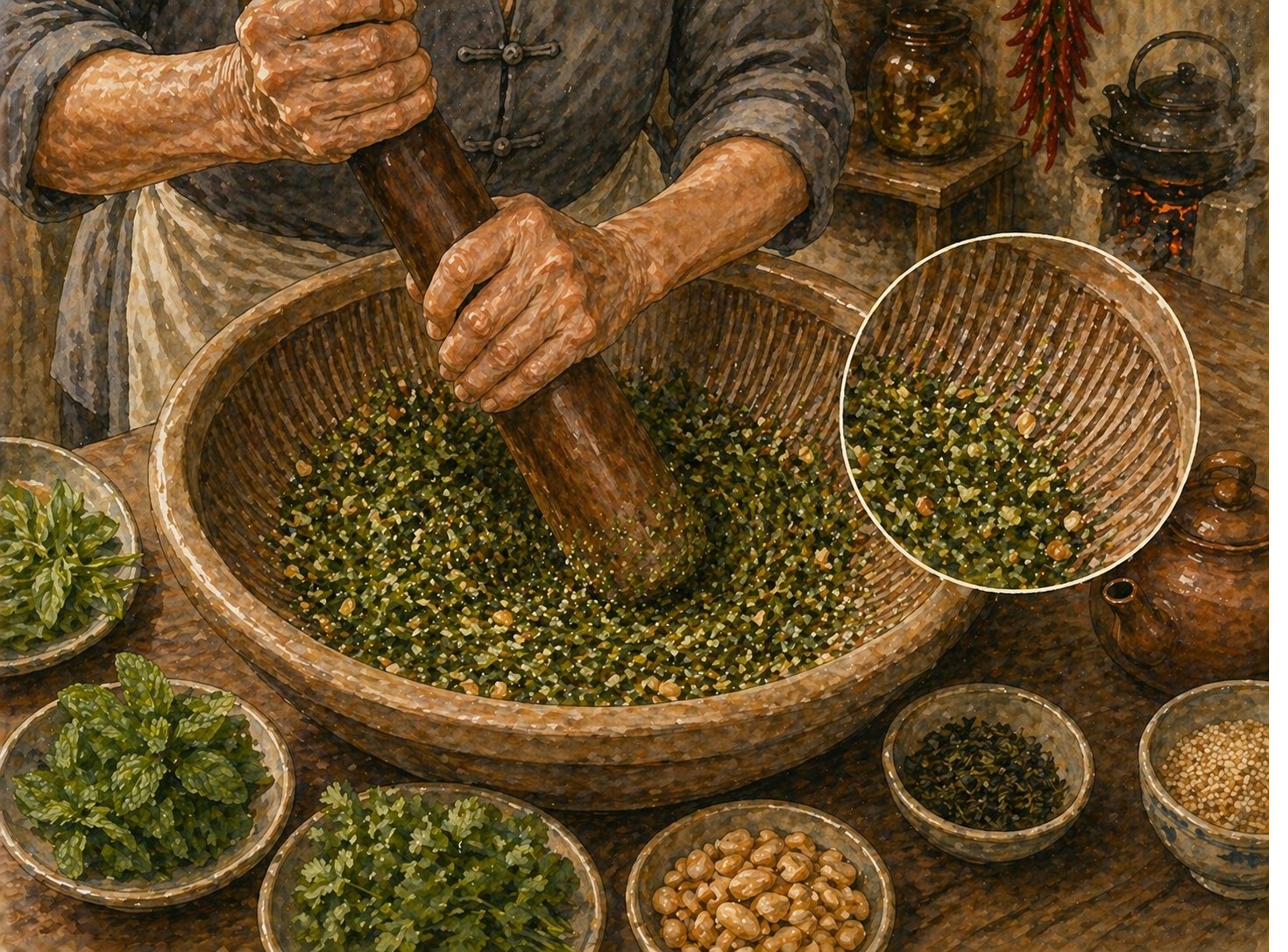
- Third: Add the fresh tea leaves, Thai basil, mint, coriander (and perilla if using). Grind in batches if the mortar is small — adding all the herbs at once makes the grinding harder. Grind for 15–20 minutes, working the pestle in a rhythmic press-and-rotate motion. The herbs will progress through stages: shred → coarse paste → smooth-but-textured paste. Heritage end-state: a sage-green smooth-but-textured paste with visible flecks of peanut and individual herb fragments still identifiable.
The lei pun grinding is meditative work. Settle into the rhythm. The pestle's weight does most of the work; your hands guide it. A grandmother who has done this for decades grinds without thinking; a new cook will feel it in the shoulders within 5 minutes.
Add 1 tsp salt. Grind 1 minute to integrate.
Thin the Paste into Broth
Pour the warm brewed green tea slowly into the mortar (or transfer the herb paste into a heat-resistant clay pitcher first if the mortar's not stable). Stir gently with the pestle to integrate. The right consistency is a pourable broth slightly thicker than water — like a thin puréed soup. If too thick, add more brewed tea; if too thin, the broth will not coat the rice properly.
Taste. Adjust salt if needed. Add the Shifu's Lift if using.
Transfer the broth to a clay teapot for serving. Keep warm (but NOT boiling — boiling destroys the fresh-herb register).
Prepare the Seven Treasures (parallel to Stages 1–4)
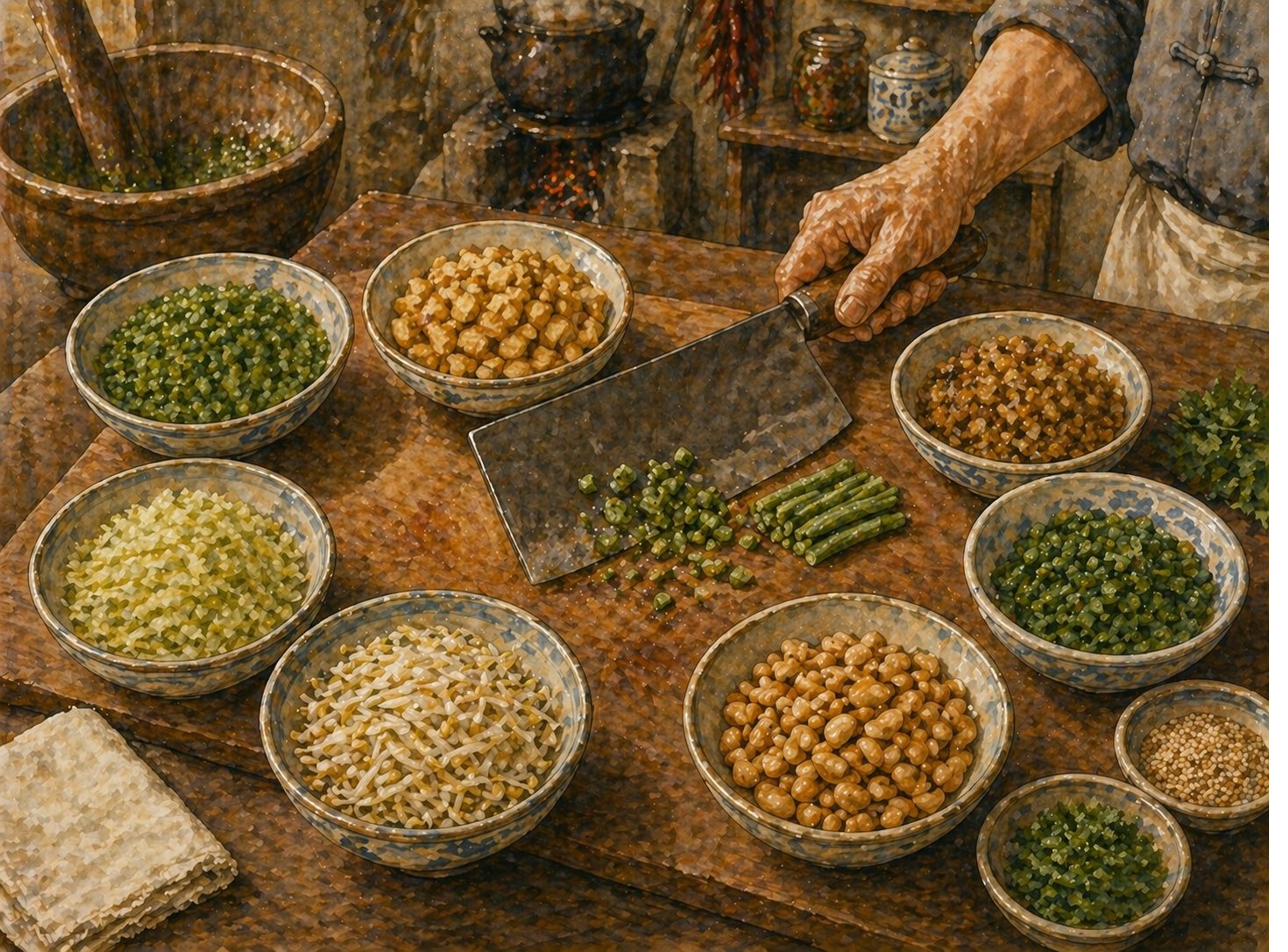
The seven-treasures prep happens in parallel during the lei-pun-grinding stage so everything is ready at the same time. Each component prepared as in the ingredient table:
- French beans: finely chopped into 3–4 mm cubes (raw or briefly blanched 30 seconds depending on the cook's preference)
- Firm tofu: cut into small cubes, pre-fried in 2 tbsp oil over medium heat until golden-brown, drained
- Chye poh: rinsed once to reduce salt, finely chopped
- Long beans: finely diced into small even segments (raw or briefly blanched)
- Toasted peanuts (the bowl portion): the second 80 g from Stage 2
- Cabbage: finely shredded and lightly blanched 30 seconds, drained, squeezed
- Bean sprouts: raw and crisp, freshly snapped at tail-end (or briefly blanched if preferred)
Each component in its own small ceramic bowl, kept SEPARATE until bowl assembly.
Assemble the Bowl (the still-life moment)
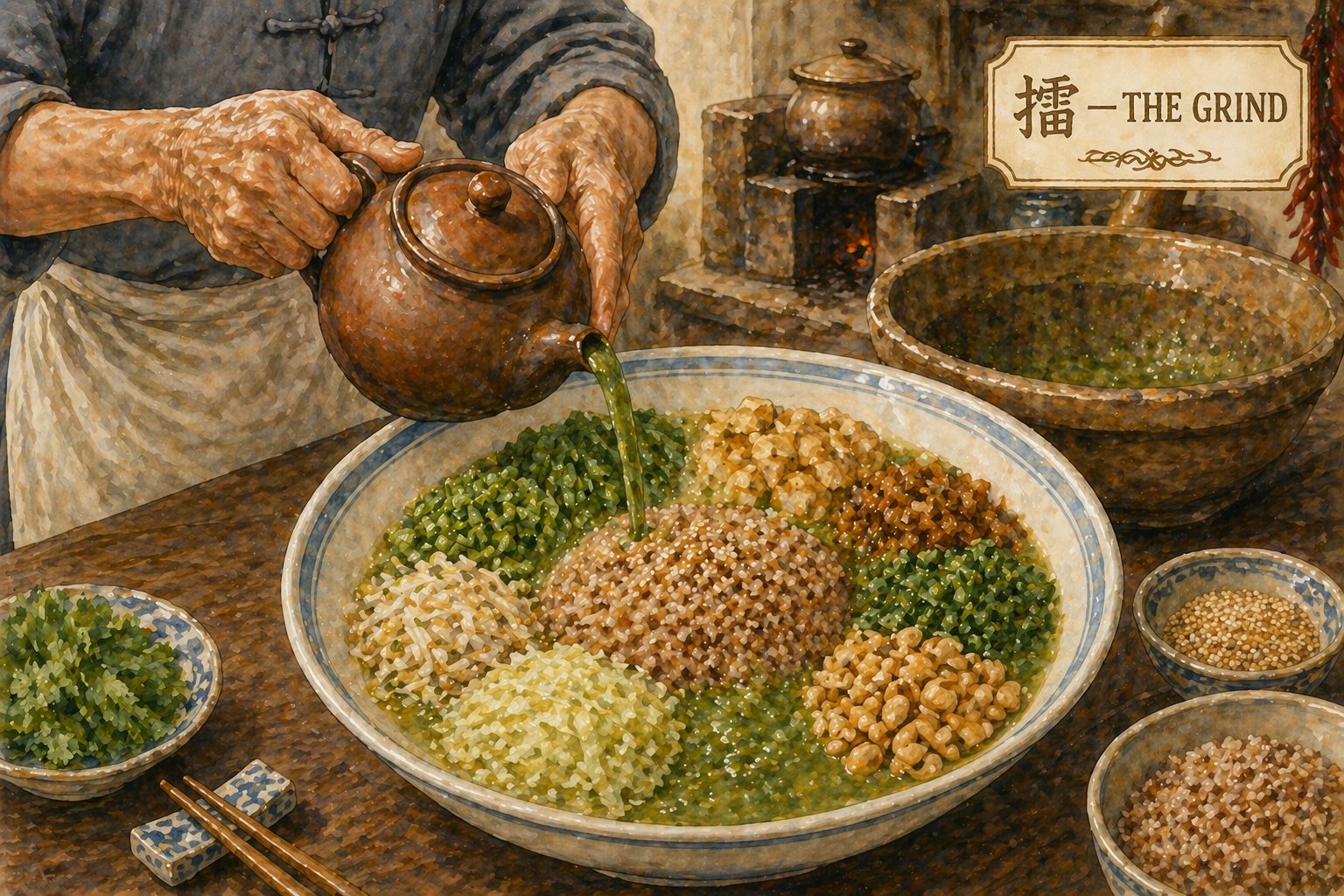
For each diner's bowl (a wide white-with-pale-blue-rim ceramic bowl — the heritage everyday register, NOT a banquet platter):
- Mound a generous serving of warm cooked brown rice in the centre.
- Surround the rice with the seven treasures in distinct small piles arranged counter-clockwise around the bowl's interior, each pile separate from the others, each one identifiable.
- Dust toasted sesame seeds across the rice mound.
- Place a few fresh coriander leaves around the rice's edge.
- Pause. The pre-pour still-life is the heritage moment. Look at the bowl. See the seven treasures. Consider the rice. The act of seeing-before-eating is part of the dish.
Pour, Mix, Eat
At the table, with all diners ready: pour the warm sage-green herb broth slowly from the teapot over the bowl, just enough to create a pool of broth around the rice and reach about halfway up the seven treasures. The broth will mix with the rice and components naturally as the diner eats.
Eat with the soup spoon (for the broth-and-rice) or chopsticks (for the components). The heritage rhythm is to mix all seven components together with the broth and rice as you eat — each spoonful a different combination of ingredients.
Drink the additional plain green tea alongside.
🎯The Three Tips
Heritage. Master's. Mistake.
🏛 Heritage Note
The Lei Pun Mortar Itself
The heritage lei pun (擂盆) — the deep clay-fired ceramic mortar with the incised-ridge interior — is the dish's defining vessel. Without it, the recipe is something else.
The mortar's design is ancient. The deep wide-mouthed shape contains the herbs as the long pestle works; the inward-curving rim concentrates the contents at the centre under the pestle's grinding action. The incised ridges — fine deep parallel grooves scored into the inner ceramic surface, running from rim toward base — are the technical heart of the design. The ridges shred the herb leaves as the pestle rotates, releasing aromatic oils that no smooth-walled mortar can extract.
A heritage Hakka grandmother's lei pun is inherited, not bought. The mortar is passed from mother to daughter (or in modern Singapore, sometimes to daughter-in-law or granddaughter). The pestle is similarly inherited — and the pestle ages beautifully into the grinding hand of the user, smooth and walnut-dark from decades of use. The mortar's ridges deepen subtly over time as well, the herb-shredding becoming slightly more efficient with each generation.
If you do not have a heritage lei pun, the dish is genuinely difficult to make at heritage scale. Modern alternatives — a Japanese suribachi (similar incised-ridge design but smaller), a heavy stone mortar (no ridges, less efficient but workable), a granite Mexican molcajete (rough surface, decent substitute) — can approximate the technique. An electric blender or food processor cannot. I am unanimous with my heritage Hakka neighbours on this.
If you have access to a Singapore heritage cookware shop (or are willing to source online), a heritage lei pun is a once-in-a-lifetime purchase. Buy it. Pass it down.
👨🍳 Master's Tip
The Grinding Order Matters
The single technique that separates a heritage Lei Cha from a half-broken-down version is the grinding order: peanuts first, then sesame, then herbs.
Peanuts first. The peanuts grind into a coarse fatty paste that captures the herb oils as you add the herbs. If you add the herbs first, the herbs go fully smooth before the peanuts have broken down, and the resulting paste lacks the binding-fat layer that gives the broth its slight creamy character.
Sesame second. Integrates into the peanut paste, reinforces the binding-fat layer.
Herbs third, in batches. Adding all the herbs at once overwhelms the mortar — the mortar's rim cannot contain a large mound of fresh leaves under the pestle, and the leaves spill. Add half the herbs, grind for 5–7 minutes, add the remainder, grind for another 8–10 minutes. The two-batch approach is heritage rhythm.
The other technique that separates good from great is the brewed-tea-water temperature for thinning. The brewed tea should be warm, not hot, when you thin the paste — about 60–70°C. If hotter, the herb paste's volatile oils flash off and the broth tastes flat. If cooler, the broth doesn't release the paste's aromatics fully. Heritage cooks judge by feel: the teapot should be warm to the touch but not uncomfortable.
⚠ Common Mistake
Bitter Broth, Wrong Texture, Lost Aromatics
Three failures:
- Bitter broth. The peanuts were over-toasted (dark-amber instead of medium-amber), or the green tea leaves were brewed in boiling water (which extracts tannins). Fix: medium-amber peanut toast; 85–90°C tea brew, never rolling boil.
- Wrong texture (too smooth or too coarse). The lei pun grinding was over-extended (fully smooth, lost texture) or under-extended (still chunky-shred, broth doesn't pour). Fix: the heritage end-state is sage-green smooth-but-textured paste with visible flecks of peanut and individual herb fragments still identifiable. Stop grinding when the paste reaches this state.
- Lost aromatics (broth tastes thin, herbs muted). The brewed tea was too hot when added to the paste, OR the broth was held at temperature too long before serving (volatile oils evaporated). Fix: brewed tea warm-not-hot (60–70°C) for thinning; serve within 15 minutes of broth completion. Lei Cha is a freshly-made dish — it does not keep.
📈 Scaling for Hawker Service
For a heritage Lei Cha stall or restaurant
The economic challenge of Lei Cha is the most demanding in this chapter: the lei pun grinding cannot be mechanised without compromising the heritage character. That is why the dish appears almost exclusively at:
- Specialist Lei Cha hawker stalls (a small handful in Singapore) — typically with two or three lei pun mortars worked in parallel by experienced grandmother-cooks, producing batches of broth at intervals through the service. The broth keeps for 30–45 minutes at warm temperature before quality degrades; service is paced around this.
- Hakka heritage restaurants with Lei Cha as a pre-order ceremonial dish (24-hour advance notice typical)
- Clan-association ceremonial kitchens where the dish is prepared for monthly heritage gatherings
Scaling notes:
- Lei pun grinding capacity: an experienced grandmother-cook produces broth for 4–6 bowls per 25-minute grinding cycle. For a stall serving 30–50 bowls per service, this means continuous parallel-mortar work or batched broth preparation.
- The seven-treasures prep is the labour-light component — done once at the start of service, the components hold at room temperature for 2–3 hours and are assembled to-order.
- The brown rice is pre-cooked in large batches in the morning, kept warm throughout service.
- Cost (Singapore 2026): Per bowl ~SGD 4.50 (brown rice 0.50 + seven-treasures vegetables 1.50 + tofu 0.50 + peanuts and sesame 0.50 + fresh herbs and tea 1.00 + lei-pun-grinding labour amortised 0.50). Sells SGD 8–12 at heritage Lei Cha stalls, SGD 12–18 at heritage Hakka restaurants. Margin: 40–55% — lower than other heritage dishes because the lei-pun-grinding labour cannot be reduced.
The dish has remained a heritage-knowledge dish rather than a hawker-economy dish. The lei pun mortar requirement, the 20–30-minute grinding, the seven-treasures coordination, and the freshly-made-only-keeps-30-minutes constraint all resist hawker scaling. That is why the Hakka grandmother is the primary keeper of this recipe — and why every grandson who inherits her lei pun is, in a small way, choosing whether the dish survives another generation.
The thunder is not in the broth. The thunder is in the grinding — the rumble of the pestle against the mortar's ridges, the rhythm that fifteen generations of Hakka grandmothers have sat to. When you grind your own Lei Cha, you join that rhythm. The bowl that comes out of your hands carries a sound you will only hear if you are quiet enough to listen for it.