Foochow Ang Chao Chicken
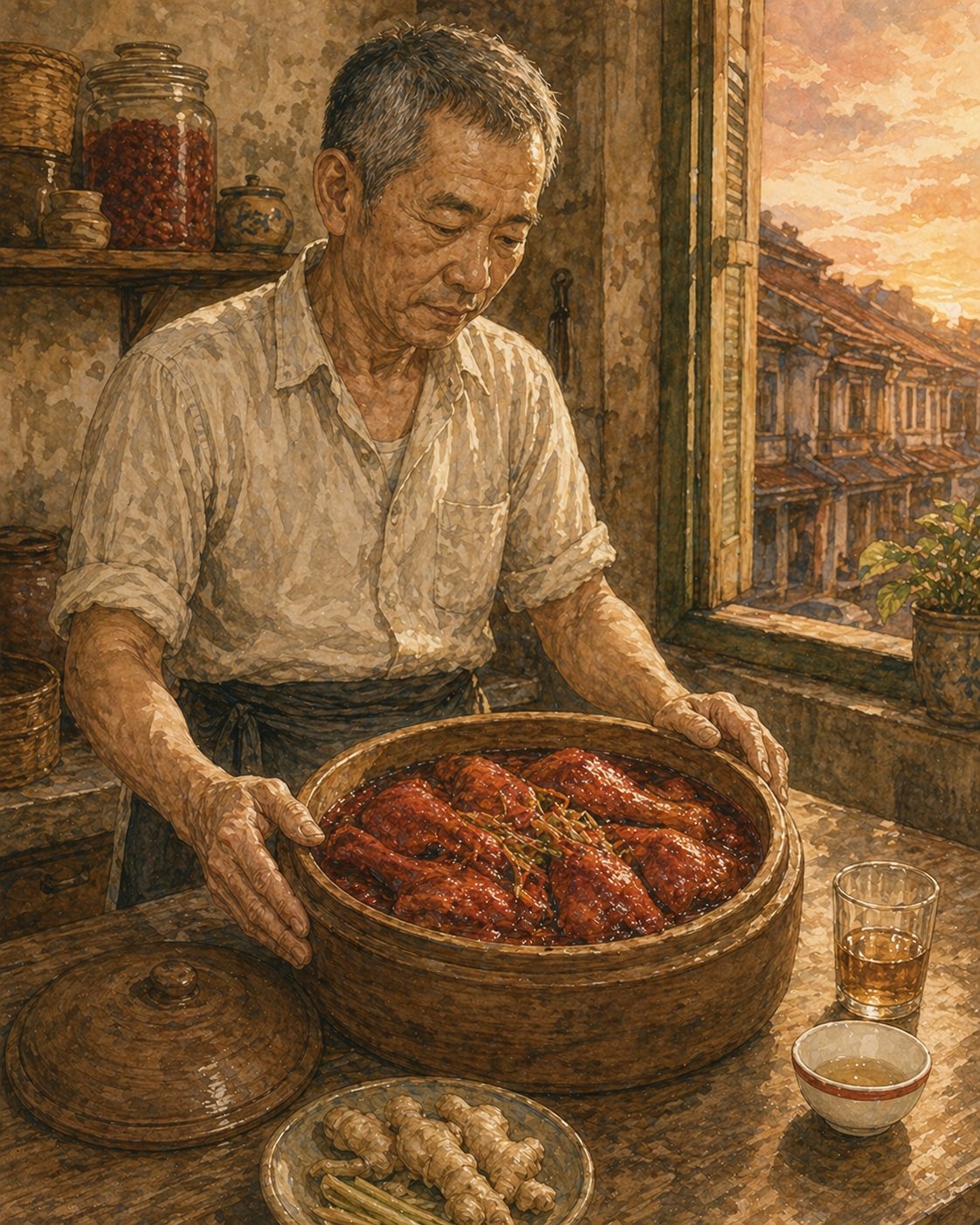
This is the last dish in the book. I have left it for last on purpose. If you have read this far, you have followed me from a Hokkien Mee stall in 1962 to my kitchen on a Lunar New Year morning to my wet-market auntie's stall at Tekka. This dish is where I have always sent the readers I trust. You make it for the people you love most.
Foochow ang chao chicken — hóng zāo jī (红糟鸡) in Mandarin, ang chao kay in the Foochow tongue — is the dish that ends every Foochow banquet, every wedding tea-ceremony, every reunion dinner, every birthday meal where the host wants to send the guests home full and remembered. Foochow ang chao chicken is documented as a celebratory dish across multiple Singapore-Foochow and Malaysia-Foochow heritage sources, cited as a wedding and reunion-dinner staple in Sibu, Sitiawan, and Singapore Foochow communities. Wikipedia documents the Fujian Red Wine Chicken tradition as a birthday-and-longevity-noodle ceremonial dish in the Fuzhou homeland. Two heritage notes worth establishing carefully before we cook:
First — this dish is NOT Shanghai drunken chicken. Shanghai zuijī (醉鸡) is poached chicken steeped in Shaoxing yellow wine and served cold — pale-amber, clean-savoury, rice-wine-fragrant, no red. Foochow ang chao kay is bone-in chicken marinated and lacquered in red yeast rice paste — deep-rose-burgundy, fermented-sweet-savoury, the colour and the body of the lees giving the dish its character. Both dishes are sometimes called "drunken chicken" in colloquial English, and the confusion is widespread; the Mandarin terms are unambiguous — 醉鸡 vs 红糟鸡 — and the colour test settles it on sight. If the chicken is pale-amber it is Shanghai; if it is deep-rose it is Foochow. I am giving you the Foochow form here. The Shanghai form is its own dish for its own occasion — make it another day.
Second — this dish is shared heritage between Foochow and Hakka. Reportedly both communities have served some form of red-yeast-rice chicken for celebrations going back generations; the Foochow form leans on more ang chao paste and longer rest, the Hakka form uses less paste and finishes warmer. Cross-dialect heritage sources document the dish in both Foochow and Hakka households, with regional variations. The Foochow Sibu-Sitiawan tradition is the form I learned and the form I will give you.
The recipe ends the chapter and the book for a reason. Across this chapter you have met Uncle Lau pounding fish paste at his Geylang stall, Auntie Lim scoring litchi pork on her Sibu chopping board, my own mother making mee sua on the first morning of every Lunar New Year, and Ah Sou Tiong choosing razor clams at Tekka. The chapter has been moving the ang chao register slowly forward — first as a small reference jar in the background of R31's stall, then as a sweet-sour parallel in R32's litchi pork, then as the broth-foundation in R33's red-wine-chicken, then as a deliberately-restrained background register in R34's razor clams. In R35 it finally arrives. The dish is the chapter's destination.
It is also where I learned — late, in my fifties — that the dishes you cook for celebrations are not different from the dishes you cook every day. They are the same dishes, made with more care. Reportedly Auntie Lim used to say "the ang chao does not ask for skill, it asks for time." The recipe's only real demand is patience: 24 hours of rest in the paste. Everything else is forgiving.
I have served this dish at my children's weddings, at my mother's wake, at every Lunar New Year reunion since 1985. The platter that comes out is always the same. The urn it rests in is the same urn my mother brought down from Sitiawan in the 1950s. The cookbook ends here because this is the dish I want you to cook when you are ready to cook for the people who matter most.
🛒Ingredients
Bone-in chicken pieces, generous ang chao paste, 24-hour rest, gentle steam, cold slice. The patience is the recipe.
For the Chicken
| Whole bone-in chicken pieces | 1.5 kg (1 whole chicken cut into 8–10 pieces, or equivalent in mixed thighs, drumsticks, wings, and breast pieces) | Bone-in is non-negotiable. The bone gives the lacquered piece its structure during the rest, and the bone-edge appears as the heritage cross-section punctuation when the dish is sliced cold. Boneless cuts collapse and lose the heritage form. |
For the Marinade Paste
| Ang chao (red wine lees) | 6 tbsp | Generous — the paste is the dish. |
| Toasted sesame oil | 3 tbsp | |
| Old ginger, finely grated | 2 thumbs (about 60 g) | |
| Garlic cloves, finely minced | 6 | |
| Light soy sauce | 2 tbsp | |
| White sugar | 2 tbsp | Balances the lees' fermented-sour edge. |
| Salt | 1½ tsp | |
| Foochow red rice wine | 3 tbsp | Thins the paste slightly into a workable lacquer consistency. |
🌶️Shifu's Lift
choose one path — see "Shifu's Secret" chapter for the philosophy- Old-school path: ½ tsp MSG worked into the marinade paste
- Modern hawker path: 1 tsp chicken stock powder worked into the marinade paste
- Heritage purist path: reportedly the Sibu-Foochow grandmothers add 1 tbsp of pork lard rendered from a separate batch of pork bones into the marinade paste — adds a deeper savoury body without changing the colour, makes the lacquer hold its sheen longer at room temperature for the banquet table.
For the Cold-Sliced Platter the heritage banquet presentation
| Toasted white sesame seeds | 1 tbsp | |
| Spring onion, green tops only, fine slivers | 2 stalks | |
| Pickled ginger slivers (jade-green-and-pale-pink) | 4–5 slivers | |
| Additional Foochow red rice wine, for the diner to drizzle at the table | 2 tbsp | |
| Fresh coriander leaf optional | a finishing scatter |
Condiment traditional
| Additional Foochow red rice wine | a small dish on the side | |
| Light soy sauce | a small dish with a small spoon |
👨🍳Method
Five stages across two days. Make the paste, lacquer the chicken, rest 24 hours, steam to set, cool and slice cold.
Build the Marinade Paste
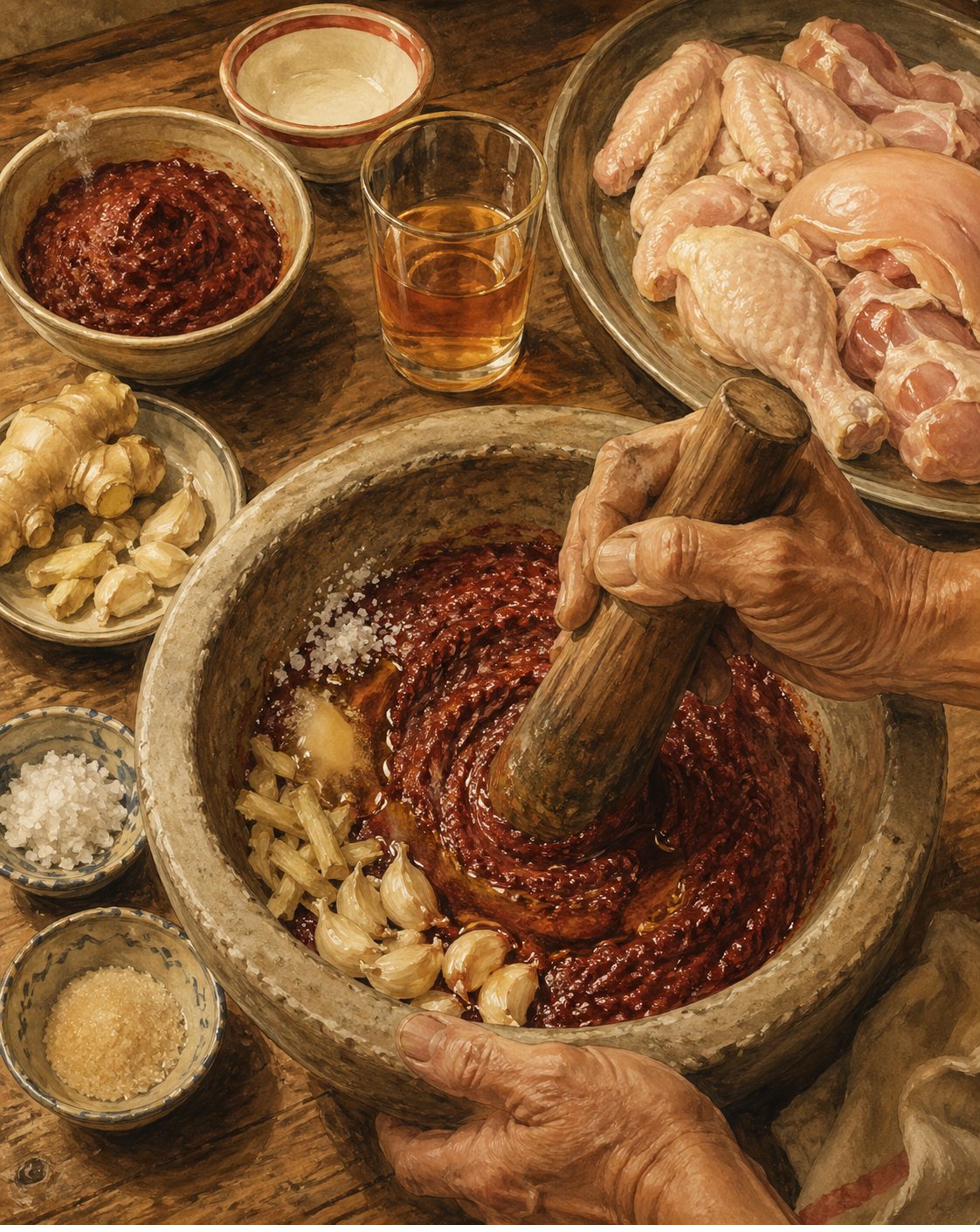
Combine all marinade-paste ingredients in a heavy stoneware mortar. Work the mixture with a wooden pestle in slow circular motions for 3–5 minutes — the paste will visibly transform from grainy-rough to silky-glossy as the ang chao releases its bound aromatic compounds.
The paste should be thick enough to coat a wooden spoon back without dripping, but loose enough to spread evenly onto chicken skin. If too thick, add 1 tablespoon more Foochow red rice wine. If too thin, add 1 tablespoon more ang chao.
Lacquer the Chicken the cartouche moment — MARINATE
Pat the chicken pieces dry with paper towels. Wet skin will not hold the paste.
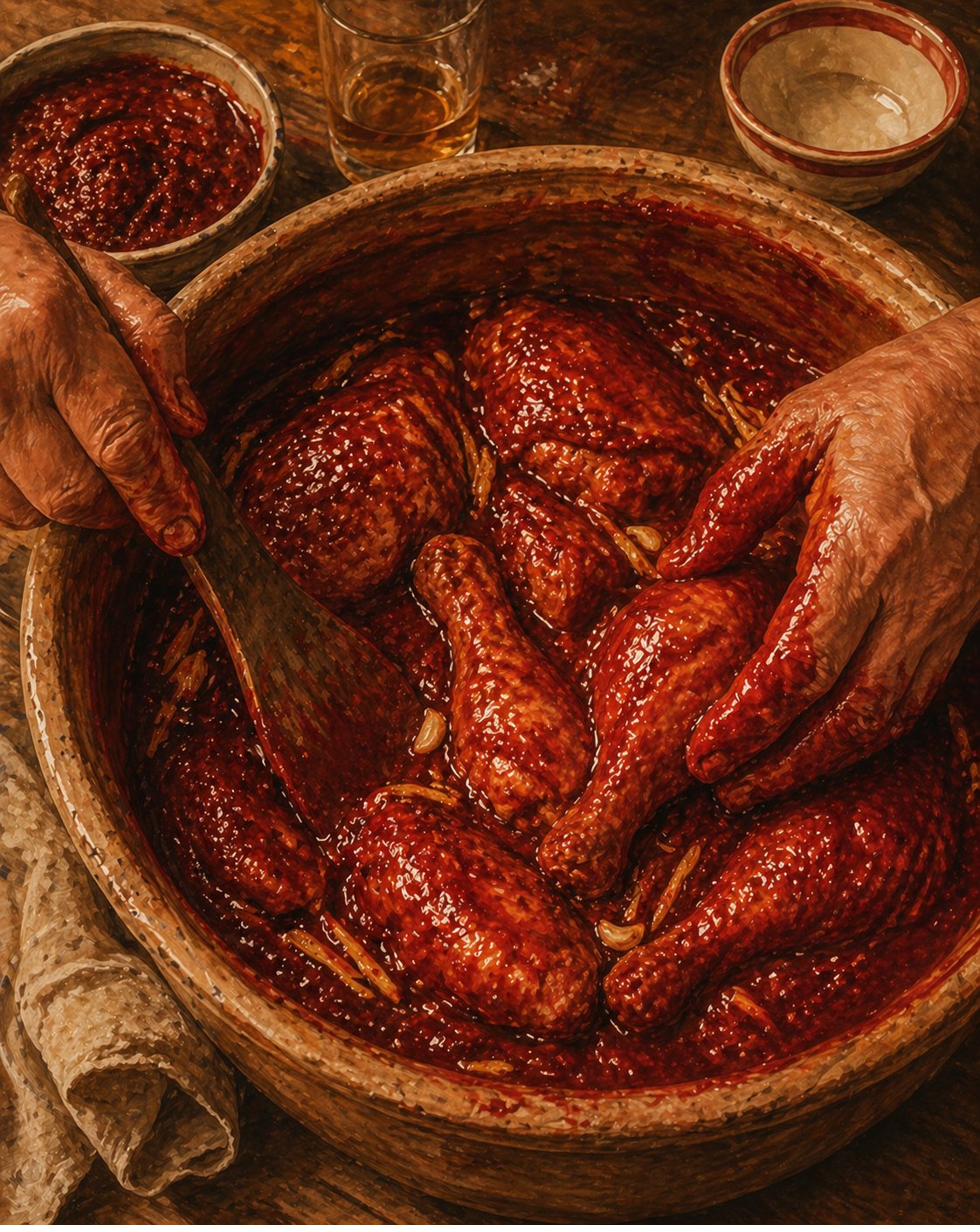
Working in a heavy unglazed earthenware urn or a deep ceramic bowl, place the chicken pieces in a single layer. Spoon a generous amount of the marinade paste onto each piece, then work the paste into every surface with your bare hands — the heritage way. Lift each piece, press paste underneath, turn it, press paste on top, work it into the cuts at the joints. Your fingers will stain dark-rose. Reportedly the heritage Sibu cooks call this kih chao — "loving the paste in" — and Auntie Lim used to say you cannot rush it.
When every piece is fully coated, the chicken should be visibly half-submerged in the remaining paste pool. Top up with additional ang chao and 1 tablespoon more Foochow red rice wine if the paste depth looks shallow — you want the lower halves of the chicken pieces sitting in paste-bath while the upper halves are surface-coated.
The Rest 24 hours — the dish is the time
Cover the urn with a clean muslin cloth (lets air in, blocks light — the rest is not refrigerated, but it must be cool). Place in the coolest part of your kitchen, away from direct sunlight. Rest 24 hours.
This is the only step that matters. The 24-hour rest is what differentiates the Foochow form from any short-marinade approximation. The ang chao paste's fermented compounds penetrate the chicken slowly through the skin and into the outer 1 cm of the meat, staining the flesh warm-rose at the edges and depositing the deep-fermented umami into the bone-in structure. The rest cannot be shortened. 12 hours is half a dish. 6 hours is a marinade. Only at 24 hours does the paste-penetration reach the depth that the heritage form requires.
Reportedly the Sibu-Foochow grandmothers rest the chicken for 36 hours when serving for weddings, and 48 hours for funerals. The longer the rest, the deeper the paste penetration, and the more the dish carries the weight of the occasion.
If your kitchen is warmer than 22 °C (most Singapore kitchens are), shorten the rest to 18 hours and refrigerate for the remaining 6. The cool-rest principle holds; the time-temperature trade is acceptable.
Steam to Set the Lacquer
After the 24-hour rest, lift the chicken pieces from the urn one at a time. Do NOT scrape off the clinging paste — the surface paste is the lacquer.
Set up a heritage round bamboo steamer over a wok of simmering water (5 cm deep). Arrange the lacquered chicken pieces on the bamboo-mat lining of the steamer in a single layer, NOT overlapping. Spoon over a thin additional layer of the resting-pool paste from the urn.
Cover the steamer. Steam over gentle simmer (NOT rolling boil) for 25 minutes. The gentle steam sets the lacquer onto the chicken skin and cooks the meat through without rendering the paste off. A rolling boil will wash the paste off and dilute the lacquer.
After 25 minutes, lift the lid. The lacquer should be glossy, deep-mahogany-rose, fully set. The bone-in pieces should be cooked through (74 °C / 165 °F internal). Lift the steamer off the wok and let the chicken rest in the steamer with the lid off for 10 minutes — the residual heat finishes everything.
Cool, Slice, Plate the heritage banquet presentation
Let the steamed chicken cool completely to room temperature. This takes about 1 hour. The lacquer fully sets at room temperature and slices cleanly only when cool — slicing while hot tears the lacquer off. Patience again.
Once cool, transfer the chicken pieces to a heavy wooden chopping block. Use a sharp Foochow cleaver to slice each piece across the bone into 1 cm-thick slices. The cleaver must be sharp — a dull cleaver crushes the lacquer. Each slice will reveal:
- The deep-mahogany-rose lacquered skin at the outer edge
- The warm-rose-stained meat where the paste has penetrated through 24 hours of rest
- The clean pale bone-edge at the centre, the heritage cross-section punctuation
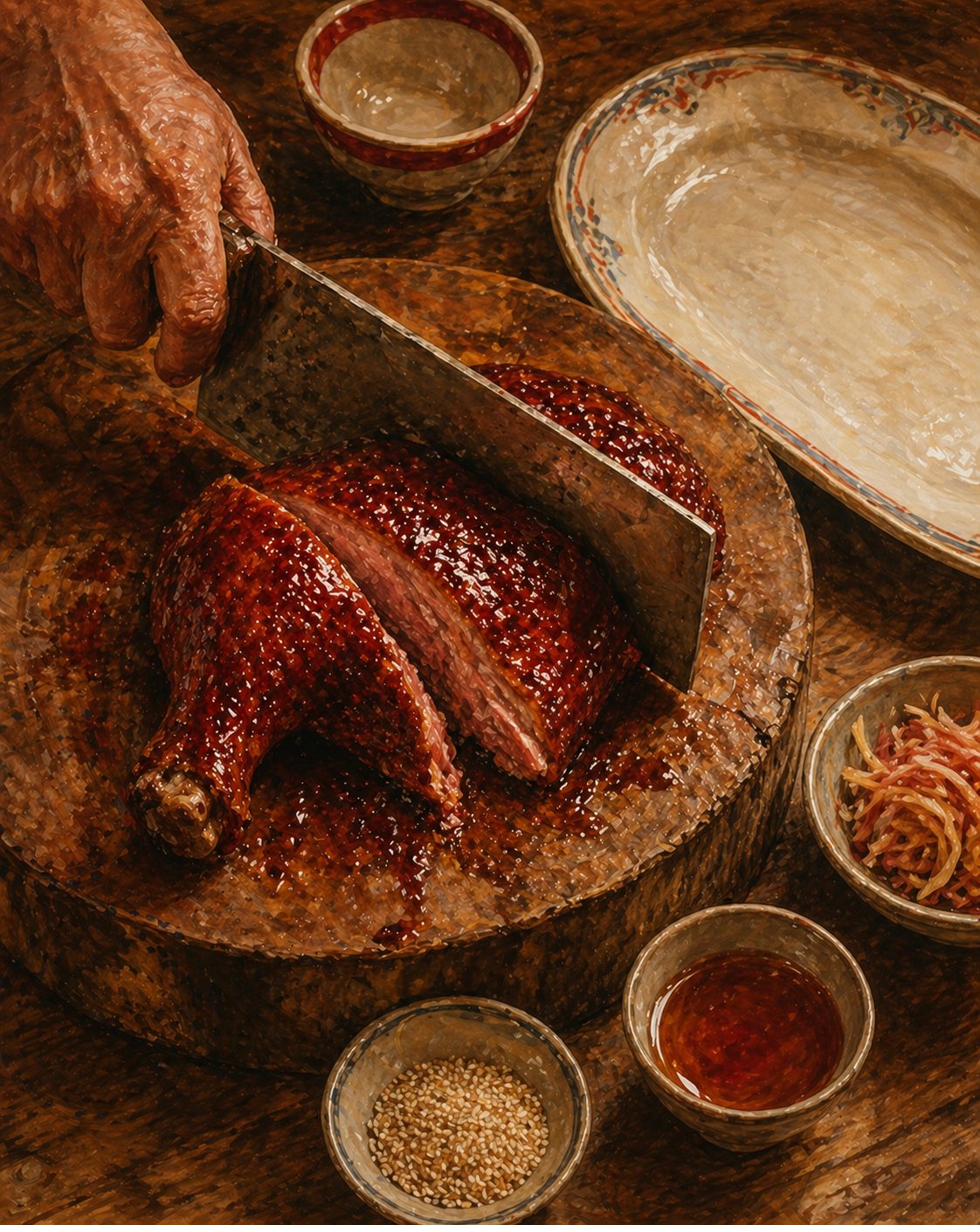
Arrange the slices in overlapping fan patterns along the length of a long oblong heritage Foochow porcelain platter. Spoon some of the resting-pool paste over the arranged slices as a sauce-bed — the paste should pool generously around the chicken, glossy and thick. Garnish with toasted sesame seeds, fine spring-onion-green slivers, pickled ginger slivers, and a final scatter of fresh coriander leaf.
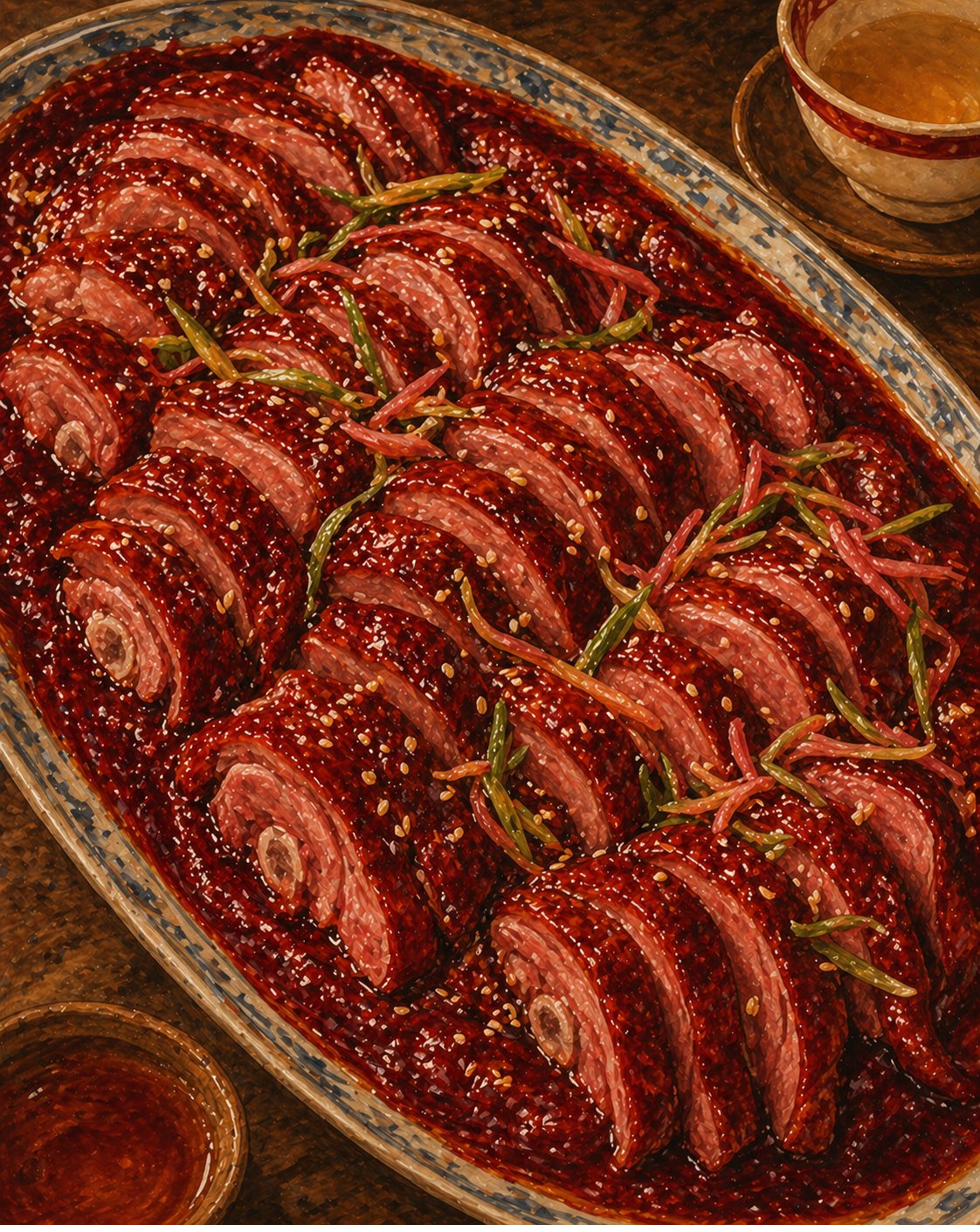
Serve at room temperature with small dishes of additional Foochow red rice wine and light soy sauce on the side. The diner drizzles a teaspoon of wine across their portion at the table — the fresh wine's amber-rose lifts the matured paste's burgundy depth.
🎯The Three Tips
Heritage. Master's. Mistake.
🏛 Heritage Note
The Dish Predates the Migration
Foochow ang chao kay is documented across the diaspora as a wedding-tea-ceremony, reunion-dinner, and ancestral-worship dish. The form predates the Foochow migration to Sibu in 1901 — it is one of the dishes my mother's family made in the same way her grandmother's family made it in Fuzhou before they left China.
For young hawkers thinking about Foochow restaurants: this dish is the closer. Most Singapore Foochow heritage restaurants serve it as the final course of a banquet menu, plated cold and brought out to be shared. Reportedly the surviving Singapore-Foochow family restaurants — Seow Choon Hua at Sultan Gate among them — keep ang chao chicken on the menu year-round but make it in larger quantities for Lunar New Year reunion-dinner bookings. The dish does not scale to high-volume hawker service for the same reason R34 doesn't: the 24-hour rest is uncompromisable, and that constrains daily output.
For home cooks: this is the dish you cook for the people who matter. Make it for an anniversary, a graduation, a homecoming, the first meal in a new house, the last meal before someone moves overseas. The 24-hour rest gives you a day to think about who you are cooking for.
👨🍳 Master's Tip
The 24-Hour Rest Is The Recipe
There is exactly one technique that separates this dish from any approximation:
The chicken must rest in the paste for 24 hours, cool but not refrigerated for the first 18 hours. The slow cool-temperature paste-penetration is what:
- Stains the meat warm-rose at the edges. The visible cross-section reveal that the cold-sliced platter depends on. Less than 18 hours and you get surface-coloured skin only — the meat stays pale.
- Develops the fermented-umami depth. The ang chao's bound compounds release slowly at cool room temperature; refrigeration slows the release further than the dish wants. The first 18 hours at room temperature do the heavy work; the final 6 hours can be cold-stored if your kitchen is too warm.
- Sets the lacquer texture. A 24-hour-rested chicken steams to a different lacquer than a short-rested one — thicker, glossier, holds its shape when sliced cold.
As noted above, the heritage Sibu wedding and funeral forms rest the chicken longer still — the principle holds: longer rest, deeper dish, weightier occasion. Whatever your rest time, do not shorten it. The dish IS the time.
⚠ Common Mistake
Three Failure Modes
Confusing this dish with Shanghai drunken chicken. Shanghai zuijī (Shaoxing yellow wine, poached, pale-amber) and Foochow ang chao kay (red yeast rice paste, lacquered, deep-rose) are entirely different dishes. The internet conflates them under the English "drunken chicken" — do not be fooled by the shared English name. If you find a recipe calling for Shaoxing yellow wine and no ang chao, that is the Shanghai form, not the Foochow.
Slicing while still warm. The lacquer fully sets only at room temperature. Slicing hot chicken tears the lacquer off and the cross-section ends up ragged instead of clean. Cool to room temperature fully before slicing — about 1 hour. If you need to chill the platter further before service, do it AFTER slicing, not before.
Boiling the steam-water instead of simmering. The steam-set stage in Stage 4 must be a gentle simmer. Rolling boil produces aggressive steam that washes the paste off the chicken and dilutes the lacquer into watery sauce. Gentle simmer always — small bubbles only, no rolling.
📈 Scaling for Banquet and Restaurant Service
This is a banquet dish, not a hawker dish
For Singapore Foochow heritage restaurants and family-run banquet kitchens: most serve 30–60 portions a day during ordinary service, scaling to 200–400 portions for Lunar New Year reunion-dinner peak. The 24-hour rest constrains daily output — the kitchen must run a 24-hour-ahead inventory of resting urns. Reportedly the surviving Singapore Foochow family restaurants keep three or four large unglazed-clay marinade urns on a rolling rest schedule throughout the year.
Cost (Singapore 2026): per platter (serving 6) ~SGD 32 (chicken 18 + ang chao paste 6 + Foochow red rice wine 4 + sesame oil and aromatics 2 + condiments and garnish 2). Sells SGD 78–95 at heritage restaurants for the 6-portion platter. Margin: 60–65%.
For home cooks: scale the recipe directly. One whole bone-in chicken serves 6–8 at a banquet, 4 as a main. The paste quantities scale proportionally; the rest time stays at 24 hours regardless of volume. The dish does not get easier at scale. It just gets bigger.
For wedding-or-reunion-dinner volume at home (serving 20+): use multiple urns on the same rest schedule rather than one giant urn. The paste-coverage-to-chicken ratio should stay constant. Reportedly the heritage Sibu cooks rotate three medium urns rather than one large one for Lunar New Year — easier to handle, easier to inspect, easier to lift onto the steamer.
This is the last dish I am going to give you. Cook it slowly. Cook it for the people who matter. The cooking takes a day. Most of that day is waiting. While you wait, think about who is coming. Think about what they have walked away from to come to your table. Think about whether you want them to come back. Then slice the chicken cold, set it on the platter, and bring it out. You do not need to say anything when you bring out this dish. The dish has already said it for you.