Foochow Razor Clams

If you want to learn how to cook razor clams properly, you have to start by learning how to BUY them properly. And for that, you need a good Ah Sou at the wet market.
Razor clams — zhúchēng (竹蛏, "bamboo clam") in Mandarin, cheng in the Foochow tongue — are one of the great gifts of the Fujian coast. The Foochow homeland is a coastal province; Fujian's intertidal mudflats are the world's primary razor-clam fishery. Razor-clam harvest from coastal Fujian mudflats is documented as a major food fishery across Chinese culinary-heritage and natural-history sources. The Nassau Weekly's heritage essay on Fujianese coastal life captures the cultural weight of the clam in the dialect homeland. The Foochow phrase for the coastal way of life — kih dik-iong, "begging the ocean" — captures the thing exactly. Some begged the small ocean for crabs, scallops, and clams; some threw themselves into the big ocean for years; reportedly by the mid-1980s, more than seven million Fujianese lived abroad — a diaspora big enough to fill another New York City.
The Foochows brought the dish to Sibu, to Sitiawan, and eventually to Singapore. Ah Sou Tiong, the auntie who taught me how to choose razor clams properly, ran a shellfish stall at Tekka Wet Market for over thirty years. She came down from Sitiawan in the early 1970s and set up her stall around 1973. Her father, reportedly, had been a clam farmer in Sitiawan before the Emergency, and his father before him had farmed clams in Fujian itself. By the time I met her in the late 1970s, she could pick a sand-empty clam by sight in three seconds — a skill it took me eight years to half-learn.
The dish has two parallel-heritage forms in the Singapore region:
- Foochow standard (Sitiawan, Sibu, Singapore): the version I will give you. Steamed plain with ginger matchsticks and Shaoxing wine, finished with a hot-oil-and-spring-onion dousing. The lightest, cleanest expression — the heritage form Foochow grandmothers serve at family meals.
- Reportedly the Xinghua / Henghua variant (Putian-origin): a similar steamed-razor-clam dish from the Min Bei dialect group, which has its own small Singapore community and its own restaurants. The Xinghua dialect branched from Min Nan more than a thousand years ago, and the Xinghua razor-clam tradition shares the steaming-method core but diverges in dousing style and finishing aromatics.
A third variation — steamed-on-glass-vermicelli — is sometimes cited as Cantonese-Foochow shared territory. Hong Kong stalls do it; some Singapore zi char restaurants do it. Heritage Foochow grandmothers, reportedly, do not.
What makes razor clams special — beyond the clean briny-sweet flavour — is that the dish rewards patience at the wet market more than at the stove. Cooking is fast and forgiving (eight minutes total). Buying is slow and unforgiving. Get a sand-full clam and the dish is ruined; no purging time can fix what the clam never expelled. Ah Sou Tiong's rule: "Take only the ones that move when you tap the shell. The dead ones are dead, the half-dead ones cheat you, the live ones tell you everything."
This recipe sits as the palette-rest moment of the Foochow chapter — the dish before the closing-payoff drunken chicken. Light, clean, fast. After R31's broth-discipline, R32's deep-fry, and R33's red-yeast-rice braise, R34 is the breath. Eat it on a hot afternoon with cold beer.
🛒Ingredients
Live clams, salted-water purge, single-layer steam, hot-oil dousing. The buying is the skill; the cooking is the breath.
For the Clams
| Live razor clams | 600 g (about 12 medium clams) | Buy from a reputable wet-market stall, NEVER frozen if you can help it. The clams should respond to a tap on the shell — that is the heritage live-clam test. Frozen razor clams work as a last resort but lose half the dish's character. |
For Purging
| Cold water | enough to cover the clams | |
| Coarse sea salt | 30 g per litre of water | Roughly seawater concentration — the heritage trick to encourage the clam to purge faster. |
For the Steamer Bed the bamboo-steamer base
| Fresh ginger, peeled, in thin matchsticks | 30 g | |
| Spring onion (white and pale-green parts only), in thin slivers | 2 stalks |
For the Dousing
| Toasted sesame oil | 1 tbsp | |
| Neutral oil (peanut, sunflower, or rice bran) | 3 tbsp | |
| Fresh ginger, peeled, in thin matchsticks second batch | 30 g | The topping batch. |
| Spring onion (green tops only), in thin slivers | 3 stalks | |
| Shaoxing wine | 2 tbsp | NOT Foochow red rice wine — this is a different dish, a different wine. |
| Light soy sauce | 1 tbsp | |
| White sugar | ½ tsp |
🌶️Shifu's Lift
choose one path — see "Shifu's Secret" chapter for the philosophy- Old-school path: ¼ tsp MSG dissolved in 1 tsp Shaoxing, drizzled over the clams before steaming
- Modern hawker path: ½ tsp chicken stock powder dissolved in the steamer-water beneath the basket
- Heritage purist path: reportedly the Sitiawan grandmothers add 1 piece of dried sole fish (ti po) to the steamer water below the basket — the steam carries a faint umami note up through the bamboo without crowding the clean clam flavour. If you have ti po on hand from the R31 broth pantry, use it.
For Finishing
| Fresh coriander leaf (jade-green) | a scattering | |
| Additional Shaoxing wine | a small dish on the side | For the diner to drizzle to taste. |
| Light soy sauce | a small saucer with a small spoon |
👨🍳Method
Six stages. Buy, purge, set the steamer, steam, douse, serve. The 30-degree gape is the doneness.
Buy the Clams Properly the dish's true skill
Before you cook anything, you have to buy the right clams. Heritage rules from Ah Sou Tiong:
- The shell must be intact. No cracks, no chips. A broken shell means a dead or damaged clam.
- The foot-tip must respond. Tap the shell with your fingernail. A live clam will retract its foot-tip slightly. A dead clam does nothing.
- The shell must close. Open shells that don't close back when touched are dead. Discard.
- The smell must be clean ocean, not fish-counter funk. Razor clams should smell like brine and seaweed, never like ammonia or sulphur.
Reject any clam that fails any of these tests. A few clams fail one of these checks even at a good stall — a careful eye is non-negotiable.
Purge the Clams non-negotiable
Razor clams burrow in mudflats. They contain sand. Skip the purge and the dish is ruined.
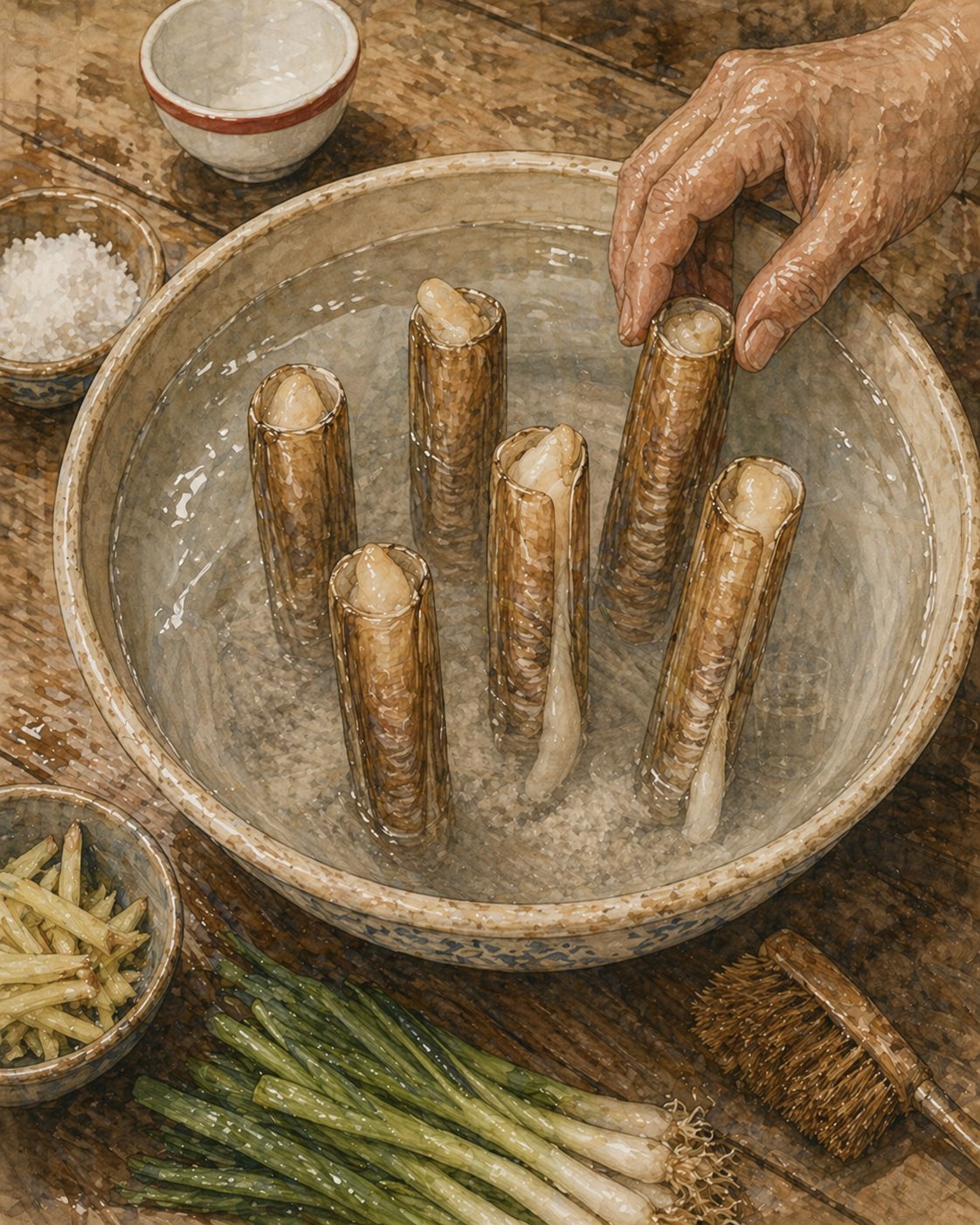
In a wide shallow ceramic basin, mix cold water with coarse sea salt at roughly seawater concentration (30 g salt per litre of water). The salinity tricks the clam into thinking it is still in the ocean, encouraging it to expel sand and grit through its siphons.
Stand the live clams upright in the basin, wider open ends facing up, foot-tips down. This is the heritage purging posture — it lets the sand fall out of the foot end and the clean siphons remain at the top.
Cover the basin loosely with a clean cloth (lets air in, blocks light — clams purge better in the dark). Leave 1 hour minimum, ideally 90 minutes. A faint cloud of pale-grey grit will settle at the bottom of the basin — that is the sand the clams have expelled.
After purging, lift the clams out gently (do NOT pour the basin out from above — the sand will flow back over the clams). Rinse each clam under cold running water. Brush any visible mud off the shells with a small bamboo brush.
Set the Steamer
Set up a heritage round bamboo steamer over a wok or wide pot. Add water to the wok beneath — about 5 cm deep. Bring the water to a steady gentle boil over medium-high heat. The steam should rise actively but not violently.
Inside the bamboo steamer, scatter the first batch of ginger matchsticks and spring-onion slivers across the bamboo-mat lining as a steamer bed. The aromatics under the clams flavour them through the steam.
Arrange the cleaned razor clams on top of the aromatic bed in a single layer, fanned out radially with their open ends pointing toward the centre of the steamer. Do NOT crowd them — uneven contact with the steam means uneven cooking.
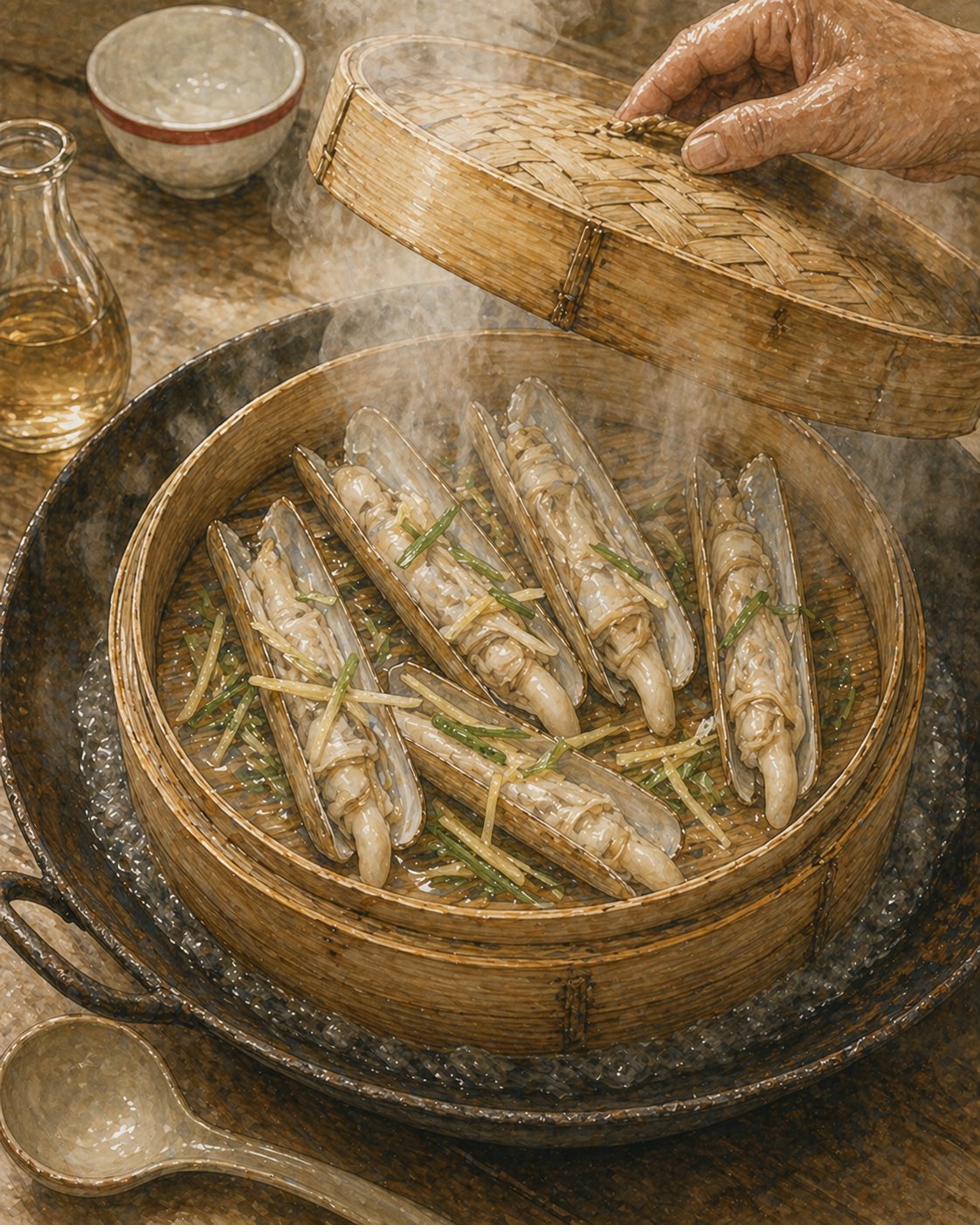
Cover the steamer with its lid. Steam 5–7 minutes, depending on clam size. Watch the lid for the first sign of a tell-tale change in steam pattern (the clams releasing their liquor changes the steam slightly).
The Doneness Cue
Lift the lid carefully. The clams are done the moment their shells gape open about 30 degrees. The meat should be plump and just-set, NOT shrivelled, NOT raw-translucent.
If a few clams haven't opened yet, replace the lid and steam another 1 minute. If a clam refuses to open after 8 minutes total, discard it — that one was already dead before steaming.
The Dousing the cartouche-completion
Lift the bamboo steamer off the wok and set it on a heat-safe surface.
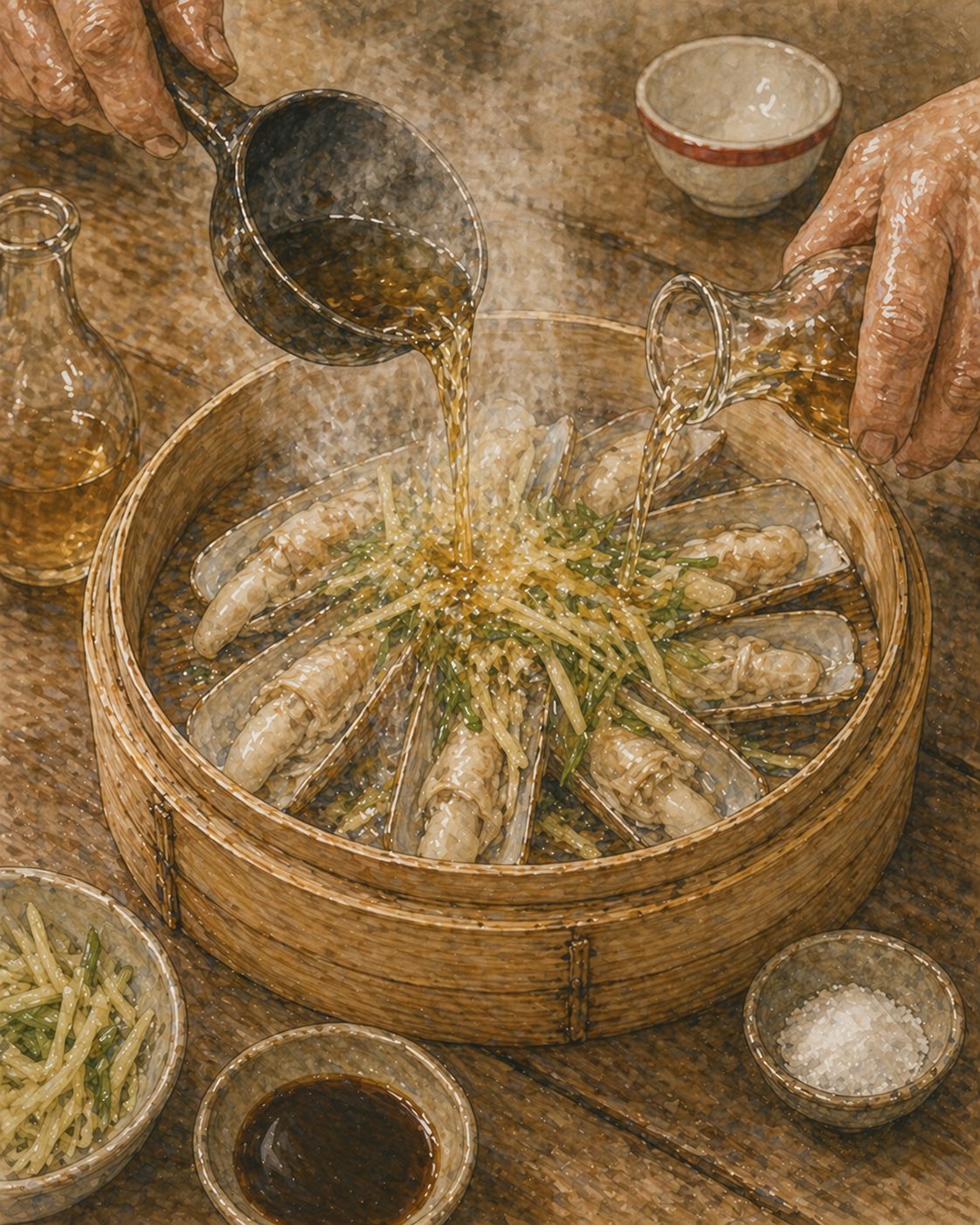
In a small heavy pan, heat the toasted sesame oil and neutral oil together over medium-high heat until the oil shimmers and the surface ripples — about 1 minute. Add the second batch of ginger matchsticks and the spring-onion green-top slivers. The aromatics will sizzle furiously for 15–20 seconds — pull the pan off the heat the moment the ginger turns translucent.
Working fast: pour the hot ginger-and-spring-onion oil DIRECTLY OVER the open clams in the steamer. The oil will sizzle dramatically as it meets the clams and their liquor — that is the dousing moment.
Immediately follow with a drizzle of Shaoxing wine, light soy sauce, and a pinch of sugar across the clams. The Shaoxing carries the dish's signature aromatic finish.
Serve
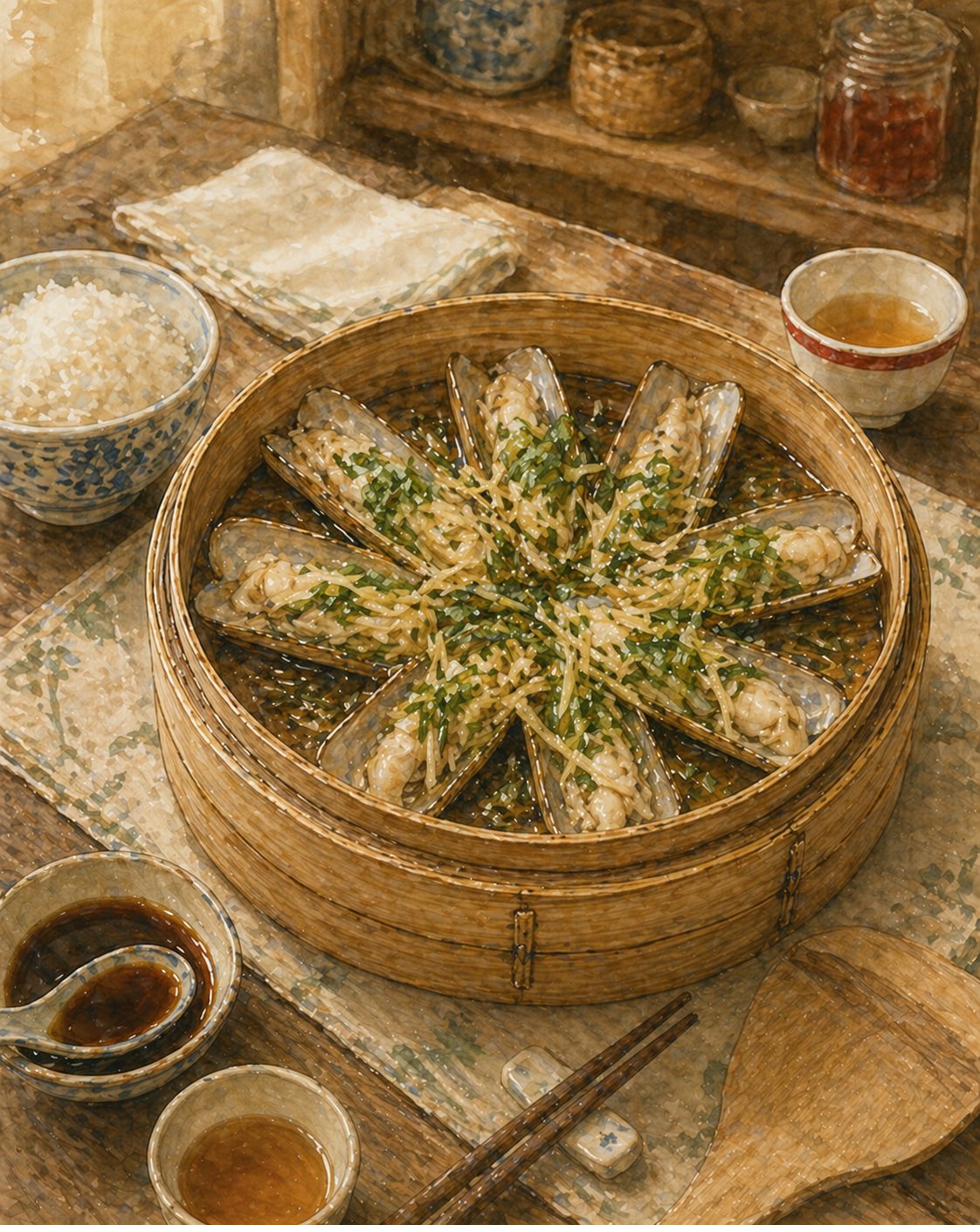
Transfer the bamboo steamer directly to the table — the steamer IS the serving vessel. Scatter fresh coriander leaf across the top as the heritage finishing touch. Serve with white jasmine rice, a small saucer of light soy sauce on the side, and a small dish of additional Shaoxing wine for diners who want to drizzle more at the table.
Eat with chopsticks: lift each clam from its open shell, sliding the meat out with the tip of the shell or with a small bamboo paddle. Sip the clam liquor pooled in the bottom of the steamer last — that is the best part.
🎯The Three Tips
Heritage. Master's. Mistake.
🏛 Heritage Note
The Fujian Coast and the Tekka Stalls
Razor clams have been a Fujian coastal staple for centuries. The intertidal mudflats of Fujian and neighbouring Zhejiang are the primary razor-clam fisheries of East Asia; reportedly the species Sinonovacula constricta is the dominant Chinese razor clam, distinct from the European species fished in Scotland and Spain.
In the Singapore region, the dish travelled through the Foochow diaspora alongside fishball soup and red-wine chicken. Tekka Wet Market in Little India and the Chinatown Complex Wet Market at 335 Smith Street are the documented heritage stalls for live razor clams in Singapore — both still operating, both still selling live clams in the morning hours. Ah Sou Tiong's stall at Tekka was one of perhaps four or five Foochow-run shellfish stalls in the city in the 1970s. Reportedly fewer than two of those original stalls survive under second-generation ownership today.
For young hawkers thinking about steamed razor clams: the dish does not scale well for stalls. Razor clams are perishable, expensive, and demand the buying-skill described above. They appear at Singapore zi char restaurants and at occasional heritage Foochow restaurants, but not at hawker stalls in any meaningful volume. Make it at home; eat it within an hour of buying the clams.
👨🍳 Master's Tip
The 30-Degree Gape
The doneness cue for steamed razor clams is one of the cleanest in all of Foochow cooking: the shell gapes open about 30 degrees from its closed position.
Closed shells = under-done. Steam another minute.
30-degree gape = perfectly cooked. Lift the lid, douse, serve.
Fully splayed-open shells with shrivelled meat = over-cooked. The dish is salvageable but not at its peak.
The whole steam takes 5–7 minutes. Watch the steam pattern through the bamboo lid — the moment the steam pattern shifts from steady to slightly irregular, the clams are releasing their liquor and you are 30 seconds from done.
The other heritage discipline: the dousing must be FAST. Hot oil cools quickly. Once the oil is heated and the aromatics have sizzled, you have about 20 seconds to pour over the clams. Slow dousing means greasy clams instead of fragrant ones.
⚠ Common Mistake
Three Failure Modes
Skipping the purge. Sand in razor clams ruins everything. The heritage minimum is 1 hour in salted water with the clams standing upright. There is no shortcut.
Over-crowding the steamer. If the clams overlap or sit in two layers, the bottom ones over-cook and the top ones under-cook. Single layer always. If you have more clams than fit, steam in two batches.
Using Foochow red rice wine instead of Shaoxing for the dousing. This is the most common cross-recipe confusion, especially after readers have made R33. Foochow red rice wine (rose-amber, sweet) is for the chicken-mee-sua. Shaoxing wine (pale-amber, dry-savoury) is for the razor clams. The wines are not interchangeable in this dish — Foochow red rice wine's sweetness clashes with the clean briny clam flavour.
📈 Scaling for Hawker Service
This dish does not scale to hawker service in any practical way
Live razor clams are expensive (S$25–35/kg at Singapore wet markets, 2026), perishable (8–12 hours of life out of seawater), and demand the buying-skill described above. A hawker stall doing 80–150 plates a day cannot economically run a daily live-clam supply. The dish appears at Singapore zi char restaurants and at heritage Foochow / Hokkien-Foochow restaurants, where it sells SGD 24–38 a portion (6 clams). Cost per portion (Singapore 2026) ~SGD 9.50 (clams 7.50 + aromatics 0.80 + oil and condiments 0.50 + ti po if used 0.70). Margin: 60–70%, but the volume cap is severe — most restaurants sell fewer than 30 portions a day.
For a heritage Foochow restaurant aiming to keep the dish authentic: build a relationship with one trusted wet-market stall, place a daily standing order in the morning, refuse old stock. Reportedly the surviving Singapore Foochow restaurants (mostly small, often family-run) all source from Tekka or Chinatown Complex.
For home cooks, the dish is genuinely worth the skill investment. It is fast, light, and cheap-by-restaurant-standards (a S$25 portion at a restaurant costs S$15 in ingredients at home). Make it for visitors. Make it on a hot afternoon. Make it the dish you cook when you don't want to cook.
The cooking of razor clams is eight minutes. The buying of razor clams is forty years. Ah Sou Tiong taught me that the best stalls don't shout — the best stalls have aunties who watch the clams move and know which ones are lying. If you cannot find an Ah Sou Tiong, do not cook this dish. Buy something else. The dish is only as good as the clams, and the clams are only as good as the woman who picks them.