Foochow Litchi Pork
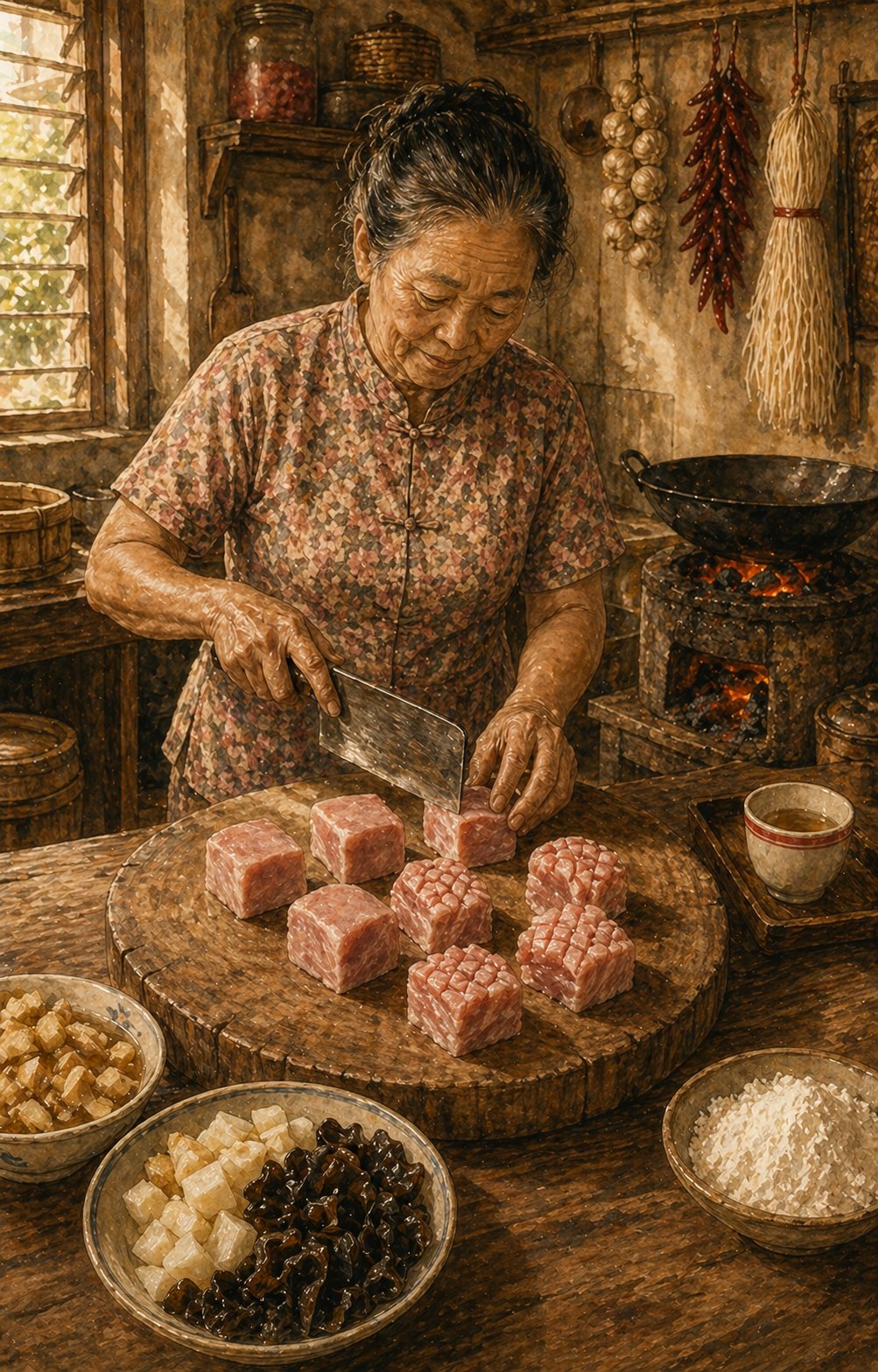
This dish is older than my grandfather. I learned it not from Sai Sook in Chinatown, but from my Auntie Lim in Sibu, when I went up to visit cousins one summer in the 1970s.
Litchi pork — lìzhī ròu in Mandarin, liĕk-chiĕ-nṳ̆k in the Foochow tongue — is one of the great old dishes of Fujian province, particularly associated with Fuzhou and Putian. The dish's Fujian-Fuzhou origin is documented in TasteAtlas, Wikipedia, and The World of Chinese; the earliest reliable written record appears in the Qing-dynasty cookbook Suiyuan Shidan by Yuan Mei.
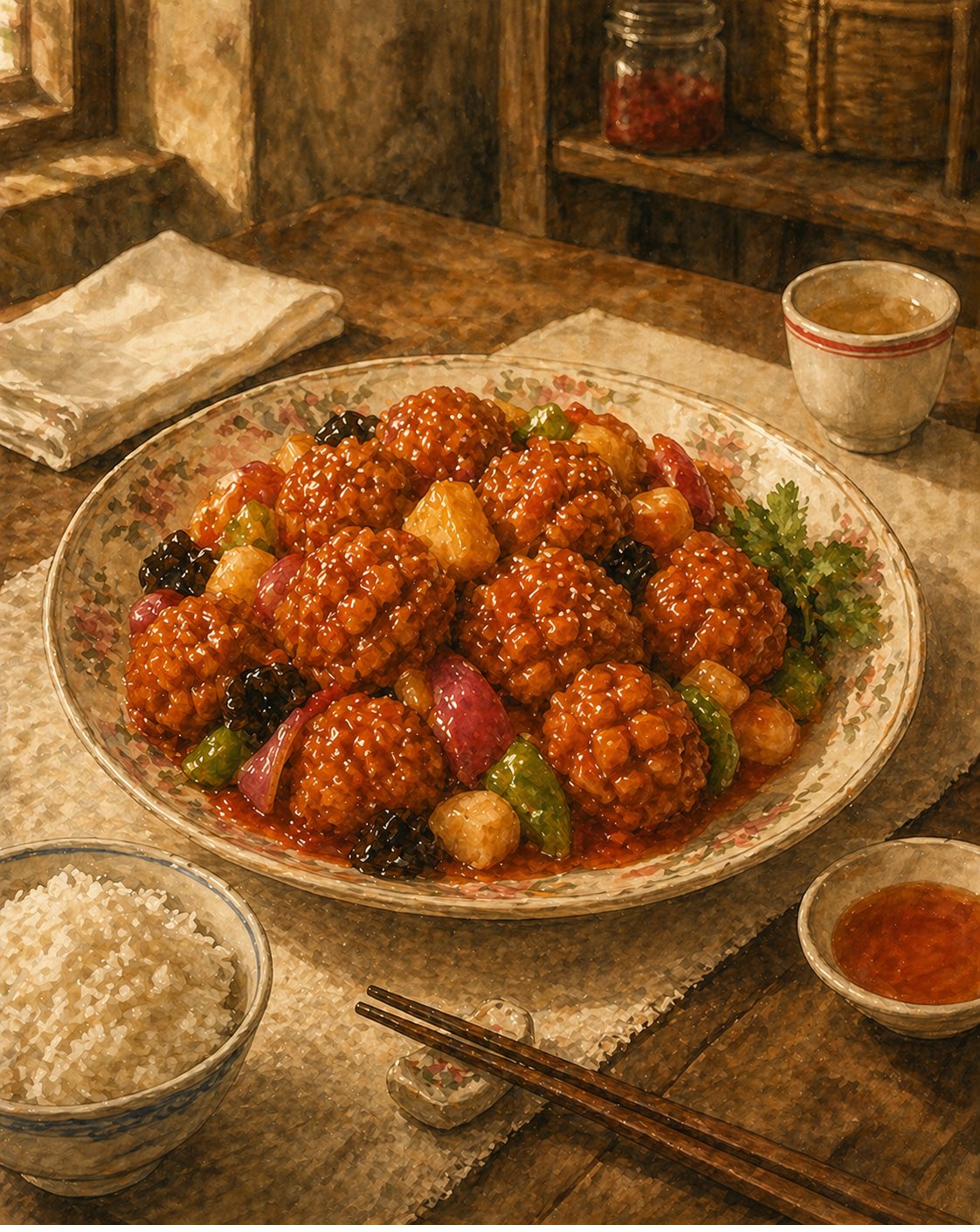
The name puzzles people who eat it for the first time. There is no lychee fruit in this dish. The name comes from how the pork looks after frying — small cubes of pork shoulder, cross-hatch-scored before cooking, that bloom open in hot oil so the cut facets curl outward into bumpy nubs that resemble the textured skin of a lychee. Reportedly an origin legend ties the dish to a Tang-dynasty consort named Mei from Putian; the legend is widely refuted by scholars including the writer Lu Xun, who considered Consort Mei fictional. The legend is colourful and persistent in food writing, but the verifiable record begins with Yuan Mei's Qing-dynasty cookbook — that is the safer anchor for the dish's pedigree.
The dish has two parallel-heritage forms:
- Singapore-Foochow homestyle: sweet-sour orange-red glaze made with rice vinegar, tomato paste, sugar, and bone broth — the version I will give you here. The colour comes from the tomato.
- Fujian-mainland banquet form: ang chao (红糟, red-yeast-rice paste) glaze. The colour comes from the red yeast rice. Closer to what cooks in Fuzhou itself would serve.
In Singapore, the Foochow community is small — most of our country's Foochows came down from Sibu in Sarawak or Sitiawan in Perak in the 1960s and 70s, looking for work or family. Auntie Lim was the first cook who showed me how to score the pork properly. She used pork shoulder, not loin, because shoulder has the marbling that keeps the cubes juicy when they bloom. She used tomato paste and rice vinegar, not red yeast rice — the Sibu way. Reportedly about one in three home cooks today uses pork tenderloin out of convenience; the result is dry, fibrous, and the cubes don't bloom right. The shoulder is the cut. Don't shortcut.
🛒Ingredients
Pork shoulder, deep cross-hatch, two-fry, sweet-sour glaze. The knife is more important than the wok.
For the Pork
| Pork shoulder | 600 g, in 3 cm × 3 cm cubes | NOT pork tenderloin (too lean — won't bloom into the lychee shape; will go dry). Pork shoulder is the heritage cut. |
Marinade
| Light soy sauce | 1 tbsp | |
| Shaoxing wine | 1 tbsp | |
| Egg white | 1 | |
| Cornflour | 1 tbsp | |
| White pepper | ½ tsp | |
| Salt | ½ tsp | |
| Sesame oil | 1 tsp |
Coating for the bloom
| Cornflour | 4 tbsp, in a shallow dish |
For the Sweet-Sour Glaze
| Tomato paste | 3 tbsp | Traditional Singapore-Foochow homestyle. Substitute: 4 tbsp ketchup if no tomato paste — slightly sweeter, slightly thinner. |
| Rice vinegar | 3 tbsp | Fujian xiangcu (香醋, aromatic vinegar) if you can find it; otherwise standard Chinese rice vinegar. |
| White sugar | 3 tbsp | |
| Light soy sauce | 1 tbsp | |
| Chicken or pork bone broth | 100 ml | Homemade is best; otherwise good-quality unsalted stock. |
| Cornflour slurry | 1 tsp cornflour + 1 tbsp water |
🌶️Shifu's Lift
choose one path — see "Shifu's Secret" chapter for the philosophy- Old-school path: ¼ tsp MSG in marinade
- Modern hawker path: ½ tsp chicken stock powder
- Heritage purist path: reportedly the Fujian-mainland banquet form gets its lift from 1 tbsp ang chao (red-yeast-rice paste) added to the glaze in place of 1 tbsp tomato paste — gives a deeper savoury-fermented note and the original heritage red-rose colour
Aromatics + Vegetables for the toss
| Water chestnuts | 80 g, peeled and quartered | The heritage aromatic — adds the cool sweet crunch that defines this dish. |
| Wood-ear mushroom (muk yi) | 10 g dried, soaked and torn into bite-sized pieces | |
| Fresh pineapple | 100 g, in 2 cm chunks | |
| Green capsicum | ½, in 2 cm chunks | |
| Red onion | ½ medium, in 2 cm chunks | |
| Garlic | 4 cloves, finely minced | |
| Fresh ginger | 1 thumb, finely minced |
For Frying + Finishing
| Neutral oil for deep-frying (peanut, sunflower, or rice bran) | 600 ml | |
| Toasted white sesame seeds | 1 tsp, for finishing | |
| Coriander sprig | for garnish |
👨🍳Method
Five stages. Score, marinate, two-fry, build glaze, toss. The cross-hatch is the dish.
Score the Pork the dish's signature
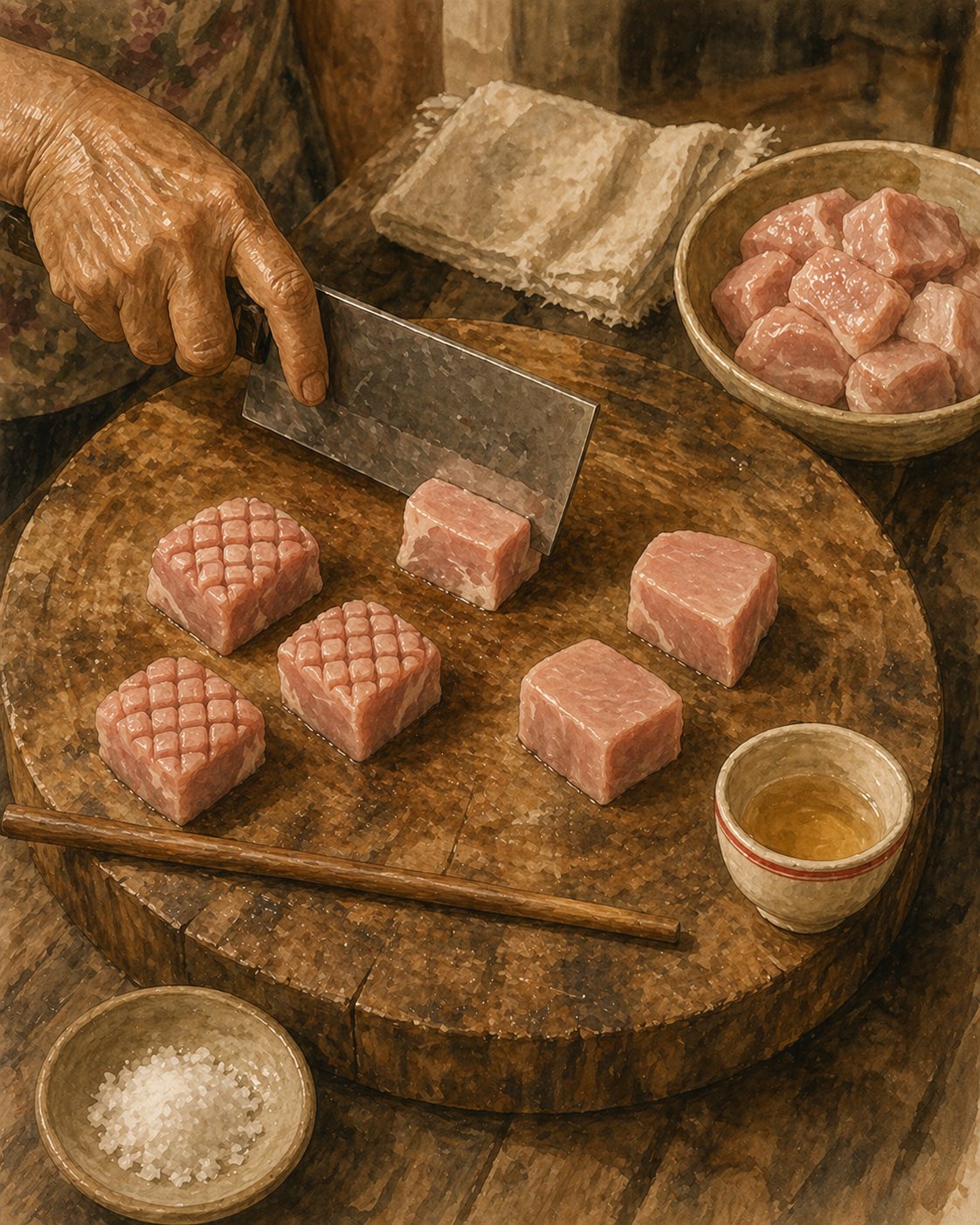
Cut the pork shoulder into 3 cm × 3 cm cubes. Lay one chopstick along each side of each cube as you score — this is Auntie Lim's depth guide. The chopstick stops your knife from cutting all the way through.
Score the upper face of each cube with a sharp cleaver:
- First, diagonal cuts going one way, about 5 mm apart, going two-thirds of the way through the meat (the chopstick guide stops you from going further).
- Then, perpendicular diagonal cuts going the other way, same depth, same spacing — forming a diamond grid pattern across the upper face.
Each cube should now look like a diamond-quilted cushion on its top surface. This is the cross-hatch that lets the cube bloom into the lychee shape during frying. Skip this step and you have ordinary fried pork.
Marinate
Combine all marinade ingredients in a bowl. Add the scored pork cubes, gently turning them by hand so the marinade gets into every cross-hatch cut. Cover and rest 30 minutes at room temperature, or up to 2 hours in the fridge.
The egg white + cornflour in the marinade gives the cubes a velvet protective layer that helps the bloom hold its shape during frying.
Coat and Fry — The Bloom
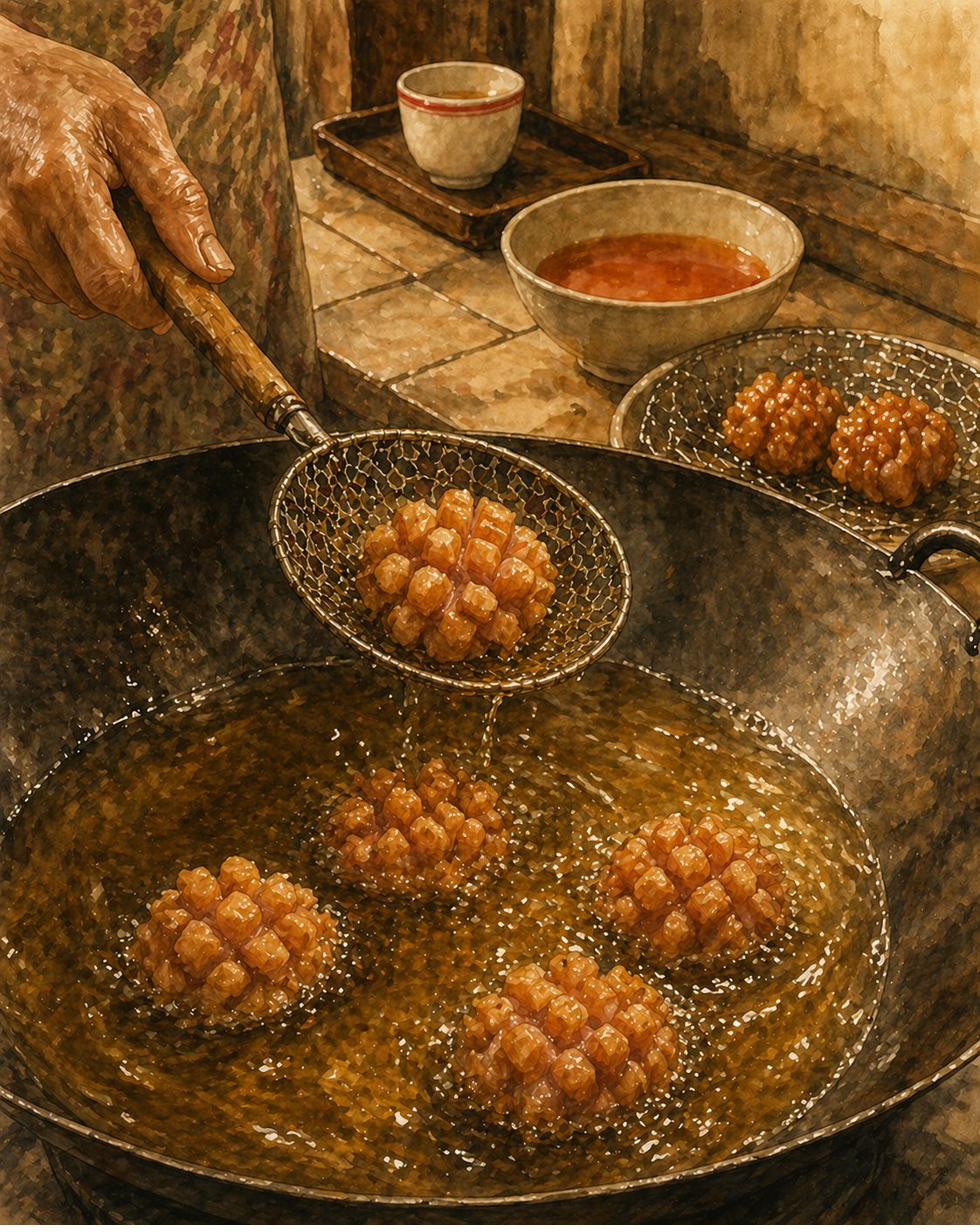
Heat the neutral oil in a heavy wok or deep pot to 170 °C / 340 °F. Test with a chopstick: small steady bubbles should rise around it.
Tip the marinated cubes into the dish of dry cornflour. Toss to coat each cube thoroughly — the cornflour should fill the cross-hatch cuts, not just sit on the surface. This is what makes the bloom crisp.
Lower the cubes into the hot oil one at a time, scored-face-down first. They will sink, then rise within 10 seconds. Fry for 3 minutes at 170 °C until pale-golden — at this point the cubes have set their shape but are not fully cooked.
Remove with a wire-mesh strainer to a wire rack. Rest 2 minutes.
Now raise the oil to 190 °C / 375 °F for the second fry.
Return the cubes to the hot oil for 45 seconds to 1 minute — the cross-hatch facets will open dramatically, the cube blooming outward into the bumpy nubbed shape that gives the dish its name. Watch carefully — this happens fast. The cubes are done when they are golden-mahogany, the cross-hatch facets crisp and open, and the cubes float high in the oil.
Lift to a wire rack to drain.
Build the Glaze
In a clean wok over medium heat, add 1 tbsp of the frying oil. Sauté the minced garlic and ginger until fragrant, about 30 seconds.
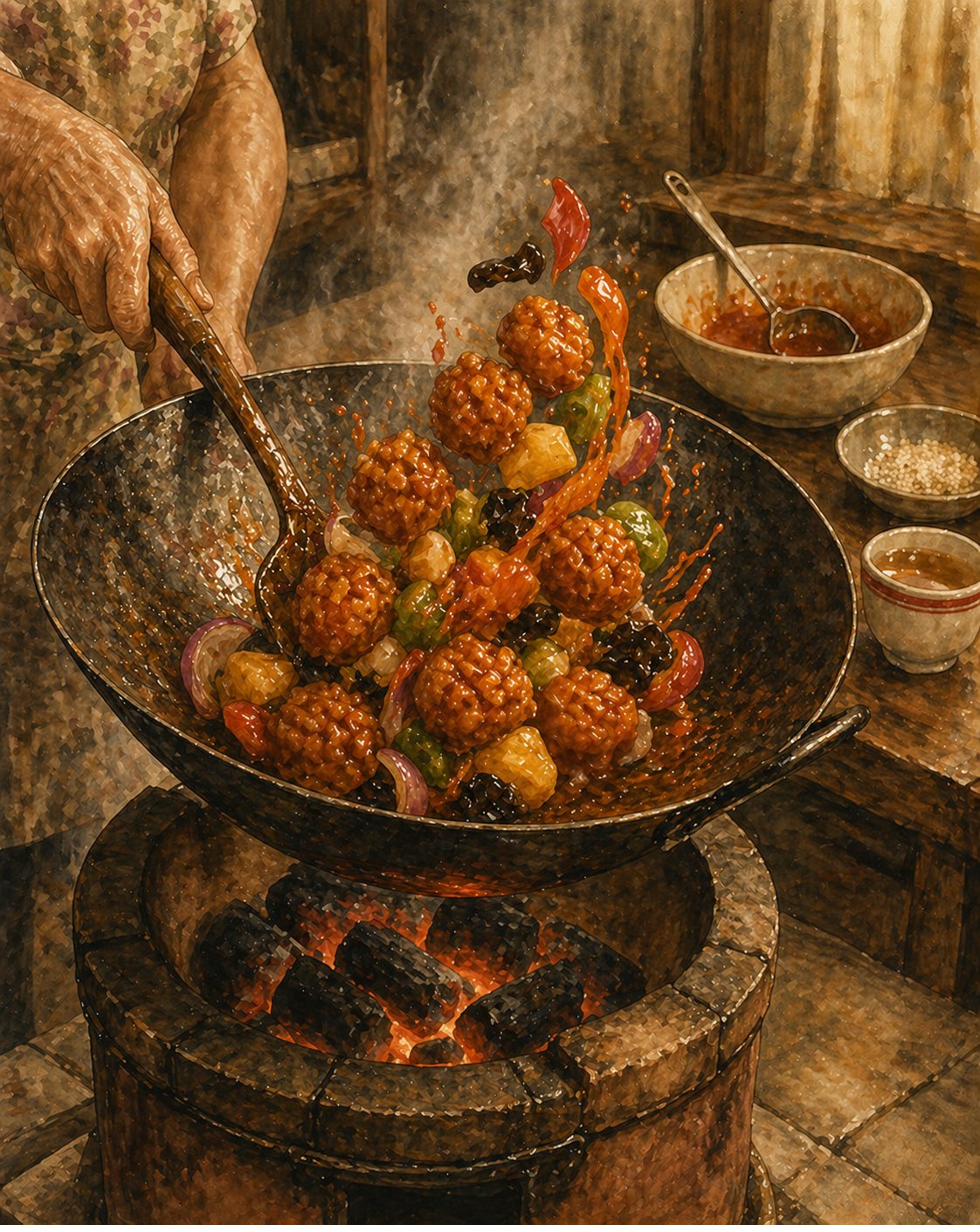
Add the red onion, water chestnuts, wood-ear, capsicum, and pineapple. Stir-fry 1 minute — keep them crisp.
Add the glaze ingredients: tomato paste, rice vinegar, sugar, soy sauce, broth. Bring to a simmer. Taste and adjust — the balance should be sweet-first, then sour, then savoury. If too sharp, add a pinch more sugar. If too flat, a splash more vinegar.
Drizzle in the cornflour slurry while stirring. The glaze will thicken and turn glossy in 15–20 seconds. Cut the heat the moment it reaches a thick syrupy coat — overcooked glaze turns gluey.
Toss and Serve
Turn the heat back to medium-high. Add the bloomed pork cubes to the wok with the glaze. Toss vigorously for 20 seconds — every cube must be coated, but no longer or the bloom softens.
Slide onto a heritage Chinese ceramic plate. Scatter toasted sesame seeds across the top. Lay a sprig of fresh coriander to one side. Serve immediately, with white jasmine rice on the side and a small saucer of additional dipping sauce.
🎯The Three Tips
Heritage. Master's. Mistake.
🏛 Heritage Note
The Verifiable Pedigree Begins With Yuan Mei
The dish predates Singapore's Foochow community by centuries. The earliest reliable written record is in Yuan Mei's Qing-dynasty cookbook Suiyuan Shidan, where the recipe calls for pork slices boiled in water, fried, then stewed in wine and soy sauce. The Tang-dynasty origin-legend involving Consort Mei is widely refuted by scholars and is best treated as folklore rather than history.
In Singapore, the dish travels through the Foochow diaspora — most often through Sibu (Sarawak) and Sitiawan (Perak) rather than direct migration from Fuzhou itself. Reportedly the Sibu-Sitiawan version uses tomato paste and rice vinegar (the version I have given you), while the Fujian-mainland banquet version uses ang chao as the colour-and-flavour anchor — both are heritage-acceptable, both are correct.
👨🍳 Master's Tip
The Two-Fry Bloom
The single technique that separates restaurant litchi pork from home-cook litchi pork is the two-fry:
1. First fry at 170 °C / 340 °F for 3 minutes — sets the shape, cooks the meat through. The cubes come out pale-golden, not yet bloomed.
2. Rest 2 minutes on a wire rack. Critical. The meat finishes cooking in the carry-over heat; the cross-hatch facets dry slightly so they hold the bloom.
3. Second fry at 190 °C / 375 °F for 45 seconds to 1 minute — the cubes bloom open, the facets crisp, the colour deepens to mahogany.
Skip the rest in step 2 and the bloom collapses. Single-fry at high heat and the outside burns before the inside cooks. Single-fry at low heat and the cubes go grey and limp. Two-fry, with the rest in between, is non-negotiable.
⚠ Common Mistake
The Cubes Don't Bloom
Three failure modes, all reportedly common in home kitchens:
Wrong cut of pork. Tenderloin doesn't have the marbling — the cubes go dry and the cross-hatch closes flat instead of opening. Pork shoulder is the cut. (About one in three home cooks gets this wrong, by Auntie Lim's count.)
Score too shallow. The cross-hatch must go two-thirds through the meat. Surface scratches give you a pretty pattern but no bloom — when the cube hits the oil, the cuts don't have enough depth to open. Use the chopstick depth guide.
Oil too cool for the second fry. If the oil is below 180 °C for the second fry, the cubes absorb oil instead of blooming. They come out greasy, soft, sad. Get the oil to 190 °C, fry fast, lift fast.
📈 Scaling for Hawker Service
For a Foochow stall doing 60–100 plates a day
Noting that full-time Foochow stalls are rare in Singapore — most Foochow dishes appear as one-of-many items in Chinese zi char menus or in family restaurants run by Sibu/Sitiawan-Foochow descendants.
- Pork prep: 8–10 kg pork shoulder cubed and scored daily, in the morning. The scoring is labour — about 2 hours for one cook with a sharp cleaver. Some stalls use a Lyoner-style cubing machine for the dicing, but the cross-hatch scoring is still done by hand. Cannot be skipped.
- Two-fry batches: first fry done in the morning in 1.5 kg batches; cubes parked on wire racks. Second fry done à la minute when the order comes in.
- Glaze: made in 2-litre batches in the morning, kept warm in a side wok. Refreshed mid-service if stocks run low.
- Cost (Singapore 2026): per plate ~SGD 3.20 (pork 1.80 + aromatics 0.60 + oil 0.40 + glaze 0.40). Sells SGD 9–14 standard, SGD 16–20 in mid-tier zi char restaurants. Margin: 60–70%.
Litchi pork is the dish where the knife is more important than the wok. If you cannot score the pork properly, no glaze will save you. If you can score it, the rest is just paying attention.