Hainanese Chicken Rice
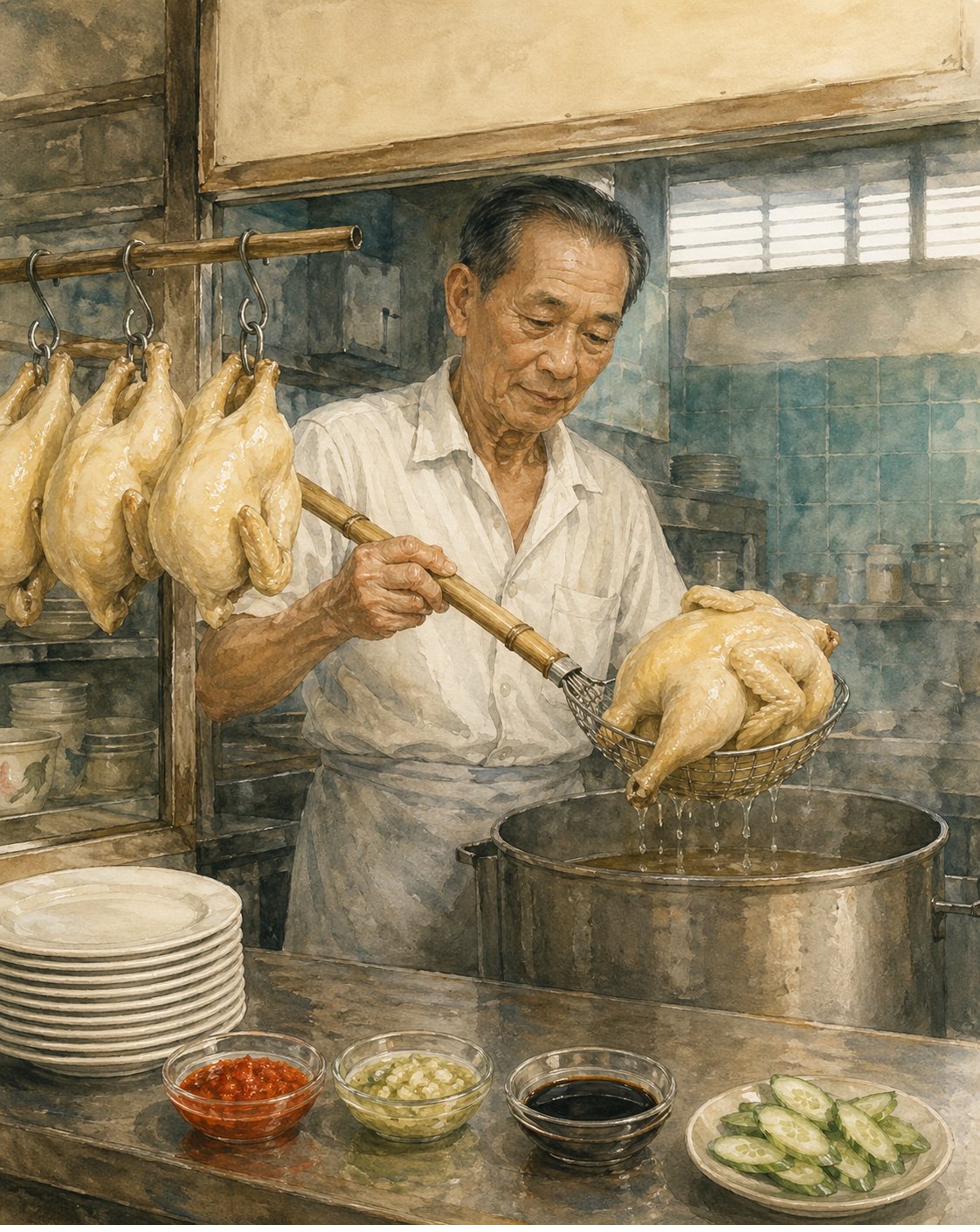
The dish that made Singapore famous around the world.
Hainanese chicken rice traces back to Wenchang chicken from Hainan island in southern China — a specific breed of free-range chicken fed coconut and peanut bran, then poached gently in salt water. Hainanese migrants brought the dish to Singapore in the early 1900s. The original Hainanese version was simple: poached chicken with white rice and a ginger-scallion dip.
The Singapore version evolved into something more elaborate:
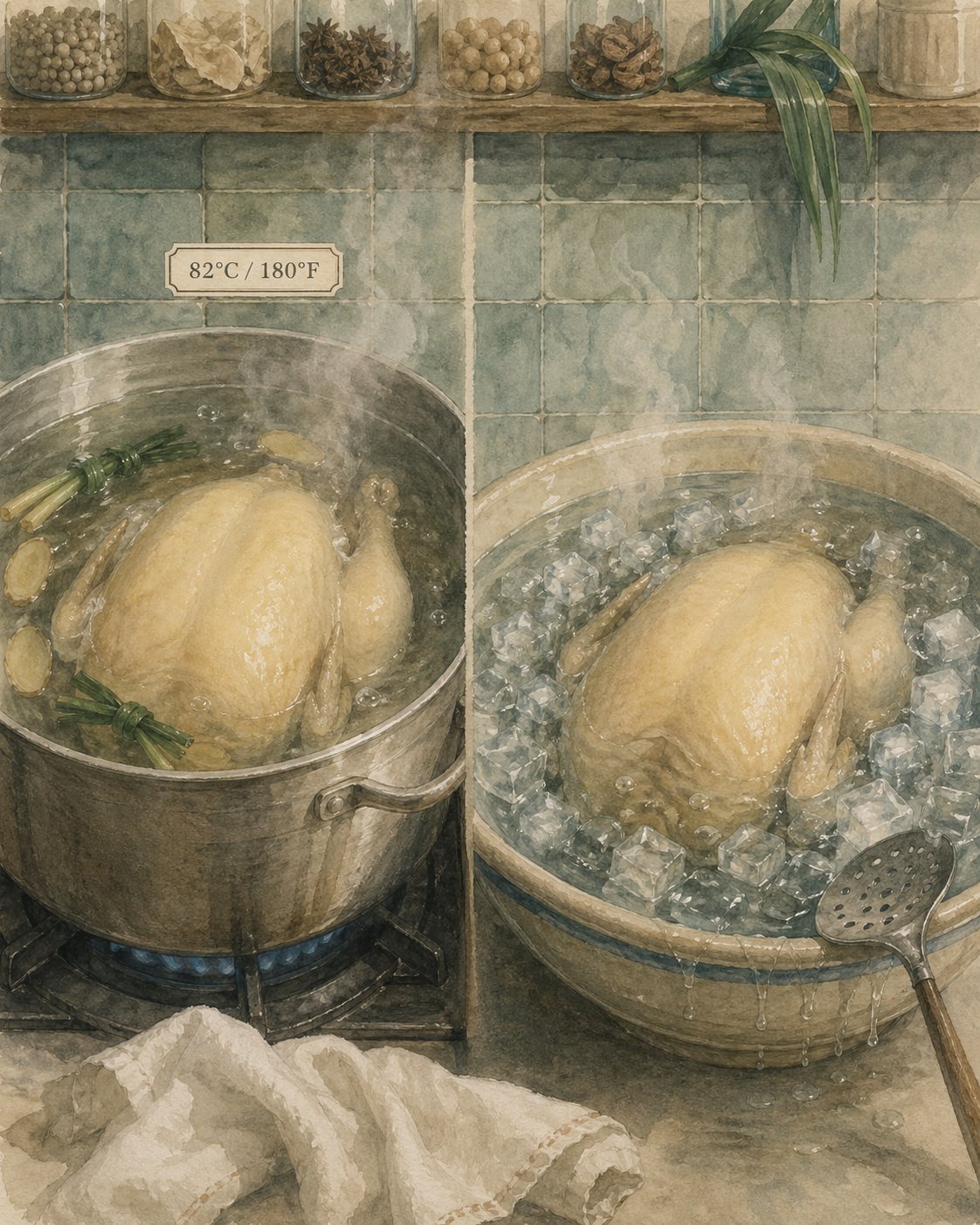
- Chicken poached gently at 82°C (sub-boiling) — for silky meat and gelatinous skin
- Ice bath shock to firm the skin (the heritage step)
- Rice cooked in chicken fat + chicken broth with garlic, ginger, pandan
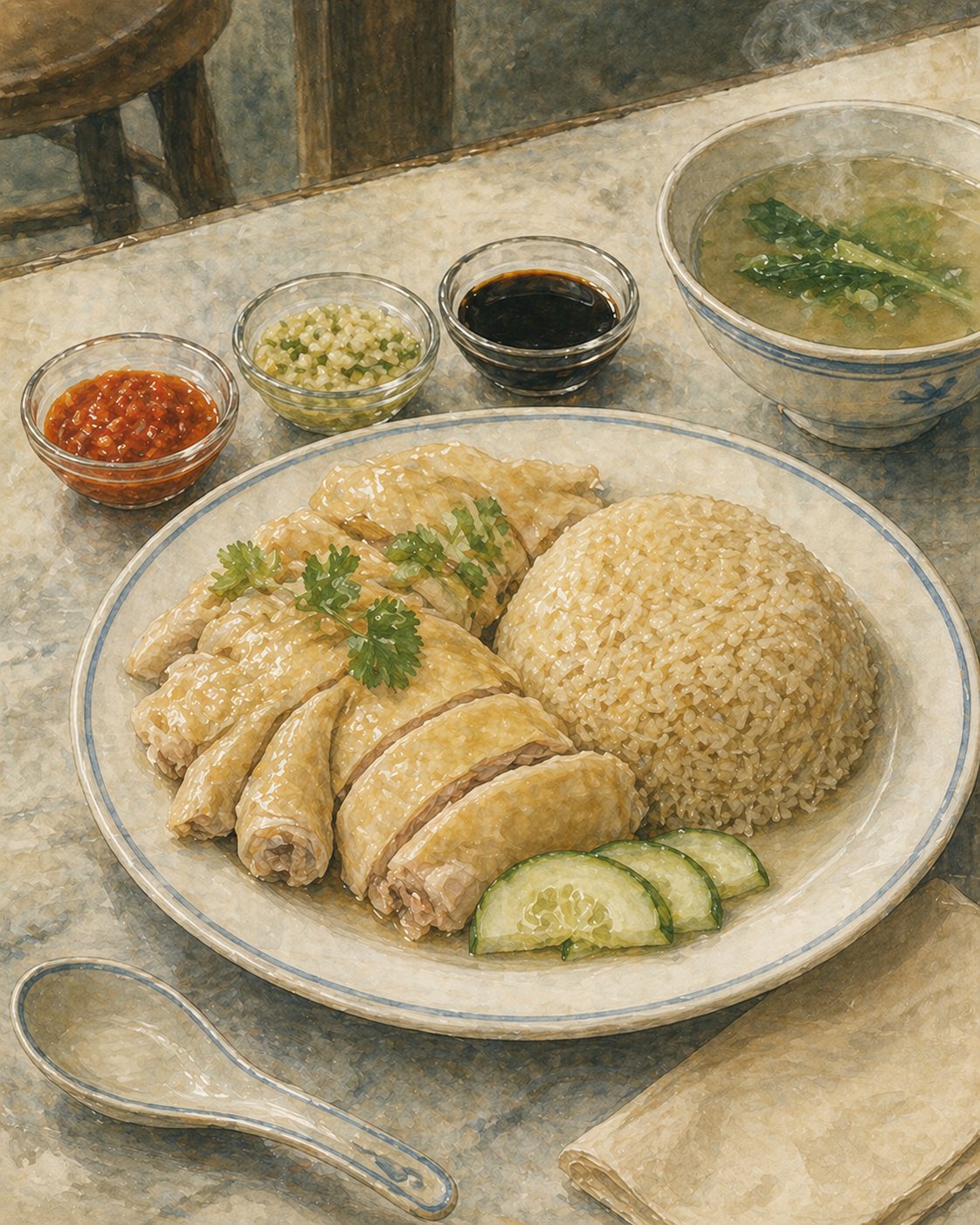
- Three sauces — chilli-garlic-lime, ginger-scallion, dark sweet soy
- Bowl of clear chicken soup on the side with chye sim (Chinese flowering cabbage) or wong nga bak (napa cabbage)
The dish became Singapore's most iconic — Tian Tian Hainanese Chicken Rice at Maxwell, Wee Nam Kee, Boon Tong Kee, Five Star, Sin Kee, Chatterbox are heritage names. Even the Michelin Guide has recognised hawker chicken rice.
This recipe is the traditional Hainanese-style poached version — what you'd get at Tian Tian or Wee Nam Kee. The roasted version (siu mei tradition) is different and not what we're making here.
🛒Ingredients
A whole chicken, a pot of fat-and-broth rice, three sauces. The cavity fat is gold — render it.
For the Chicken
| Whole chicken (free-range / kampong if possible) | 1 (1.5–1.8 kg) | Smaller bird poaches more evenly. Set aside the cavity fat — that's gold. |
| Coarse salt | 3 tbsp | For the salt rub. |
| Fresh ginger | 50 g | Lightly smashed. |
| Spring onions | 4 stalks | Knotted. |
| Garlic | 1 bulb | Smashed. |
Poaching Water
| Cold water | 4 L | |
| Salt | 2 tbsp | |
| Shaoxing wine | 1 tbsp | Optional. |
For the Rice
| Long-grain jasmine rice | 3 cups (~600 g) | Rinse 3 times until water runs clear. Drain. |
| Reserved chicken fat | all of it | Rendered. About 4–6 tbsp of liquid fat. |
| Garlic | 6 cloves | Finely minced. |
| Fresh ginger | 30 g | Finely minced. |
| Pandan leaves | 4, knotted | Heritage — the rice's signature aroma. |
| Reserved chicken poaching broth | 4 cups (~1 L) | |
| Salt | ½ tsp |
Sauce 1 — Chilli-Garlic-Lime essential
| Red chillies, deseeded | 6 | |
| Garlic | 3 cloves | |
| Ginger | 20 g | |
| Lime juice (or calamansi) | 2 tbsp | |
| Hot chicken broth | 4 tbsp | |
| Salt | 1 tsp | |
| Sugar | 2 tsp | |
| White rice vinegar | 1 tbsp | Blend all together. Should be sharp, gingery, lifted by lime. |
Sauce 2 — Ginger-Scallion
| Ginger, finely minced | 50 g | |
| Spring onions (white parts), finely chopped | 4 | |
| Salt | ½ tsp | |
| Neutral oil | 4 tbsp | Heat to smoking with sesame oil and pour over. |
| Sesame oil | 1 tbsp |
Sauce 3 — Dark Sweet Soy
| Dark soy sauce | 2 tbsp | |
| Light soy sauce | 1 tbsp | |
| Sugar | 1 tsp | |
| Sesame oil | 1 tsp |
To Serve
| Sliced cucumber | ½ small | Peeled, half-moons. |
| Clear chicken soup with chye sim and white pepper | a bowl | |
| Coriander sprigs | to taste |
🌶️Shifu's Lift
choose one path — see "Shifu's Secret" chapter for the philosophy- Old-school path: 1 tsp MSG in the poaching water (this is the heritage hawker truth)
- Modern hawker path: 2 tsp chicken stock powder
- Heritage purist path: Use the chicken's natural sweetness from a quality kampong bird; no additives
👨🍳Method
Seven stages. Sub-boiling poach + ice bath = silky meat, gelatinous skin. The two heritage techniques.
Prep the Chicken
Remove the chicken from the fridge 1 hour before cooking to come to room temperature.
Reach into the cavity and pull out the lump of fat (usually 60–80 g near the tail). Set aside in a small bowl.
Rinse chicken inside and out. Rub all over with 3 tbsp coarse salt — like exfoliating. This removes loose skin and smells. Rinse thoroughly. Pat dry.
Stuff the cavity with: smashed ginger + knotted spring onions + smashed garlic.
Render the Chicken Fat
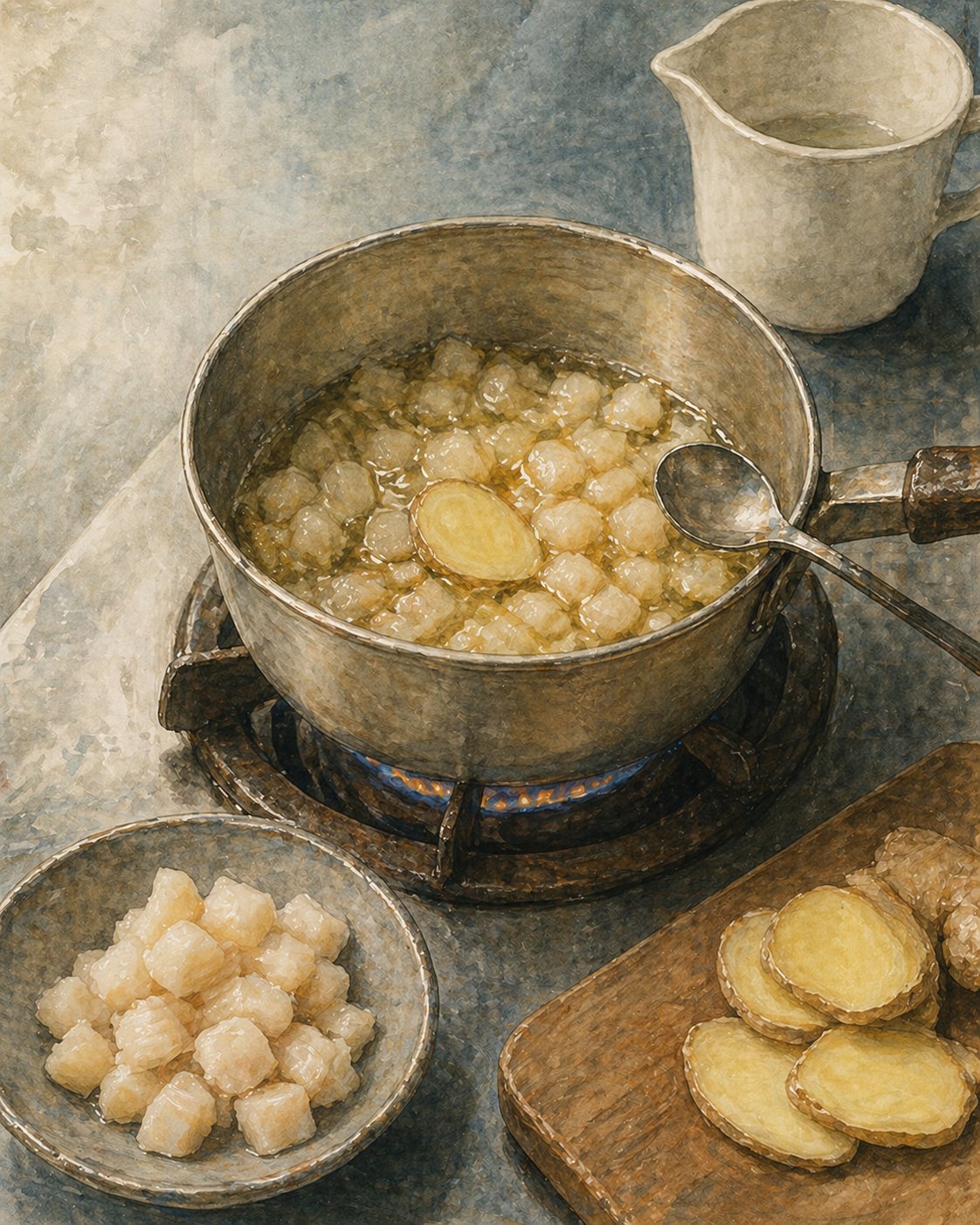
Cube the reserved fat. Place in a small saucepan with 2 tbsp water and 1 slice ginger. Cook on lowest heat until the fat slowly melts (about 30 minutes). Strain. You should have ~4–6 tbsp of pure liquid chicken fat. Reserve.
The Gentle Poach
In a large stockpot, bring 4 litres of water to a rolling boil with 2 tbsp salt + Shaoxing wine + a few extra ginger slices and spring onions.
Lower the heat to a bare simmer — water should be steaming but not bubbling. Aim for 82°C / 180°F. This is the heritage standard.
Carefully lower the chicken in breast-side up. Use a ladle to spoon hot water through the cavity 3 times to ensure the inside cooks. The water level should just barely cover the chicken; if not, add boiling water from a kettle.
Important: keep heat low so water stays sub-boiling. If it bubbles hard, the meat tightens and the skin tears.
Poach for 45 minutes for a 1.5 kg bird, 50–55 minutes for 1.8 kg.
Test for doneness: lift the chicken, tilt to drain juices from cavity. Pierce thickest part of thigh with a chopstick. Juices should run clear-yellow, not pink.
The Ice Bath
Prepare a large bowl with ice water (with extra ice cubes ready).
When chicken is done, lift it out gently (use a slotted spoon under the cavity to support it). Drain water from the cavity over the pot.
Plunge into ice bath, fully submerged, for 15 minutes. This is non-negotiable — it stops cooking, firms the skin, gives that signature jelly-like skin texture.
Reserve the poaching broth — this is now your chicken broth for rice and soup.
After ice bath: lift out, pat dry. Rub all over with 1 tsp sesame oil and a splash of light soy sauce. This gives the skin its glossy sheen. Set aside on a plate.
Cook the Rice — The Hainanese Method
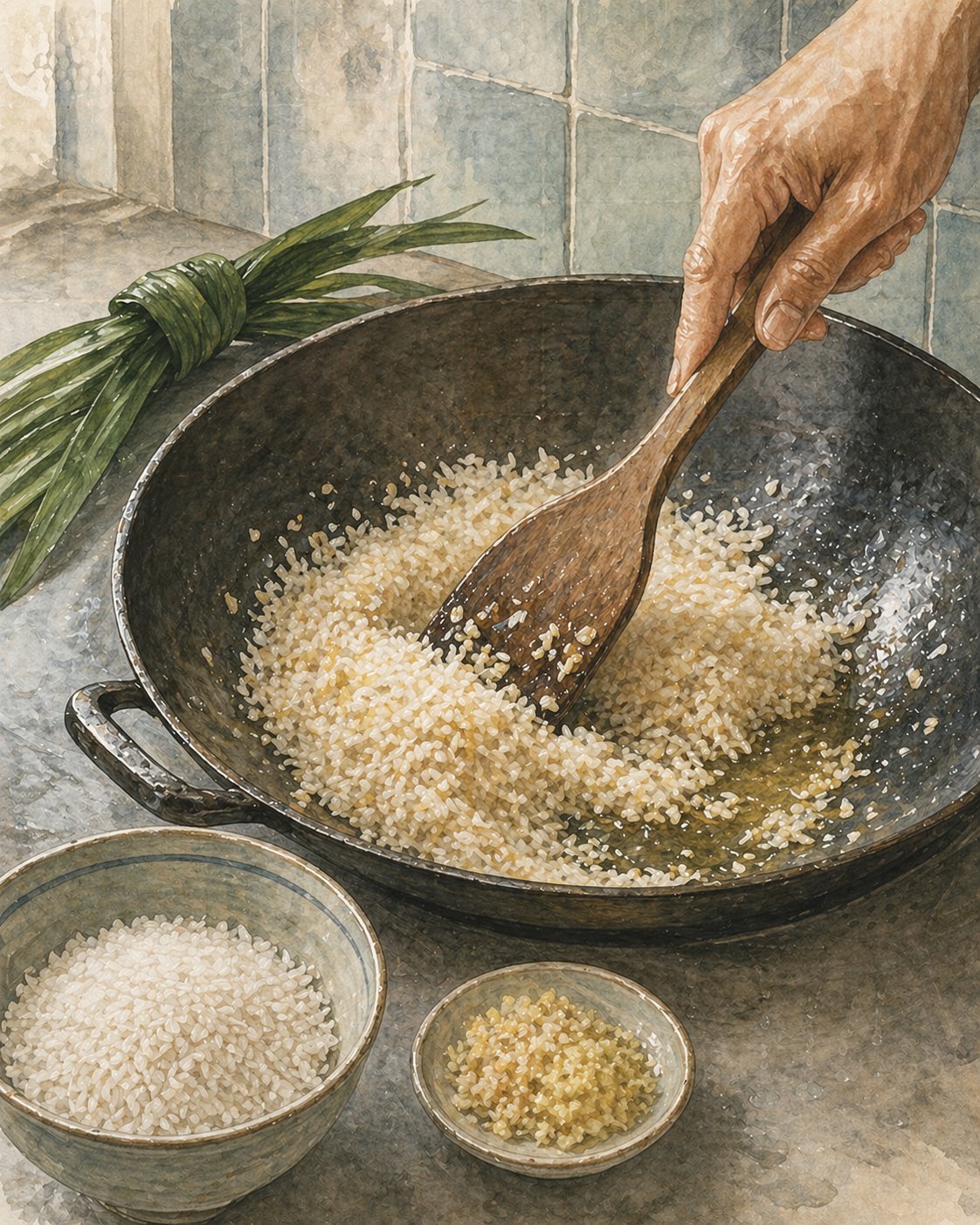
Heat a wok or pot over medium heat. Add all the rendered chicken fat. When hot, add minced garlic and ginger. Stir-fry 3 minutes until golden and fragrant. This is the foundation aroma.
Add the rinsed and drained jasmine rice. Stir-fry for 3 minutes to coat every grain in the chicken-fat-garlic-ginger mixture. The rice should turn slightly translucent at the edges.
Transfer rice mixture to a rice cooker. Add 4 cups of strained chicken broth + ½ tsp salt + knotted pandan leaves.
Cook on standard rice setting. When done, let stand 10 minutes covered before fluffing.
Make the Three Sauces
(See ingredients section above for each.) Blend, mix, prepare. Set out in three small bowls per plate.
Carve and Plate
Place the rested chicken on a chopping board. Use a heavy cleaver:
- Cut off the legs at the joints
- Cut off the wings at the joints
- Halve the chicken along the spine
- Cut each half into 2 cm-wide cross-sections through the bone (heritage Cantonese chopping style)
Arrange chicken pieces neatly on a platter, bone-in pieces angled to show the meat.
Per serving plate: mound rice on one side, 4–6 chicken pieces on the other, cucumber half-moons garnish, three small dipping bowls of sauces.
Serve with a small bowl of clear chicken soup (clarify the leftover broth, season with salt, white pepper, chopped chye sim).
🎯The Three Tips
Heritage. Master's. Mistake.
🏛 Heritage Note
The Eating Rhythm
The "blanched chicken with the dipping sauce on the side" eating method is not Cantonese soy chicken (which is darker, more sauced) and not Western roast chicken (browned, thick gravy). It's its own thing: the chicken is a blank canvas, and the sauces are the experience.
The proper way to eat: spoon a bit of rice, pick a chicken piece, dip in chilli-garlic-lime first (the dominant), then in ginger-scallion (for body), and finally drizzle dark sweet soy over the rice. That's the heritage rhythm.
The cucumber slices — often dismissed as "garnish" — are functional. They cleanse the palate between bites of fatty chicken. Old-school stalls insist on them.
👨🍳 Master's Tip
Sub-Boiling Poach + Ice Bath
The two techniques that separate heritage chicken rice from amateur attempts:
- Water at 82°C, not 100°C. Boiling water destroys the silky chicken skin and tightens the meat into rubber. Sub-boiling water (just steaming, no active bubbles) cooks the chicken gently — collagen melts, fat renders into the broth, meat stays juicy. Test: bubbles should come up gently every few seconds, not constantly.
- 15-minute ice bath, fully submerged. The cold shock stops cooking instantly, firms the skin into that gelatinous jelly texture, locks juices into the meat. Do not skimp on the ice — water alone won't work. The temperature must drop to 4°C or below.
⚠ Common Mistake
Dry, Tough Chicken
The single worst mistake: boiling instead of poaching. Hard-boiling for 45 minutes = leather chicken.
Other mistakes:
- Skipping the ice bath = pale, soft skin instead of glossy, firm jelly skin
- Cooking rice in plain water = no chicken flavour, the rice is flat
- Using boneless chicken breast = no collagen, no flavour, no sweetness
- Forgetting pandan = noticeably less aromatic rice (though it works without)
📈 Scaling for Hawker Service
For a chicken rice stall
- 15–25 chickens per day for a popular stall. Poach in batches of 4–5 at a time; ice bath on a rotating schedule.
- Rice production: 8–12 cups raw rice per cycle, cooked 4–6 times throughout the day. Always cook fresh batches; reheated rice is dead rice.
- Sauce containers: Pre-fill 100 ml takeaway containers of each sauce — for delivery and dabao (打包, takeaway).
- Premium upsell: Half chicken (SGD 18–24), whole chicken (SGD 30–45), char siew + chicken combo (SGD 12–16), kampong vs farm (+SGD 4–6).
- Cost (Singapore 2026): Per plate ~SGD 2.20 (chicken portion 1.20 + rice 0.50 + sauces 0.30 + cucumber/soup 0.20). Sells SGD 5.50–9 standard. Margin: 60–75%.
Chicken rice is the dish that pretends to be simple but isn't. Three ingredients — chicken, rice, sauce — and a thousand mistakes you can make. The masters got it right because they were patient enough to fail a hundred times first.