Hainanese Curry Rice
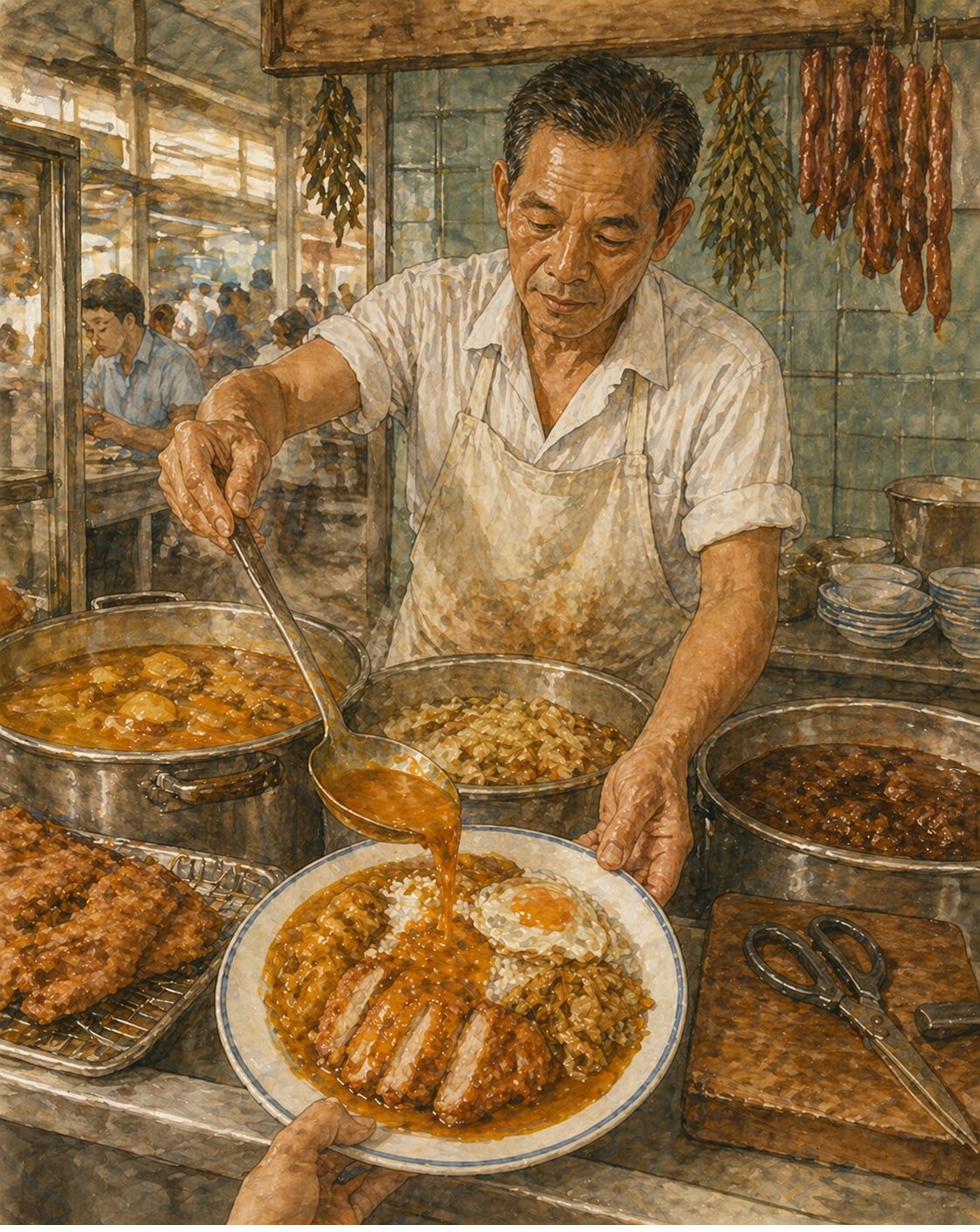
This is the dish my Ah Kong helped invent.
Hainanese Curry Rice is not from Hainan, China. It was created in Singapore by Hainanese cooks who worked in British and Peranakan kitchens during the colonial era. They fused:
- British pork chop (with cream cracker crust)
- Peranakan chicken curry (coconut milk, rempah (the foundation aromatic spice paste), with potatoes)
- Peranakan chap chye (braised mixed vegetables with dried shrimp)
- Cantonese braised pork belly (lor bak 滷肉 / kong bak 扣肉)
- Hainanese-style cooking principles (clean flavours, layered sauces)
The result is the four heavenly kings plus rice and sauces, all on one plate. Loo's Hainanese Curry Rice — reportedly founded in 1946 by Mr Loo Niap Tan — is the most famous heritage stall, where Mr Loo learned the recipes from his Peranakan brother-in-law, then made them his own.
Other heritage names: Hong Seng Curry Rice (Redhill), Tian Tian Curry Rice (Beo Crescent), Beo Crescent Hainanese Curry Rice, Truly Curry Rice (Hong Lim), No Name / Beo Crescent Curry Rice, Cheng's @ Tiong Bahru, Sin Chie Toke Huan.
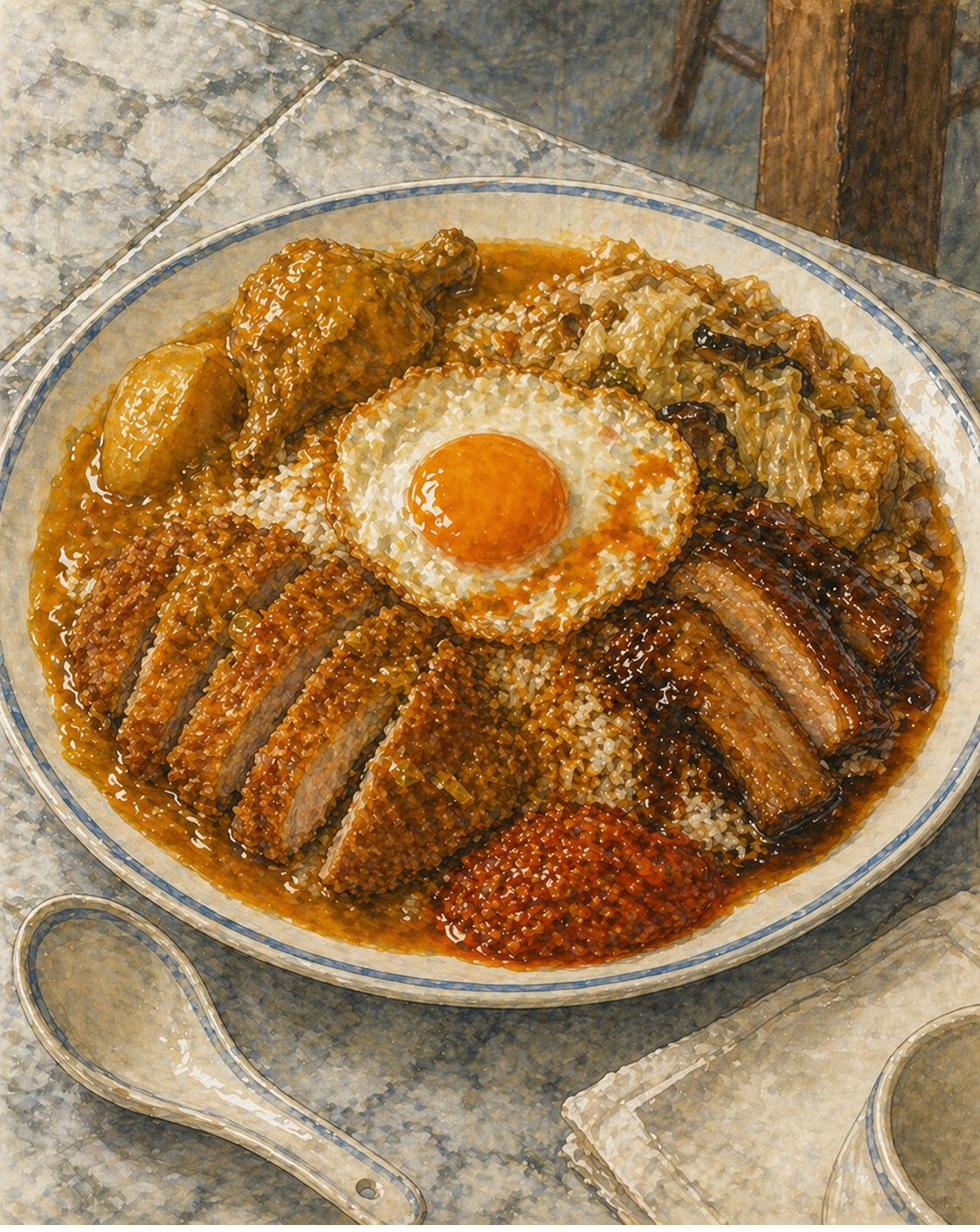
The signature visual is what food writer Leslie Tay called "the gravies messily mixed together over rice — looks like hell, tastes like heaven."
I am giving you the recipe for the chicken curry + chap chye + the rice + sauces. The pork chop is from Recipe 17. The braised pork belly (kong bak / lor bak) I will give you as a master sauce in the final supporting chapter.
🛒Ingredients
Four heavenly kings, three gravies, one plate. Curry benefits from overnight rest — start the day before.
For the Hainanese-Nyonya Chicken Curry
| Bone-in chicken thigh and drumstick | 1 kg | In pieces. |
| Potatoes | 3 medium | Peeled and quartered. |
| Curry powder (Babas Meat Curry) | 4 tbsp | Or any Singapore meat curry powder. |
| Coconut milk (thick) | 200 ml | |
| Coconut cream (top of can) | 100 ml | Added at end for richness. |
| Water | 600 ml | |
| Lemongrass | 2 stalks | Bruised. |
| Curry leaves | 2 sprigs | |
| Cinnamon stick | 1 | |
| Star anise | 2 | |
| Sugar | 1 tbsp | |
| Salt | to taste |
Curry Rempah Paste blend together
| Shallots | 6 | |
| Garlic | 4 cloves | |
| Ginger | 30 g | |
| Galangal | 30 g | |
| Dried red chillies, soaked | 2 | |
| Fresh red chillies | 2 | |
| belacan (fermented shrimp paste) | 1 tbsp | Toasted. Optional — heritage Peranakan touch. |
| Turmeric powder | 1 tsp |
For the Chap Chye braised cabbage
| White cabbage | ½ head (~600 g) | Cored and sliced. |
| Dried mushrooms | 4 | Soaked, sliced. |
| kim chiam (dried lily buds) | 20 g | Soaked. |
| mok yee (wood ear fungus) | 10 g | Soaked. |
| Tau pok (fried tofu puffs) | 6 | Halved. |
| tang hoon (glass noodles) | 30 g | Soaked. |
| Dried shrimp | 30 g | Soaked, chopped. |
| Garlic | 4 cloves | Minced. |
| Shallots | 4 | Sliced. |
| Light soy sauce | 1 tbsp | |
| Oyster sauce | 1 tbsp | |
| Sugar | 1 tsp | |
| White pepper | ½ tsp | |
| Pork lard or oil | 2 tbsp | |
| Mushroom soaking water | 200 ml |
For the Plain Rice
| Jasmine rice, cooked | 4 cups | No chicken fat, no aromatics — plain is the canvas for the curry. |
🌶️Shifu's Lift
choose one path — see "Shifu's Secret" chapter for the philosophy- Old-school path: ½ tsp MSG in chap chye
- Modern hawker path: 1 tsp chicken stock powder in curry
- Heritage purist path: Already covered with belacan + dried shrimp + bones
Plate Components per plate
| Pork chop, sliced (Recipe 17) | 1 piece | |
| Curry chicken with potato | 1 piece | |
| Chap chye | a scoop | |
| Braised pork belly (Master Sauces chapter) | a scoop | Optional. |
| Fried egg, sunny-side up | 1 | Optional but heritage. |
| Plain rice | 2 ladles | |
| All gravies | poured generously |
👨🍳Method
Four stages. Curry first (ideally day before), chap chye second, plate the mess of heaven last.
The Rempah Components
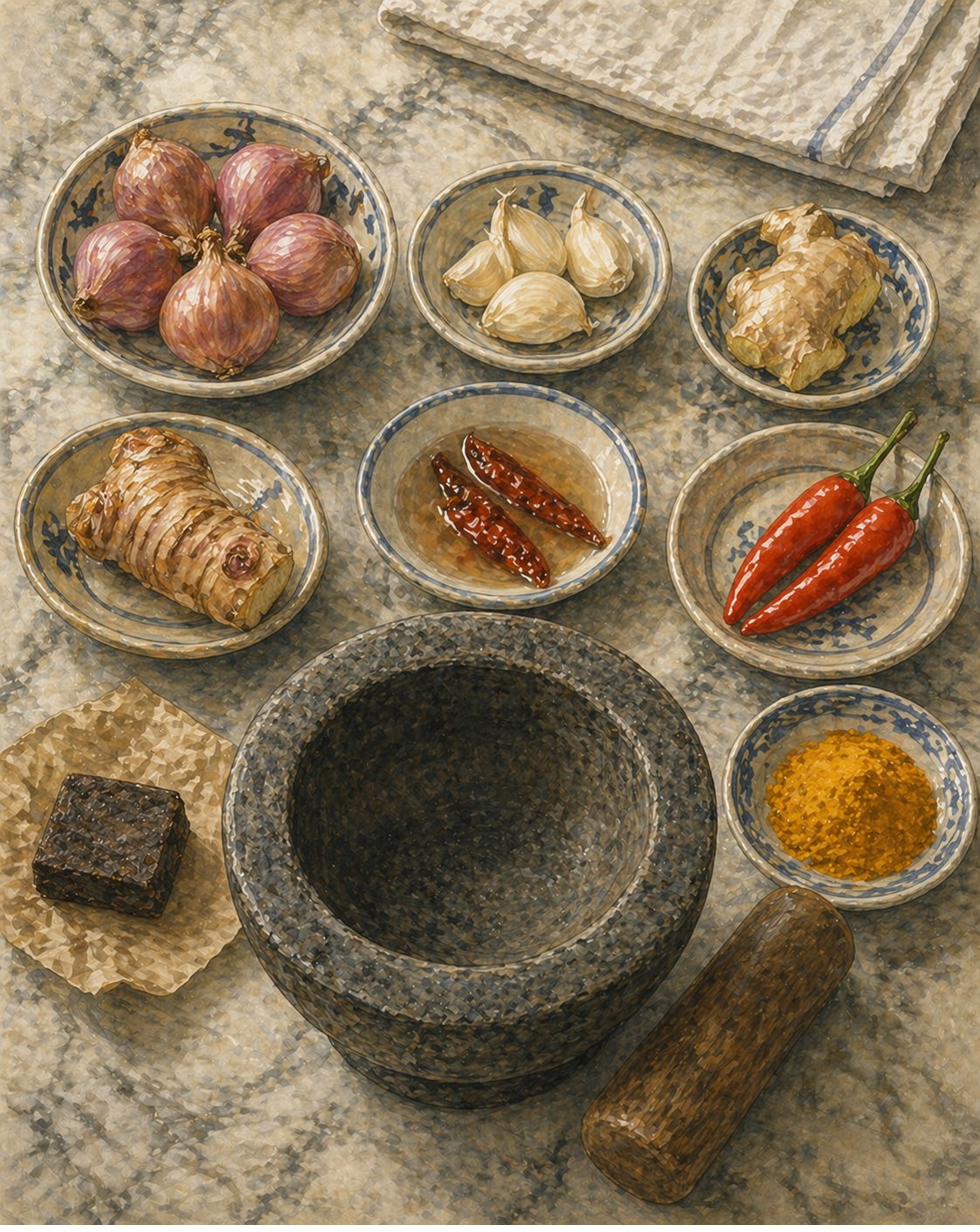
Gather all rempah paste ingredients on the counter: 6 shallots (peeled), 4 garlic cloves, 30 g ginger, 30 g galangal, 2 dried red chillies (pre-soaked in hot water 10 minutes), 2 fresh red chillies, 1 tbsp toasted belacan, 1 tsp turmeric powder.
Blend all rempah components with 3 tbsp oil into a smooth paste. Heritage hawkers grind this in a lesung batu (Malay stone mortar) for deeper flavour, but a blender works.
The Curry (1 hour, ideally made day before)
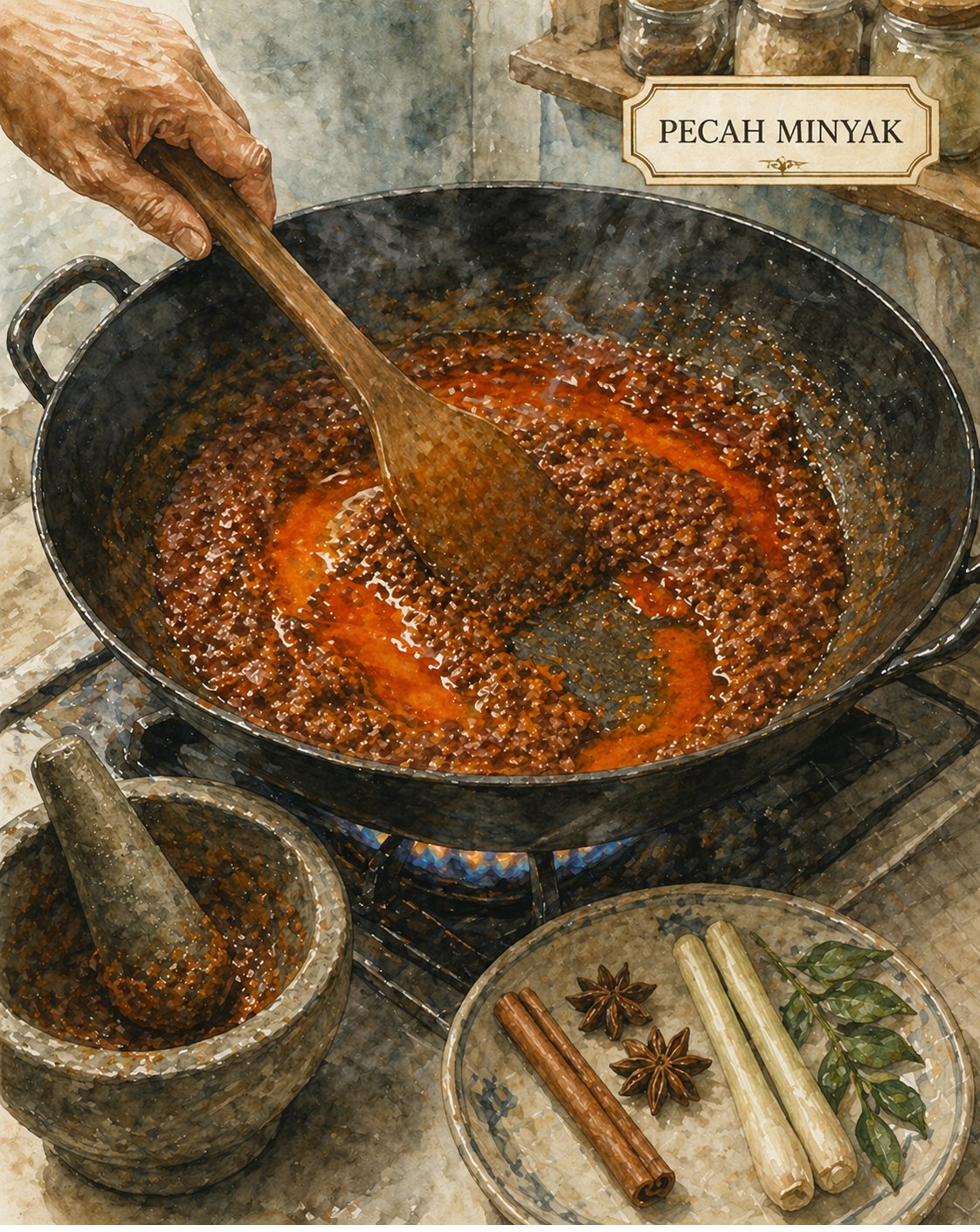
Heat 4 tbsp oil in a heavy pot. Fry the rempah paste over medium heat for 12–15 minutes, stirring constantly. This is the most important step — the paste must reach pecah minyak (Malay for 'split oil', when aromatic oil pools on the surface) before you proceed. The colour will deepen from pale yellow to deep red-brown, and aromatic oil will pool on the surface.
Add curry powder, cinnamon, star anise, lemongrass, curry leaves. Fry another 2 minutes.
Add chicken pieces. Toss to coat in the rempah. Cook 5 minutes.
Add 600 ml water + 200 ml coconut milk + sugar + salt. Bring to a gentle boil. Add potatoes.
Lower to simmer. Cook uncovered for 35 minutes until chicken is tender and potatoes are cooked through. Skim the orange curry oil that rises (reserve some for plating drizzle).
Stir in the coconut cream in the last 5 minutes. Adjust seasoning.
Best made the day before — refrigerate overnight, the flavours deepen significantly.
The Chap Chye (40 minutes, can also be made ahead)
Heat 2 tbsp lard in a wok. Sauté garlic and shallots until golden. Add chopped dried shrimp, stir 30 seconds.
Add cabbage. Stir-fry 3 minutes until slightly wilted.
Add mushroom slices, lily buds, wood ear, tau pok. Toss.
Add 200 ml mushroom water, light soy, oyster sauce, sugar, white pepper.
Cover and simmer 15 minutes. The cabbage should turn soft and translucent — the heritage chap chye is "limp," not crunchy.
In the last 3 minutes, add soaked glass noodles. Stir to incorporate.
Hold warm.
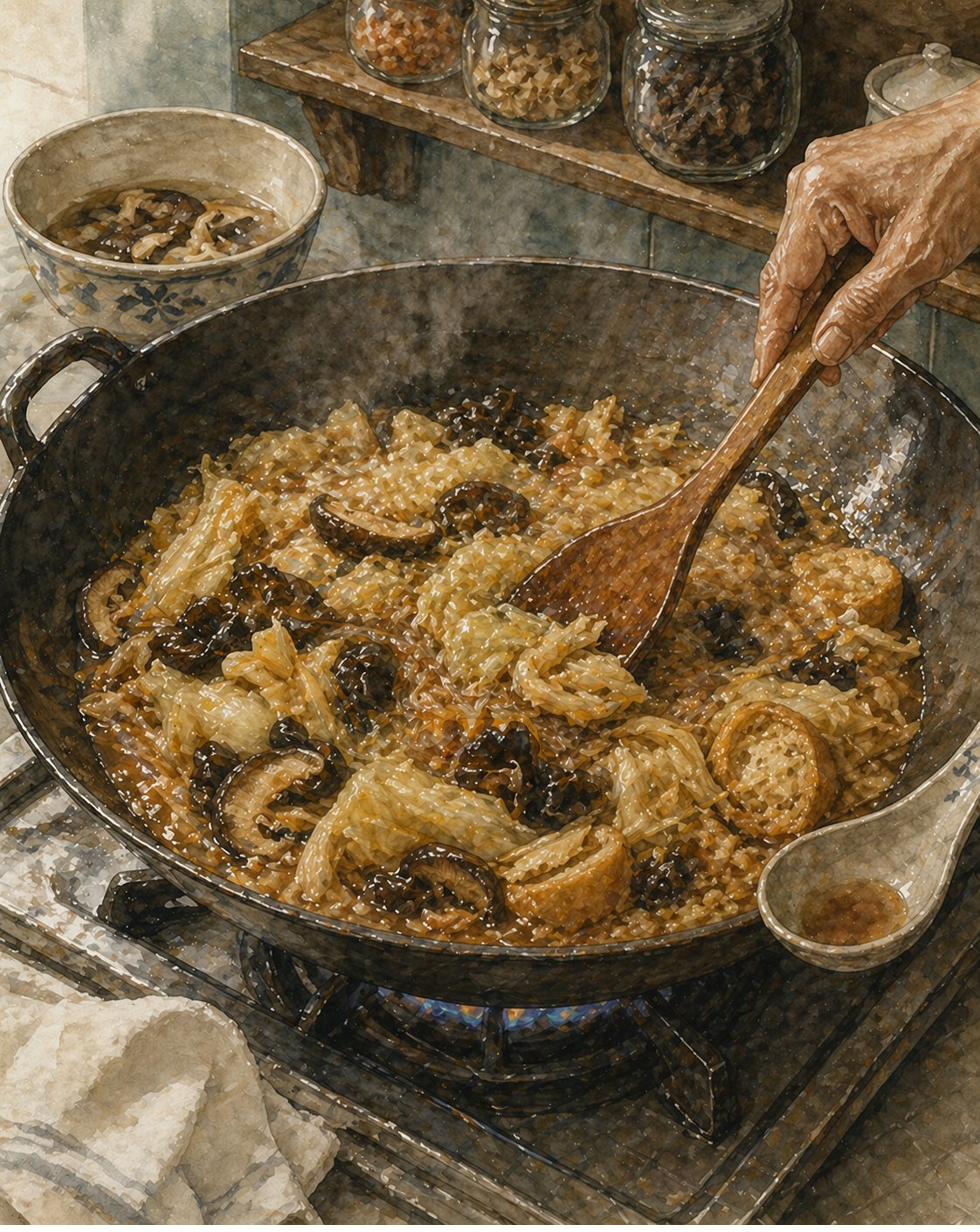
Plate the "Mess of Heaven"
Per plate:
- Mound 1 cup of plain rice in the centre.
- Lay sliced pork chop on top of one section of rice.
- Place 1 piece of curry chicken + 1 potato chunk on another section.
- Spoon a generous mound of chap chye on a third section.
- Add braised pork belly if you have it (see Master Sauces chapter).
- Crown with a fried sunny-side egg if going full-heritage.
- Now pour:
- 2 ladles of curry gravy over the rice
- 1 ladle of chap chye liquid
- 1 ladle of braised pork belly sauce
- Drizzle a final tablespoon of curry oil for the orange sheen.
Eat by mixing everything together as you go. Use spoon, not chopsticks. That's the heritage way.
🎯The Three Tips
Heritage. Master's. Mistake.
🏛 Heritage Note
The Scissors-Cut Tradition
At some heritage stalls (Beach Road Scissors-Cut Curry Rice, Hong Seng), the meat is chopped with kitchen scissors at the point of service — directly over the rice. The clacking metallic sound is part of the experience.
This started as a practical technique (scissors are faster than knives at chopping fried pork chop into bite-size on a busy hawker line) but became part of the theatre of Hainanese Curry Rice. Some say the scissors-cut also creates a different texture — slightly torn edges that absorb gravy better than clean knife cuts.
👨🍳 Master's Tip
Make the Curry the Day Before
Hainanese Curry — like all Peranakan-influenced curries — demands an overnight rest.
The flavours that develop overnight cannot be replicated in same-day cooking:
- The rempah aromatics fully infuse into the broth
- The coconut milk fat congeals on top, creating a layered richness when reheated
- The chicken absorbs the curry deeply, becoming "marinated"
- Potatoes break down slightly, thickening the gravy naturally
For the home cook: minimum 24 hours. Restaurant level: 48 hours. The rempah paste itself can be made up to a week in advance and refrigerated.
⚠ Common Mistake
The Curry Tastes Flat
Three failures:
- Rempah not fried long enough ("not pecah minyak"). The paste must visibly split oil — if you stop at "smelling fragrant," the spices remain raw and the curry tastes harsh. Fix: fry the rempah at least 12 minutes, until oil pools clearly on top.
- Wrong curry powder. Western "curry powder" is too mild and turmeric-heavy. Use Singapore meat curry powder (Baba's, Indian shops in Tekka, Little India). It has the proper coriander-cumin-fennel-pepper-clove balance.
- Coconut milk added too early and boiled hard. Boiling coconut milk hard splits the fat and gives a grainy texture. Fix: add coconut milk in the last 30 minutes, simmer gently. Add coconut cream in last 5 minutes only — never boil.
📈 Scaling for Hawker Service
For a Hainanese Curry Rice stall
- Three large pots simultaneously: chicken curry (8 L), chap chye (5 L), braised pork belly (5 L). Each cycles every 24 hours.
- Pork chop fried to order — every 5 minutes, a batch goes in.
- Sambal sotong (sambal spicy chilli paste with sotong squid) as side dish — pre-made, reheated.
- Average plate carries 4–5 sauces — ladles work harder than knives in this kitchen.
- Rice rotation: cook a fresh batch every 2 hours.
- Cost (Singapore 2026): Per plate ~SGD 3.50 (pork chop 1.00 + curry chicken 1.20 + chap chye 0.30 + braised pork 0.50 + rice 0.30 + amortised 0.20). Sells SGD 6–10. Margin: 50–60% (lower than other dishes due to multi-component complexity).
Hainanese Curry Rice is not a dish. It is a plate of negotiations between four cultures, all reconciled by gravy. Eat it messy. Eat it slow. Mix everything. That is the only correct way.