Hainanese Pork Chop
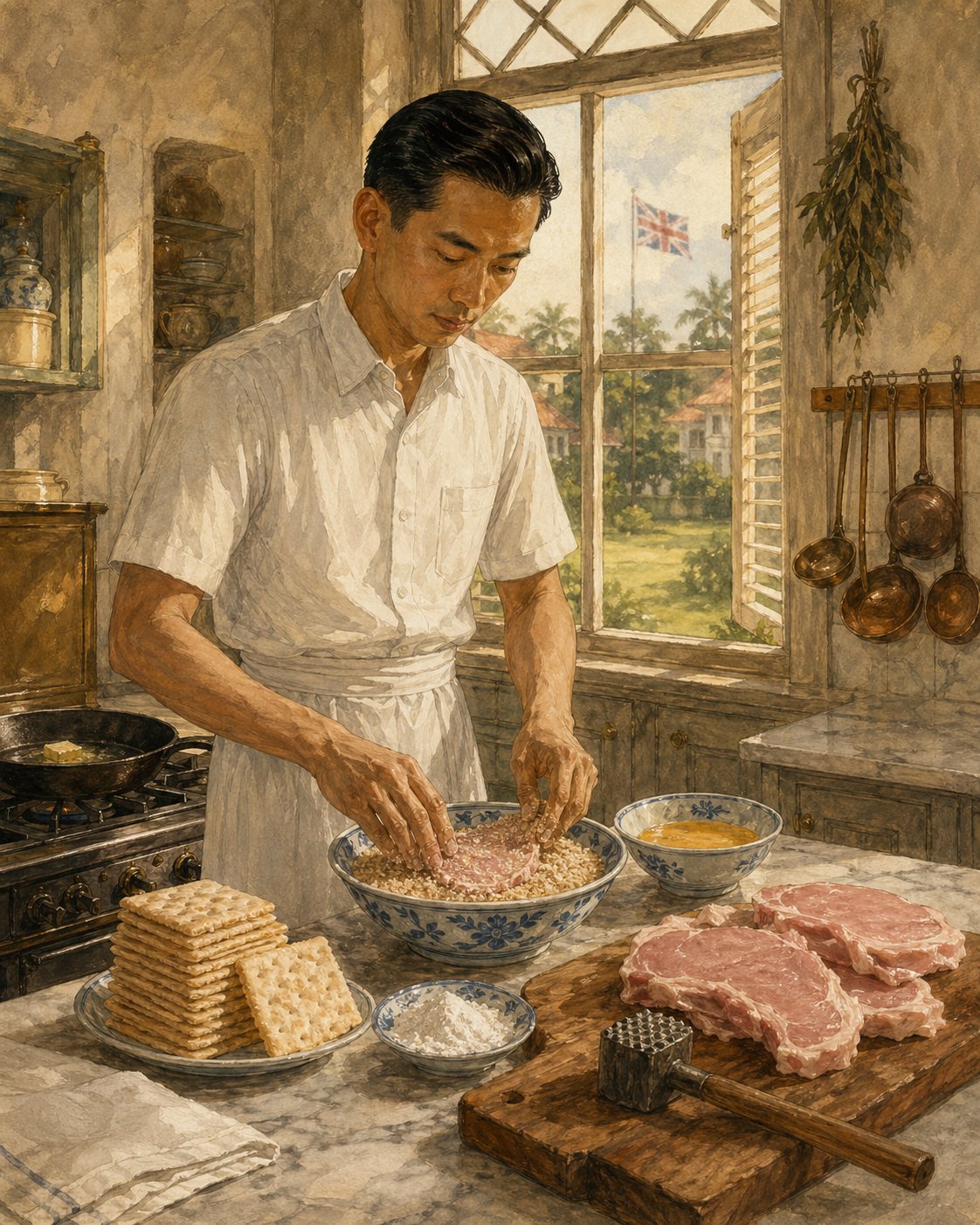
This is the dish my Ah Kong made for the British family he worked for. Then he taught my mother. Then she taught me.
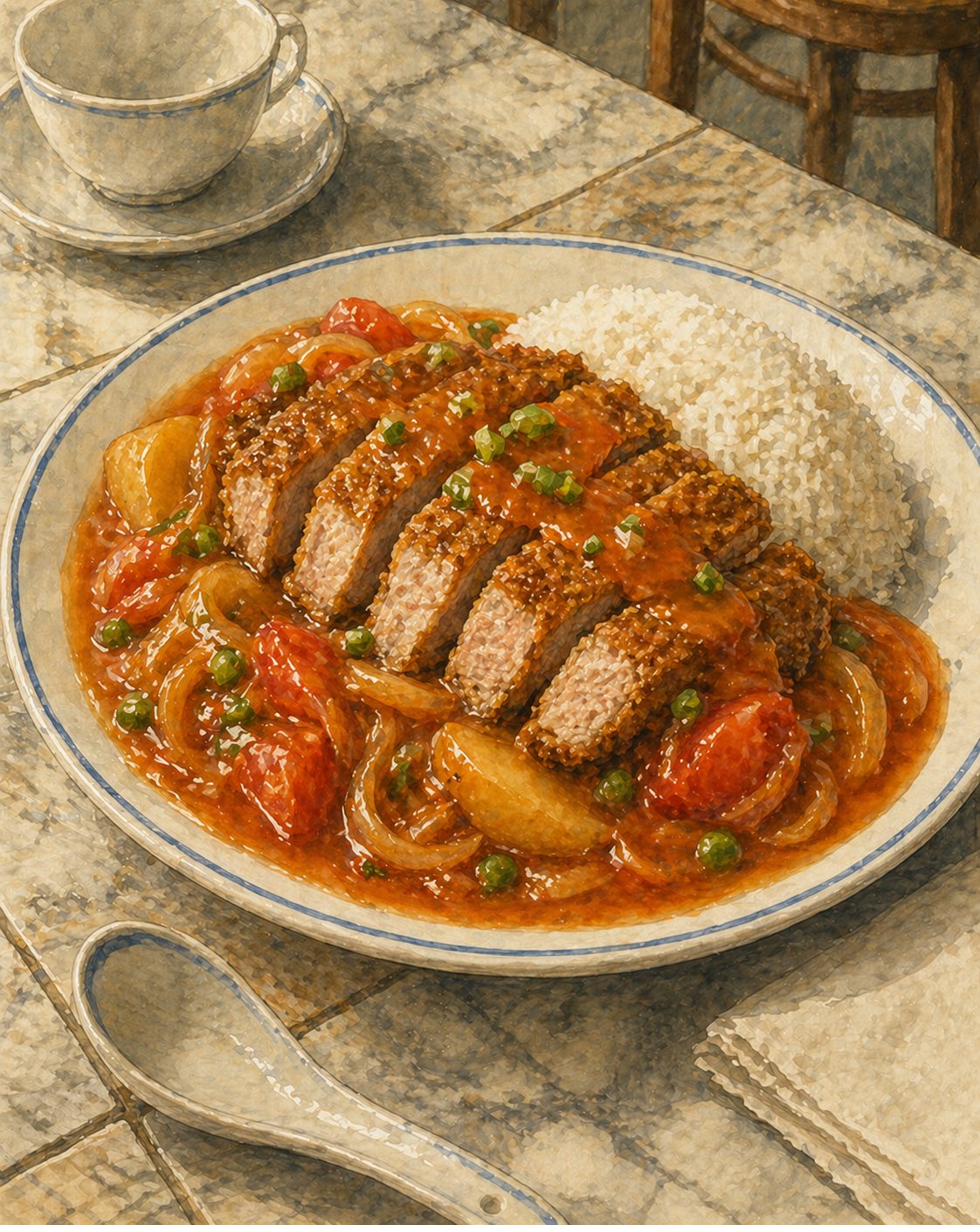
Hainanese pork chop is one of the clearest examples of Singapore's colonial-era fusion: a Chinese cook in a British kitchen, watching the British Mem (the lady of the colonial household, from Hindustani 'memsahib') make pork chops with breaded coating, tomato gravy, peas, potato. He copied the form, but used Khong Guan cream crackers instead of European breadcrumbs, Worcestershire sauce + tomato ketchup because that's what was in the colonial pantry, and Chinese sesame oil + light soy in the marinade because that's what tasted right to him.
The Khong Guan cream cracker coating is the signature signature. Old-school Hainanese cooks insist on Khong Guan brand — the texture and saltiness is just slightly different from generic crackers, and it crisps differently.
Heritage stalls serving the proper version: Yet Con (closed in 2018, but legendary), Loo's Hainanese Curry Rice (Tiong Bahru), Hong Mei Western Food, Sin Kee, Swee Kee, Beach Road Scissors-Cut Curry Rice.
The pork chop appears in two contexts:
- Standalone — pork chop with gravy and rice, the kopitiam classic
- Part of Hainanese Curry Rice — the "four heavenly kings" combo of pork chop + curry chicken + chap chye (mixed braised vegetables) + braised pork (Recipe 18)
I'm giving you the standalone version here. Recipe 18 ties it into the Curry Rice combo.
🛒Ingredients
Pork chop, three-layer coating, tomato gravy. The Khong Guan cracker is the signature.
For the Pork Chop
| Pork loin (or pork ham/back thigh — heritage cut) | 600 g | In 4 pieces ~1.5 cm thick. Butterfly cut. Avoid pork tenderloin — too lean. |
Marinade
| Light soy sauce | 1 tbsp | |
| Oyster sauce | 1 tbsp | |
| Shaoxing wine | 1 tbsp | |
| Sesame oil | 1 tsp | |
| Salt | 1 tsp | |
| White pepper | 1 tsp | |
| Sugar | 1 tsp | |
| Ginger juice | 1 tsp | |
| Garlic powder | ½ tsp | Optional. |
| Bicarbonate of soda | ¼ tsp | Tenderiser — do not exceed. |
Coating three layers
| Layer 1: Cornflour | ½ cup | |
| Layer 2: Eggs, beaten with 1 tbsp water | 2 | |
| Layer 3: Khong Guan cream crackers, crushed coarse | 10 crackers | Mix in 2 tbsp rice flour for crispness and to prevent sogginess. |
For the Tomato Gravy
| Onion | 1 large | Sliced into rings. |
| Fresh tomato | 1 large | In wedges, skin removed via blanch. |
| Tomato ketchup | 4 tbsp | |
| Worcestershire sauce | 2 tbsp | |
| HP brown sauce | 1 tbsp | Traditional — adds complexity. |
| Oyster sauce | 1 tsp | |
| Light soy sauce | 1 tsp | |
| Sugar | 1 tbsp | |
| Salt | ½ tsp | |
| White vinegar | 1 tsp | |
| Water or chicken stock | 200 ml | |
| Frozen green peas | ½ cup | |
| Potato | 1 medium | In wedges, par-fried. |
| Cornflour slurry | 1 tbsp + 2 tbsp water | |
| Butter | 1 tsp | British colonial heritage touch. |
For Frying
| Neutral oil | ~4 cm depth | Heated to 170°C / 340°F. |
🌶️Shifu's Lift
choose one path — see "Shifu's Secret" chapter for the philosophy- Old-school path: ½ tsp MSG in marinade
- Modern hawker path: 1 tsp chicken stock powder
- Heritage purist path: Use proper bone broth instead of water in the gravy
👨🍳Method
Six stages. Pound, marinate, coat, fry, gravy, plate. The coating order is the technique.
Tenderise & Marinate
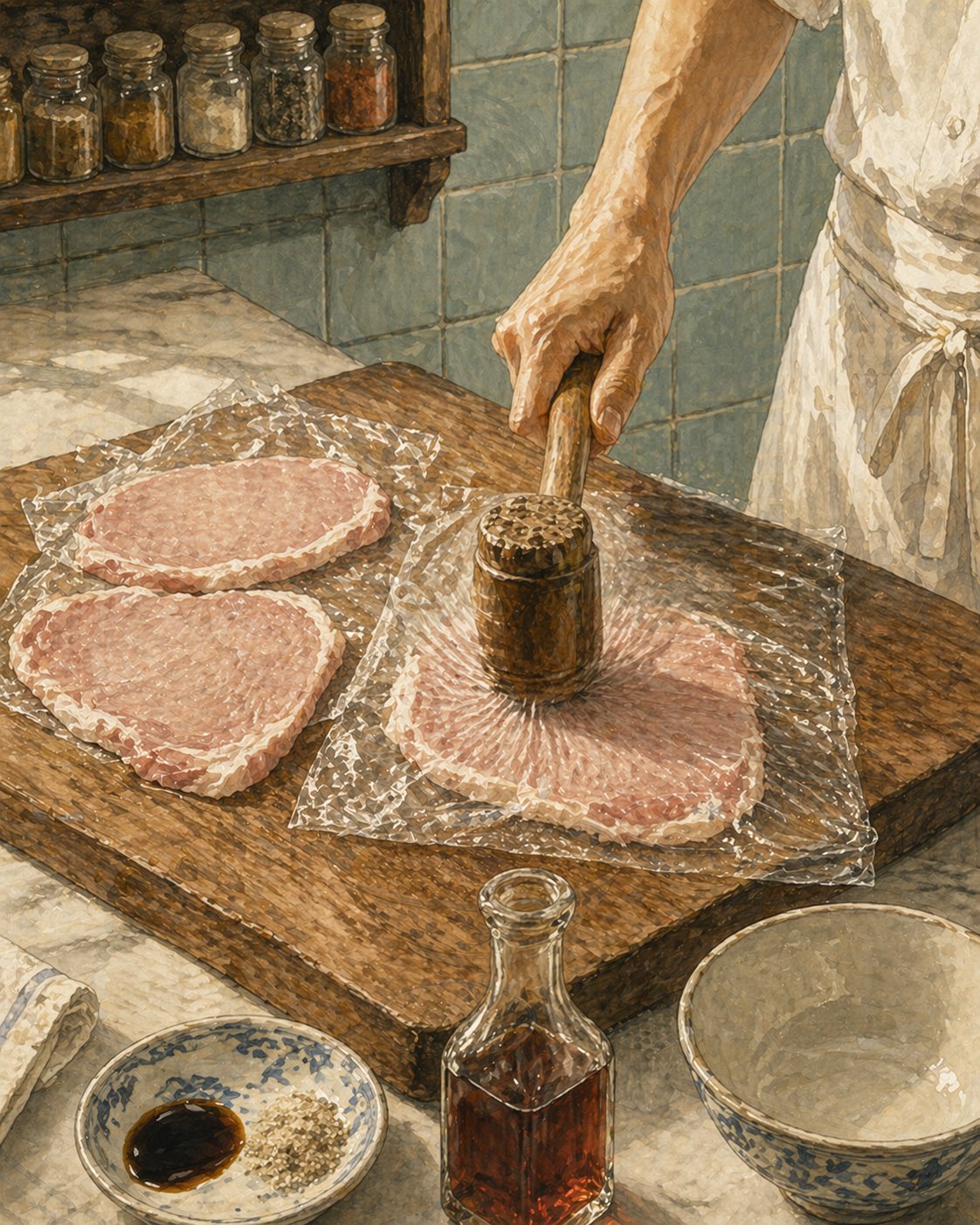
Lay each pork piece between sheets of cling film. Pound with a meat mallet (or the back of a heavy cleaver) to ~1 cm thick. Pound evenly — uneven thickness means uneven cooking.
Combine all marinade ingredients in a bowl. Add pork. Massage in. Refrigerate 2 hours minimum, ideally 4 hours. The bicarbonate of soda will tenderise (do not exceed ¼ tsp or the meat turns soapy).
Prepare the Coating Stations
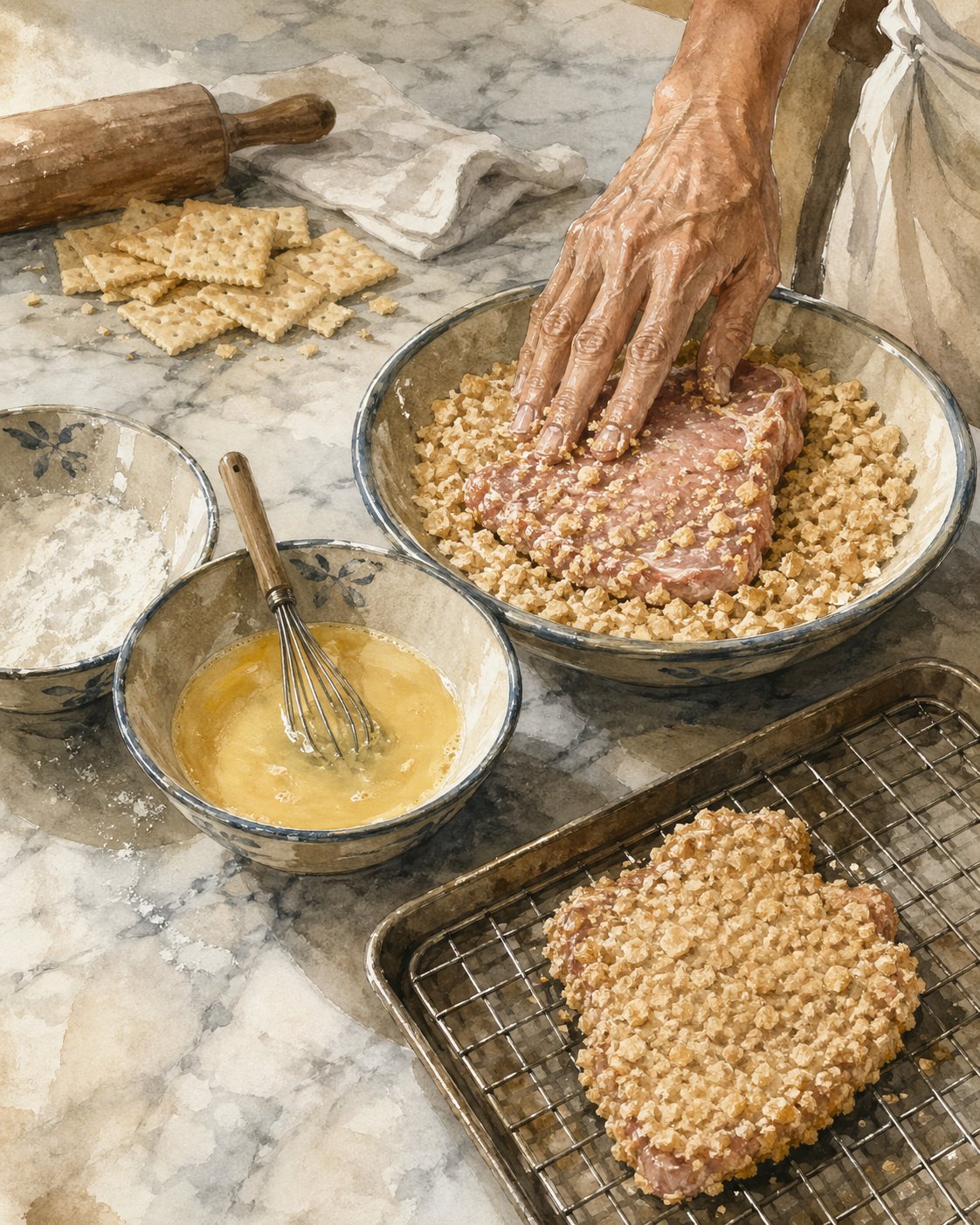
Set up three shallow dishes:
- Cornflour
- Beaten egg with water
- Cream cracker crumbs + rice flour mixture
Crush crackers in a zip-lock bag with a rolling pin. Coarse crumbs, not fine powder — coarse gives texture.
Coat the Pork
Drain pork briefly (excess marinade liquid causes soggy coating). One piece at a time:
- Dredge in cornflour, shake off excess
- Dip in egg mixture, drain briefly
- Press firmly into cracker crumbs, coating both sides and edges thoroughly
Place on a wire rack. Let stand 10 minutes — this helps the coating adhere.
Make the Tomato Gravy
Heat 1 tbsp oil + 1 tsp butter in a saucepan. Sauté onion rings until soft, ~3 minutes.
Add tomato wedges, stir 1 minute. Add ketchup, Worcestershire, HP sauce, oyster sauce, light soy, sugar, salt, vinegar. Stir.
Pour in 200 ml water/stock. Bring to simmer.
Add peas. Simmer 2 minutes.
Stir in cornflour slurry. Cook until thickened to a spoon-coating gravy. Adjust salt/sugar. Add par-fried potato wedges last (they retain texture).
Hold warm.
Fry the Pork
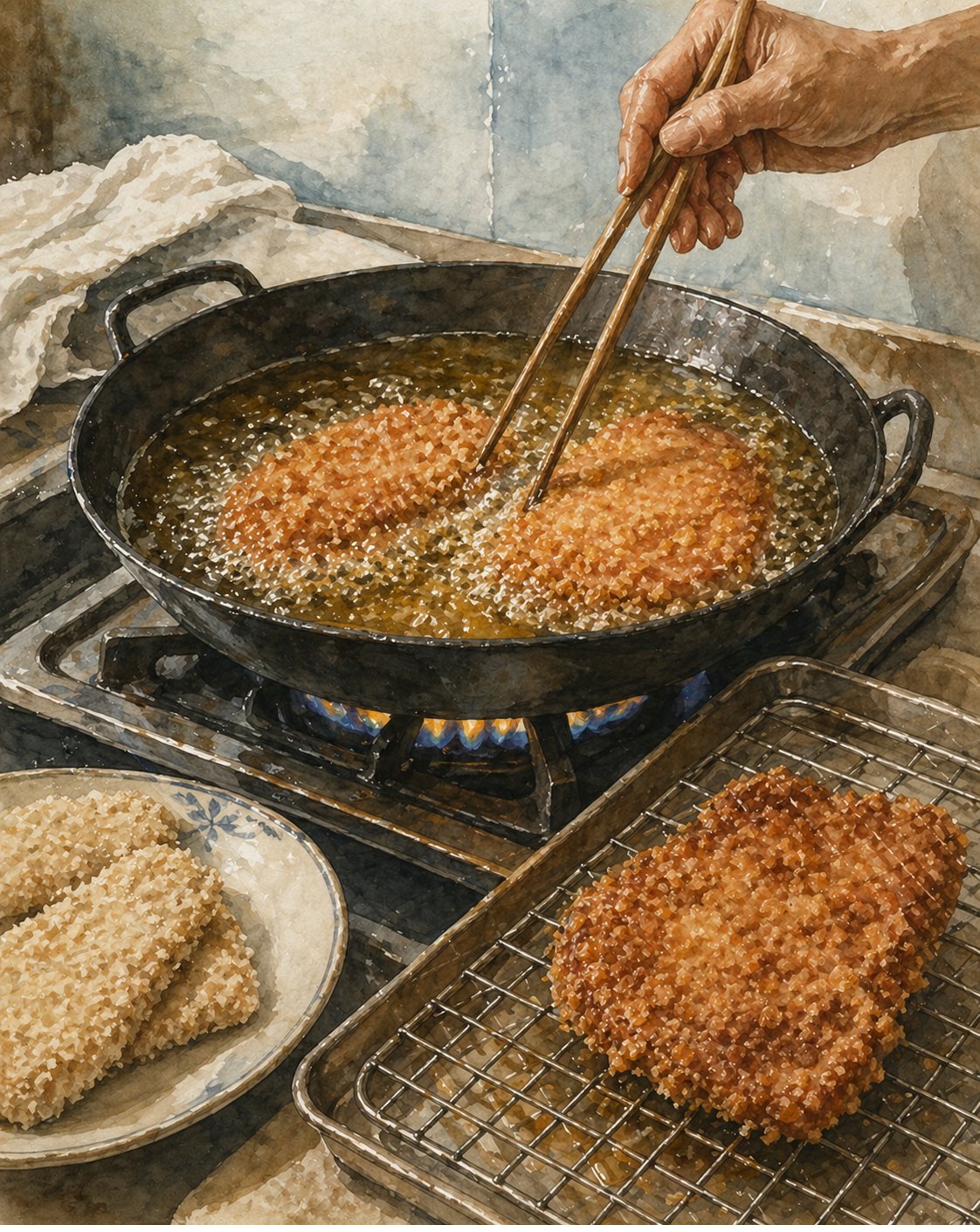
Heat oil to 170°C / 340°F. Fry pork chops 2–3 at a time (do not crowd):
- 2 minutes first side
- 2 minutes second side
Pork is done when crust is deep golden brown and crackers smell toasted. Internal temperature should be 70°C if you have a probe thermometer.
Drain on a wire rack (not paper towel — paper traps steam).
Rest 3 minutes before slicing.
Plate
Slice each pork chop into 2 cm strips with a heavy cleaver — single decisive chop, do not saw.
Plate with:
- Sliced pork chop in a row
- Tomato gravy generously poured over (heritage style) or in a side dish (for crispness preservation)
- Mound of plain white rice on the side
- Garnish with chopped spring onion or coriander
🎯The Three Tips
Heritage. Master's. Mistake.
🏛 Heritage Note
The Khong Guan Cracker
The Khong Guan cream cracker is a specifically Singapore product — manufactured in Singapore since 1947. The slightly toasty, mildly salty cracker has the precise crumb texture for this dish. Generic saltines or Western breadcrumbs work but give a different (less authentic) flavour.
Loo's Hainanese Curry Rice at Tiong Bahru is documented as still using Khong Guan crackers for their pork chops — the heritage continuity is reportedly unbroken since 1946.
👨🍳 Master's Tip
Three-Layer Coating Order
The signature crispness of Hainanese pork chop depends on the three-layer coating done in the right order:
- Cornflour first — fills micro-pores in the meat, gives the egg something to bind to
- Egg second — the glue
- Cracker crumbs + rice flour third — the texture and flavour
Skip the cornflour and the coating slides off in the fryer. Skip the rice flour and the coating goes soggy within 10 minutes.
The other technique: rest the coated pork on a wire rack for 10 minutes before frying. This lets the coating set and adhere — fry immediately and the crumbs fall off.
⚠ Common Mistake
Soggy Crust, Tough Meat
Two failures:
- Soggy crust = oil temperature too low (below 160°C), or coating not allowed to rest. Fix: maintain 170°C strictly. Use a thermometer. Rest coated pork 10 minutes before frying.
- Tough meat = under-marinated, over-tenderised, or overcooked. Fix: marinate at least 2 hours. Bicarbonate ¼ tsp maximum. Fry only 4 minutes total.
A third mistake: pouring gravy over the chop and letting it sit. The crust softens fast. Fix: serve gravy on the side, OR pour-and-eat-immediately.
📈 Scaling for Hawker Service
For a Hainanese pork chop / curry rice stall
- Daily prep: 4–6 kg pork loin pounded and marinated overnight. Fry to order in batches of 4–5 chops.
- Coating prep: Crush 2–3 packets of Khong Guan crackers daily. Mix with rice flour. Store in airtight container.
- Gravy production: Make 2 L of tomato gravy in the morning, hold warm. Refresh peas and potato wedges every 2 hours.
- Cost (Singapore 2026): Per plate ~SGD 2.50 (pork 1.20 + crackers 0.20 + gravy 0.40 + rice 0.30 + oil amortised 0.40). Sells SGD 7–11 standard, SGD 12–16 as part of Hainanese Curry Rice combo. Margin: 60–70%.
My Ah Kong learned to make pork chop for the British. Then he made it for our family. Then we made it for ourselves. That is how heritage moves — across borders, across kitchens, across generations. Always carrying something forward.