Hakka Abacus Seeds
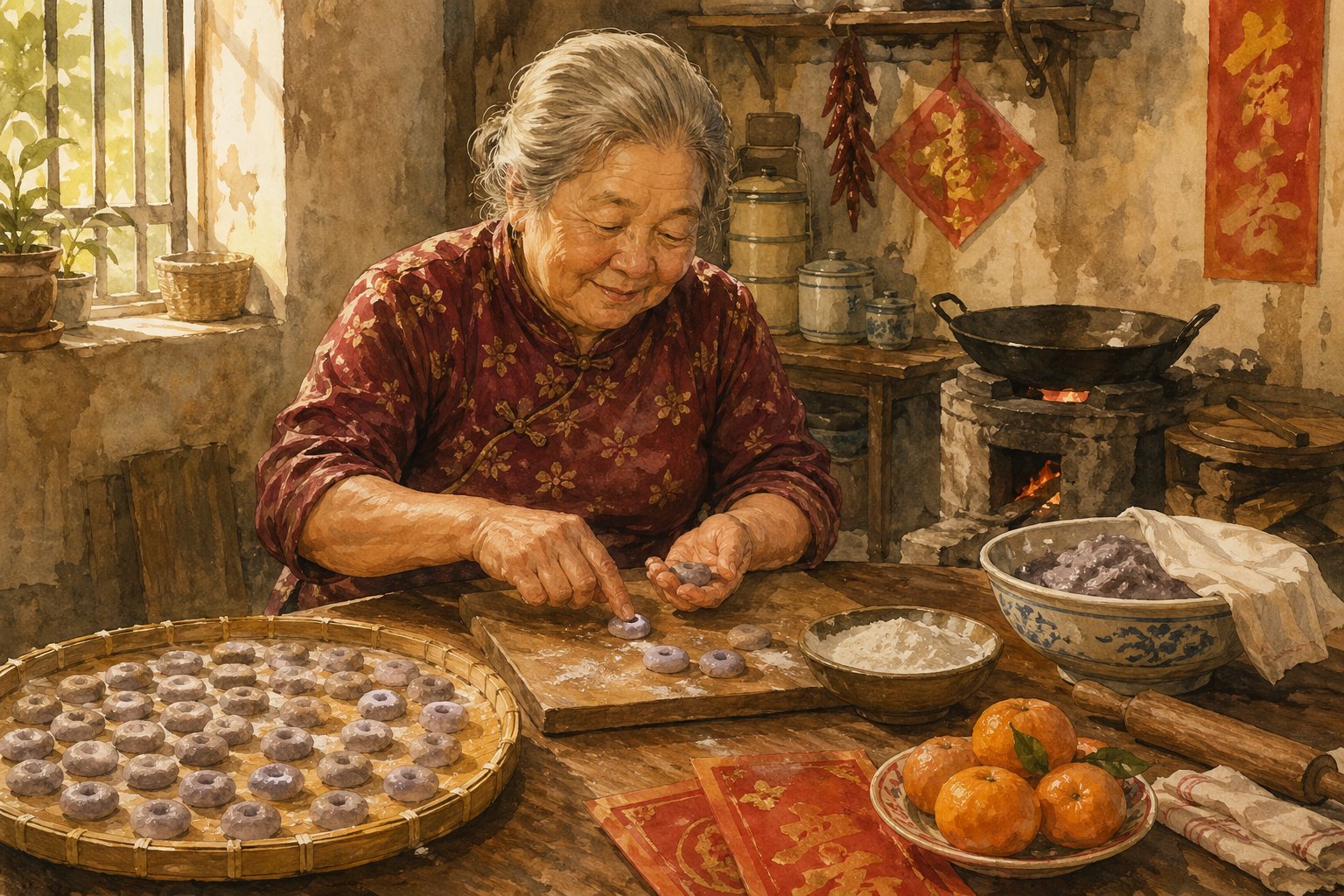
The Hakka count their blessings on a plate — one bead at a time.
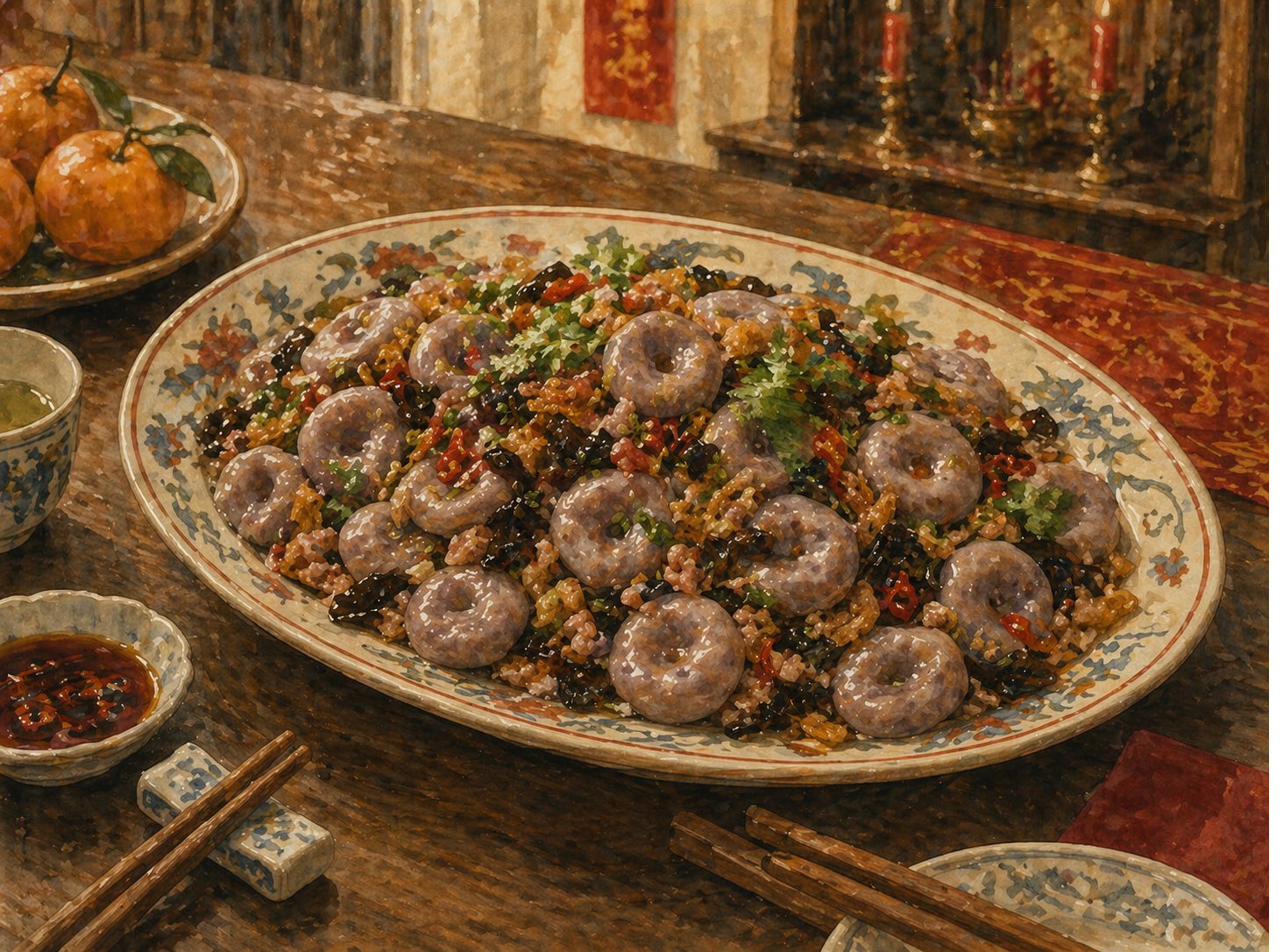
Suan Pan Zi 算盘子 — literally "abacus seeds" — is one of the most quietly extraordinary dishes in the Singapore Hakka kitchen. It is named for the small flat-disc-with-thumb-indented-dimple shape of the bead, which mimics the wooden beads of the traditional Chinese abacus (suan pan). The symbolism is direct: each bead represents a unit of prosperity, a year of counting, a blessing remembered.
This is a Lunar New Year reunion-dinner dish in heritage Hakka households — and at clan-association banquets, weddings, and ancestral-veneration meals throughout the year.
The technique is unmistakably Hakka — the dish has no exact counterpart in Hokkien, Teochew, or Cantonese cooking. Steamed taro yam is mashed with tapioca starch to form a soft, slightly chewy dough. The dough is hand-rolled into small portions, then each portion is pressed flat into a 2 cm disc with a clear thumb-indented dimple in the centre. The beads are blanched briefly in boiling water until they float, drained, and then stir-fried at high heat (wok hei) with minced pork, soy-glossed black fungus, dried shrimp, chye poh, and dried squid or sole-fish for umami depth.
The texture is the heritage marker — qq on the outside (the chewy springy bite that good Hakka cooking is famous for), soft-yam interior, all coated in a savoury-glossy stir-fry layer. Most home cooks who try the dish for the first time are surprised by the texture: it is not pasta, not gnocchi, not glutinous rice ball — it is its own distinct chewy-soft register.
In Singapore, Abacus Seeds appears most reliably at:
- Plum Village (now reportedly closed) — the heritage Hakka restaurant on Sin Ming Avenue that ran for decades and was one of the few places where Singaporeans encountered the dish at restaurant scale
- Chuk Yuen Seafood Restaurant — the Hakka banquet specialist in Bishan
- Moi Lum Restaurant — the Hakka heritage restaurant on South Bridge Road, reportedly running since 1965
The dish has remained largely a home dish and a banquet-occasion dish, rarely sold at hawker scale. The bead-rolling step is too labour-intensive for the per-plate hawker margin. That is why the Hakka grandmother is the primary keeper of this recipe — without her, the dish quietly disappears.
I am giving you the heritage banquet version here, the way my Hakka neighbour-uncle's wife made it for Lunar New Year reunion dinners. The proportions are scaled for a six-person banquet plate — but you can multiply easily for a larger gathering.
🛒Ingredients
Steamed taro yam mashed with tapioca starch into beads. A savoury-glossy stir-fry of pork, fungus, shrimp and chye poh on top.
For the Abacus Beads makes about 60 beads
| Taro yam (yu tou, 芋头) | 500 g, peeled, cut into 4–5 cm chunks | Use the smaller "small taro" variety (kō kèu in Hakka, 小芋头) if available — better starch character than the large oblong "elephant taro." If small taro is unavailable, use any taro yam, NOT sweet potato (which gives wrong colour and texture). |
| Tapioca starch | 250 g (about 2 cups) | Tapioca starch — NOT cornflour, NOT potato starch. Tapioca gives the heritage qq bounce. |
| Salt | 1 tsp | |
| Hot water | 80–100 ml, added gradually | Boiling water hydrates the tapioca starch — gives the dough its bind. |
| Tapioca starch (extra, for dusting) | 2–3 tbsp |
For the Stir-Fry Toss
| Minced pork (with 20% fat) | 200 g | Heritage form uses pork shoulder mince, not lean — fat carries the seasoning. |
| Dried hae bee (蝦米, dried shrimp) | 30 g, soaked, finely chopped | Heritage Hakka stir-fry foundation. |
| Dried mok yee (木耳, wood ear fungus) | 15 g, soaked until soft, sliced into thin strips | |
| Dried squid or ti po (dried sole fish), finely chopped or powdered | 1 tbsp | Heritage umami booster — choose ONE; the dried squid is more common in Singapore Hakka homes. |
| Chye poh (菜脯, preserved sweet radish) | 30 g, chopped, rinsed once to reduce salt | The signature Hakka pickle — adds sweetness, saltiness, and gentle crunch. |
| Garlic | 4 cloves, finely chopped | |
| Shallots | 3, finely sliced | |
| Spring onion | 3 stalks | White and green parts separated, finely sliced. |
| Coriander leaves | a small handful | For garnish. |
| Mild red chilli | 1, sliced into thin rings | For garnish — decorative, not for heat. |
| Light soy sauce | 1.5 tbsp | |
| Dark soy sauce | 1 tsp | For colour only. |
| Oyster sauce | 1 tbsp | Heritage Singapore-Hakka stir-fry binder — adds depth and gloss. |
| Sesame oil | 1 tsp, added at the end | |
| White pepper | ½ tsp | |
| Sugar | ½ tsp | |
| Pork lard or neutral oil | 3 tbsp | Heritage version uses pork lard for depth; neutral oil substitutes acceptably. |
🌶️Shifu's Lift
choose one path — see "Shifu's Secret" chapter for the philosophy- Old-school path: ½ tsp MSG dissolved in the toss
- Modern hawker path: 1 tsp chicken stock powder
- Heritage purist path: Already covered with hae bee + chye poh + dried squid/ti po + oyster sauce
For Serving
| Light soy with sliced bird's-eye chilli | side condiment | Hakka banquet-register dipping sauce — lighter than the Recipe 21 sauce. |
👨🍳Method
Six stages. Steam, dough, shape, blanch, toss, plate. The hand-shaped dimple is the visual marker.
Steam the Yam
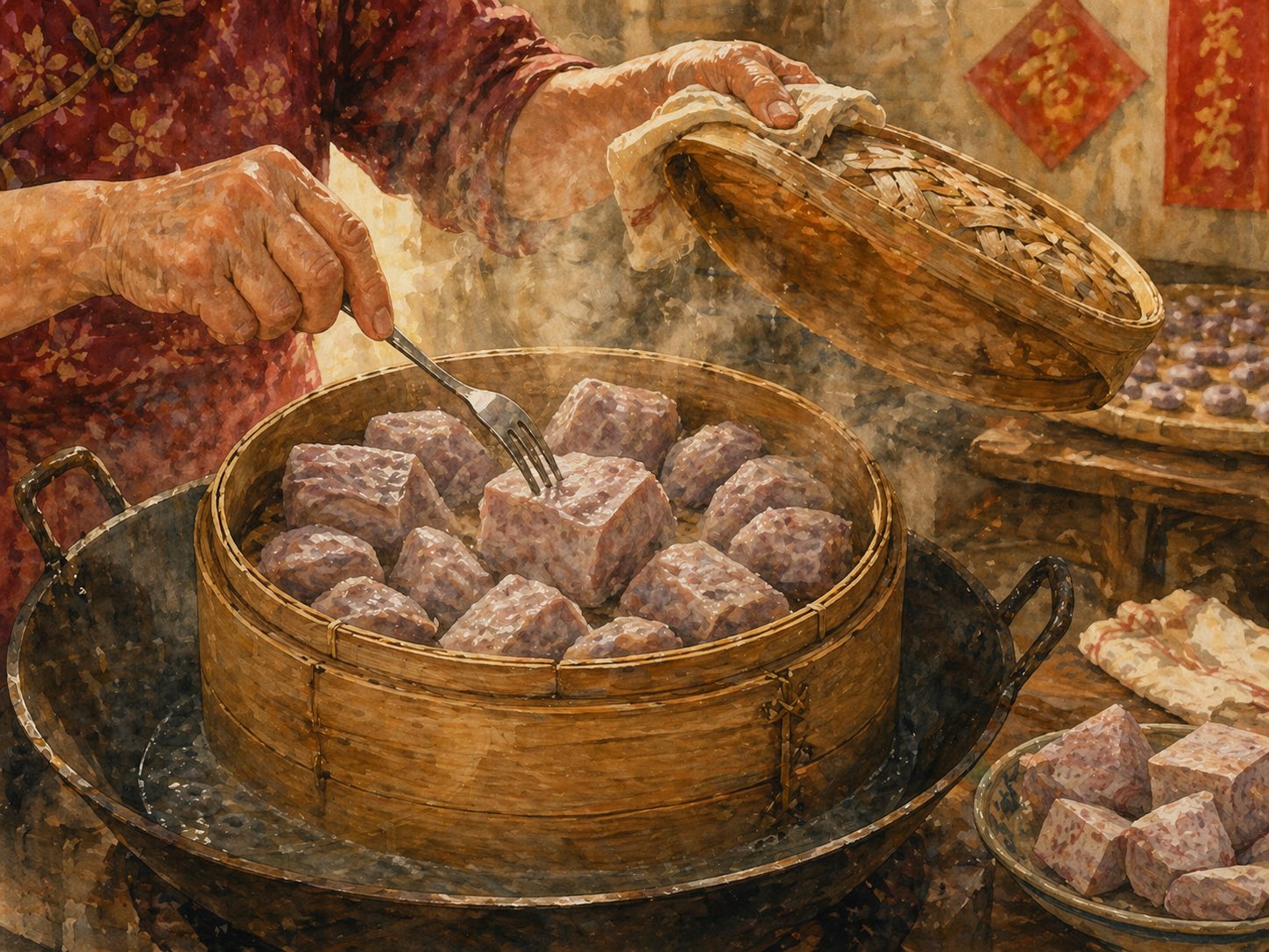
Peel the taro yam (wear thin gloves if your hands are sensitive — raw taro skin can irritate) and cut into 4–5 cm chunks.
Place the chunks in a bamboo steamer basket. Set over a wok of simmering water, cover, and steam for 20–25 minutes, until the yam is fork-tender (the largest chunk should yield to a fork like soft butter, with no resistance at the centre).
Remove the yam from the steamer while still hot. The dough binds best when the yam is mashed hot — the residual moisture and warmth hydrate the tapioca starch in the next step.
Make the Dough
Transfer the hot steamed yam to a heavy ceramic mixing bowl. Mash with a fork or potato masher until mostly smooth — small lumps are acceptable; the dough does not need to be perfectly homogeneous.
Add the salt. Add the tapioca starch in three additions, stirring after each. After the third addition, add hot water 1–2 tablespoons at a time, kneading between additions, until the dough comes together into a soft but not sticky ball. The dough is ready when it holds together when pressed but does not stick to your hands.
Heritage cooks judge the dough by feel — not by exact measurement. The yam's natural moisture varies, so the hot water amount adjusts.
Cover the dough with a damp cloth and rest 15 minutes. The rest hydrates the starch fully and makes the dough more pliable for shaping.
Pause point: the dough does NOT keep refrigerated well — the tapioca starch firms up irreversibly. Make the dough fresh on the day of cooking. The steamed yam alone keeps refrigerated for 24 hours; mash and dough-make on the day.
Hand-Shape the Beads
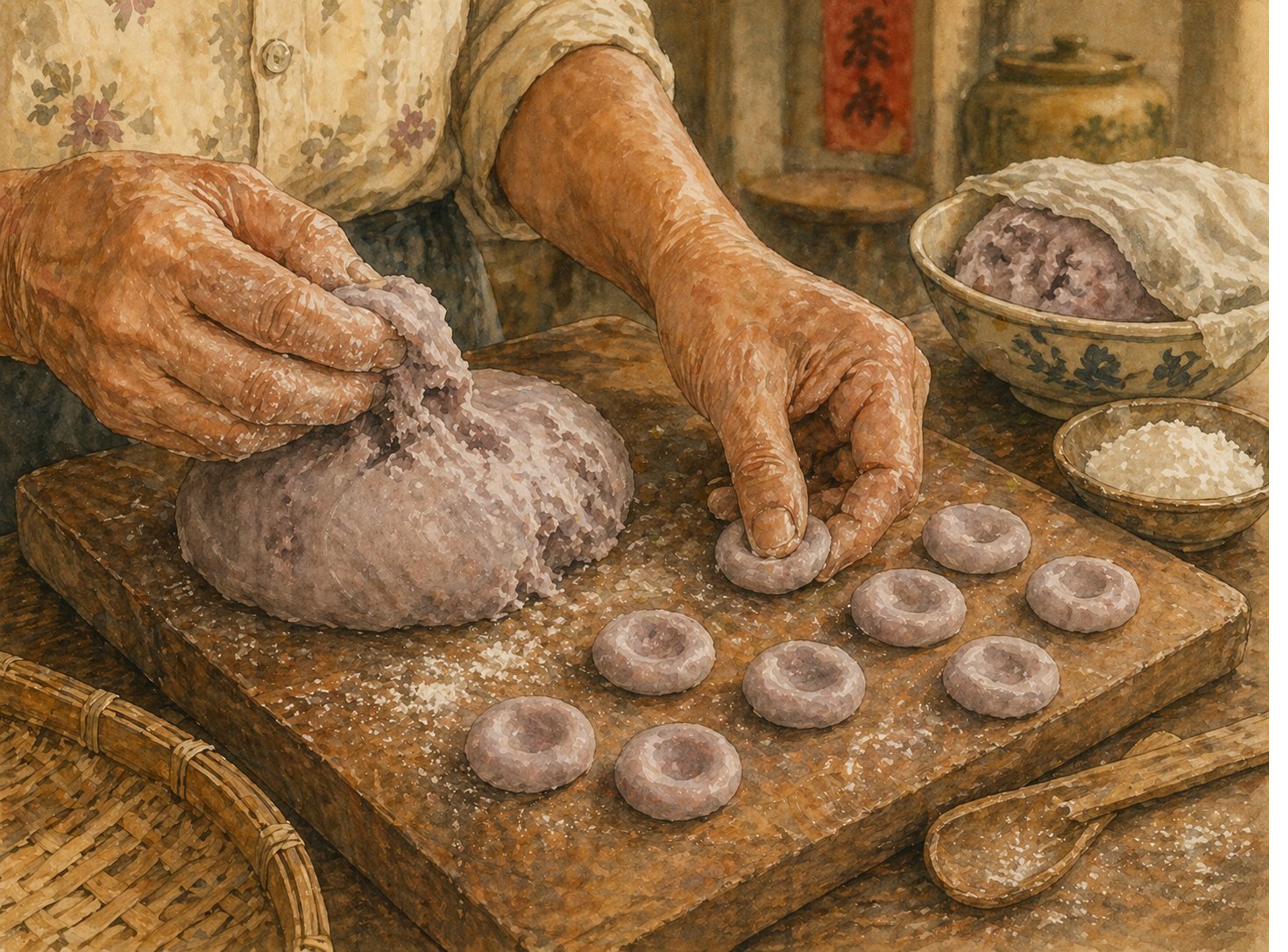
Lightly dust a wooden cutting board with tapioca starch. Pinch off small portions of dough about the size of a small marble (10 g per bead — about 60 beads from the full dough quantity).
For each bead:
- Roll between your palms into a small ball.
- Place on the cutting board and gently flatten with the side of your thumb into a 2 cm disc.
- Press the centre with your thumb to create a clear dimple — this is the abacus-bead shape, the visual marker of the dish.
Arrange the shaped beads on a flat bamboo tray dusted with tapioca starch, in a single layer (do NOT stack — they will fuse).
The heritage rhythm is one bead every 6–8 seconds. A practised matriarch can shape 60 beads in 8–10 minutes. New cooks take 20–25 minutes; the technique builds with practice.
Blanch the Beads
Bring a large pot of water to a rolling boil. Add a small pinch of salt.
Drop the beads in by the handful (about 20–25 beads at a time — do NOT crowd the pot, the beads need room to bob).
The beads sink at first, then rise to the surface within 90–120 seconds. When they float, give them another 20 seconds at the surface, then scoop out with a slotted spoon. Drain in a colander. Toss with a teaspoon of neutral oil to prevent sticking.
The boil is the only stage that uses rolling water — the beads need the convection to cook through and develop their qq bounce. Sub-boiling here would leave them gluey. The wok-toss in the next stage uses high heat but no water.
Repeat with the remaining beads in batches.
The Wok Toss
Heat 2 tbsp pork lard (or neutral oil) in a heavy carbon-steel wok over high heat until shimmering and just beginning to smoke at the edges. This is the wok hei moment — the heat is the seasoning.
Add the chopped garlic and shallots. Stir-fry 15–20 seconds, until fragrant and just beginning to colour.
Add the minced pork. Stir-fry, breaking up clumps with the wok spatula, 2–3 minutes, until the pork is nearly fully cooked and the fat has rendered.
Add the chopped hae bee, the soaked sliced mok yee, the dried squid or ti po, and the chopped chye poh. Stir-fry 1–2 minutes to integrate.
Add the light soy, dark soy, oyster sauce, sugar, and white pepper. Stir-fry to integrate, about 30 seconds.
Add the blanched beads. Toss vigorously — the wok-toss should lift the beads off the pan in a coordinated arc, integrating the seasonings. Toss for 1–2 minutes, no longer (overcooking turns the beads gluey).
Add the white parts of the spring onion. Toss in. Drizzle the sesame oil. Final toss. Add the Shifu's Lift if using.
Test: a single bead lifted from the wok should be glossy with the seasonings, springy when pressed with a chopstick, and visibly distinct from neighbouring beads (NOT homogenised into a paste). The minced pork bits, mok yee strips, hae bee flecks, and chye poh bits should remain individually identifiable in the toss.
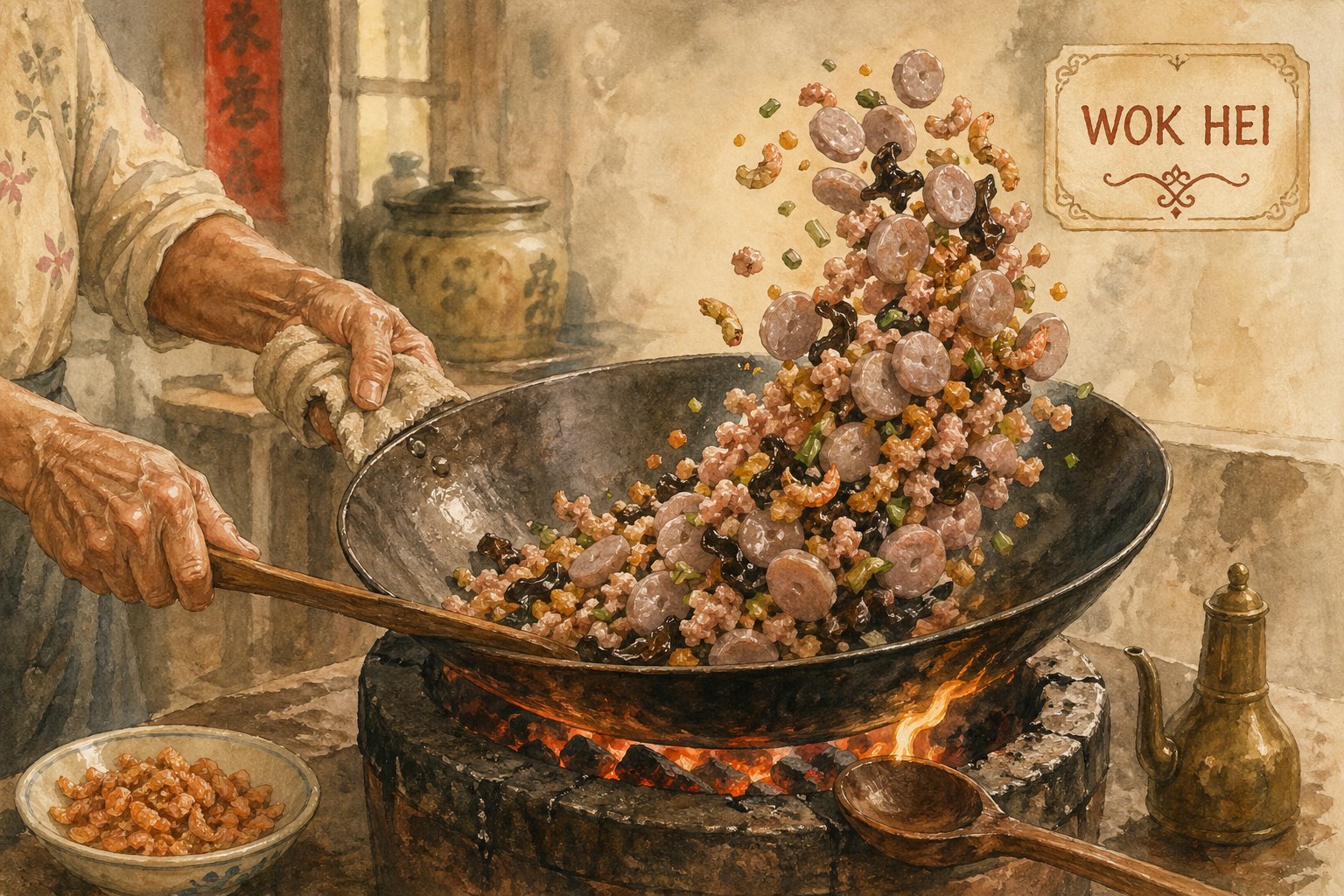
Plate and Garnish
Transfer the hot beads to the serving platter (heritage Hakka banquet platter — NOT a deep bowl). Mound generously but not overflowing — banquet-restrained register.
Garnish with:
- The green parts of the spring onion, scattered across the top
- A small handful of fresh coriander leaves
- The thin rings of mild red chilli (decorative, not for heat)
Serve immediately, while the wok hei aroma is still active. Place a small dish of light-soy-and-bird's-eye-chilli at the side of the platter for diners who want extra heat — the heritage banquet expectation is that the dish itself carries enough seasoning, but the dipping sauce is the polite available option.
🎯The Three Tips
Heritage. Master's. Mistake.
🏛 Heritage Note
The Suan Pan Symbolism
The suan pan (算盘) is the traditional Chinese abacus — a wooden frame with rows of sliding beads used for calculation. It is the symbolic tool of the merchant, the bookkeeper, the prosperous trader. Every Lunar New Year, the suan pan is brought out (in heritage households) and the year's accounts are reviewed; the new year's hopes are tallied symbolically.
The dish's beads mimic the suan pan beads — flat discs with a thumb-indented dimple, the dimple suggesting the slot through which the abacus's wire passes. To eat Abacus Seeds at the Lunar New Year reunion dinner is to count the family's blessings, and to wish for prosperity in the year ahead.
This is why the dish is rarely sold at hawker scale — the symbolism is bound to the home, the banquet, the family table. A young Hakka cook who serves Abacus Seeds at a Lunar New Year reunion is keeping a recipe alive that few outside the Hakka community have ever heard of.
👨🍳 Master's Tip
The Tapioca-Starch Hydration Window
The single technique that separates the heritage Abacus Seeds from the supermarket-frozen version is the tapioca-starch hydration window during dough-making.
The tapioca starch must hydrate against the hot mashed yam — the residual heat from steaming activates the starch and gives the dough its bind. If the yam cools before you add the starch, the dough goes crumbly and the beads fall apart in the boil. If the yam is too dry (under-steamed or aggressively-mashed), the dough goes brittle.
Mash and dough-make in one continuous motion, while the yam is still steaming-hot in your hands. The hot water added 1–2 tablespoons at a time fine-tunes the hydration — the dough is ready when it holds together when pressed but doesn't stick to your hands.
The other technique that separates good from great is the wok-toss timing. The blanched beads should hit the wok at high heat and toss for no more than 1–2 minutes — overcooking turns them gluey. Heritage Hakka cooks finish the toss the moment the seasonings are integrated, never longer.
⚠ Common Mistake
Beads That Fall Apart
Three failures:
- Yam under-steamed. Hard yam at the centre means the dough won't bind. Fix: the fork test is non-negotiable. The largest chunk must yield like soft butter, no resistance at the centre, before you mash.
- Wrong starch. Cornflour or potato starch produces a brittle dough that breaks in the boil. Fix: tapioca starch only. Tapioca is the heritage starch and gives the qq bounce.
- Beads boiled in cold water or under-boiled. If the water is not at a rolling boil when the beads go in, the surface starch leaches into the water and the beads disintegrate. Fix: rolling boil, beads added by the handful (not crowded), removed promptly when they float.
📈 Scaling for Hawker Service
For a Hakka heritage banquet restaurant
The economic challenge of Abacus Seeds specifically: the hand-shaping step is too labour-intensive for hawker-stall margins. That is why the dish appears almost exclusively in (a) Hakka home kitchens for Lunar New Year and family banquets, and (b) Hakka heritage restaurants where the per-dish price is high enough to cover the labour.
For a heritage restaurant that serves it:
- Bead production: 2–3 hours of dawn prep daily for a full service. A skilled bead-shaper produces about 400 beads per hour; a banquet portion takes 50–60 beads, so one shaper produces about 7–8 banquet portions per hour.
- Stockpiling strategy: beads are shaped fresh in the morning, blanched in batches at the start of service, then stir-fried-to-order as banquets are seated. The blanched-and-oiled beads keep at room temperature for 4–5 hours but are best within 2–3 hours.
- Banquet-set context: Abacus Seeds appears as one dish in a heritage Hakka banquet of 6–8 dishes — the banquet-pricing absorbs the dish's labour cost. Single-dish ordering at restaurant scale is rare.
- Cost (Singapore 2026): Per banquet portion ~SGD 4.50 (taro yam 1.20 + tapioca starch 0.20 + minced pork 0.80 + dried ingredients 0.80 + aromatics 0.30 + bead-shaping labour 1.20). Sells SGD 14–22 at heritage Hakka banquet restaurants. Margin: 50–60%, lower than hawker-scale dishes due to the labour-intensive bead-shaping.
The Lunar New Year and ancestral-veneration occasions remain the dish's most reliable cultural anchor. A young Hakka cook who masters the bead-shaping at home preserves a tradition that hawker economics actively works against.
Each bead is a prosperity counted, a year remembered, a blessing pressed into the centre with your own thumb. A platter of Abacus Seeds is the family's accounts, made edible. Eat slowly. Count well.