Hakka Yong Tau Foo
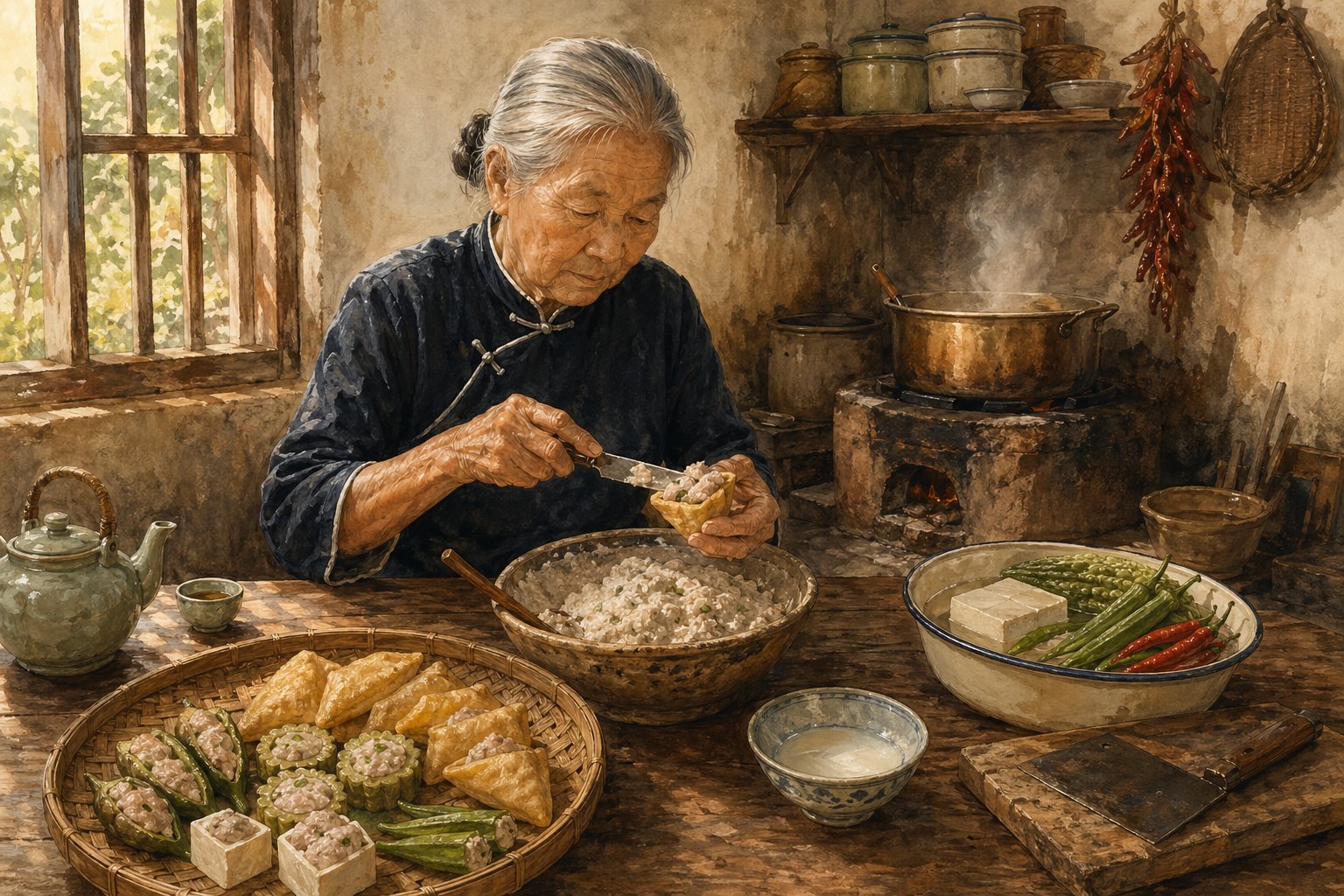
The Hakka brought their stuffed dumpling to a country with no wheat — and so they stuffed everything else.
The Hakka are the wandering people of southern China — kejia literally means "guest people," the migrant clans who moved south from the central plains and never quite settled, generation after generation. They carried their food traditions across centuries of displacement, and one of those traditions was the stuffed-dumpling: a wheat wrapper filled with seasoned meat, cooked in broth.
When the Hakka arrived in Singapore and Malaya from Guangdong and Fujian in the nineteenth century, they ran into a problem. The southern climate did not produce wheat the way the northern plains did. Wheat was expensive, foreign, scarce. So the Hakka cooks did what the Hakka always did — they adapted.
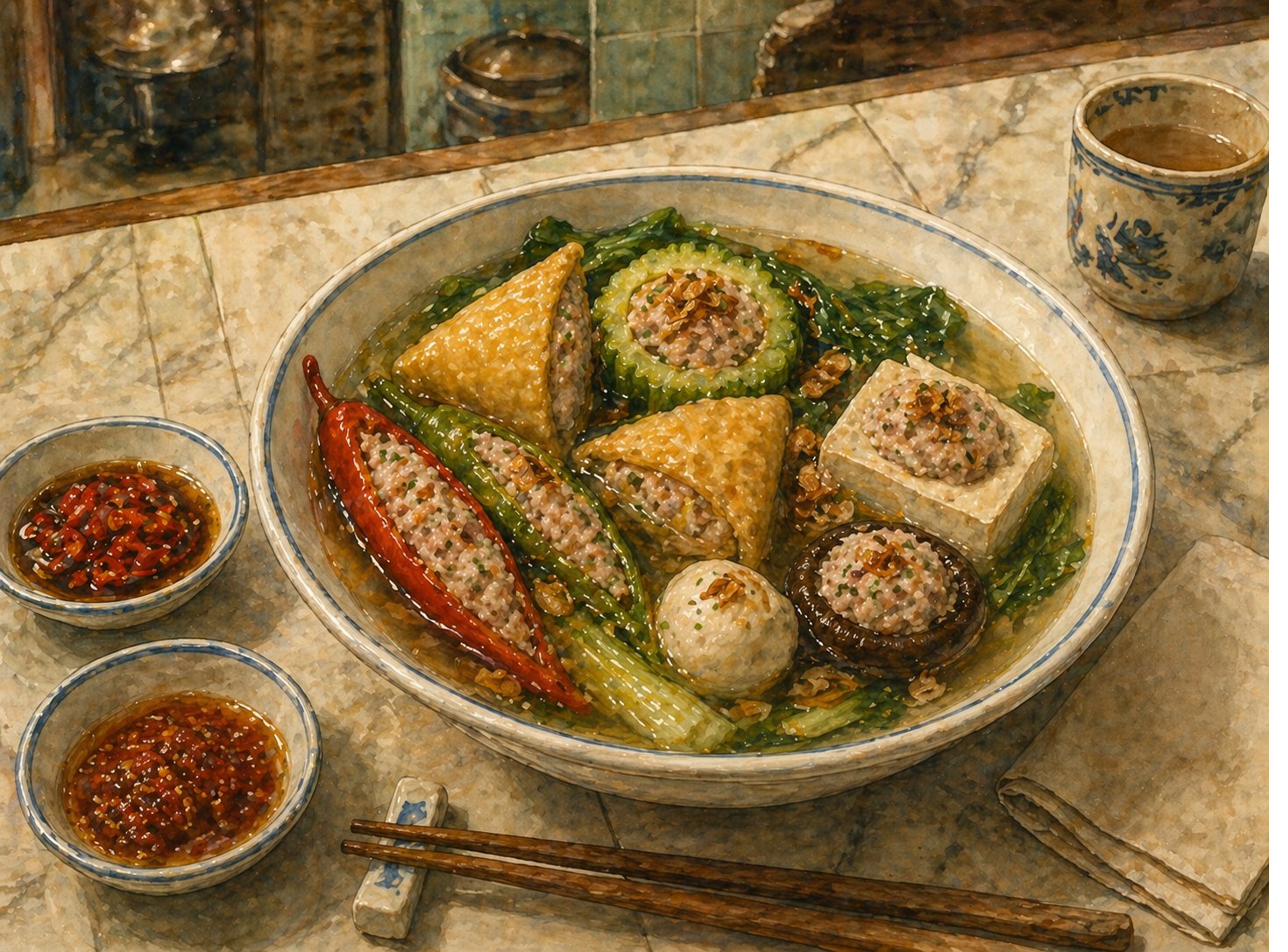
They took the same stuffing — minced fish and minced pork, seasoned with white pepper and soy and a little chopped water chestnut for crunch — and stuffed it into whatever vessels the new climate offered. Tau pok (豆卜, fried tofu puffs). Soft tofu. Bitter gourd. Long red chillies. Long green chillies. Ladies' fingers. Aubergine. Shiitake mushrooms. Each vegetable became a little dumpling-replacement, each one a small Hakka argument with the local pantry.
The dish that resulted — Hakka Yong Tau Foo, literally "stuffed tofu" but functionally meaning "stuffed everything" — became the chapter's defining heritage form. It is the most genuinely Hakka of the Hakka dishes that survived to Singapore: a dish that exists nowhere else in this exact form, the direct descendant of a centuries-old migration habit.
In Singapore the dish split into two streams. The heritage stream — what my Hakka neighbour-uncle made — is a soup bowl: a customer's selection of stuffed pieces poached gently in clear broth, served with a heritage dipping sauce of light-soy-and-chilli on the side. This is the Hakka home version, the wedding-dinner version, the version where the broth itself is the unifying force. The hawker-centre stream — what most Singaporeans eat today — is the "pick-your-own" stall: a glass display of forty or fifty different stuffed and unstuffed items (fish balls, beancurd skin rolls, fish cake, beancurd puffs alongside the heritage stuffed pieces), the customer picks with a pair of tongs, and the auntie boils them and serves either in soup or with a sweet-savoury sauce on the side, with rice or noodles. The pick-your-own register is now the dominant commercial form.
Heritage names for the soup-bowl form include Goldhill Hill Street (the heritage matriarch-cooked register, reportedly run by the same family for over fifty years) and Eminent Frog Porridge's Hakka offerings on Geylang. Heritage names for the pick-your-own form include Rochor Original Yong Tau Foo and Xiu Ji at Chinatown Complex.
I am giving you the heritage soup-bowl version here. The pick-your-own form descends directly from this — the same stuffing, the same broth, just at hawker scale.
🛒Ingredients
Fish-and-pork paste, a variety of vessels, clear broth. The slap-mix and the broth clarity are the two locks.
For the Fish-and-Pork Stuffing Paste makes enough to stuff ~50 pieces
| Fresh white fish fillet (yellowtail or wolf herring) | 400 g, deboned and minced | Heritage version uses ikan parang (wolf herring) — the wolf herring's fine bones release a natural binder when pounded. |
| Minced pork (with 20–25% fat) | 300 g | NOT lean pork — the fat is essential for tenderness. |
| Water chestnut, finely chopped | 80 g (~4) | The textural anchor — adds a small audible crunch. |
| Salted dried fish (ti po, dried sole fish), finely powdered | 1 tsp | Optional umami boost — heritage Hakka stalls add a tiny pinch. |
| Spring onion, finely chopped (greens only) | 3 tbsp | |
| Light soy sauce | 1.5 tbsp | |
| Shaoxing wine | 1 tbsp | |
| Sesame oil | 1 tsp | |
| White pepper | 1 tsp | |
| Sugar | 1 tsp | |
| Ice-cold water | 3 tbsp | Added gradually during the slap-mix to keep the paste cold. |
| Cornflour | 2 tbsp | Binder. |
| Salt | 1 tsp |
For the Vegetables and Vessels scale up or down based on selection
| Yellow tau pok | 12, cut into triangles | Slit along the cut edge. |
| Long red chillies (mild, not bird's-eye) | 4, halved lengthwise | Heritage Hakka chilli stuffing uses long mild chillies, not the small fiery ones. Deseeded. |
| Long green chillies (mild) | 4, halved lengthwise, deseeded | |
| Bitter gourd | ½ medium | Cut into 2 cm-thick discs, seeds and white pith scooped out, blanched 1 minute. Blanching reduces the bitterness without destroying the texture. |
| Silken tofu | 1 block (300 g) | Cut into 3 cm cubes, top hollowed with a small spoon. Soft and fragile — handle with both hands. |
| Dried shiitake mushrooms | 6, soaked | Soaked in warm water until soft, stems trimmed. Reserve the soaking water for the broth. |
| Ladies' fingers (okra) | 6, slit lengthwise on one side | |
| Cornflour slurry | 2 tbsp + 4 tbsp water | For sealing the cuts on the chillies and tau pok. |
For the Clear Broth makes about 2.5 litres
| Pork bones (with marrow) | 800 g | Pork rib bones or pork-leg bones. |
| Dried ikan bilis (Malay for dried anchovies) | 50 g, rinsed | The heritage Hakka clear-broth base — gives clean umami. |
| Dried hae bee (蝦米, dried shrimp) | 30 g, soaked | |
| Mushroom soaking water | 250 ml | Reserved from the shiitake soak above. |
| Fresh ginger | 30 g, sliced | |
| Spring onion (whole) | 2 stalks, knotted | |
| White peppercorns | 1 tbsp, lightly cracked | |
| Salt | 1.5 tsp, or to taste | |
| Light soy sauce | 1 tbsp | For seasoning only — the broth should NOT take on a soy colour. |
| Water | 3 litres |
🌶️Shifu's Lift
choose one path — see "Shifu's Secret" chapter for the philosophy- Old-school path: ¼ tsp MSG dissolved in finished broth
- Modern hawker path: ½ tsp chicken stock powder
- Heritage purist path: Already covered with ikan bilis + hae bee + mushroom soaking water
For Each Bowl per serving
| Customer's selection of stuffed pieces | 8–10 | |
| Plain fish ball | 2 | |
| Chye sim (菜心, choy sum) or bok choy, blanched | A small handful | |
| Hot clear broth | ~400 ml | |
| Fried shallots | 1 tsp | |
| Fried garlic chips | A small pinch | |
| Chilli oil drizzle | 1 tsp |
Heritage Dipping Sauces serve on the side, customer chooses
| Hakka light-soy-and-chilli | to taste | Light soy + sliced bird's-eye chilli + a few drops of sesame oil. |
| Toasted-sesame-and-chilli paste | to taste | Ground toasted sesame + chilli flakes + a touch of sugar + light soy. A heritage second condiment, found at older Hakka stalls. |
👨🍳Method
Five stages. Slap-mix, build broth, stuff, sub-boil, assemble. The bare hand and the patient broth do the work.
Make the Stuffing Paste — Bare-Hand Slap-Mix
Place the minced fish in a heavy ceramic bowl. Add the salt, sugar, white pepper, and Shaoxing wine. Mix with your bare hand for 3–4 minutes, slapping the paste against the side of the bowl repeatedly. The paste will gradually transform from sticky-loose to springy-bouncy. This is the heritage-Hakka technique that develops the fish protein's bounce — what Hokkien hawkers call qq.
Add the minced pork. Continue slapping for another 2–3 minutes, until the two are fully integrated into a single uniform pink-grey paste.
Add the chopped water chestnut, spring onion, and powdered ti po. Mix in by hand without slapping (the water chestnut should remain in distinct flecks — slapping further will break it down).
Whisk the cornflour into 3 tbsp ice-cold water. Add to the paste in three additions, slap-mixing between each. The paste should now be shiny, springy, and slightly wet. Add the sesame oil and light soy. Final slap-mix.
Cover and rest in the refrigerator for 30 minutes. The rest develops the paste's bounce further.
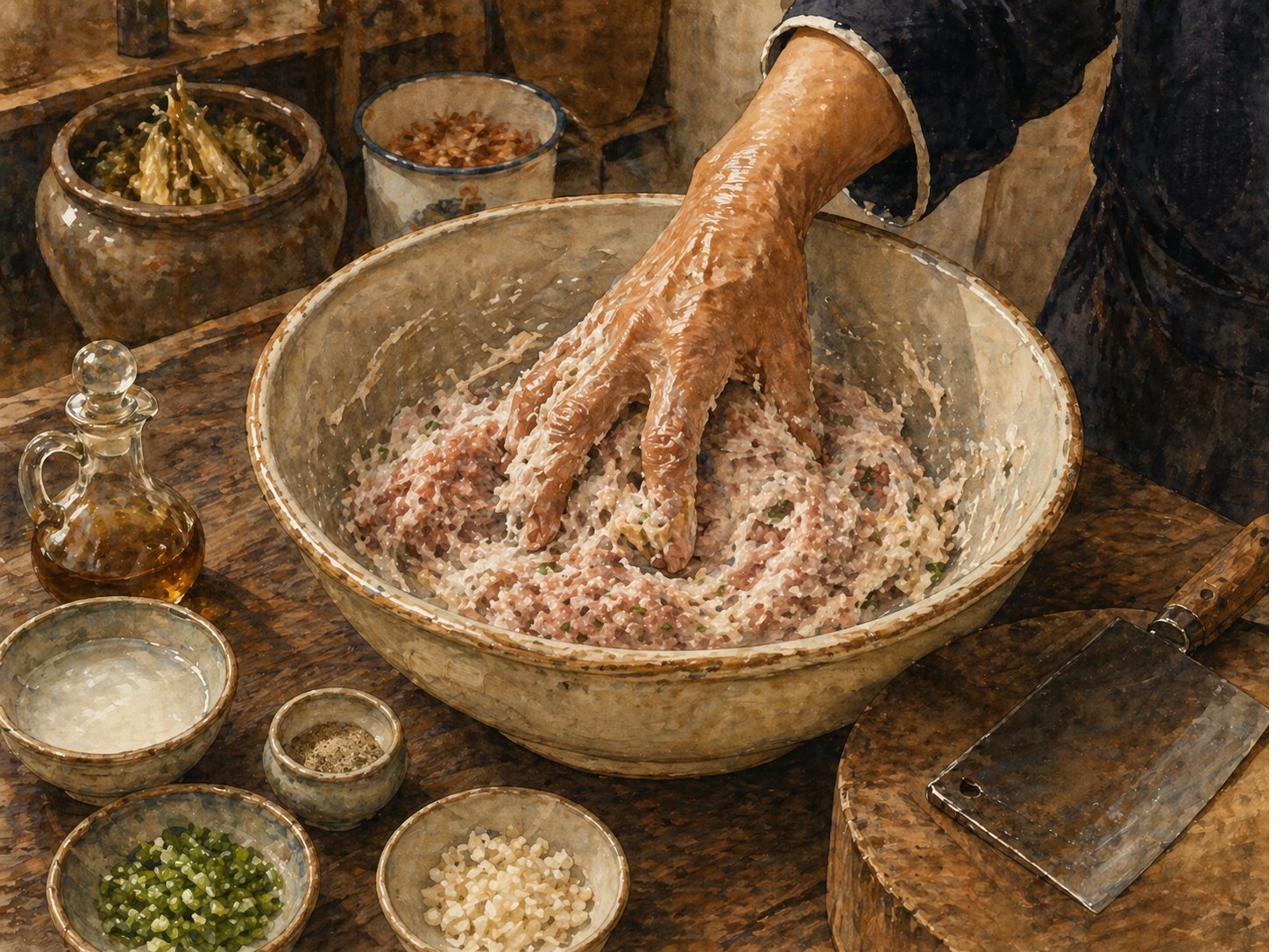
Pause point: the paste keeps refrigerated for 24 hours. The rest improves it.
Build the Clear Broth
In a stockpot, blanch the pork bones: cover with cold water, bring to boil, boil 5 minutes, drain, rinse the bones under cold running water (this removes the surface scum that would cloud the broth — heritage clarity is non-negotiable).
Return the bones to a clean pot. Add 3 litres fresh cold water, the rinsed ikan bilis, the soaked hae bee with its soaking water, the mushroom soaking water, ginger slices, knotted spring onion, and white peppercorns.
Bring slowly to a simmer (not a hard boil). Skim foam every 15 minutes for the first hour. Simmer gently for 2.5 hours total, uncovered. The broth should remain clear amber, never cloudy.
Strain through a fine sieve into a clean pot. Discard solids. Season with salt and the small amount of light soy. Taste — the broth should be clean, savoury, with a soft seaweed-and-mushroom backbone, and a long peppery finish.
Hold at sub-boiling temperature (the surface tremor should be barely visible) for service.
Stuff the Vegetables
Lay all the prepped vegetables on a wooden cutting board. With a butter knife, scoop a small portion of paste — about 1.5–2 tablespoons per piece — and press into each vessel:
- Tau pok triangle: slit the long edge with a small knife, gently spread the cavity, press paste into the slit.
- Halved long chillies (red and green): mound paste along the cut surface, slightly overfilling.
- Bitter gourd discs: press paste firmly into the hollow centre, mounding slightly above the rim.
- Silken tofu cubes: with the back of the spoon, scoop a small hollow in the top of each cube. Mound paste in the hollow — handle gently, the tofu is fragile.
- Shiitake mushrooms: mound paste over the gill-side, smoothing with the back of the knife.
- Ladies' fingers: slit lengthwise on one side, press paste into the slit.
For the chillies and the tau pok, brush the cut edges with cornflour slurry before pressing the paste in. This seals the paste to the vessel during poaching and prevents it from falling out into the broth.
Rest the stuffed pieces on a cool wicker tray. Do not stack them.
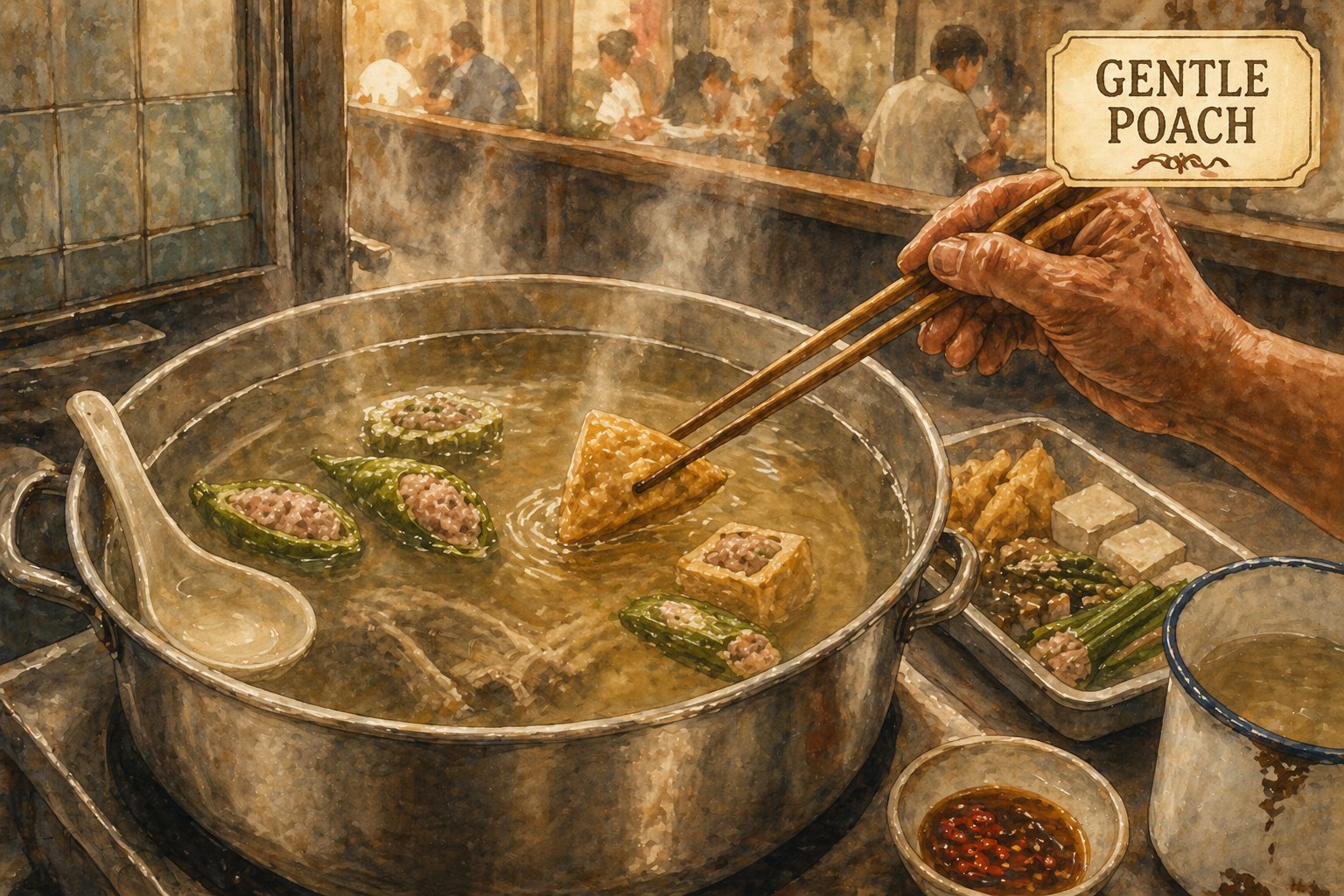
Pause point: the stuffed pieces keep refrigerated for 4 hours before poaching. Beyond that, the vessels begin to weep.
Poach Gently in Sub-Boiling Broth
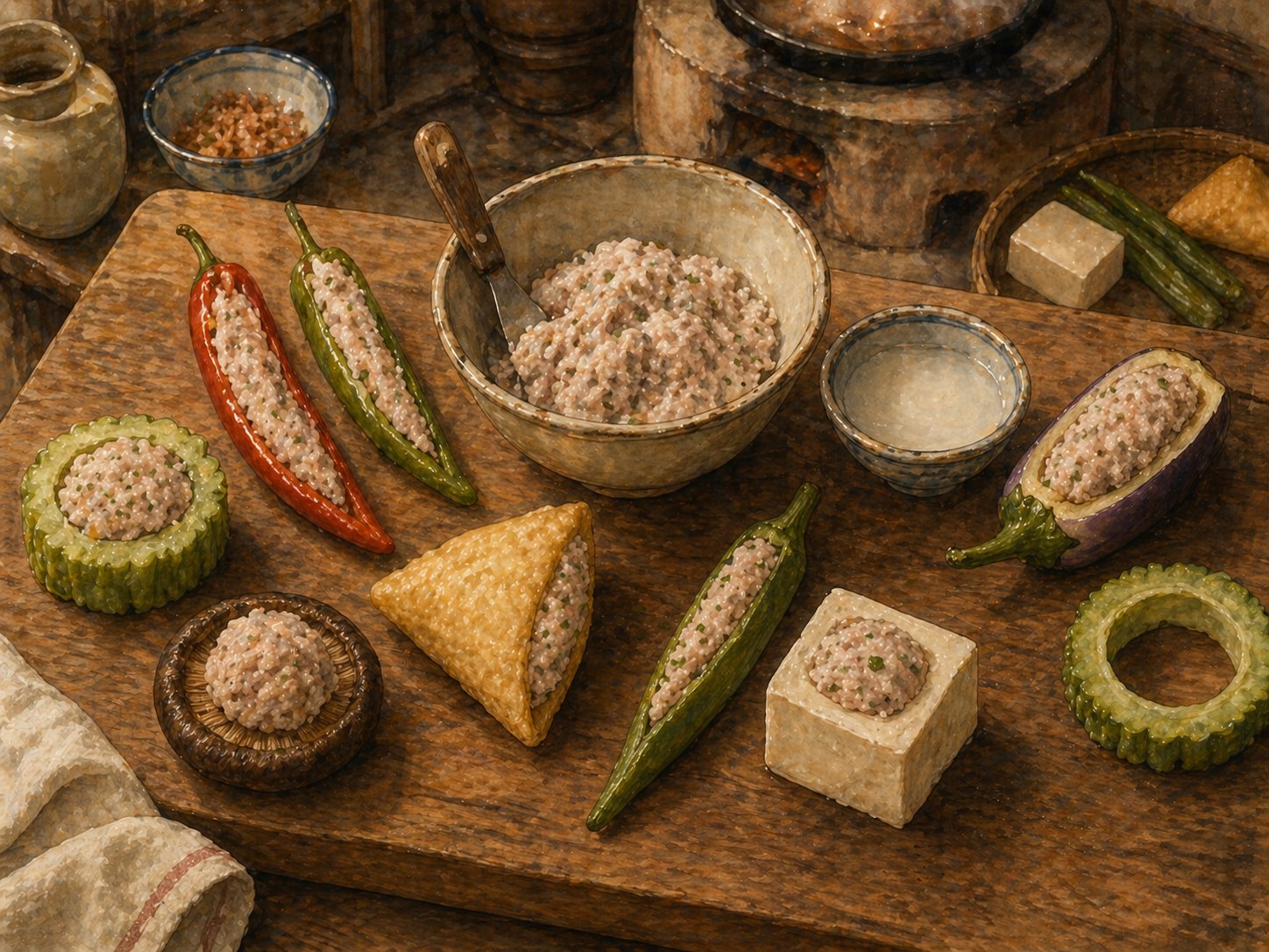
Bring the strained broth back to a gentle pre-boil — the surface should show only the finest tremor, never rolling bubbles. Heritage Hakka clear-broth poaching is sub-boiling, not simmer-boil. Test: a single stuffed bitter-gourd disc dropped into the broth should sink slowly and bob gently, not be tossed by convection currents.
Lower the stuffed pieces into the broth in batches by category (chillies first, they cook fastest; then bitter gourd; then tau pok; then tofu and mushrooms; ladies' fingers last). Each piece poaches 5–7 minutes, depending on size. The fish paste turns from pink-grey to opaque white-grey when fully cooked.
Add the plain fish balls to the broth. They float when fully heated through — about 3 minutes.
Blanch the chye sim or bok choy in a separate pot of plain boiling water for 30 seconds. Drain.
Assemble and Serve
For each bowl:
- Arrange 8–10 of the customer's selected stuffed pieces in a wide bowl.
- Add 2 plain fish balls.
- Add a small handful of blanched chye sim or bok choy.
- Ladle hot clear broth over to cover (about 400 ml per bowl).
- Crown with fried shallots, fried garlic chips, and a small drizzle of chilli oil.
- Serve immediately with the heritage dipping sauces on the side — customer chooses.
🎯The Three Tips
Heritage. Master's. Mistake.
🏛 Heritage Note
The "Yong" Word
The character yong (酿) means literally "to ferment" but in Cantonese-Hakka cooking it has a second meaning: "to stuff." The dish is named for the act of stuffing, not for any single vessel. That is why a stall with forty different stuffed and unstuffed items is still called Yong Tau Foo — the word names the technique, not the ingredients.
This is a Hakka linguistic-and-culinary fingerprint worth keeping. When a young Singaporean cook calls the dish "stuffed tofu" they have collapsed forty different vessels into the most famous one. The heritage form is stuffed everything, with tofu as the most iconic but never the only example.
👨🍳 Master's Tip
The Slap-Mix Rhythm
The single technique that separates the heritage Yong Tau Foo from the supermarket-paste version is the slap-mix rhythm of the stuffing paste. The fish paste must be slapped against the bowl wall, hard, repeatedly, for the full 3–4 minutes — this aerates the paste and develops the bounce. It is a wet-thump rhythm, like a small drum.
Most home cooks underdo the slap-mix because their hands tire. Persist past the moment your hands want to stop. The paste tells you when it is done — it goes from sticky-loose to springy-shiny, and a small ball of it dropped into water will float instead of sinking.
The other technique that separates good from great is keeping the paste cold throughout the slap-mix. The ice-cold water added in three additions during the mix is not just for moisture — it keeps the fat from breaking.
⚠ Common Mistake
Cloudy Broth
Three failures:
- Pork bones not blanched first. Surface scum from raw bones clouds the broth permanently. Fix: the 5-minute boil-and-rinse step is non-negotiable. Heritage clarity demands it.
- Broth boiled too hard. Hard boiling extracts collagen too fast, turning the broth milky. Fix: gentle simmer only, never a rolling boil. Skim foam every 15 minutes.
- Stuffed pieces poached in rolling boil. The convection of a hard boil knocks paste out of the chillies and tau pok, into the broth, where it cooks into a cloudy crud. Fix: sub-boiling only — surface tremor barely visible. Heritage Hakka poaching is patient.
📈 Scaling for Hawker Service
For a heritage Hakka Yong Tau Foo stall (the soup-bowl form)
- Daily prep: 8–10 kg fish paste mixed at dawn (4 am–6 am, the bare-hand slap-mix is the slowest step). Stuffing happens through the morning — variety of vessels stuffed in batches as customers' selections settle in.
- Display: the heritage soup-bowl form keeps stuffed pieces on a refrigerated tray, NOT in the hot broth (broth-side storage destroys the texture). Pieces go into broth only when an order comes in.
- Broth management: one large pot of clear broth held at sub-boiling temperature throughout service. Topped up with reserve broth from a smaller pot every 2 hours. Never let the broth go to rolling boil during service — the entire pot's clarity collapses.
- The dipping-sauce ritual: light-soy-and-chilli is the customer-default; the toasted-sesame-and-chilli paste is for the heritage-aware customer. A young hawker who keeps both is signalling Hakka authenticity.
- Cost (Singapore 2026): Per 8-piece bowl ~SGD 2.40 (fish paste 1.00 + vegetables and tofu 0.50 + broth amortised 0.40 + condiments and aromatics 0.30 + labour 0.20). Sells SGD 6–10 standard. Margin: 60–70% at the heritage soup-bowl register.
The pick-your-own form scales differently — the customer-pricing-by-piece economy means margins fluctuate per-customer, with the high-margin items (handmade fish balls, stuffed chillies) carrying the low-margin items (industrial fish cake, beancurd skin rolls). Heritage stalls publishing per-piece pricing in 2026 typically run SGD 0.60–1.20 per piece, with the customer assembling a 6–10 piece bowl for SGD 5–9.
Yong Tau Foo is the dish the Hakka brought from the cold north and finished in the warm south. Every stuffed piece is a small argument with the local pantry. Every clear bowl is a record of who walked here, and what they cooked when they stopped walking.