Hae Mee
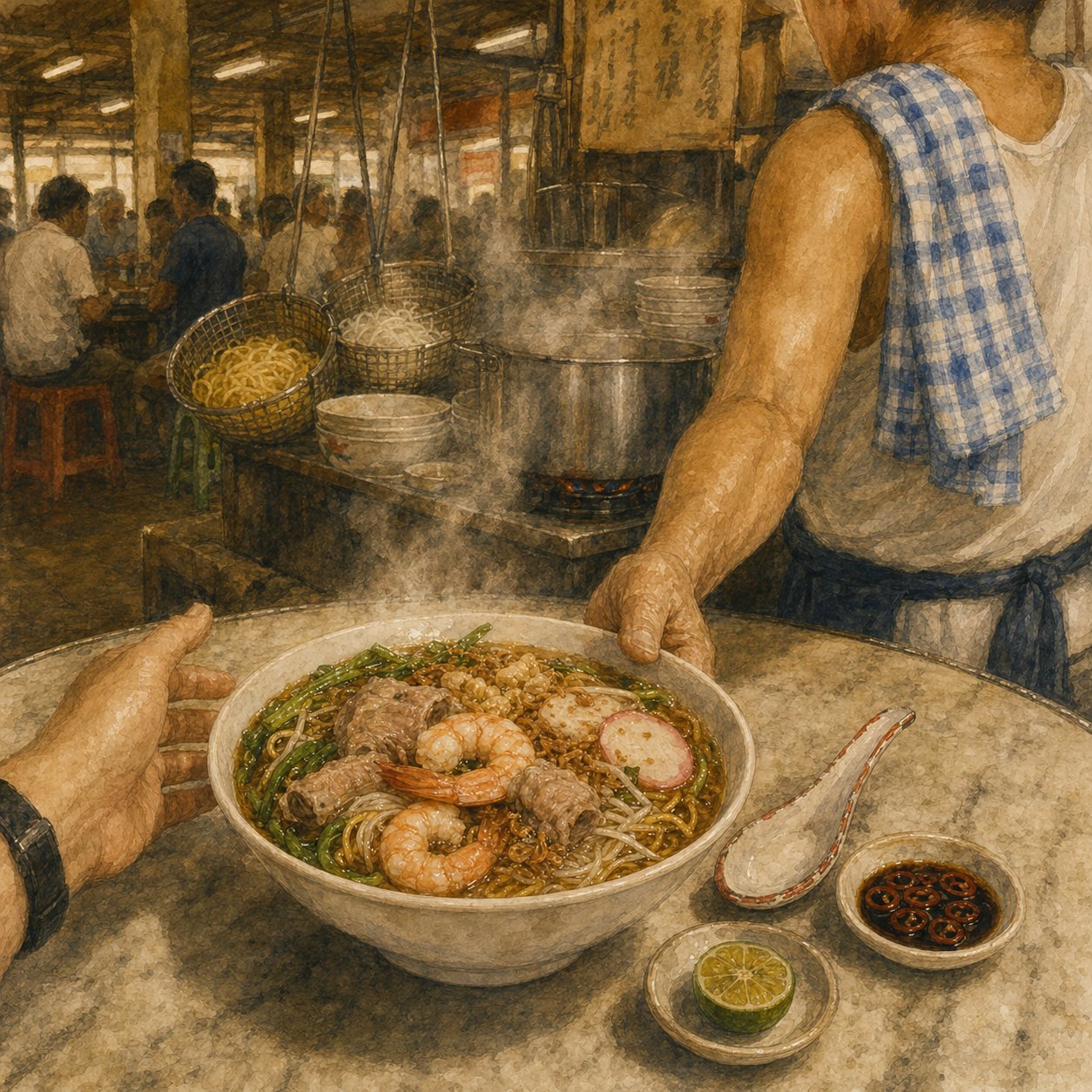
Now we come to my own dish — the one I sold at Maxwell for nineteen years.
Singapore prawn noodle soup is older than most people realise. Brought from Fujian in the 1880s, it took root on Hokien Street in the post-war period, where Australian flour was mixed with alkaline solution to create the yellow Hokkien noodle. They called it "boiled mee" to distinguish it from the egg-based Cantonese noodles.
Between 1940 and 1960, Hokien Street was the place to eat prawn noodles, especially for the night crowd — cabaret girls, taxi drivers, dock workers heading home. A bowl of broth alone was sold to the very poor; prawns and pork were a splurge.
The soul of this dish is the stock. Most stalls today use prawn heads + pork bones + dried shrimp. The premium stalls go further — Adam Road Famous Prawn Mee uses sea prawns + pork ribs + crabs. Some Ang Mo Kio stalls use black sugarcane for natural sweetness. The Joo Chiat stalls sometimes add submarine prawns and rock sugar for that distinctive sweet-fragrant signature.
I am sharing the premium version with sugarcane and a flower crab — because if young hawkers are going to differentiate themselves in a saturated market, stock depth is where you win. The customers cannot articulate why your soup is better, but they will queue.
🛒Ingredients
The premium version. Stock makes ~3 litres for 6–8 bowls — the heart of the dish.
For the Stock ~3 litres · 6–8 bowls
| Whole fresh prawns, head-on | 1.5 kg | sua lor (sea prawns) from wet market — premium. Vannamei substitute acceptable but inferior. |
| Pork bones (rib, neck, leg mix) | 1 kg | The bone variety gives complexity. |
| Pork ribs (for serving) | 600 g | Cut into pieces. |
| Flower crab (small) | 1 piece (~250 g) | Premium addition — adds clean shellfish sweetness. Substitute: 200 g extra prawn shells. |
| Fresh sugarcane | 200 g | 5 cm sections. Or substitute 50 g rock sugar (less premium but works). |
| ti po (dried sole fish) | 15 g | Adds umami backbone. |
| hae bee (dried shrimp) | 30 g | Soaked. Briny depth. |
| ikan bilis (dried anchovies) | 30 g | |
| Pork lard | 6 tbsp | |
| Garlic | 1 bulb | Peeled, smashed. |
| Shallots | 8 | Peeled, smashed. |
| White peppercorns | 2 tbsp | Lightly cracked. |
| Star anise | 2 pieces | |
| Rock sugar | 25 g | Additional, for final balance. |
| Dark soy sauce | 1 tbsp | For colour only. |
| Light soy sauce | 3 tbsp | |
| Fish sauce | 2 tbsp | |
| Salt | to taste | |
| Water | 4 L |
For Each Bowl per serving
| Yellow Hokkien noodles | 100 g | |
| Thick bee hoon | 50 g | |
| Whole prawns, peeled (tail-on) | 4 medium | |
| Pork ribs (from stock) | 3–4 pieces | |
| Sliced fish cake | 4 slices | |
| Bean sprouts | a handful | Blanched. |
| kang kong (water spinach) | a handful | Blanched. |
| Fried shallots | 1 tbsp | |
| Crispy lard cubes | 1 tbsp | |
| Sliced red chilli in dark soy | on the side |
🌶️Shifu's Lift
choose one path — see "Shifu's Secret" chapter for the philosophy- Old-school path: ¼ tsp MSG, dissolved in finished stock
- Modern hawker path: ½ tsp chicken stock powder
- Heritage purist path: Already covered with hae bee + ikan bilis + sole fish — no extra needed
👨🍳Method
Four stages. Stage 1–2 is the soul. Stage 3–4 is fast assembly. Stock is everything.
Render Lard & Toast Aromatics
Render 200 g pork fat into 6 tbsp liquid lard plus crispy cubes (see Hokkien Mee recipe Stage 1). Reserve.
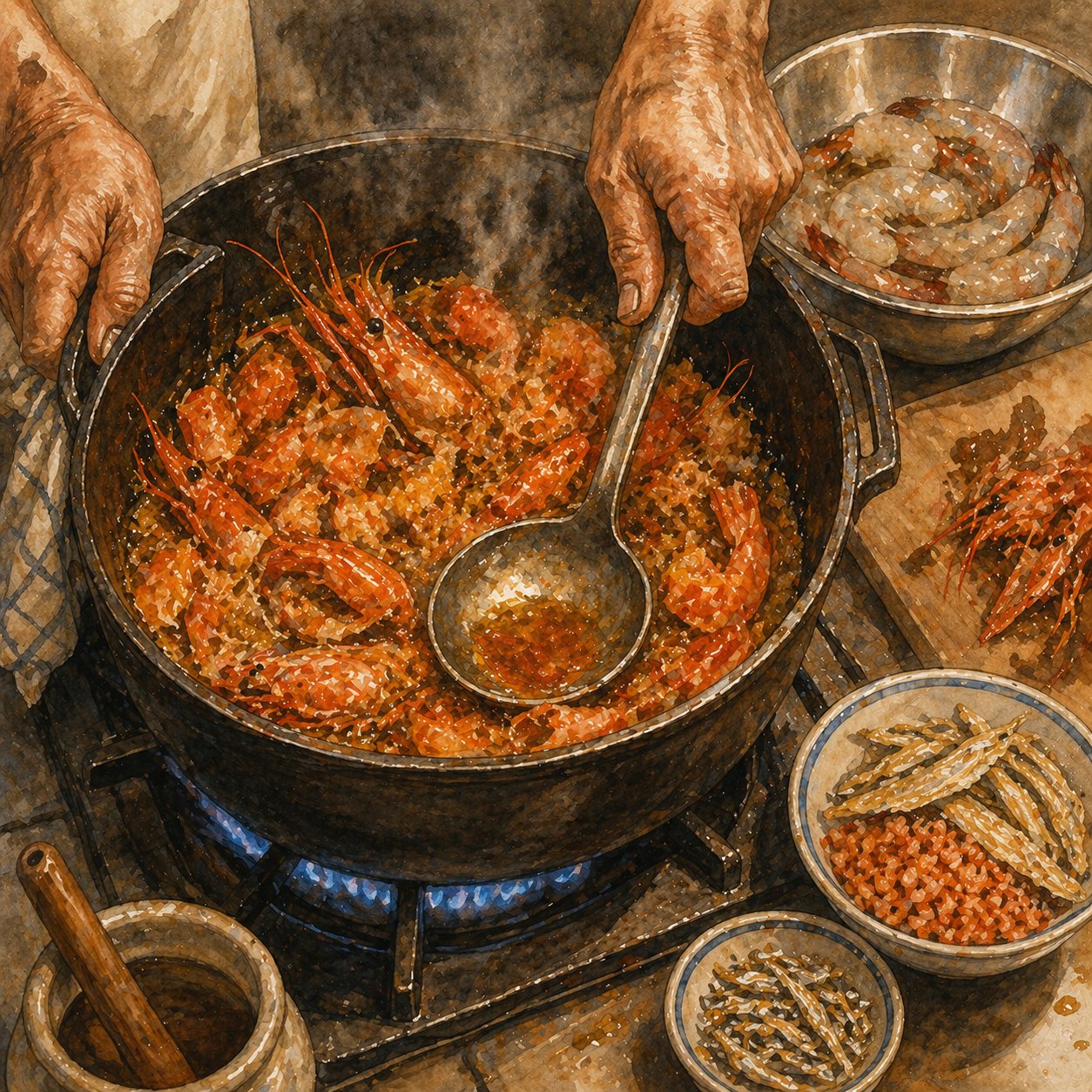
In a stockpot, heat 4 tbsp of fresh lard. Add prawn heads and shells (peel the prawns first, reserving 24 prawn bodies for serving). Fry hard, pressing with a ladle, for 6 minutes until deep orange. Add ikan bilis, dried shrimp, sole fish — fry another 2 minutes.
Build the Stock
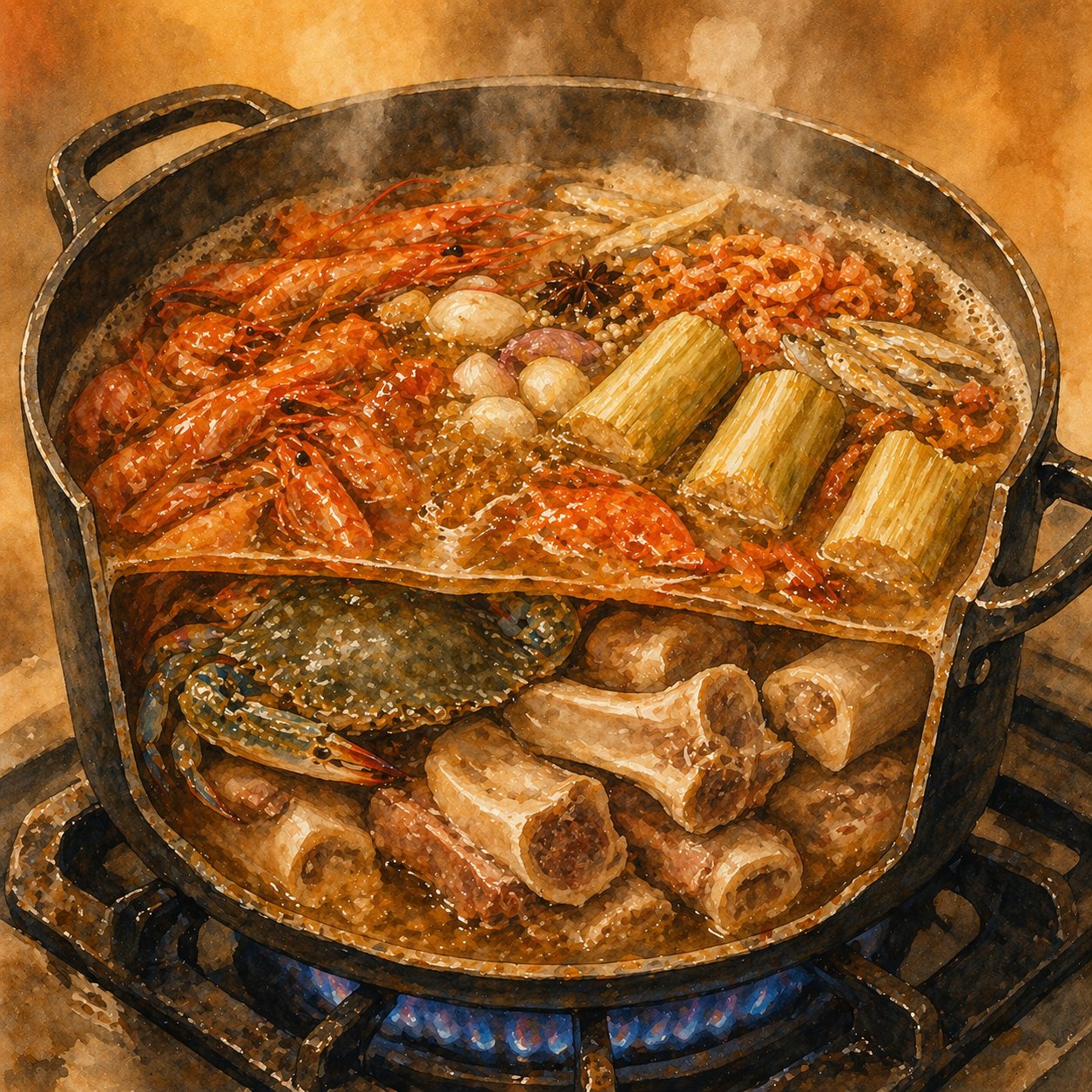
Add pork bones, ribs, garlic, shallots, peppercorns, star anise. Sear briefly. Add 4 litres water. Bring to boil, skim.
Add sugarcane sections, flower crab, rock sugar. Lower to gentle simmer. Cook 3 hours uncovered, skimming foam every 30 minutes.
After 3 hours: remove pork ribs (set aside for serving), strain stock through fine sieve into a clean pot. Reduce by one-third over high heat to concentrate — your final volume should be ~3 litres of deep amber broth.
Add dark soy, light soy, fish sauce. Taste. Adjust with salt. The broth should be slightly sweet, briny, with a long peppery finish.
Prep the Toppings
Blanch bean sprouts (15 sec) and kang kong (30 sec) in boiling water. Drain. Slice fish cake.
For the prawn bodies, drop them into the simmering stock for 90 seconds — just until they curl into a U-shape, not O-shape. Remove.
Assemble
For each bowl:
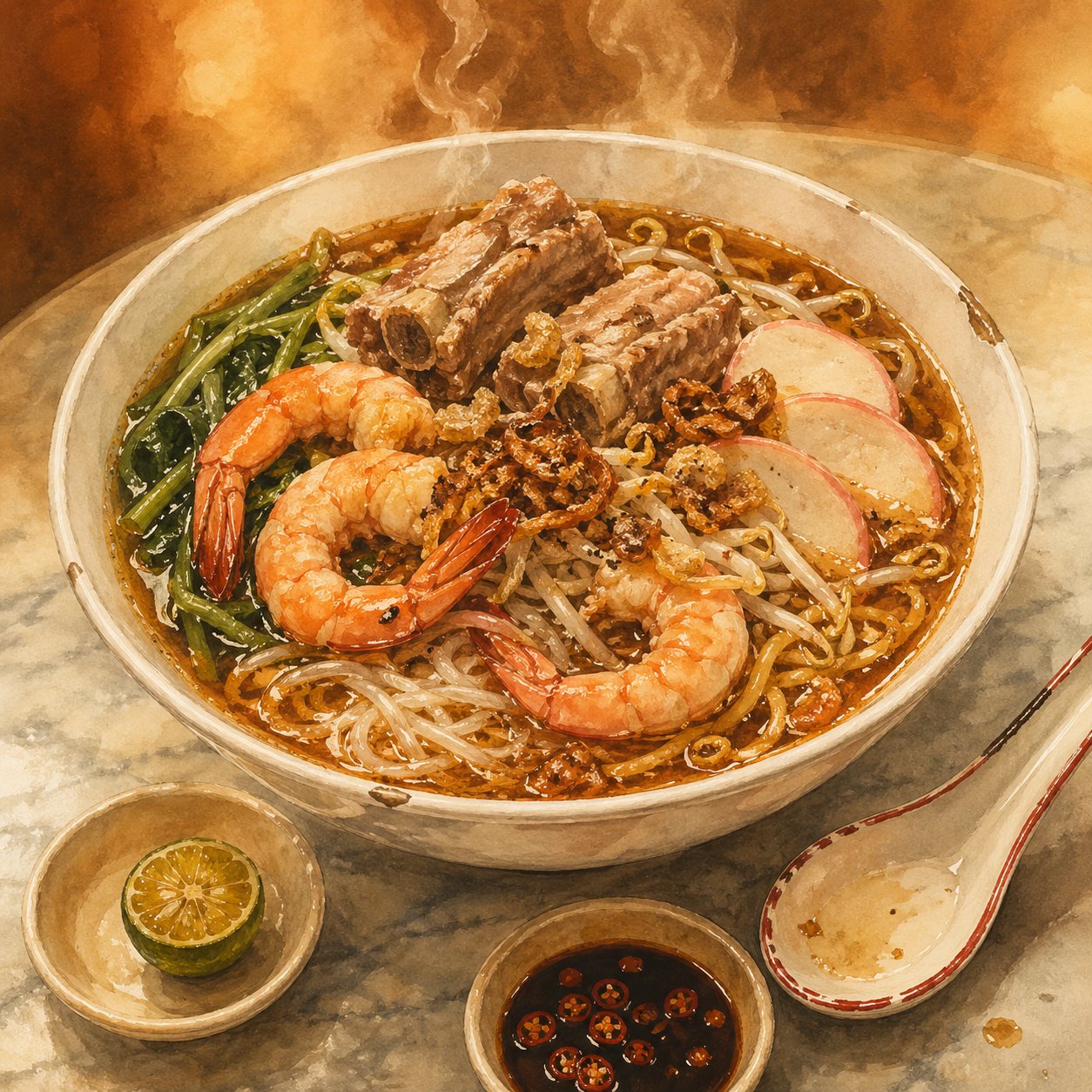
- Blanch yellow noodles + bee hoon together for 60 seconds. Drain.
- Place in bowl with bean sprouts and kang kong.
- Arrange prawns, ribs, fish cake on top.
- Ladle hot stock over to cover.
- Crown with fried shallots and crispy lard cubes.
- Serve with chilli-dark-soy condiment on the side.
🎯The Three Tips
Heritage. Master's. Mistake.
🏛 Heritage Note
The Stock Wars
Every prawn mee stall in Singapore is fighting the same war: who has the deepest, sweetest, most complex stock. The famous ones win on 8-hour simmer, secret ingredient, and obsessive freshness. Hoe Nam (River South) is famous for an 8-hour simmer. Adam Road uses crabs. Old Stall at Hong Lim uses pork-stomach broth. Each stall stakes its identity on stock.
For young hawkers entering the trade, your stock is your business. Spend more time on it than on anything else. Customers don't say "your prawns are fresh" — they say "your soup is so sweet." That sweetness is years of layered flavour, not sugar.
👨🍳 Master's Tip
Caramelised Rock Sugar Bridge
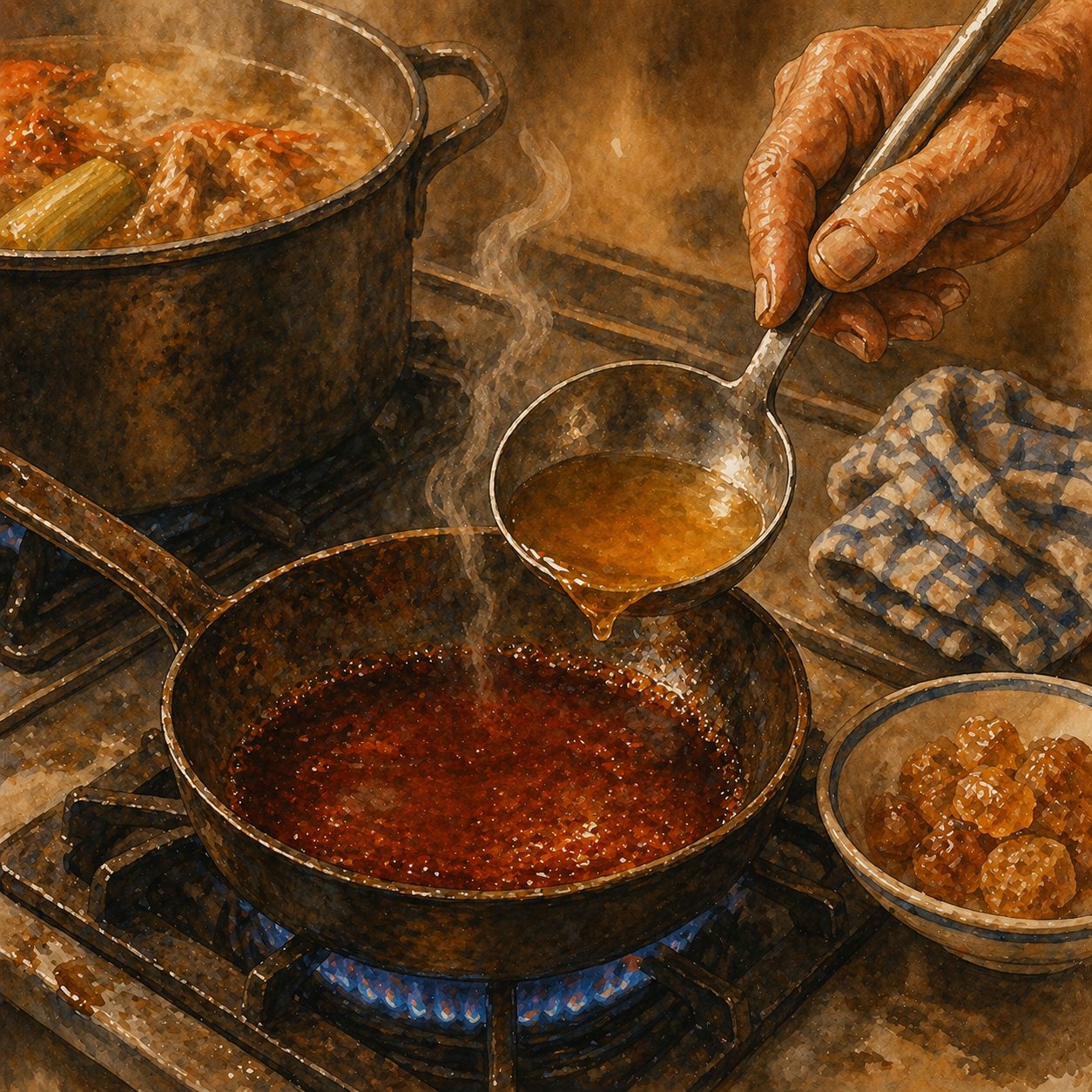
Here is a heritage technique most home cooks skip: caramelise the rock sugar separately, then add to stock.
In a small dry pan, heat 25 g rock sugar over low heat until it melts and turns mahogany brown. Carefully ladle in 100 ml of hot stock (it will hiss violently — keep your face back). Stir until dissolved. Pour the dark caramel back into the main stock pot.
This adds a bittersweet caramel layer that sugar alone cannot provide. It is the difference between a flat-sweet broth and a deep-sweet broth.
⚠ Common Mistake
Bitter Stock
If your stock tastes bitter or "flat-fishy," one of three things happened:
- Prawn shells burned during the initial fry. Bitter prawn oil ruins everything. Fix: Always fry on medium-high, not high, and stir constantly.
- You boiled the stock instead of simmering. Hard boiling extracts bitter compounds from bones. Fix: Lower to gentle simmer; reduce only at the end on high heat.
- You used old prawns. Fresh prawn heads = sweet broth. Day-old = bitter, ammonia-tinged. Fix: Source daily.
📈 Scaling for Hawker Service
For 100 bowls a day
- Stock production: 30 litres of stock daily, started at 4am, ready by 10am opening. Hold on low simmer all day.
- Prawn turnover: 8–10 kg fresh prawns daily — 60% to stock (heads/shells) and 40% to serve (bodies). Pre-peel in morning batch.
- Premium upsell strategy: Offer "regular" (SGD 6) and "big prawn / extra prawn / pork rib upgrade" (SGD 8–14). Margins are higher on upgrades because base stock cost is fixed.
- Cost (Singapore 2026): Per bowl ~SGD 2.20 (prawns 0.80 + ribs/fish cake 0.50 + noodles 0.30 + stock amortised 0.40 + lard/aromatics 0.20). Sells SGD 6–14. Margin: 60–75%.
At 4am the stockpot starts. By 11am the queue has formed. Every step in between is what you sell. There is no shortcut to this soup.