Babi Pongteh
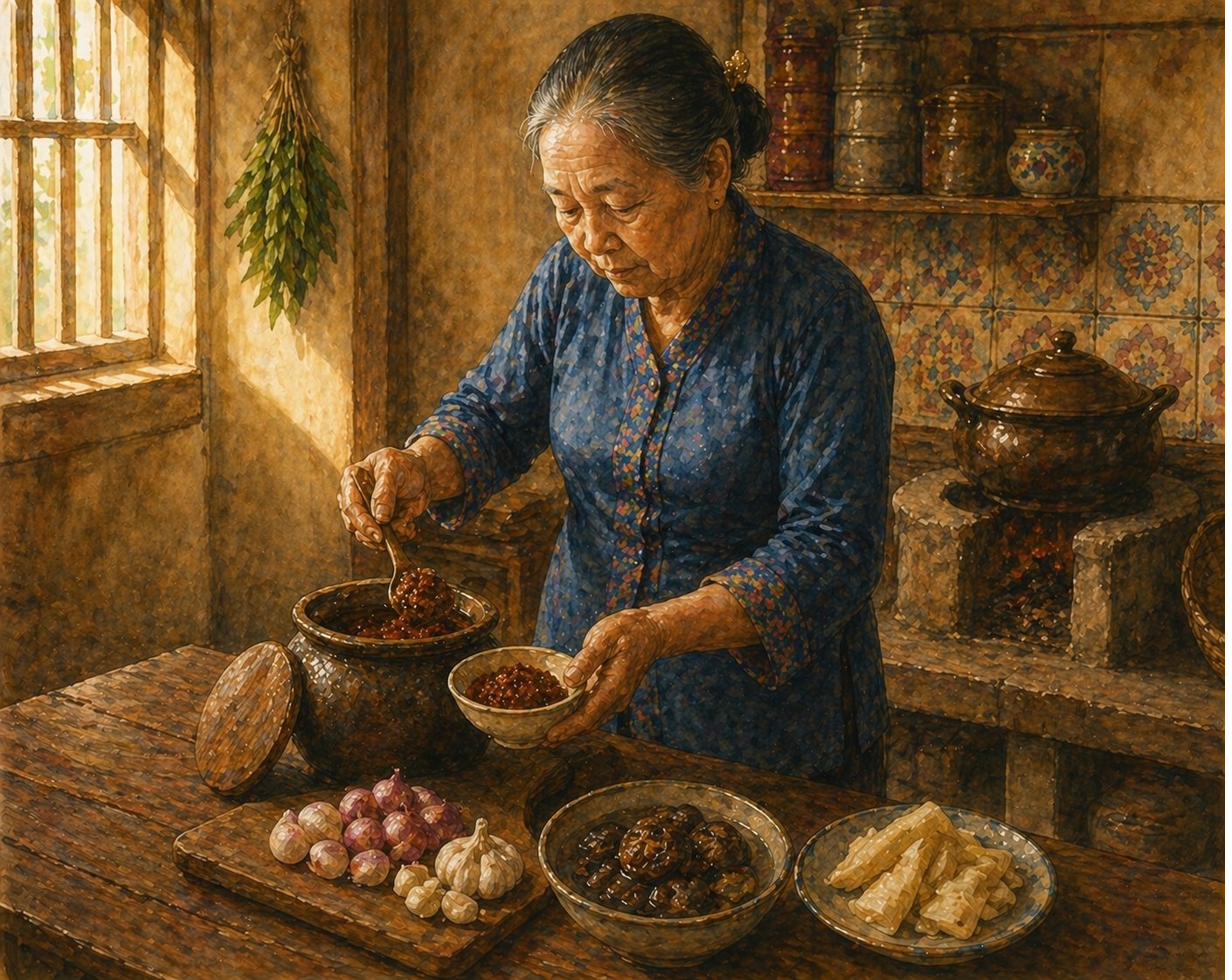
If buah keluak is the Peranakan dish that announces its heritage, babi pongteh is the dish that anchors it to the family table. This is what the Nyonyas cooked when family gathered — for Chinese New Year, for tok panjang feasts, for the ordinary weekend lunch that stretched into the afternoon.
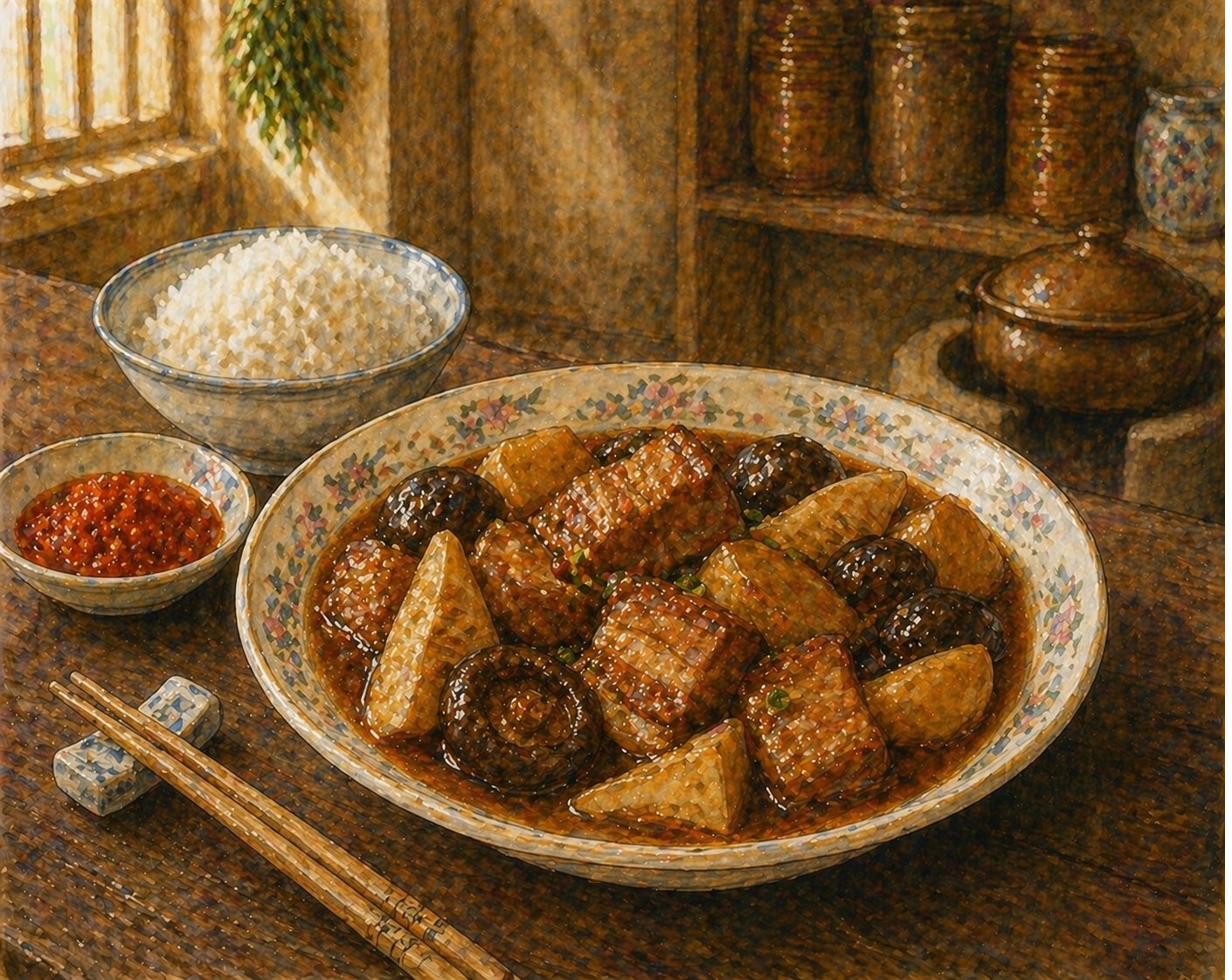
Babi Pongteh is a slow-braised pork stew built on tau cheo (豆酱) — the salty-funky fermented-soybean paste that gives the gravy its characteristic mahogany-brown depth and savoury anchor. Pork belly or pig trotter (the fatty cuts — lean pork ruins this dish) is browned, then layered with shallots, garlic, dried shiitake mushrooms, gula melaka, dark soy, and a touch of cinnamon. Bamboo shoots are added for textural contrast. The whole thing braises for two to three hours until the pork is melt-in-the-mouth and the gravy is glossy with rendered fat.
The name's etymology is contested. The Singlish dictionary records babi (Malay for pig) clearly enough, but pongteh itself remains an open question. The most-cited theory across heritage Peranakan cooking sources holds that "pong" derives from the Hokkien hong (烘 / 焖, to stew or braise in soy sauce) and "teh" from Hokkien te (蹄, pig trotter) — making "babi pongteh" a doubly-redundant "pig trotter stewed pig." A second theory holds that pongteh is a Hokkien-flavoured rendering meaning "meat tea" — referencing the dish's almost-soupy gravy that one slurps over rice the way one would tea or broth.
The dish is documented as far back as 2006 in William Gwee Thian Hock's A Baba Malay Dictionary (page 31) as "babi pongteh: stewed pork with bean paste" — a heritage register confirmation that places the dish solidly within the Peranakan culinary canon.
What's NOT contested: the dish's heritage form. Babi Pongteh originated in Malacca-Peranakan kitchens with bamboo shoots as the carbohydrate-and-textural element — pale-yellow wedges that absorb the tau-cheo gravy and give the dish its classic mouthful of soft-meat-and-firm-shoot bite. The Singapore-Peranakan evolution, particularly from the mid-twentieth-century onwards, added (or in some households substituted) potatoes — a starchier, softer carbohydrate that thickens the gravy as it cooks. I am giving you the Malacca-original heritage form here: bamboo shoots, no potatoes. A note at the end on the potato variation if you want to make it that way.
Two times in three Peranakan home cooks who attempt babi pongteh will reportedly undercook the rempah-tumis step — frying the shallots-garlic-tau-cheo without taking it far enough to bloom the paste into deep mahogany. The gravy then comes out flat, with the tau cheo's salty edge sticking out instead of melting into the dish. My Peranakan neighbour-auntie was very firm on this: the rempah-tumis is the dish. The braise just finishes what the tumis starts.
Babi Pongteh is a respectable feast dish in heritage Peranakan culture — served at tok panjang (Malay: long table) family gatherings during Chinese New Year, weddings, and birthdays, alongside ayam buah keluak, ngoh hiang, chap chye, and itek tim. According to heritage-cooking source Foodelicacy, Peranakan girls of marrying age were reportedly required to demonstrate their cooking skills to future in-laws by preparing a Peranakan delicacy — and a well-cooked Babi Pongteh was reportedly important in affirming a marriage proposal. Heritage references in Singapore today include Candlenut at 17A Dempsey Road (the Michelin-starred Peranakan restaurant from R26 — Babi Pongteh appears on the menu), Bibik Violet (Violet Oon's casual Peranakan café at Temasek Shophouse, where Babi Pongteh appears reportedly as a dinner staple per The Peak, October 2025), and the heritage Peranakan home kitchens where the dish most authentically lives.
I am giving you the heritage home-kitchen version here, the way it was made by my Peranakan neighbour-auntie's mother — same kitchen, same recipe-keeper as Recipes 26 and 28.
🛒Ingredients
Tau cheo is the soul; the pork is the body. Heritage rough-pounded shallots and garlic, no blender. Best made the day before.
For the Rempah Base
| Shallots | 12 medium (~200 g), peeled | Pounded or finely chopped — NOT a paste; heritage texture is rough-pounded. |
| Garlic | 8 cloves, peeled | Same treatment as shallots — pounded rough, not pasted. |
| Tau cheo (whole-bean variety) | 3 tbsp | The load-bearing flavour anchor. NOT the smooth taucheo paste — heritage texture has the soybeans visible in the gravy. |
| Cinnamon stick | 1 piece (~5 cm) | Optional but heritage; rounds the gravy. |
| Cooking oil (peanut or vegetable) | 5 tbsp |
For the Pork Braise
| Pork belly (skin-on) OR front-leg trotter (kaki babi) | 1.2 kg, cut into 4–5 cm cubes | Heritage cut. Lean pork is wrong — the dish needs the rendered fat for the gravy. Front-leg trotter gives the most luxurious mouthfeel; pork belly is the everyday-Peranakan substitute. |
| Dark soy sauce | 2 tbsp | Heritage cooks divide this — 1 tbsp marinade + 1 tbsp braise. |
| Gula melaka (Malay palm sugar) | 25 g, shaved | Heritage. White sugar substitutes but loses the dish's caramel note. |
| White pepper | ½ tsp | |
| Salt | to taste, only after final tasting | The tau cheo + dark soy usually deliver enough. |
| Mushroom-soaking water + boiling water | ~1.2 L total | Heritage cooks build the braise liquid from the mushroom-soaking water for added umami depth. |
For the Components
| Dried Chinese shiitake mushrooms (xiang gu, 香菇) | 80 g (~12–15 mushrooms), soaked in warm water 30 min | RESERVE the soaking water for the braise. Heritage Peranakan kitchens use medium-large dried shiitake, NOT fresh. |
| Bamboo shoots (fresh or vacuum-packed, NOT canned-in-brine) | 500 g, cut into 5 cm wedges | Boil in salted water for 15 minutes to remove bitterness, drain, set aside. The Malacca-original heritage form. If using canned, drain and rinse twice. |
| Garlic cloves (extra, whole) | 5 cloves, peeled, left whole | Heritage Peranakan addition — adds a second register of garlic depth at the braise stage. |
🌶️Shifu's Lift
choose one path — see "Shifu's Secret" chapter for the philosophy- Old-school path: ¼ tsp MSG dissolved in finished gravy
- Modern hawker path: ½ tsp chicken stock powder during the braise
- Heritage purist path: already covered with tau cheo's intrinsic umami + dark soy depth + mushroom soaking water + gula melaka caramel + the long-braise rendered-fat richness
For Serving
| Sambal belacan (heritage chilli-and-shrimp-paste condiment) | on the side | The non-negotiable Peranakan side — heat-and-bright counter to the rich gravy. |
| Steamed white rice | 1 cup per diner | The gravy is the soul; the rice is the canvas. Heritage cooks slurp the almost-soupy gravy over the rice the way one would soup or tea — possibly the etymological origin of pongteh as "meat tea." |
👨🍳Method
Seven stages. Marinate, prep, tumis, sear, braise, rest, plate. The tumis is the dish.
Marinate the Pork
In a large bowl, combine the cubed pork with 1 tablespoon dark soy sauce and the white pepper. Toss to coat. Set aside, covered, for at least 30 minutes — heritage cooks marinate longer (up to 2 hours) for deeper flavour penetration.
Prepare the Rempah Components
Pound (or finely chop) the shallots and garlic separately to a rough texture. Do not paste them in a blender — heritage Peranakan rempah for Babi Pongteh is rough-pounded, not smooth. The texture you're after: visible shallot-and-garlic pieces, just past mince. The blender's blades shred-and-spin rather than crush, producing a paste that releases water during the tumis and prevents proper bloom.
Mash the tau cheo in a small bowl with a fork to break up the larger soybean clumps; you want some bean texture left, not a complete paste.
Slice the soaked mushrooms into halves or thick pieces. Reserve the soaking water (strain through a fine sieve to remove any grit).
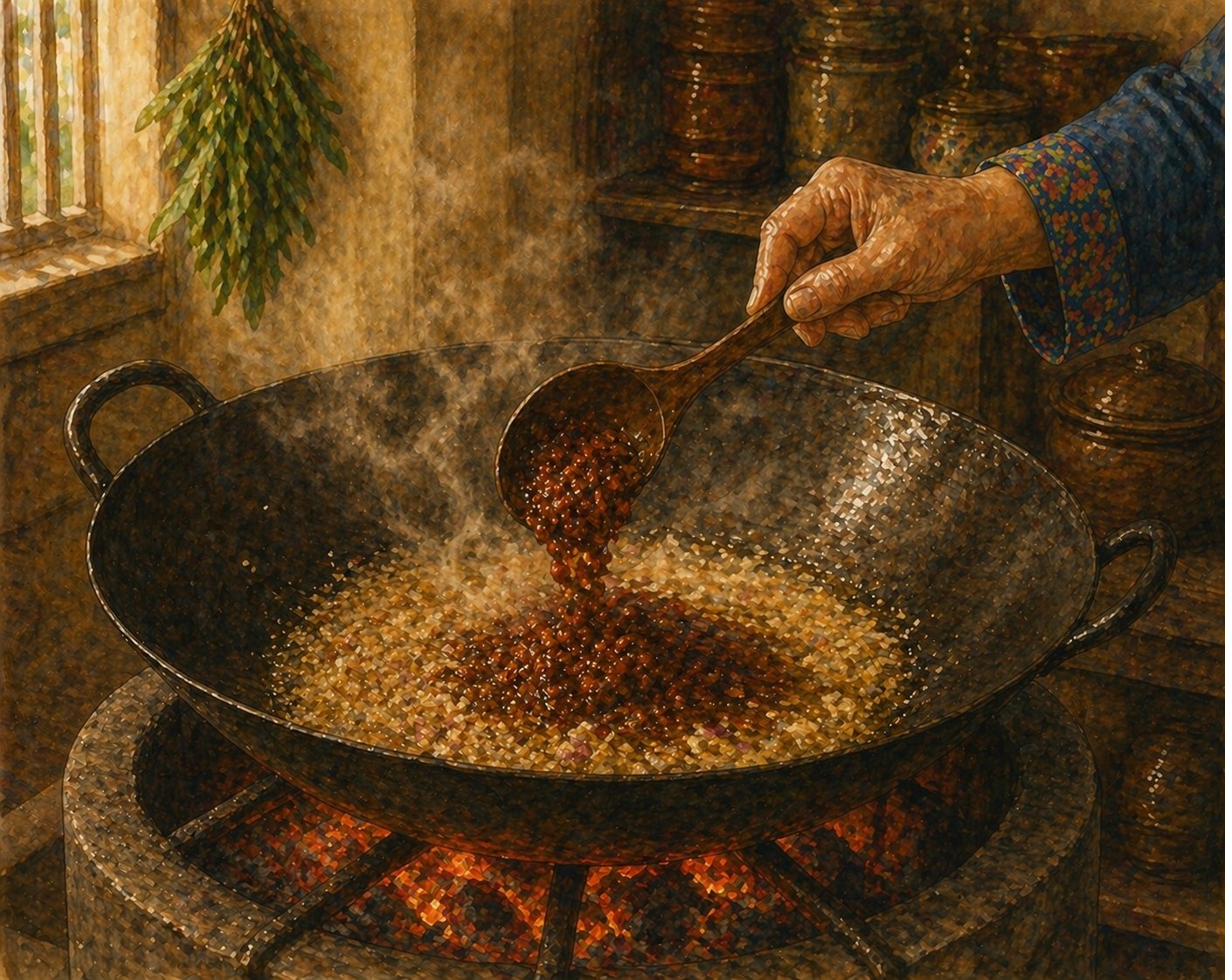
The Tumis heritage bloom step
Heat the oil in a heavy claypot or heavy-bottomed wok over medium-high heat. Add the pounded shallots and garlic, and the cinnamon stick. Stir constantly for 5–6 minutes — the shallots should soften, turn translucent, and edge into pale-gold without burning.
Reduce heat to medium-low. Add the mashed tau cheo. Stir constantly for another 6–8 minutes — this is the heritage tau cheo toast step, the dish's pivotal technique. The paste will progress from raw-pasty to deep-mahogany-brown with visible oil-pools at the surface. Heritage cooks watch for the oil-separation moment — when the rendered oil pools at the surface and the paste's colour deepens to glossy mahogany. This is the heritage marker that the tau cheo is fully cooked through.
Until you see this oil-separation, the tau cheo is not bloomed and the dish will lack depth. The most common heritage failure point.
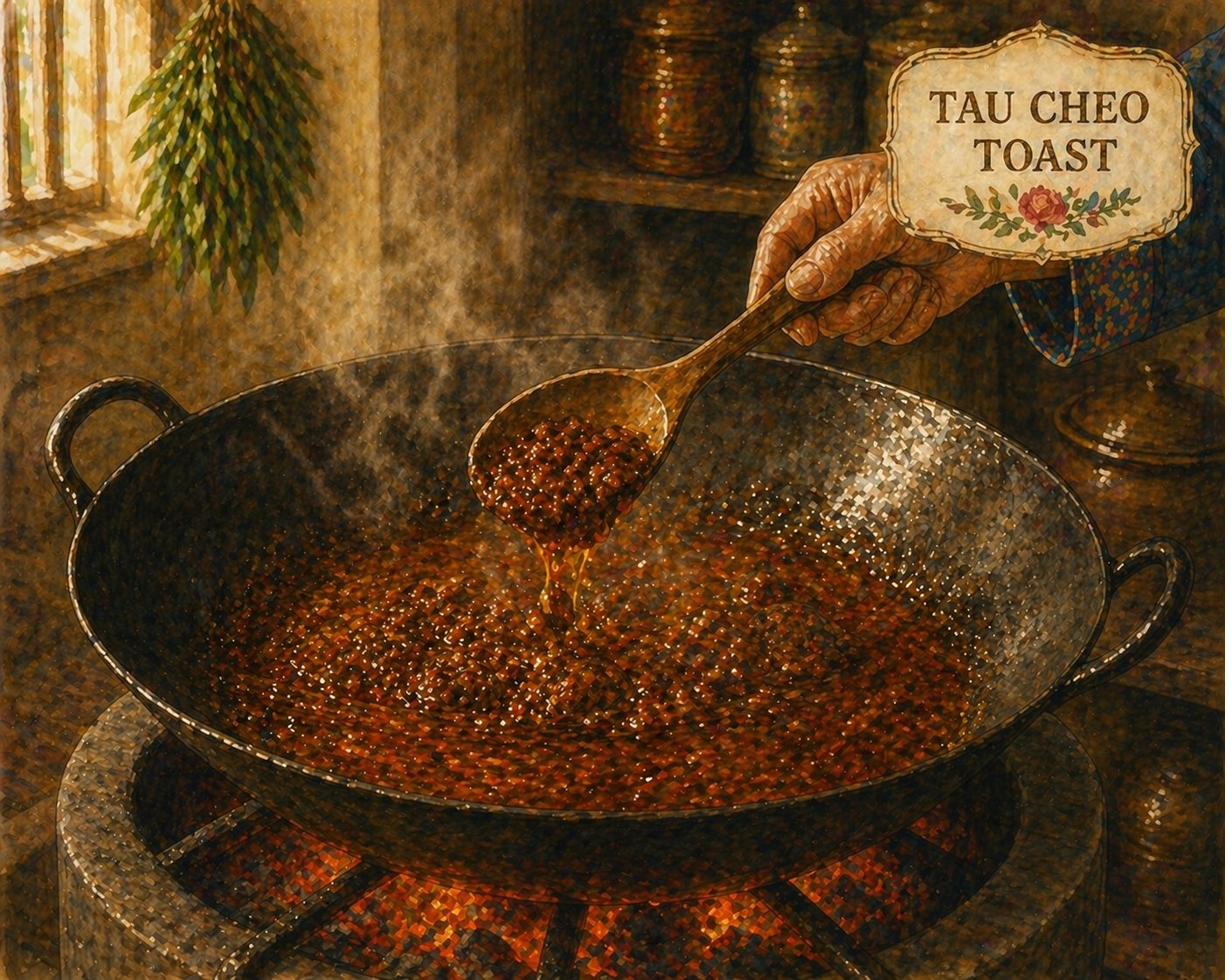
Sear and Braise
Add the marinated pork cubes to the bloomed tau cheo. Stir to coat — the pork should darken with the gravy register within 2–3 minutes. Add the remaining 1 tablespoon dark soy sauce, the gula melaka, and the whole garlic cloves. Stir 1 minute.
Pour in the strained mushroom-soaking water, plus enough boiling water to cover the pork by about 3 cm (total approximately 1.2 L). Add the sliced mushrooms.
Bring to a gentle boil, then reduce heat to LOW. Cover with the lid slightly ajar. Simmer for 1 hour 30 minutes — until the pork is fork-tender but still holding shape.
Add the Bamboo Shoots
Add the blanched bamboo shoot wedges. Simmer another 30–45 minutes — the bamboo shoots should absorb the gravy register and turn pale-mahogany-yellow on their surfaces while keeping their firm bite. The gravy should reduce to a glossy mahogany sheen with rendered-fat surface oil.
Taste; adjust salt only if needed (the tau cheo and dark soy usually deliver enough). If the gravy is too thin, uncover and simmer 10 minutes more to reduce. If too thick, add a splash of hot water.
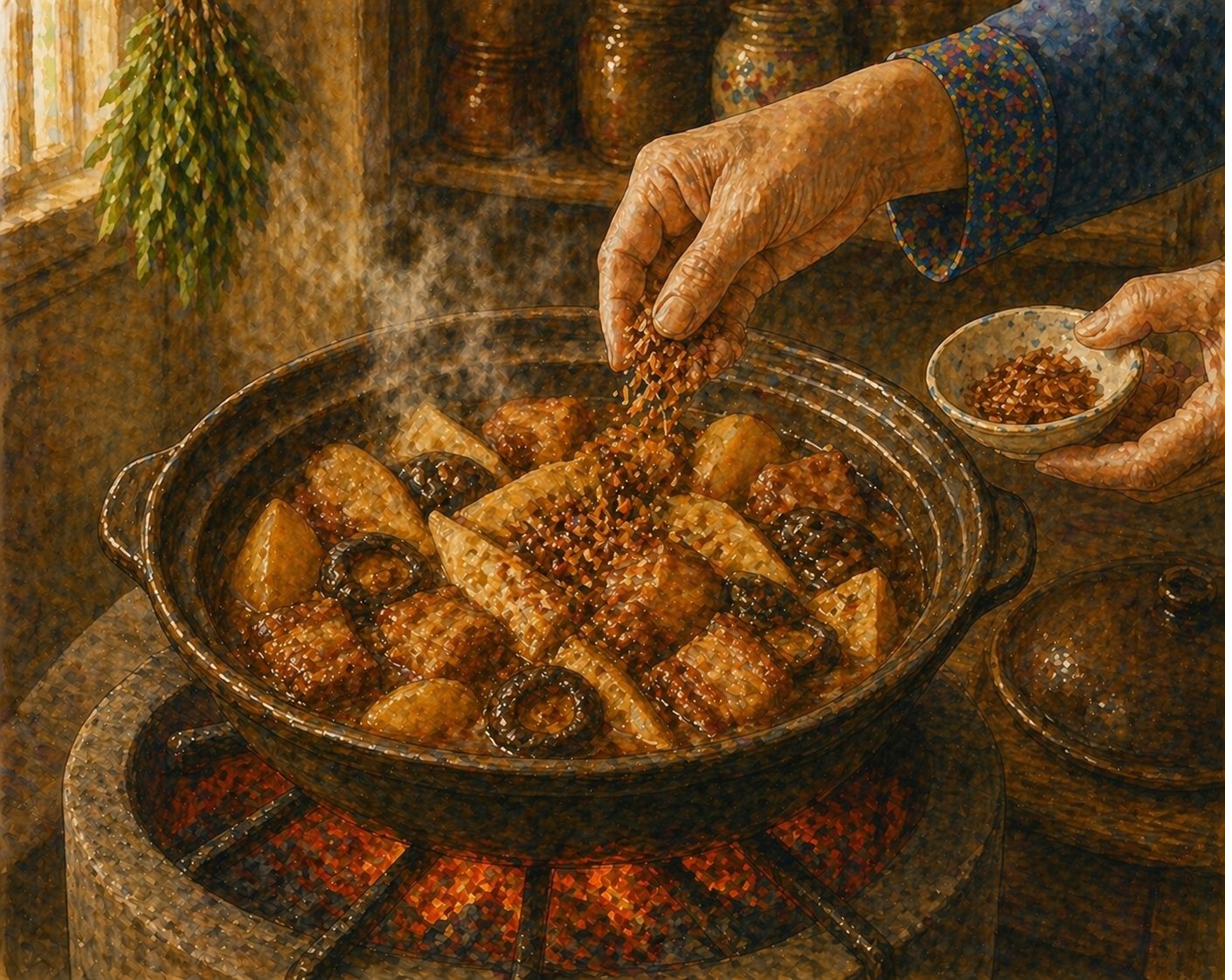
Rest and Re-warm heritage
Heritage Babi Pongteh is genuinely better the next day. The gravy thickens, the flavours integrate, and the pork's fat redistributes through the braise liquid. Cool the pot, refrigerate covered overnight. Re-warm gently the next day over low heat, adding a splash of water if the gravy has thickened beyond ladle-able.
Plate
Transfer pork chunks, bamboo shoots, mushrooms, and gravy to a heritage Peranakan everyday-bowl (NOT the deep tureen of R26 — Babi Pongteh's domestic-banquet register sits in a shallower, smaller serving vessel). Drizzle the surface with the rendered-fat-and-tau-cheo oil from the pot. Optional: scatter a small pinch of crushed bird's-eye chillies as a final-flourish accent. Finish with a tiny pinch of sea salt.
Serve hot at the centre of a tok panjang or family dining table. Each diner serves themselves pork-and-gravy over rice, with sambal belacan on the side.
🎯The Three Tips
Heritage. Master's. Mistake.
🏛 Heritage Note
The Heritage Is in the Small Disciplines
The whole dish is built on the rempah-tumis discipline. Skip the proper bloom and the gravy is flat. Use a blender for the rempah and the tau cheo separates from the oil during cooking. Use lean pork and the gravy lacks the rendered-fat richness that defines the dish.
The heritage is in the small disciplines, not the long ingredient list.
👨🍳 Master's Tip
The Bloom Marker
The oil-separation moment during the tau cheo bloom is the dish's pivotal technique-marker — the moment when rendered oil pools at the surface and the paste's colour deepens to glossy deep-mahogany-brown. The same heritage technique-watch as the minyak pecah marker in R26's rempah cookery, applied to a simpler shallots-garlic-tau-cheo paste.
Heritage cooks watch for this marker as the signal that the dish's flavour foundation is complete. Until you see oil-separation, the tau cheo is not bloomed — and braising over an unbloomed paste produces a gravy that tastes flat no matter how long you simmer it.
⚠ Common Mistake
Using Lean Pork
Lean pork is the most common heritage-failure substitution — home cooks worried about fat content swap pork belly for shoulder or loin. The dish does not work without rendered fat. The fat carries the tau cheo's flavour into the gravy and gives the braise its mouthfeel.
Heritage Peranakan-cooking sources are unanimous on this — Foodelicacy explicitly warns against the substitution. If you're worried about fat, eat less of it — but cook it the heritage way.
📈 Scaling for Hawker Service
Heritage-departure note: babi pongteh is a home-kitchen and family-restaurant dish, not a hawker dish
Like Ayam Buah Keluak (R26) and Itek Tim (R28), Babi Pongteh's labour-and-time profile sits outside the hawker-stall economics — the 2.5-to-3-hour braise plus the rempah-tumis discipline rules it out. Heritage Peranakan Babi Pongteh lives at the family table and the heritage Peranakan restaurant. There is no hawker-stall version of the dish in heritage Singapore.
For the home cook scaling up for a Peranakan family meal:
- The dish improves with overnight rest — make the day before serving for the best flavour integration. Heritage cooks make Babi Pongteh in the morning of the day before the feast.
- Tau cheo is non-uniform across brands — different Singapore Chinese-provision-shop tau cheo varies in salt-to-funk ratio. Taste-test on a small batch before scaling.
- The Singapore-Peranakan potato variation: if you want the modern-Singapore form, deep-fry 600 g of peeled-and-quartered potatoes in oil until golden-brown (about 4–5 minutes); add them to the pot at Stage 5 alongside the bamboo shoots. The potato form is a legitimate heritage evolution and is now standard in many Singapore-Peranakan family kitchens — both forms are heritage.
- Cost in Singapore (2026): the pork belly or front-leg trotter is the dominant raw-ingredient cost. The dish runs in the standard Peranakan home-cook tier — comparable to Itek Tim in raw-ingredient cost, meaningfully less expensive than Ayam Buah Keluak.
Babi Pongteh is the dish that proved you could marry a man's son. The Nyonya grandmothers I knew judged a Peranakan woman by her Babi Pongteh — not by how fancy it was, but by whether the tau cheo had bloomed. The bloom is the patience. The patience is the cook. If you cannot wait for the oil to separate, you cannot make this dish.