Itek Tim
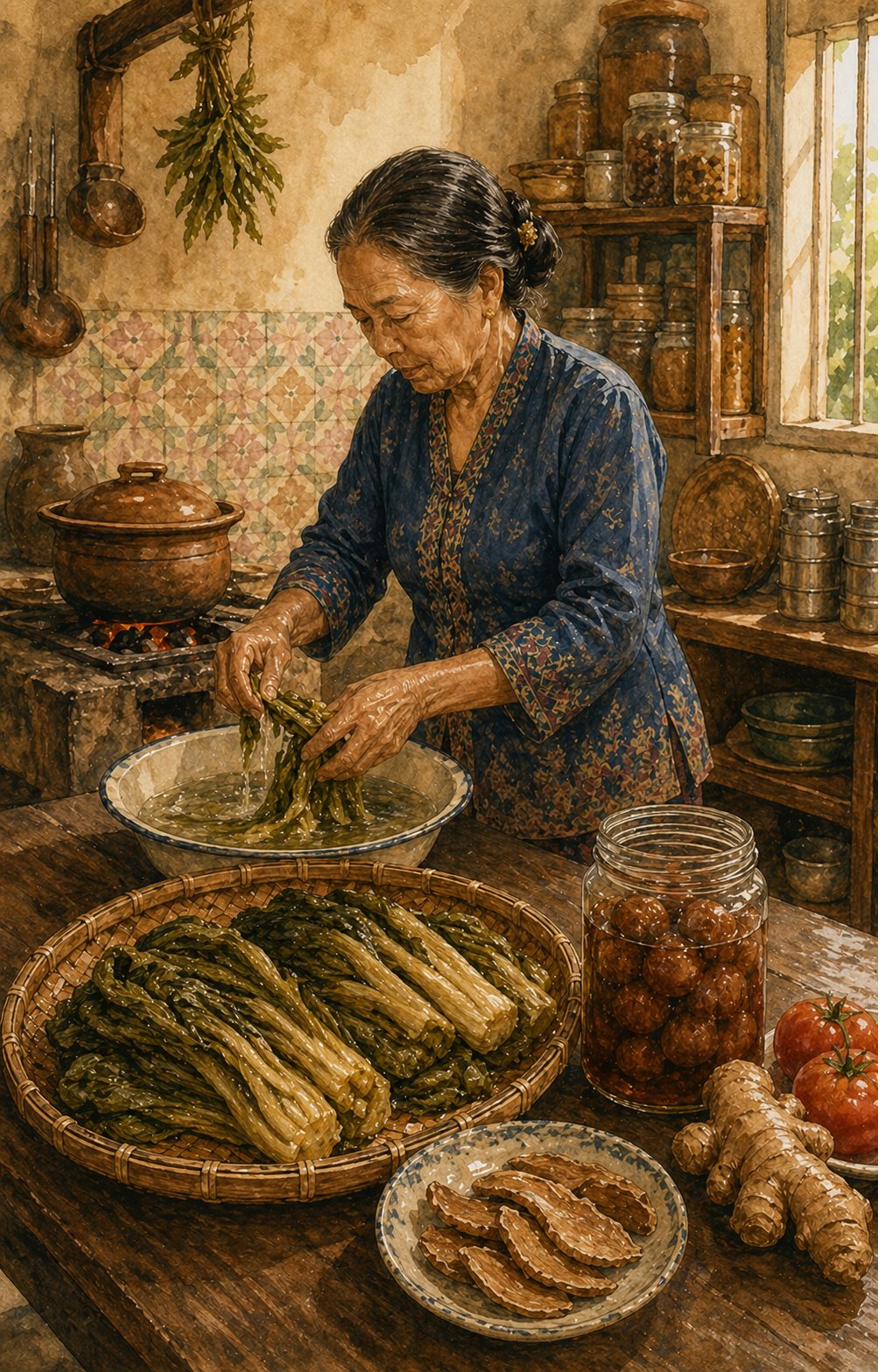
Itek Tim is the soup that quiets a Peranakan family table. After the rempah-rich ayam buah keluak and the tau-cheo-anchored babi pongteh, the meal needs a clear bowl. Pearl-cream broth, salted greens, sour plums, brandy. This is the dish that resets your palate and reminds you what duck tastes like under everything.
Itek Tim is a clear-broth, salted-vegetable duck soup — the third pillar of the Peranakan festive table after ayam buah keluak and babi pongteh, and the one that's least photographed because it doesn't pose well. The broth is pale, the components quiet, the surface scattered with floating asam-gelugur slices and salted plums. But sit at a Peranakan dining table during Chinese New Year or Winter Solstice and the Itek Tim is what you remember three days later — the salt of the kiam chye, the slow tang of asam gelugur, the small kick of brandy that rounds out the duck.
The dish has three names that all refer to the same bowl: Itek Tim is the Peranakan name; kiam chye ark (咸菜鸭, salted-vegetable duck) is the Teochew/Hokkien parent dish from which the Peranakan version evolved; "Teem Reunion Soup" is what the Malacca Eurasians called their cousin-version, served at Christmas Eve.
The etymology most cited across heritage sources holds that "itek" is the Malay word for duck and "tim" derives from the Hokkien/Teochew pronunciation of 炖 — meaning to slow-simmer. A second theory holds that "tim" came from the Portuguese-Eurasian "Teem" (a soup name dating from the Portuguese occupation of Malacca, 1511–1641), which the Peranakans adopted and pronounced "Tim" in Baba Malay. Both etymologies are heritage-documented and not mutually exclusive — the dish lived simultaneously in Hokkien-Teochew, Eurasian, and Peranakan Malacca communities.
What makes the Peranakan version distinct from its Teochew/Hokkien parent are two heritage additions: asam gelugur (the dried slices of Garcinia atroviridis fruit-rind, a Malay-Peninsula souring agent) and a shot of brandy (a heritage flourish that masks the duck's gaminess and rounds out the broth). The Teochew version uses tamarind paste (which clouds the broth) and rice wine (lighter than brandy); the Hokkien version uses preserved-plum-only as the acid. The Peranakan adaptation is a thoughtful hybrid: keep the broth clear (asam gelugur), and round it out with a Western liquor (brandy, picked up reportedly from the British colonial era's brandy availability in Malacca and Singapore). The result is a soup that tastes more layered than its parent — sour on top, savoury underneath, with a faint warmth from the brandy.
The dish is eaten at heritage Peranakan festive occasions: tok panjang (Malay: long table) gatherings during Chinese New Year, Winter Solstice, deities' commemorative days, and ancestral-anniversary meals. Heritage references in Singapore include The Peranakan at Claymore Connect (Executive Chef Raymond Khoo's family-recipe-based menu, where Itek Tim appears as a heritage staple), Candlenut at 17A Dempsey Road (the Michelin-starred Peranakan restaurant from R26 and R27), and the heritage Peranakan home kitchens where the dish most authentically lives.
I am giving you the heritage home-kitchen version here, the way it was made by my Peranakan neighbour-auntie's mother — same kitchen, same recipe-keeper as Recipes 26 and 27. Two times in five home cooks who attempt Itek Tim reportedly under-rinse the kiam chye, and the broth comes out salt-bombed; the heritage cook's discipline is the brief pre-soak-and-rinse to control salt before the kiam chye goes anywhere near the pot.
🛒Ingredients
Whole duck, salted greens, dried fruit-rind acid, salted plum acid, brandy. The discipline is broth-clarity. Best made the day before.
For the Soup
| Whole duck, cleaned | 1 (~1.6–1.8 kg), quartered or chopped into 6–8 large bone-in pieces | Heritage cut. A whole duck gives the broth its full body. Half a duck works for smaller groups but reduce other quantities proportionally. |
| Pickled mustard greens (kiam chye, 咸菜) | 600 g | The vat-pickled vat-style from a Chinese provision shop, NOT the leafier modern Malaysian variety. Soak in cold water 5–10 minutes, drain, chop into 5 cm pieces. |
| Dried asam gelugur slices (Garcinia atroviridis fruit-rind) | 6–8 slices | The signature heritage souring agent. Pale-tan-brown dried arcs. Heritage-Malacca cooks consider this NON-NEGOTIABLE for broth-clarity. If unobtainable, substitute 6 salted plums + 1 tsp white vinegar — but the broth will be marginally cloudier. |
| Salted preserved plums (sng buay) | 6 plums | Packed in brine. Adds a fruit-acidic layer underneath the asam gelugur's tartness. |
| Old ginger | 60 g, peeled and bashed | Old ginger only — young ginger is too sharp. |
| Tomatoes | 3 medium, quartered | Added in the last 10 minutes only. |
| Garlic cloves | 6, peeled, left whole | |
| Star anise | 1 whole | Optional but heritage; rounds the broth. |
| Black peppercorns | ½ tsp | Whole, lightly bashed. |
| Brandy | 2 tbsp (1 tbsp during cook + 1 tbsp at finish) | Heritage Peranakan flourish. Cognac, VSOP, or any decent brandy works. Reportedly masks the duck gaminess and adds warmth — heritage cooks emphasise this. |
| Salt | to taste | Only if the kiam chye and salted plums haven't already provided enough. |
| Water | ~3.5 L |
For Serving
| Fresh bird's-eye chillies | 2–3, torn just before serving | Heritage finishing touch — torn into the individual diner's bowl just before the soup is poured. The chilli's piquant edge cuts the salt-and-sour broth. |
| Sambal kicap (dark-soy-and-sliced-chilli condiment) | on the side | The heritage condiment — sliced bird's-eye chillies in dark soy sauce. |
| Steamed white rice | 1 cup per diner | The broth is the soul; the rice carries the components. |
🌶️Shifu's Lift
choose one path — see "Shifu's Secret" chapter for the philosophy- Old-school path: ¼ tsp MSG dissolved in finished broth
- Modern hawker path: ½ tsp chicken stock powder during the simmer (reduce salt elsewhere)
- Heritage purist path: already covered with the dual-souring (asam gelugur + salted plums) + kiam chye's intrinsic umami + brandy's warmth + duck's deep-stock body
👨🍳Method
Six stages plus the family-table moment. Blanch, prep, build, add, finish, plate. The patience is the heat.
Blanch the Duck
Bring a large pot of water to a vigorous boil. Lower the duck pieces in, blanch for 5 minutes. Skim off the surface foam aggressively. Remove duck, rinse under cold water to wash off any remaining scum. Discard the blanching water entirely. This step is non-negotiable — it removes the duck's surface impurities and is the heritage discipline for keeping the final broth clear.
Prep the Souring Components
Soak the kiam chye in cold water for 5–10 minutes (set a timer; do not exceed 10 minutes — the kiam chye is meant to remain salty-and-sour, the soak is just to control the salt edge). Drain, squeeze gently, chop into 5 cm pieces.
Rinse the asam gelugur slices under running water for 30 seconds; drain.
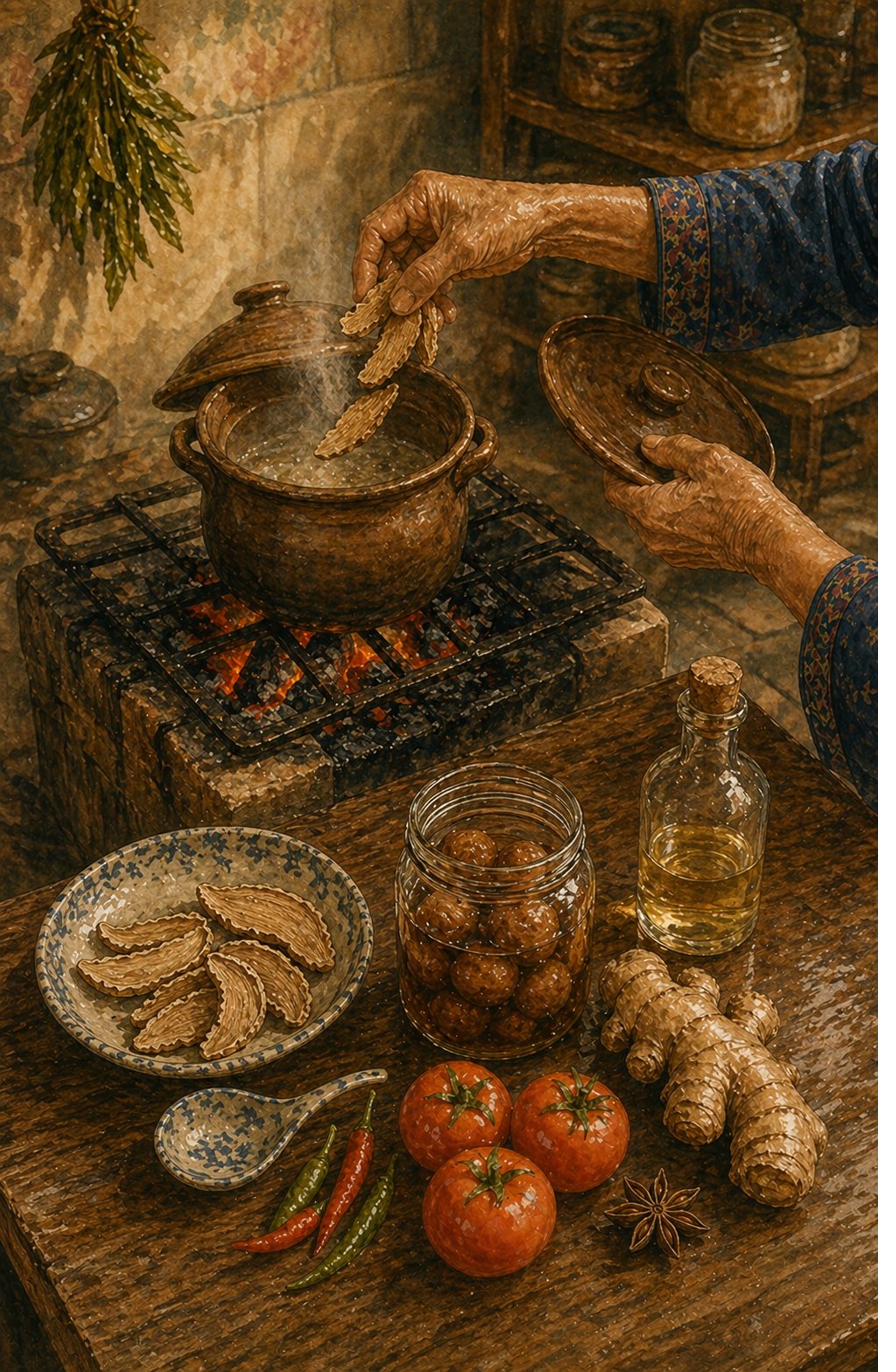
Have the salted plums, ginger, garlic, star anise, peppercorns, and brandy all measured out and arrayed.
Build the Broth
In a large heritage claypot or a heavy stockpot, place the blanched duck, ginger, garlic, star anise, peppercorns, asam gelugur, salted plums, and 1 tablespoon of brandy. Add 3.5 L cold water — enough to cover the duck by 5 cm.
Bring to a simmer over high heat. Once simmering, reduce heat to LOW — this is the broth-clarity discipline. Itek Tim broth is built on a low simmer, never a vigorous boil. A vigorous boil emulsifies the duck fat into the broth and clouds the soup.
Skim the surface fat aggressively for the first 20 minutes. After that, the duck has stopped releasing scum and the broth will run cleaner.
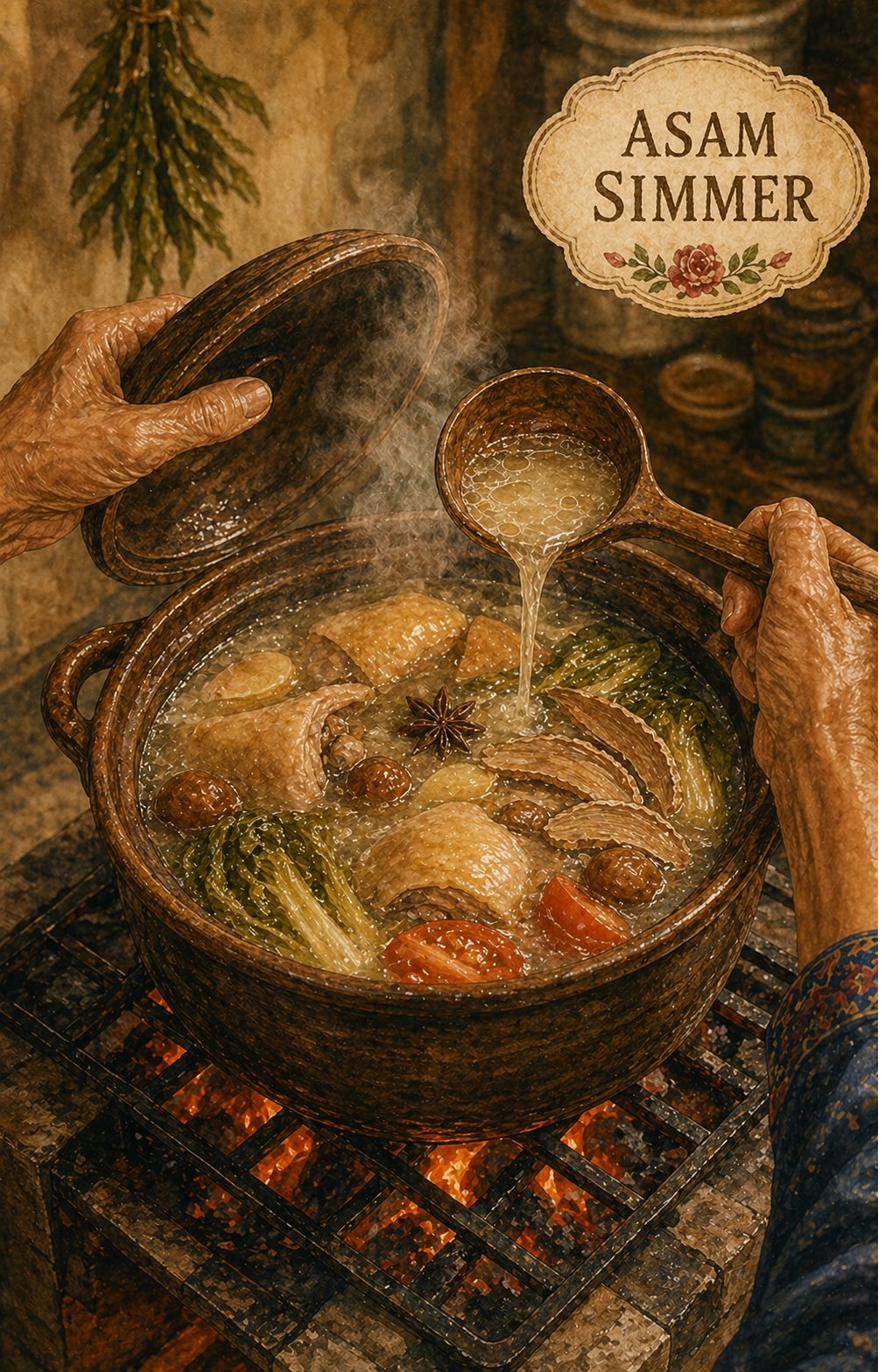
Cover with the lid slightly ajar (full-cover traps steam and over-reduces; full-uncovered loses too much liquid). Simmer gently for 1 hour 30 minutes — until the duck meat is falling-off-the-bone tender.
Add the Kiam Chye and Tomatoes
Add the chopped kiam chye and the quartered tomatoes. Simmer another 10 minutes — the kiam chye should soften but retain a bit of bite; the tomatoes should hold their shape but yield at the edge.
Taste the broth. If too salty, add a splash of hot water and re-simmer 2 minutes. If under-sour, add 1–2 more asam gelugur slices and simmer another 10 minutes. Salt is rarely needed — the kiam chye and salted plums usually deliver enough.
Finish with Brandy
Just before serving, add the second tablespoon of brandy to the pot. Simmer 1 minute (long enough to integrate, short enough that the brandy's warmth is preserved). Remove from heat.
If preparing a day ahead (which most heritage cooks recommend — itek tim tastes better the next day), cool the pot, refrigerate covered overnight, re-warm gently the next day before adding the second brandy shot.
Plate
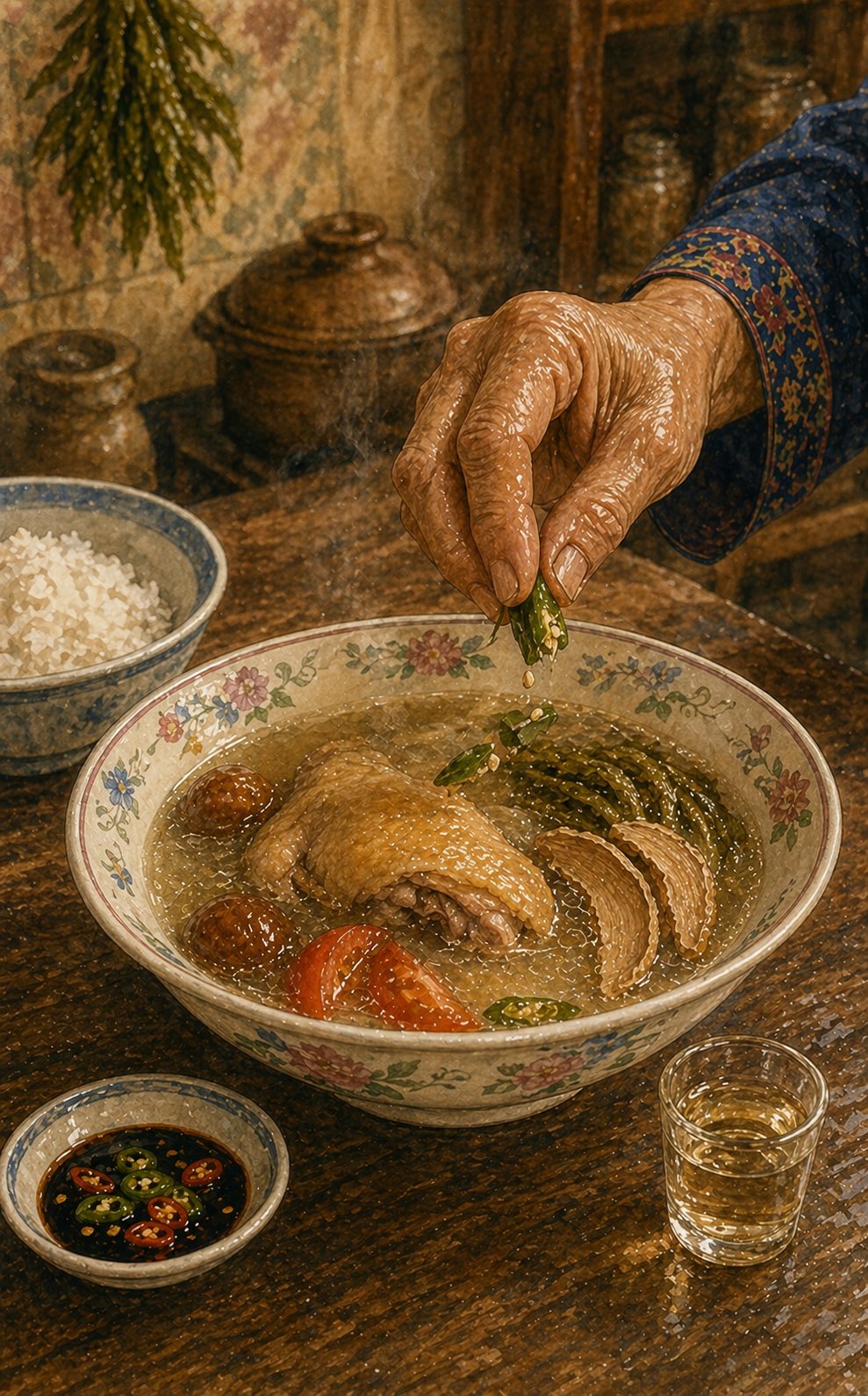
Tear 1–2 fresh bird's-eye chillies into each individual diner's serving bowl. Ladle hot broth + duck + components over the chilli; the heat of the broth releases the chilli's aroma without cooking it through.
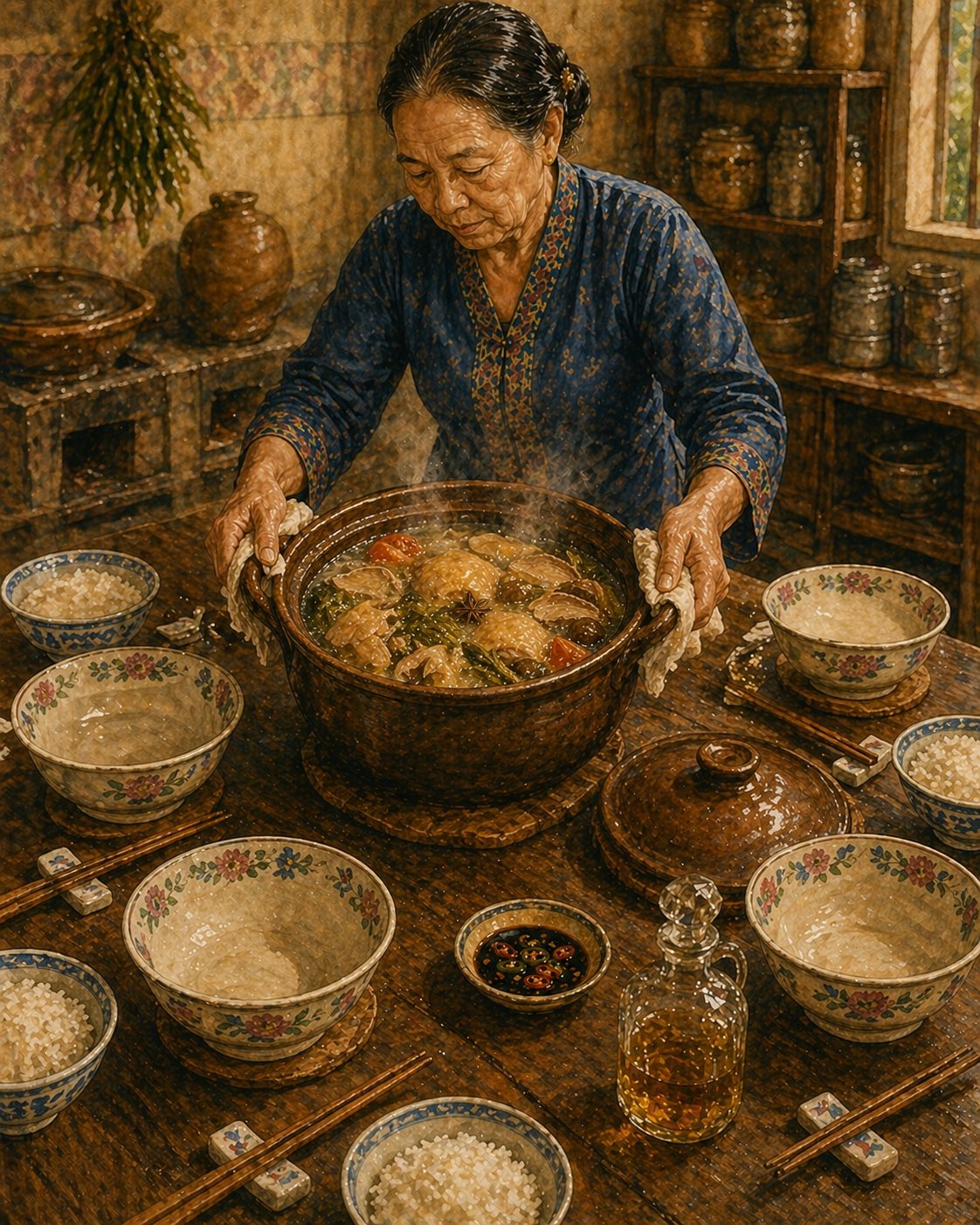
Place the central claypot at the table for family-style top-ups. Side of sambal kicap (dark-soy-and-sliced-chilli) and steamed white rice. A small heritage decanter of brandy on the table — heritage Peranakan diners reportedly add a small final splash to their own bowl just before eating.
The Family Table
Bring the full claypot to the table for family service. Each diner ladles broth, duck, and components into their own bowl. The heritage register: the broth is sipped first, the duck and kiam chye eaten with the rice, and the brandy added in small splashes throughout the meal.
🎯The Three Tips
Heritage. Master's. Mistake.
🏛 Heritage Note
The Half-Dozen Small Disciplines
The whole dish is built on broth-clarity discipline. Vigorous boil clouds it; under-skimming clouds it; tamarind paste clouds it; rinsing the kiam chye too long under-salts it.
Itek Tim is a heritage soup with a half-dozen small disciplines that, kept together, give you the pearl-cream broth heritage cooks recognise. Skip any of them and you get a passable kiam chye ark — but not Itek Tim.
👨🍳 Master's Tip
The Brandy Finish
The second tablespoon of brandy at the end is the heritage Peranakan flourish that distinguishes Itek Tim from its Teochew/Hokkien parent. Add it after the heat is off, simmer one minute only — just enough to integrate, not long enough to burn off the brandy's warmth.
Diners may add a further small splash to their own bowl. The brandy doesn't taste like alcohol in the finished soup — it tastes like warmth.
⚠ Common Mistake
Boiling Instead of Simmering
Heritage Itek Tim broth is built on a slow gentle simmer, not a rolling boil. The boil emulsifies the duck fat into the broth and turns the soup cloudy-and-greasy. The simmer keeps the fat as discrete globules at the surface that you can skim.
If your broth is cloudy at the end, you boiled instead of simmered. Reduce the heat next time; the patience pays.
📈 Scaling for Hawker Service
Heritage-departure note: itek tim is a home-kitchen and family-restaurant dish, not a hawker dish
Like Ayam Buah Keluak and Babi Pongteh, Itek Tim's labour-and-time profile sits outside the hawker-stall economics. Heritage Peranakan Itek Tim lives at the family table and the heritage Peranakan restaurant. There is no hawker-stall version of the dish in heritage Singapore.
For the home cook scaling up for a Peranakan family meal:
- The dish keeps and improves with overnight rest: cook the day before serving for the best flavour integration. Itek tim is genuinely better on day two.
- Kiam chye salt management is the variable that scales worst: different brands of vat-pickled kiam chye carry different salt levels. Rinse-and-taste each batch before committing it to the pot — the salt is non-uniform across suppliers.
- Asam gelugur quantity is to-taste: start with 6 slices for a 1.6 kg duck. Heritage cooks adjust upward if the broth tastes flat in the final tasting.
- Cost in Singapore (2026): the duck is the dominant raw-ingredient cost. The dish runs in the standard Peranakan home-cook tier — meaningfully less expensive than Ayam Buah Keluak (which carries the buah keluak premium) and broadly comparable to Babi Pongteh in raw-ingredient cost.
You can tell a good Peranakan kitchen by the Itek Tim. The buah keluak announces the heritage. The pongteh feeds the family. But the Itek Tim — the Itek Tim is what you remember three days later. It is the soup that proves the cook was patient.