Kueh Pie Tee
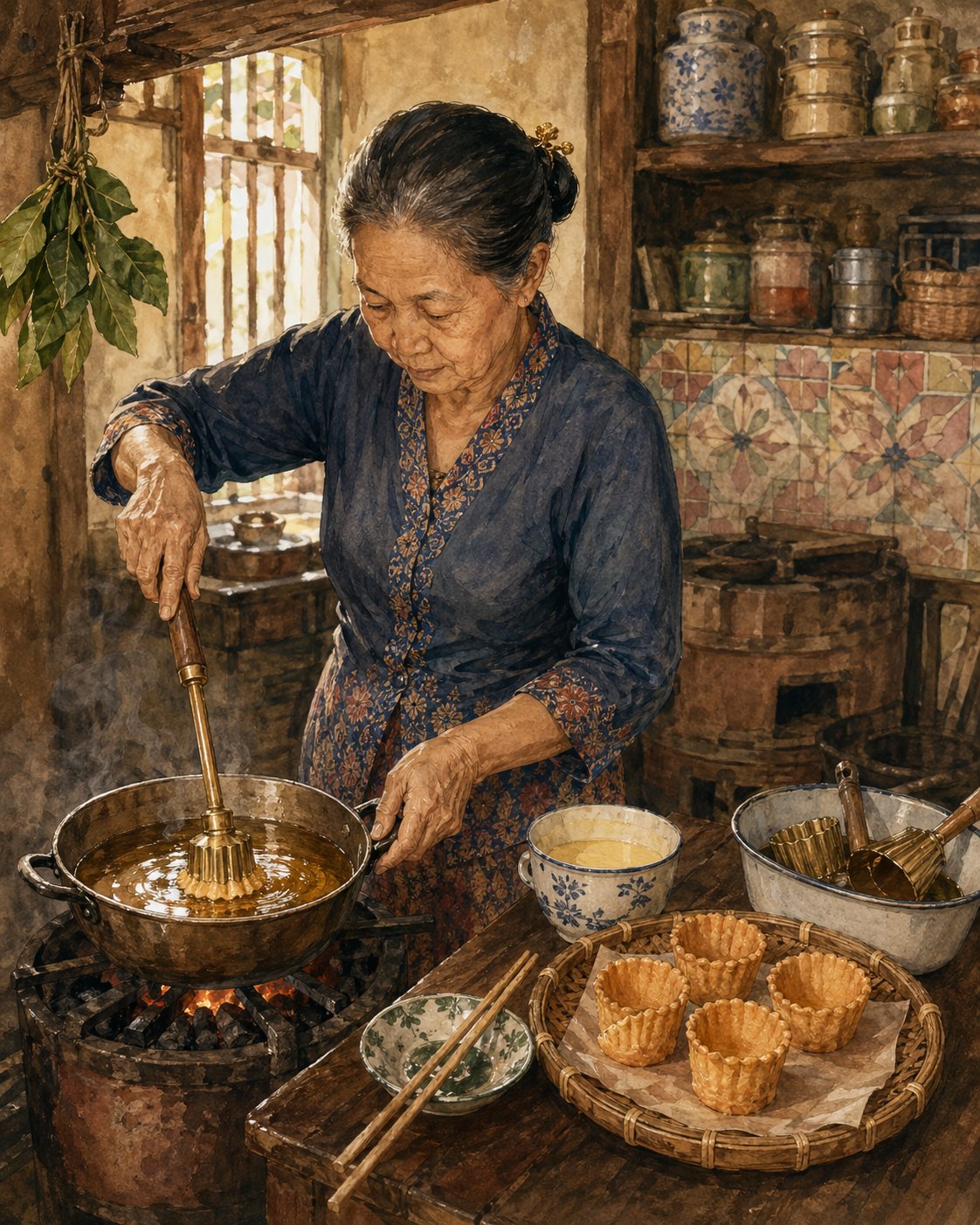
If buah keluak announces the heritage and pongteh feeds the family, kueh pie tee is the dish the Peranakans bring out when there is something to celebrate. Birthdays. Weddings. Chinese New Year. This is the tea-party hero — the dish that says "we have guests, and we are showing off."
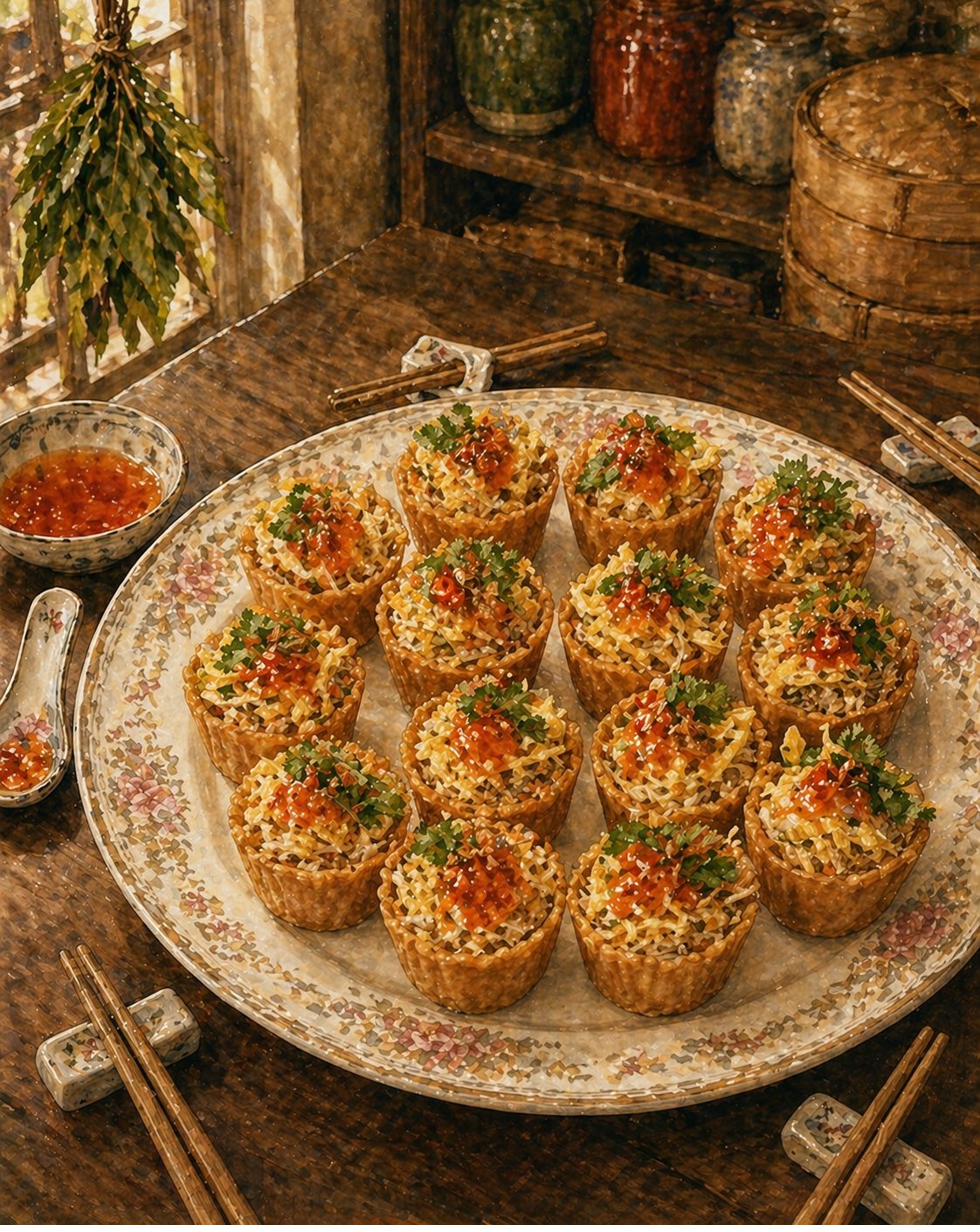
Kueh Pie Tee is a Peranakan top-hat-shaped pastry cup — a thin, crispy, deep-fried shell about 4 cm wide and 3 cm tall, with a delicately fluted brim, filled at the moment of serving with a savoury sautéed mixture of shredded bangkuang (yam bean / jicama), carrot, dried prawns, and french bean strips, then garnished with shredded omelette, fried shallots, fresh coriander, and a dot of sweet chilli sauce. The crisp shell against the moist filling is the dish's defining textural contrast — heritage cooks insist the assembly happens at the table, never in advance, because the shells turn soggy within minutes of being filled.
The dish has a contested origin and three names. In Singapore and Penang it is kueh pie tee; in Melaka the locals call them top hats (the Melaka version's brim flares outward like a hat, while the Singapore version sits more cup-shaped); in Malay-Singaporean usage the dish is also documented as kuih jambang (where "jambang" means "vase" in the local Singaporean Malay dialect).
The etymology of "pie tee" itself remains heritage-contested. The most-cited theory holds that "pie tee" is the Baba-Malay corruption of the English word "patty" — referring to the patty-iron moulds (cast-iron specialty tools for making rosette-style fritters) reportedly introduced to Singapore in the early 1900s. A second theory holds that kueh pie tee was a Singapore invention — known during the Japanese Occupation as Syonan-to Pie (where "Syonan-to" was the Japanese name for occupied Singapore), and that the modern dish-name traces to that Occupation-era usage.
What's NOT contested: the dish is documented in Singapore from at least 1952, when Ellice Handy's My Favourite Recipes (Singapore's foundational early cookbook, first edition 1952) included a recipe for "pie tee" — interestingly, listed as a Chinese dish rather than a Peranakan one. The earliest known media mention is a Straits Times article of 7 March 1954 by Francis Wong covering a Wesley Methodist Church food fair, which described the dish as a tiny pastry cup of meat-and-vegetable bathed in two delicate sauces — the quotation marks around the dish-name in the original article reportedly suggesting the dish was still unfamiliar to the average Singapore reader in 1954.
The filling is the dish's heritage-debate flashpoint. Ellice Handy's 1952 recipe included BAMBOO SHOOTS — a heritage-Hokkien-popiah marker (bamboo shoots' appearance in spring is the symbolic anchor of 春卷 chun juan, the spring roll). Modern Singapore stalls reportedly often omit bamboo shoots due to cost — but heritage cooks consider the omission a meaningful loss. The protein component carries a parallel heritage-debate: dried shrimps give the filling a concentrated umami register and are heritage-standard at many home kitchens, while fresh shelled prawns give a sweeter cleaner register and are heritage-standard at others. Both protein forms are heritage-acceptable parallel practice. I am giving you the heritage form here: with bamboo shoots in the filling, with a choice of dried shrimps or fresh prawns for the protein.
Two times in five home cooks who attempt the heritage shell-frying step reportedly produce shells that are too thick or that won't release from the mould — heritage Peranakan home-kitchens are very firm on the technique: the brass mould must be heated in oil first, then dipped just past 95% of its depth into the batter (NOT all the way — the top 5% must remain bare so the shell will release later), then plunged into hot oil at exactly the right temperature (around 170 °C). Too cool, the batter won't crisp; too hot, the shell sets faster than it can release. The technique is the dish.
Heritage references in Singapore today include Ann Chin Popiah (Chinatown Complex Food Centre origin + ten islandwide locations; kueh pie tee at reportedly S$3.70 for four pieces; party sets from S$30), Violet Oon Singapore (the Peranakan group from R26 and R27, where Kuay Pie Tee features as a starter at reportedly S$19 with a julienned-bamboo-shoots-and-turnip poached-prawn-bisque filling — the heritage-bamboo-shoot version), Kway Guan Huat Joo Chiat Popiah (80+ year family popiah-skin tradition at Joo Chiat, makes pie tee shells too), and My Cosy Corner at Coronation Shopping Plaza (operating reportedly since 1998; pie tee at reportedly S$5.80 for six pieces).
I am giving you the heritage home-kitchen version here, the way it was made by my Peranakan neighbour-auntie's mother — same kitchen, same recipe-keeper as Recipes 26, 27, and 28. The home cook's labour-of-love version, with the heritage bamboo shoot included.
🛒Ingredients
Three components: the shells, the filling, and the garnishes for fill-it-yourself assembly. The brass mould is the non-negotiable heritage tool.
For the Shell Batter makes ~30 shells; rest 1 hour
| Plain (all-purpose) wheat flour | 100 g | |
| Rice flour | 70 g | Heritage Singapore-humid-weather adaptation — rice flour keeps the shells crispy longer. Skip and the shells go soggy within an hour. |
| Cornflour (cornstarch) | 30 g | Heritage adjusts as needed; some recipes use only wheat-and-rice. |
| Salt | ½ tsp | |
| Egg | 1 large, beaten | |
| Water | 250 ml, room temperature | |
| Kapur sirih (slaked lime paste) | a small pinch (~⅛ tsp), dissolved in 1 tbsp water | Optional but heritage; the alkalinity adds colour and crunch. Skip if unobtainable. |
For the Filling
| Bangkuang (yam bean / jicama, 沙葛) | 600 g, peeled and shredded into thin strips | The dish's primary filling. Pale-cream-yellow, crisp, slightly sweet. NOT to be confused with white turnip or daikon. |
| Bamboo shoots (fresh or vacuum-packed, NOT canned-in-brine) | 200 g, shredded into thin strips, blanched 10 minutes | Heritage signature ingredient per Ellice Handy 1952 — many modern Singapore stalls omit this due to cost; heritage cooks consider its inclusion a meaningful marker. |
| Carrot | 1 medium (~100 g), peeled and shredded | |
| French beans (long beans) | 80 g, finely sliced into thin strips | |
| Dried shrimps OR fresh shelled prawns | 30 g dried (soaked, drained, finely chopped) OR 150 g fresh (deveined, roughly chopped) | Heritage umami-anchor for the filling. Both forms are heritage-acceptable: dried shrimps give a deeper concentrated umami; fresh prawns give a sweeter cleaner register. |
| Shallots | 4 medium, peeled and finely chopped | |
| Garlic | 4 cloves, peeled and finely chopped | |
| Light soy sauce | 1 tbsp | |
| Sugar | 1 tsp | |
| White pepper | ¼ tsp | |
| Salt | to taste | |
| Cooking oil | 3 tbsp | |
| Reserved dried-shrimp soaking water (or light chicken stock if using fresh prawns) | 100 ml | If using fresh prawns, substitute with light chicken stock or water to maintain the moisture level for the filling-fry. |
For the Garnishes arranged for fill-it-yourself assembly
| Eggs | 2, lightly beaten | Pan-fried into thin omelettes, then shredded into thin strips. |
| Bawang goreng (golden fried shallots) | 4 tbsp | Heritage garnish — the small dark-amber-bronze flakes. |
| Fresh coriander leaves | a small bunch, leaves picked | |
| Fresh red bird's-eye chillies | 4–5, thinly sliced | Heritage finishing accent — adds the heat-and-bright kick. |
| Sweet chilli sauce (heritage) | a small dish | The heritage Peranakan accompaniment — sweet-tart-spicy, vivid orange-red. |
🌶️Shifu's Lift
choose one path — see "Shifu's Secret" chapter for the philosophy- Old-school path: ¼ tsp MSG dissolved in finished filling
- Modern hawker path: ½ tsp chicken stock powder during the filling-fry
- Heritage purist path: already covered with dried-shrimp umami + bangkuang's intrinsic sweetness + bamboo shoot's spring-vegetable register + the omelette-and-shallot garnish layers
Heritage Tools
| Brass pie tee mould | 1 (single or 2–3-mould variants both heritage) | The non-negotiable heritage tool — fluted, top-hat-shaped, on a long wooden handle. Brass is preferred for heat retention. Modern stainless-steel substitutes work but produce slightly less even browning. |
| Small deep frying pot (NOT a wok) | 1 | The mould needs full submersion in oil; a wok's curve makes this awkward. |
| Long bamboo chopsticks or thin metal skewer | 1 set | For releasing shells from the mould after frying. |
👨🍳Method
Six stages. Batter, filling, fry, store, assemble, plate. The dish is its assembly.
Make the Shell Batter rest 1 hour
In a large bowl, sieve together the wheat flour, rice flour, cornflour, and salt. Make a well in the centre.
Add the beaten egg into the well. Begin stirring from the centre outward, gradually incorporating the dry ingredients while pouring in the water in a slow stream. Stir until a smooth lump-free batter forms — the consistency should be like a thin pancake batter (it should drip easily off a spoon, not pour like cream).
If using kapur sirih, stir in the dissolved 1 tablespoon now.
Cover and rest the batter at room temperature for at least 1 hour — the rest is non-negotiable. Heritage cooks rest the batter so the flour fully hydrates; an unrested batter produces uneven crackly shells.
Strain through a fine sieve before frying to remove any persistent lumps.
Make the Filling
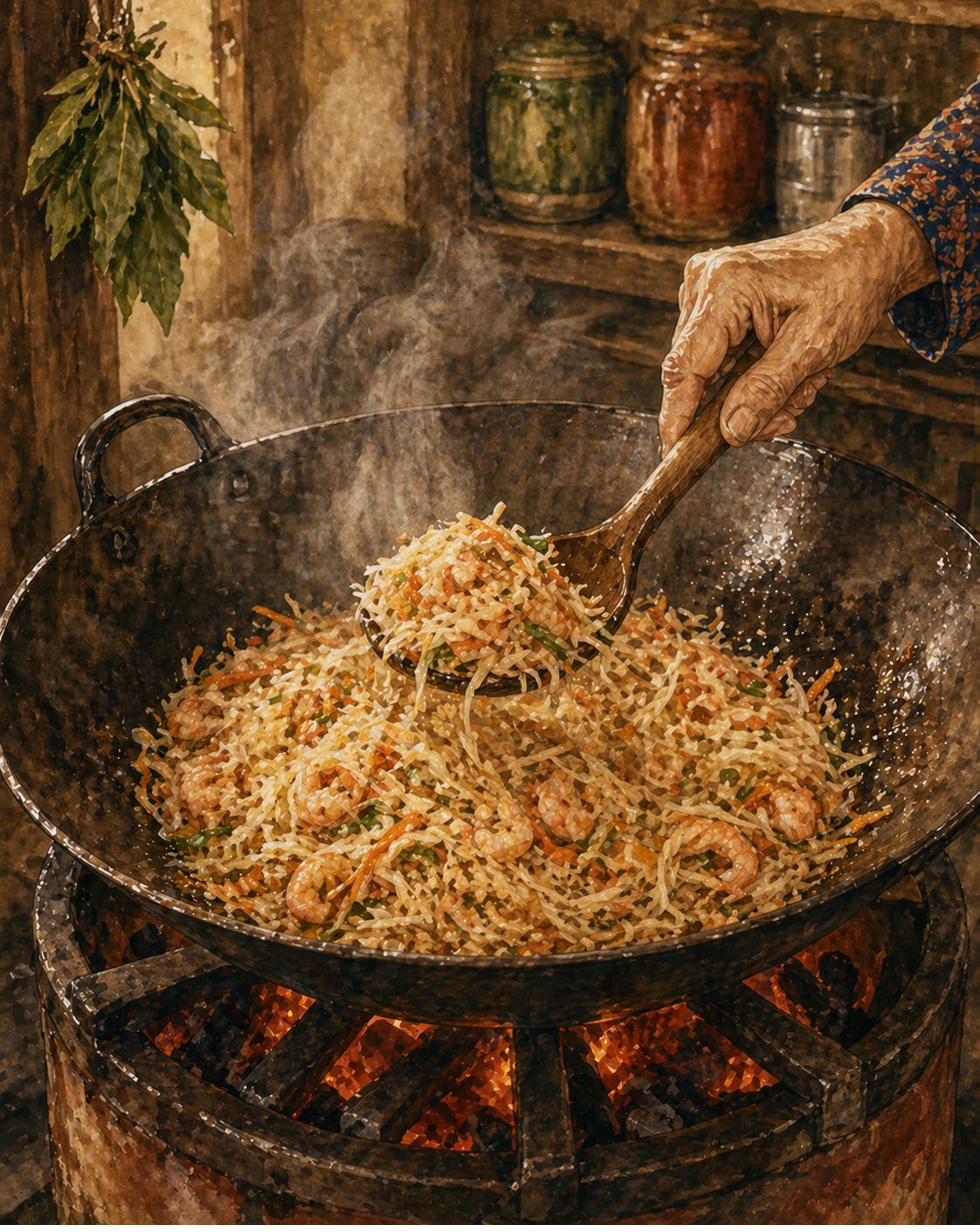
Heat 3 tablespoons cooking oil in a wok over medium heat. Add the chopped shallots and garlic, fry 2–3 minutes until fragrant and pale-gold (NOT browned).
Add the chopped dried shrimps (or fresh shelled prawns, if using). Fry 2 minutes — if using dried shrimps, the kitchen will fill with the heritage concentrated dried-shrimp aroma; if using fresh prawns, the prawns will turn pink-and-coral and release a cleaner sweet-prawn scent.
Add the shredded bangkuang. Stir-fry 5 minutes — the bangkuang will soften slightly and pick up the rendered shallot-and-prawn flavour.
Add the shredded carrot, blanched bamboo shoot, and french bean strips. Stir to combine. Add the light soy sauce, sugar, white pepper, salt, and the reserved dried-shrimp soaking water (or light chicken stock if using fresh prawns).
Reduce heat to low. Simmer covered for 8–10 minutes — the bangkuang should turn translucent-pale-yellow, the bamboo shoot should retain its firm bite, the gravy should reduce to a glossy moist coating (NOT wet-soupy).
Taste and adjust. Set aside, covered, while you fry the shells.
Fry the Shells heritage technique
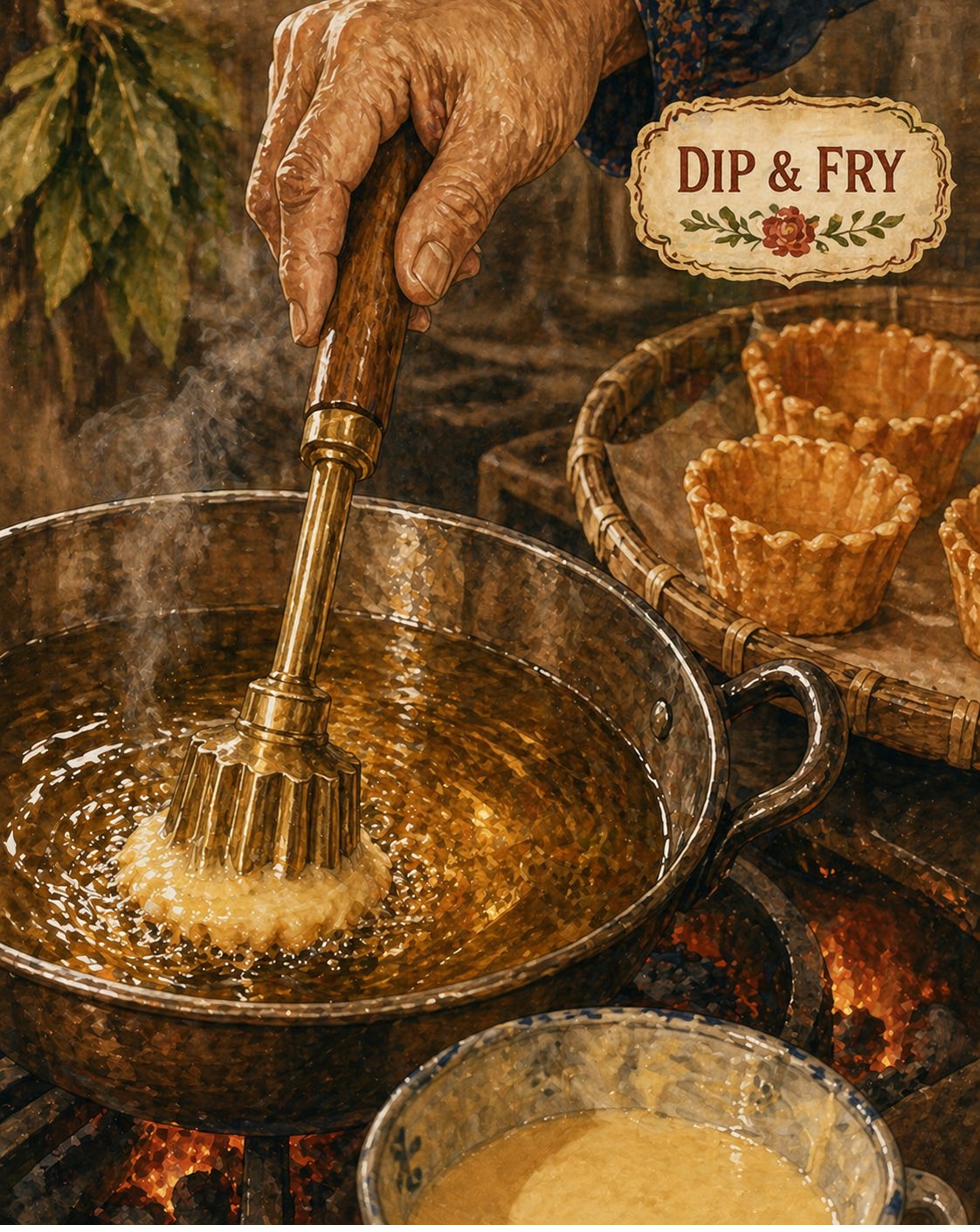
Pour the rested batter into a small deep cup that is wide enough and tall enough to fully submerge the brass mould. Heat 5 cm of cooking oil in a small deep frying pot to 170 °C — heritage cooks check the temperature by dipping a wooden chopstick: small steady bubbles around the chopstick = correct; vigorous bubbles = too hot; few bubbles = too cool.
The heritage Peranakan dip-fry technique:
- Heat the brass mould first. Submerge the mould fully in the hot oil for 30 seconds. Lift out and shake off excess oil. The mould must be HOT for the batter to adhere properly. This step is often the most-overlooked failure mode.
- Dip the heated mould into the batter to about 95% of its depth (NOT to the very top — the top 5% must remain bare to allow the shell to release later). The batter should coat the mould's outer surface in a thin even film.
- Plunge the batter-coated mould into the hot oil. Hold steady for 2–3 seconds without moving — this lets the shell set onto the mould.
- Jiggle the mould gently up-and-down to release the shell. The shell should drop free into the oil within 5–10 seconds.
- Continue frying the released shell in the oil for another 30–45 seconds until golden-brown.
- Remove with a long bamboo chopstick or skewer, drain on paper towels.
The shell should be golden-brown, crispy, and cleanly top-hat-shaped with the fluted brim distinct. Reheat the brass mould between each shell — the cooling-down between dips is the most common heritage-failure mode.
Cool and Store the Shells
Drain the fried shells on paper towels. Cool completely (at least 20 minutes) before storing. Once cool, store in an air-tight container — heritage shells keep crispy for at least a week; some heritage cooks keep them longer in biscuit tins.
If the shells lose crispness over time, toast lightly in a 150 °C oven for 3–4 minutes to refresh.
Assemble
This is a fill-it-yourself dish in heritage Peranakan tradition — each diner assembles their own at the table. Arrange on a heritage flat round Peranakan platter:
- The empty pie tee shells (about 12 per round)
- A bowl of warm bangkuang filling (re-warm gently if it has cooled)
- Shredded omelette strips
- Bawang goreng in a small dish
- Fresh coriander leaves
- Sliced red bird's-eye chillies
- Sweet chilli sauce in a small dish
Each diner picks up a shell, spoons a small portion of filling into the cup, tops with omelette + bawang goreng + coriander + 1–2 slices of chilli, and finishes with a small dot of sweet chilli sauce. Eaten in a single mouthful.
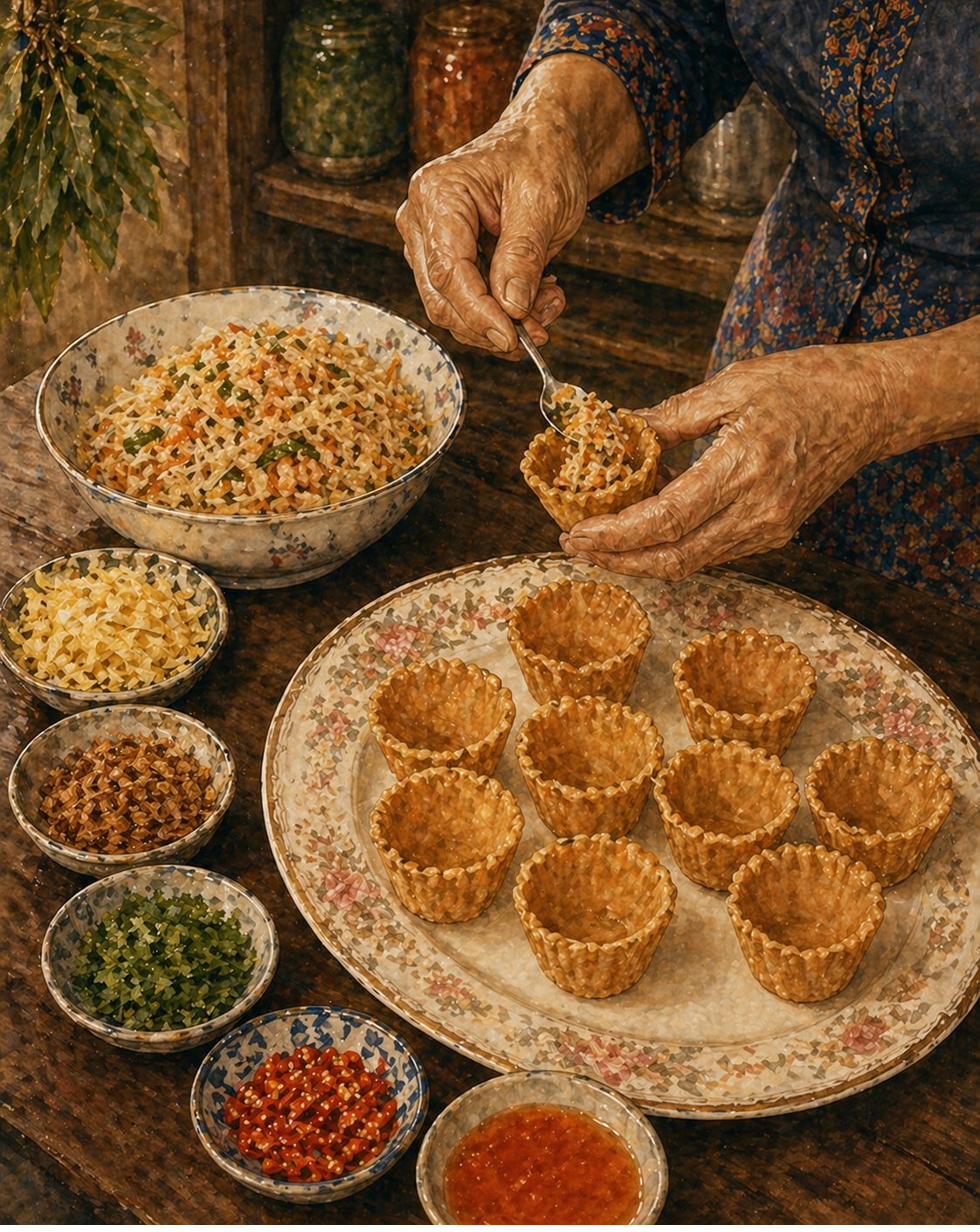
Plate the Variety Shot
Once the family has had their fill of fill-it-yourself, the matriarch reportedly assembles a final platter of pre-filled shells for guests-of-honour or for photographs — the heritage variety shot. 12 pie tee, fully assembled, abundant cluster on a flat round platter.
🎯The Three Tips
Heritage. Master's. Mistake.
🏛 Heritage Note
The Dish Is Its Assembly
The whole dish is built on shell-discipline + filling-restraint + assembly-at-the-moment. Shells must be crisp at the moment of filling — never pre-filled-and-stored, the contrast collapses within minutes. Filling must be moist-not-wet — too dry and it falls out, too wet and the shell goes soggy.
Assembly must happen at the table, never in the kitchen — heritage Peranakan tea parties are fundamentally about the assembly ritual. The dish is its assembly.
👨🍳 Master's Tip
The Heated-Mould Step
The brass mould must be heated in the oil before each dip into the batter. The single most-common heritage failure mode is dipping a cool mould into the batter — the batter then refuses to adhere and the shell either won't form or won't release.
Heritage cooks reheat the mould between every dip — patience pays in even golden-brown shells.
⚠ Common Mistake
Filling the Shells in Advance
The shells go soggy within 10–15 minutes of being filled. Heritage Peranakan tea-party tradition is fill at the table — diners assemble their own. The hostess may pre-assemble a small "variety-shot" platter for ceremony or photography, but the family-eating register is fill-it-yourself.
If you pre-fill the entire platter and bring it to the table, the dish is already past its peak by the time the second diner picks up a shell. This is the most common modern-failure mode.
📈 Scaling for Hawker Service
Heritage-departure note: kueh pie tee is a hawker-curated-ceremonial dish — it sits on the boundary between home-kitchen and stall
Unlike Ayam Buah Keluak (R26), Babi Pongteh (R27), and Itek Tim (R28) — which are strictly home-kitchen — Kueh Pie Tee has a meaningful Singapore hawker-stall presence at heritage stalls including Ann Chin Popiah and Kway Guan Huat Joo Chiat Popiah. The shells can be made in batches of 100+ in advance and stored in air-tight tins; the filling is straightforward to scale. The bottleneck is assembly — every shell is filled at the moment of serving, which limits stall-scale throughput.
For the home cook scaling up for a Peranakan tea party or Chinese New Year:
- The shells can be made up to 1 week ahead — heritage cooks store them in biscuit tins.
- The filling can be made 2–3 days ahead — refrigerate, re-warm gently before serving.
- The garnishes (omelette strips, bawang goreng) can be prepped same-day — fresh coriander and chilli at the very last moment.
- The Singapore-modern bamboo-shoot-omitted variation: if bamboo shoots are unavailable or too expensive, increase the bangkuang quantity to 750 g and add 100 g shredded napa cabbage to the filling for textural-bulk replacement. The bamboo-shoot-omitted form is the standard at most modern Singapore hawker stalls — both forms are acceptable, though heritage cooks reportedly prefer the bamboo-shoot heritage form.
- Singapore restaurant references for inspiration: Violet Oon Singapore's Kuay Pie Tee features the heritage bamboo-shoot version with a prawn-bisque-poached filling at reportedly S$19; Ann Chin Popiah's standard pie tee at reportedly S$3.70 for four pieces represents the budget-heritage hawker register. Both sit within heritage-acceptable practice.
- Cost in Singapore (2026): the bangkuang and bamboo shoots are the dominant raw-ingredient cost for the filling; the brass mould is a one-time heritage investment. The shells are cheap to produce in batches; the labour-of-assembly is the constraining factor.
Kueh pie tee is the Peranakan dish that proves the cook took time. The shells take time. The filling takes time. The assembly takes time, every single shell. There is no shortcut, no make-ahead, no scale-up. You either make the time or you serve something else. The Nyonya grandmothers I knew made the time, and that is the lesson.