Bubur Cha Cha
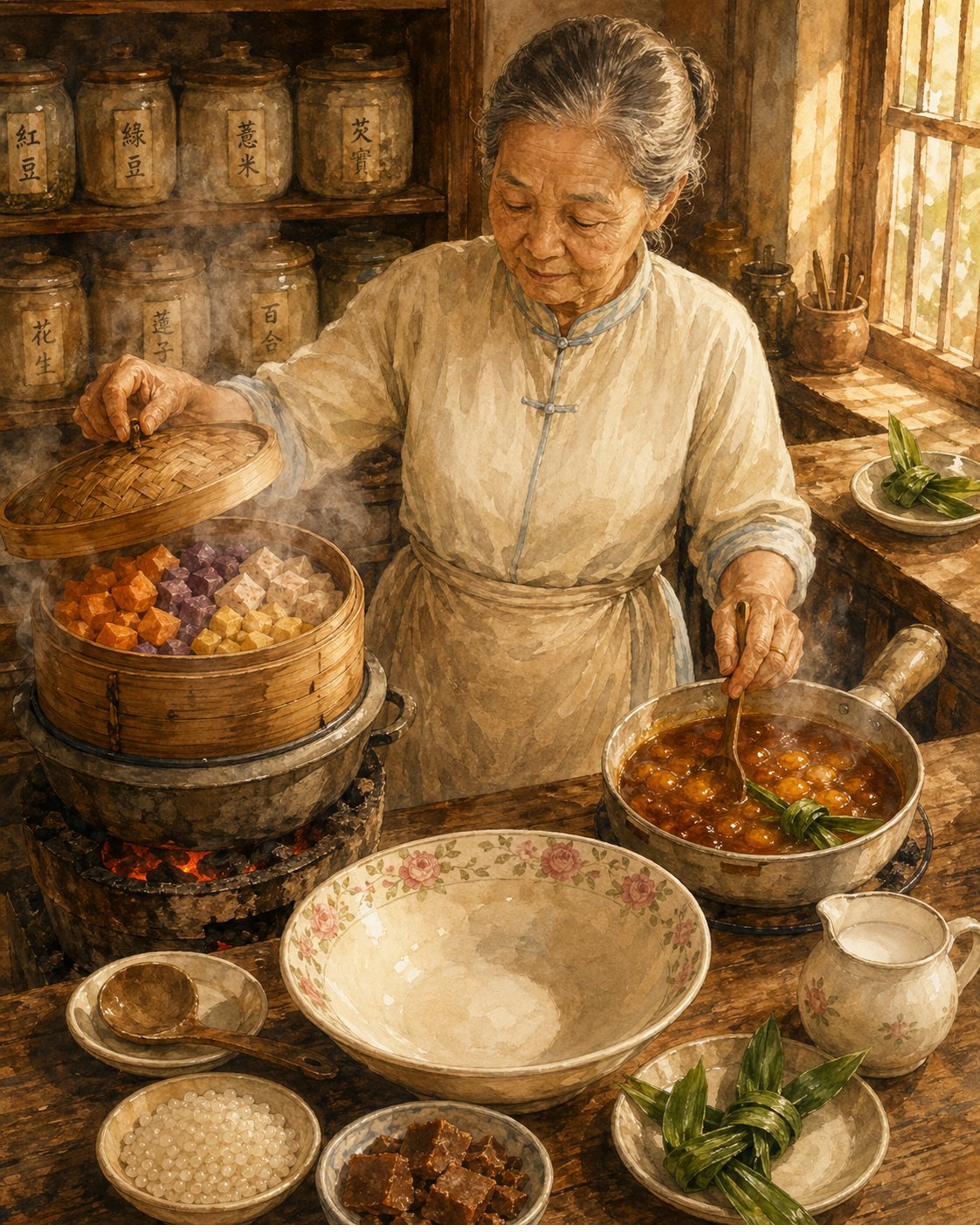
My mother made bubur cha cha at the close of every Chinese New Year, on Chap Goh Mei, the fifteenth night. She made it on other afternoons too — when bananas were sweet, when sweet potatoes had come into the wet market in the deep-purple kind. But Chap Goh Mei was the one she would never miss. She made enough for the household, and then she made enough to send to the neighbours, and then — only then — she would sit down with her own bowl while the sun set behind the kitchen window. The pandan-leaf knot floated. The amber broth caught the late light. The chapter ended on the last bowl.
Bubur cha cha — bubur is "porridge" in Malay; cha cha is the Hokkien homophone for che che (车车), meaning abundance — is the heritage Peranakan-Singapore coconut-milk dessert that closes the Chinese New Year. The dish is the chapter's closing register and the book's bridge — heritage Peranakan in its origin, heritage Hokkien-Singapore in its pronunciation, pan-dialect in its surviving practice.
A note on heritage. Reportedly the dish descends from the older Peranakan dessert pengat (sometimes pengat pisang, "banana broth"), which is itself an adaptation of Malay coconut-and-banana broths combined with Chinese sweet-soup traditions. Some Peranakan households maintain the pengat-vs-bubur-cha-cha distinction strictly; others treat them interchangeably. My mother held the distinction — pengat for Chap Goh Mei specifically with banana and sometimes kueh bakul; bubur cha cha for ordinary afternoons. The recipe below gives the bubur cha cha form because that is the form she made most.
The dish has THREE heritage technical-discipline rules. Each one is non-negotiable.
Rule one — steam the tubers separately, NOT in coconut milk. Heritage Peranakan practice steams the four tuber colours in a bamboo steamer for 12–15 minutes until just-fork-tender, holding their shape with NO mushy edges. Boiling tubers directly in coconut milk softens the edges into the broth and turns the dish into a literal bubur (porridge). The failure-mode prevented: literal-porridge texture that loses the dish's defining tuber-cube identity.
Rule two — turn the coconut milk off THE MOMENT it reaches boil. Heritage Peranakan practice kills the heat the instant the surface shows the first rolling-boil bubble. Simmering coconut milk past this point breaks the emulsion — pecah minyak in Malay, "broken oil" — producing a greasy-glistening surface and a thin watery base. The failure-mode prevented: pecah-minyak broth that reads as oily-watery-and-broken instead of creamy-luxurious.
Rule three — pour the gula melaka syrup INTO the broth at service, do NOT cook it INTO the broth. Heritage practice melts the gula melaka separately and pours this syrup into the coconut-milk-and-tuber broth at the LAST moment. Cooking the gula melaka into the base from the start "stains the colour, turning it into an unappetising beige" — heritage Penang-Nyonya warning per Adrian Cheah's documentation. The heritage signature is the marbled swirl — deep-amber gula-melaka tendrils unfurling through pure-white coconut, never fully integrated. The failure-mode prevented: uniform-beige broth that loses the heritage Peranakan visual identity.
Two final notes. The dish is a multi-component assembly, NOT a single-pot stew. A heritage bubur cha cha requires four to six things cooking-or-cooked at once. Reportedly heritage Penang Nyonya households cook it as a multi-handed family activity — the eldest daughter handling the tubers, an aunt managing the gula-melaka, a cousin watching the coconut-milk broth, the grandmother orchestrating from the head of the kitchen. The dish that arrives at the table is the trace of an hour of coordinated work.
The warm-vs-cold register carries the season. Heritage Peranakan-Penang practice favours warm bubur cha cha for cool weather and cold bubur cha cha for hot tropical afternoons — by far the more frequent Singapore form. My mother served warm at Chap Goh Mei (festival heritage); cold on ordinary afternoons.
This is the dish that closes Chapter 8 because it is the dish my mother made to close every Chinese New Year. The chapter ends the way she ended a long afternoon of cooking: by sitting down with the last bowl, while the late-afternoon light came through the kitchen window, and saying nothing for a while.
🛒Ingredients
Multi-component choreography. Four tubers steamed separately. Coconut killed at first bubble. Gula poured at the bowl, never cooked in.
For the Heritage Triad-of-Tubers steamed separately — heritage rule one
| Orange sweet potato | 200 g | Peeled, cubed 2 cm. The warm-orange colour-anchor. |
| Purple sweet potato | 200 g | Peeled, cubed 2 cm. The deep-aubergine register that gives the dish its visual identity. |
| Yellow yam | 150 g | Peeled, cubed 2 cm. |
| Taro | 150 g | Peeled, cubed 2 cm. Wear gloves while peeling — raw taro causes skin-itch. |
For the Gula-Melaka Syrup melted separately — heritage rule three
| Gula melaka (palm sugar) | 150 g, chopped | Heritage Peranakan-Singapore palm-sugar. Solid blocks of deep-amber-bronze; chop coarsely. |
| Water | 100 ml | For the melt. |
| Pandan leaves | 2 large | Tied into a knot. Pandan + gula melaka is the Nyonya flavour-anchor. |
For the Coconut-Milk-and-Pandan Base warmed separately — heritage rule two
| Fresh coconut milk (santan) | 500 ml | Heritage Peranakan practice uses fresh-pressed. Substitute: full-fat canned (Ayam, Kara). Avoid coconut cream (too thick) and low-fat (no body). |
| Water | 300 ml | Dilutes the coconut milk to the heritage broth-consistency. |
| Pandan leaves | 3 large | Tied into a knot. |
| Sea salt | ½ tsp | A small pinch sharpens the lemak (richness) of the coconut milk. |
| White granulated sugar | 30 g | Keeps the broth white. Some heritage Singapore Peranakans skip this and rely on gula melaka alone. |
For the Sago boiled separately
| Pearl sago (sagu / 西米) | 60 g | Pre-cooked separately to translucent. |
| Water | 1 L | For the boil. |
Optional Heritage Additions
| Tapioca jelly cubes | small handful | 60 g tapioca starch + boiling water + food colouring (red, green, yellow, blue), kneaded, divided, cubed, boiled until they float. The "cha-cha" visual identity. |
| Black-eyed peas | 80 g cooked | Heritage Penang-Nyonya. Canned acceptable. |
| Banana coins (Pisang Raja) | 1–2 ripe | Heritage pengat-leaning. Add ONLY for Chap Goh Mei. |
🌶️Shifu's Lift
choose one path- Old-school path: ALL FOUR tuber colours, gula-melaka syrup poured at table per bowl, no optional additions — austere Peranakan-Penang heritage form.
- Modern hawker path: Add tapioca jelly cubes (red + green + yellow + blue) and 4–5 sliced banana coins per bowl — visual playfulness at full register.
- Heritage purist: Heritage Penang Nyonya practice for Chap Goh Mei prepares as pengat rather than bubur cha cha — adds Pisang Raja banana coins AND a small piece of kueh bakul cut into diamond shapes. My mother prepared pengat for Chap Goh Mei specifically.
👨🍳Method
Six stages, four heating stations, one bowl. The choreography is the dish.
Mise-en-Place: The Heritage Choreography
Set up four heating stations. If you have only two burners, work in sequence: tubers + sago first, gula-melaka + coconut-milk second.
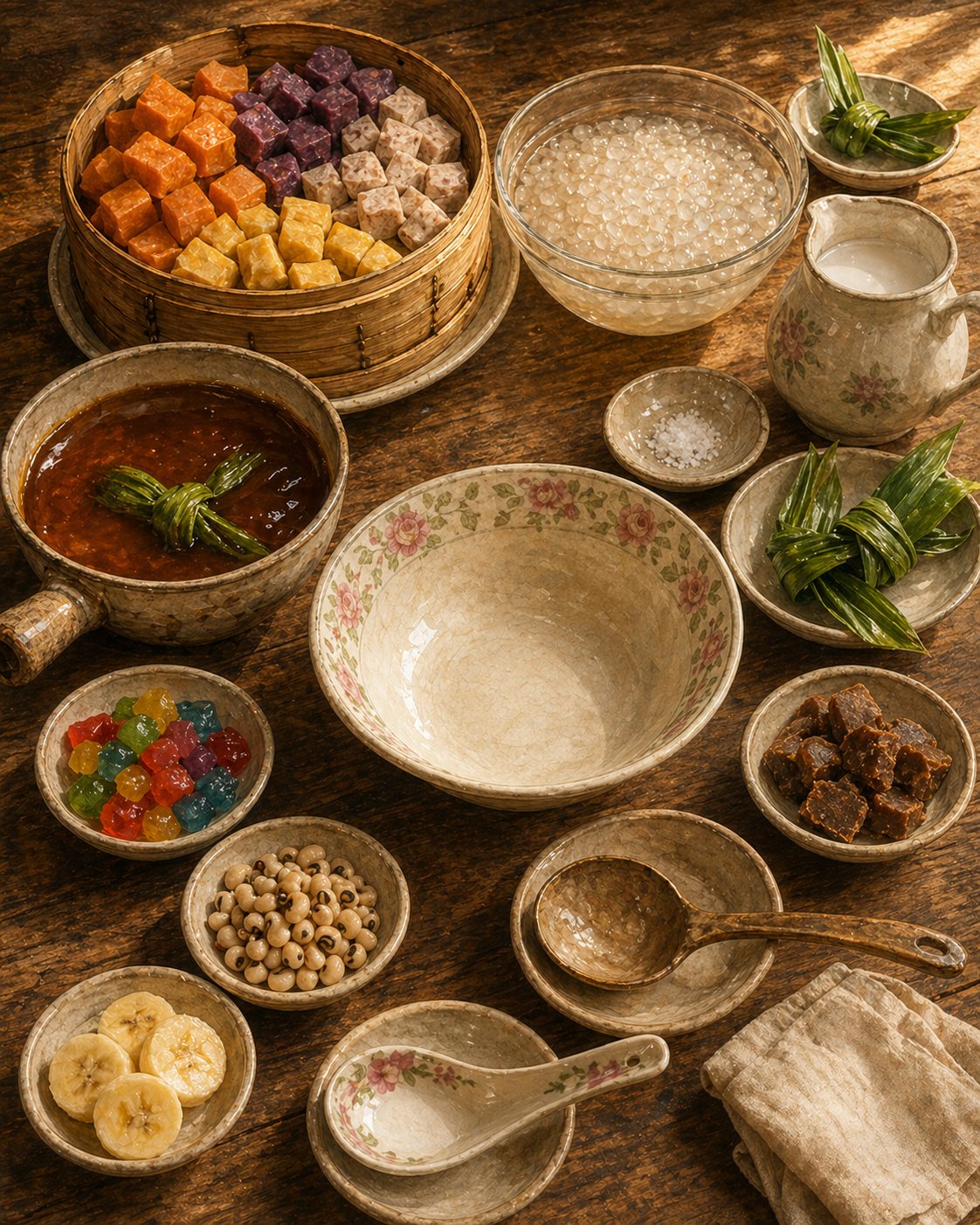
- Station 1 (bamboo steamer): Wide bamboo steamer over a stoneware steaming pot. Bring water to gentle boil.
- Station 2 (sago pot): Bring 1 litre water to rolling boil.
- Station 3 (gula-melaka melt-pot): Small heavy-bottomed saucepan ready.
- Station 4 (coconut-milk-base saucepan): Heavy-bottomed saucepan ready, separate from Station 3.
Steam the Tubers heritage rule one
Peel and cube the four tubers separately into uniform 2 cm cubes. Wear gloves while peeling taro. Keep peeled cubes in cold water until ready.
Drain. Layer in the bamboo steamer in separated sections — keep each colour distinct. Steam 12–15 minutes until just-fork-tender — a fork should slide in with a moment of resistance, NOT mush through. The cubes must hold their shape.
Test from each colour. The orange sweet potato is usually done first; remove to a heritage rice bowl. The purple and yellow next; the taro takes the longest. Each rests covered with a clean cloth.
Boil the Sago
At rolling boil, drop in 60 g pearl sago — do NOT rinse first. Boil 10 minutes, stirring occasionally. Pearls start opaque-white and become translucent.
Test: pearls should be translucent throughout with a faint white at the very centre. Drain, rinse briefly under cold water, transfer to a heritage clear-glass bowl with enough cool water to cover. Reserve.
Melt the Gula-Melaka Syrup separate-melt, NOT cooked-in
In the small heavy-bottomed saucepan, combine 150 g chopped gula melaka, 100 ml water, and 2 knotted pandan leaves. Heat gently over medium-low, stirring occasionally, until the gula-melaka fully dissolves (~8–10 minutes).
The syrup should read as deep-amber-bronze, glossy, slightly viscous. Strain through a fine-mesh sieve. Discard the spent pandan-knot. Transfer to a heritage glass pouring-jug. Reserve warm.
Warm the Coconut-Milk Base heritage rule two
In the second saucepan, combine 500 ml fresh coconut milk, 300 ml water, 3 knotted pandan leaves, ½ tsp sea salt, and 30 g white sugar.
Heat over medium-low, stirring gently. Watch carefully — heritage rule two is the most-warned-about technique-rule.
The MOMENT the coconut milk reaches gentle simmer with the first rolling-boil bubble: TURN OFF THE HEAT IMMEDIATELY. Do not let it boil. Reportedly even an additional 30 seconds of boil produces pecah minyak.
Discard the pandan knot. The base should read as pure-white-cream, smooth, fragrant with pandan, warm but no longer cooking.
The Assembly: GULA POUR the cartouche moment — heritage rule three
Bring the wide heritage Peranakan serving bowl to the counter. Ladle the warm coconut-milk base — fills about half. The broth reads pure-white-cream.
Add the steamed tubers gently — distribute the four colours so each spoonful catches at least three. Add the cooked sago pearls. If using optional additions: add black-eyed peas, multi-colour tapioca cubes, sliced bananas. Add 1 fresh knotted pandan leaf to float at the surface.
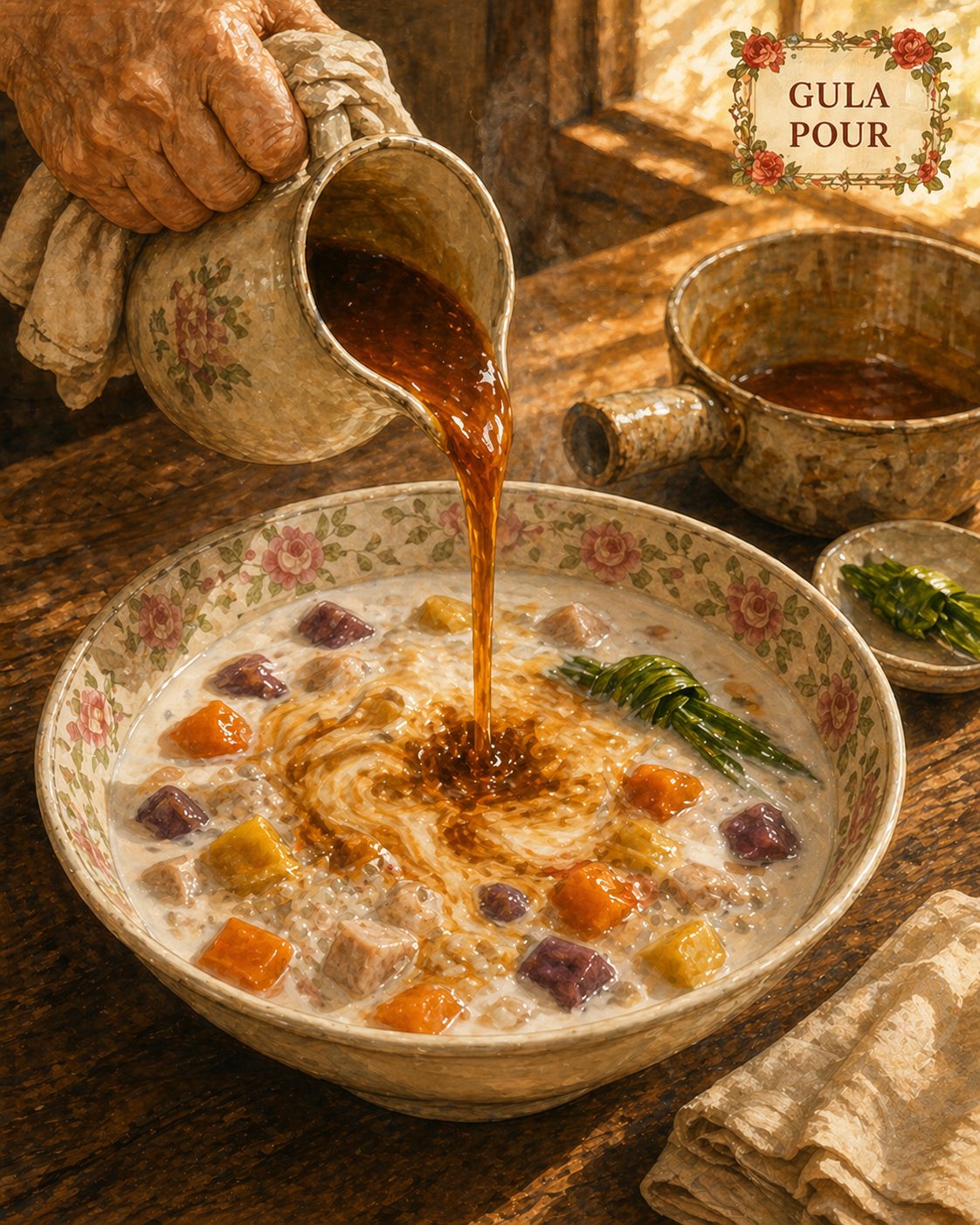
THE GULA POUR. Holding the heritage glass pouring-jug at about 20–25 cm above the bowl, pour a steady stream of the deep-amber-bronze syrup INTO the centre of the broth. The syrup hits the pure-white surface and creates the heritage Peranakan signature: golden-amber tendrils unfurling outward in spiralling marbled patterns through the white broth — never fully integrated.
Take a heritage flat ladle (the same tool as the tau hwey skim). Lift the broth from the bottom in 4–5 slow gentle strokes, allowing the gula-melaka to distribute through the column without breaking the surface marbled-swirl. After 4–5 strokes, STOP.
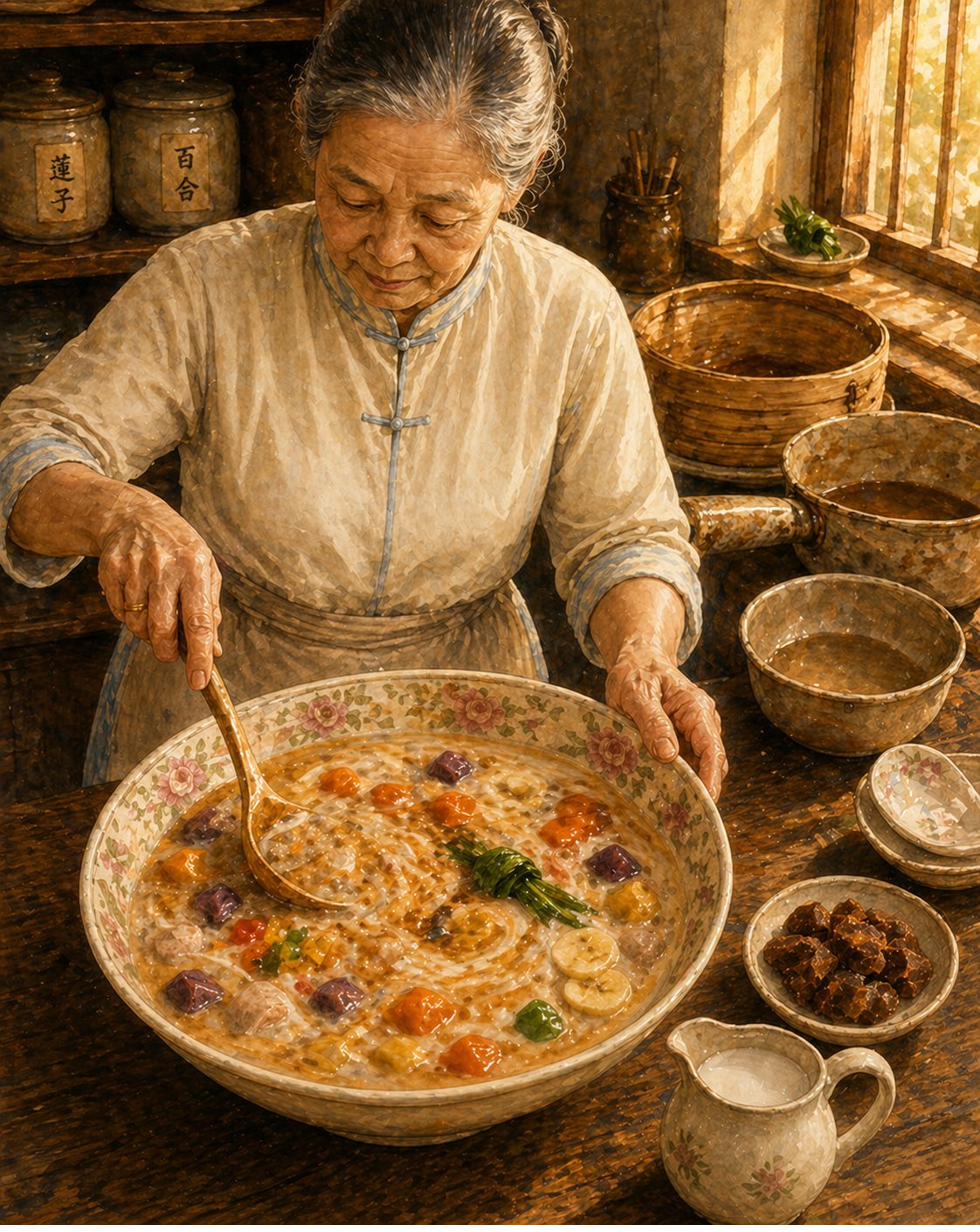
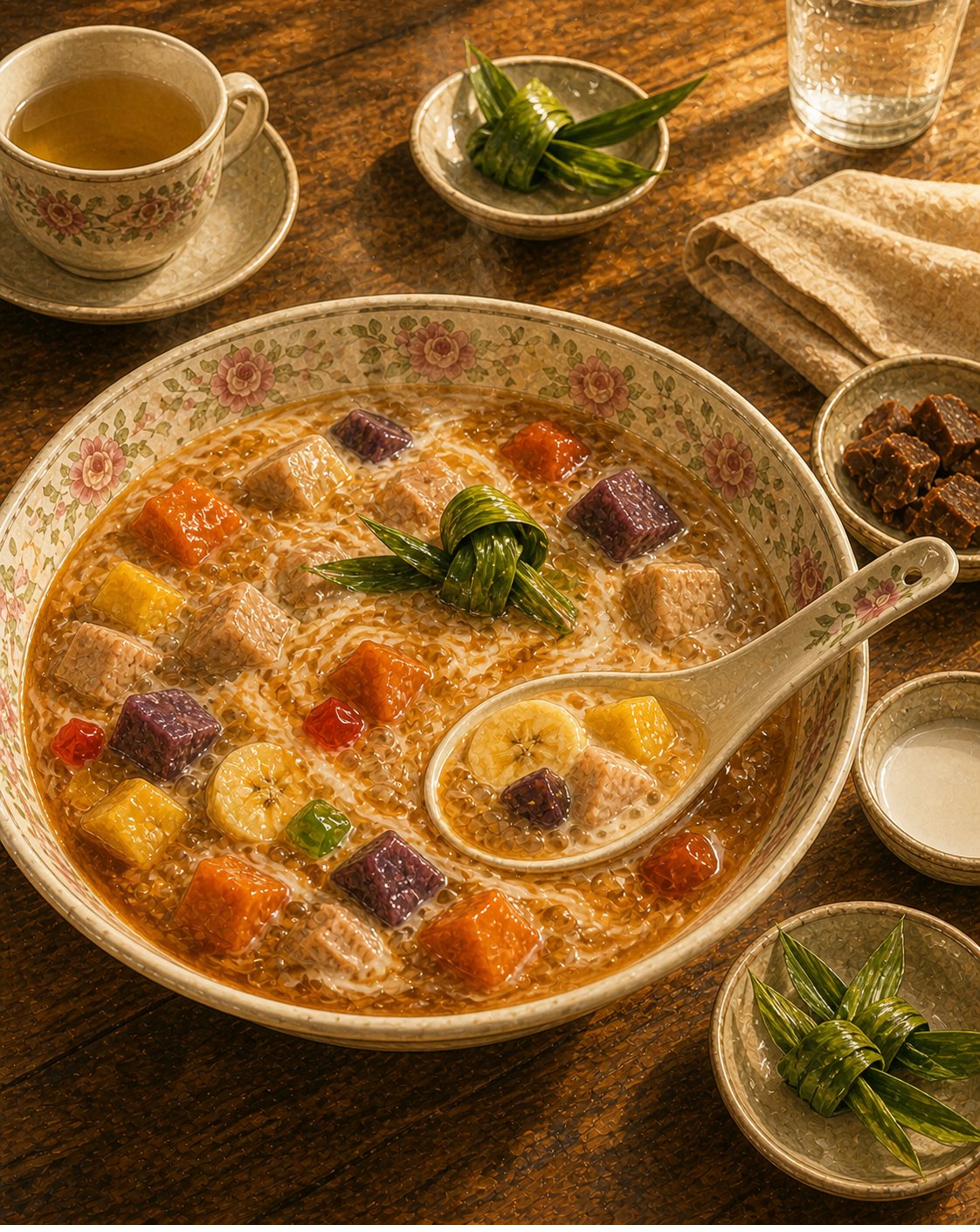
Serve immediately for warm. For cold: refrigerate the assembled bowls 2 hours minimum, serve chilled with a fresh coconut-milk drizzle and an extra small ladle of gula-melaka at the table.
🎯The Three Tips
Heritage. Master's. Mistake.
🏛 Heritage Note
Distribution Is the Dish
The dish's deepest heritage register is distribution. Reportedly heritage Peranakan-Penang practice for Chap Goh Mei prepares bubur cha cha in volume and distributes bowls to neighbours, family, and household helpers — the dish is a vehicle for "abundance" (che che) shared outward, not hoarded inward. The auspicious meaning is realised in the giving, not the eating.
My mother carried this practice — every Chap Goh Mei she would prepare bowls for the four neighbouring households on her stretch of the kampung, and then for two or three households whose children she had watched grow up. The dish was the message; the message was abundance.
For young hawkers thinking about a heritage Peranakan stall: bubur cha cha is your festival anchor. Outside Chap Goh Mei the dish sells at modest volumes, but on the 15th day demand spikes dramatically — heritage stalls prepare 10–15× normal volume on the festival day. The dish has cultural weight that other tong-sui do not.
👨🍳 Master's Tip
The Marbled Swirl Discipline
The hardest single technique is the gentle fold after the gula-pour — too much fold and the gula-melaka homogenises into uniform beige; too little and it pools at the bottom and never reaches the top tubers.
The heritage rule: 4–5 fold-strokes maximum, slow and from below. Heritage practice uses a wide flat ladle and lifts the broth from the bottom in slow gentle strokes, allowing the gula-melaka to distribute through the column without breaking the surface swirl. After 4–5 strokes, STOP.
Reportedly my mother's marbled swirl was always denser at the centre and lighter at the edges, with the gula-melaka catching the bowl-rim in deep-amber pools. The centre-to-edge gradient is the visual evidence that the gula-melaka was poured at the centre and folded gently outward. I have spent years trying to replicate her gradient. Mine is good now. Hers was better.
⚠ Common Mistake
Three Failure Modes
- Boiling tubers in coconut milk for "convenience". The most common modern shortcut and the most catastrophic heritage failure. Boiling tubers in coconut milk softens their edges and turns the dish into literal porridge. Heritage rule one: separate-steam.
- Letting the coconut milk fully boil. Boiling past the first bubble breaks the emulsion: oil separates, broth thins, surface develops a glistening greasy sheen — pecah minyak. The recovery is impossible — once broken, the broth cannot be re-emulsified.
- Cooking gula melaka into the coconut-milk base from the start. Heritage Penang-Nyonya warning: turns the broth uniform-beige, "an unappetising beige". The heritage signature is the marbled-swirl, which requires the late-pour. Heritage rule three: pour, don't cook-in.
📈 Scaling for Hawker Service
For a heritage Peranakan dessert stall doing 80–200 bowls a day (festival days, 200–500)
The heritage Singapore Peranakan-Nyonya dessert stall is concentrated in the Joo Chiat / Katong heritage Peranakan district, with notable presence at Geylang Serai, Tiong Bahru, and select heartland HDB markets. Heritage stalls sell bubur cha cha as one of 4–6 menu items alongside other heritage Nyonya desserts (kueh dadar, chendol, pulut hitam, ondeh-ondeh). Pricing runs SGD 3.50–6.00 per bowl, with festival-day pricing typically holding (heritage discipline rather than seasonal markup).
- Daily prep cycle (100-bowl volume): 5–6am — peel and cube all tubers (~2.5 kg total), reserve in cold water. 6–7am — steam tubers in batches across multiple bamboo steamers; in parallel boil sago. 7–7:30am — melt gula-melaka in single 1.5 L batch, strain, hold warm. 7:30–8am — warm coconut-milk-base in single 5 L batch, kill heat at first bubble. Service 11am–9pm — build individual bowls to order with late gula-pour and gentle fold.
- Cost (Singapore 2026): ~SGD 1.40 per bowl (tubers 0.50 + sago 0.10 + gula 0.30 + coconut milk 0.30 + labour 0.20). Sells SGD 3.50–6.00. Margin: 60–75%.
- For Chap Goh Mei festival: Steam tubers from 4–5am. Maintain TWO coconut-milk-base pots in rotation. Pre-portion 50-bowl batches into chillers; gula-pour at customer-order to preserve the marbled-swirl signature. Designate ONE staff member solely for the gula-pour-and-fold.
- For home cooks: The 6–8 bowl batch keeps refrigerated 2 days for cold (the warm version's coconut milk thickens substantially when chilled, recoverable with a fresh coconut-milk drizzle). Do NOT reheat with the gula-melaka already integrated — reheating breaks the marbled-swirl irrecoverably.
My mother said the marbled swirl was the dish's signature, but what I remember is the moment after the swirl — the moment she sat down with her own bowl, while the late-afternoon light came through the kitchen window, and ate slowly. She did not talk while eating bubur cha cha. None of us did. The bowl was the conversation. The chapter ended every Chap Goh Mei the way the year ended — quietly, on amber, with the household and the neighbours all fed, and one bowl left for the cook. I have made bubur cha cha forty-three times since she stopped being able to. Mine still swirls, but the swirl moves differently in my hand than it did in hers. The chapter ends here. The bowl is for you.