Cheng Tng
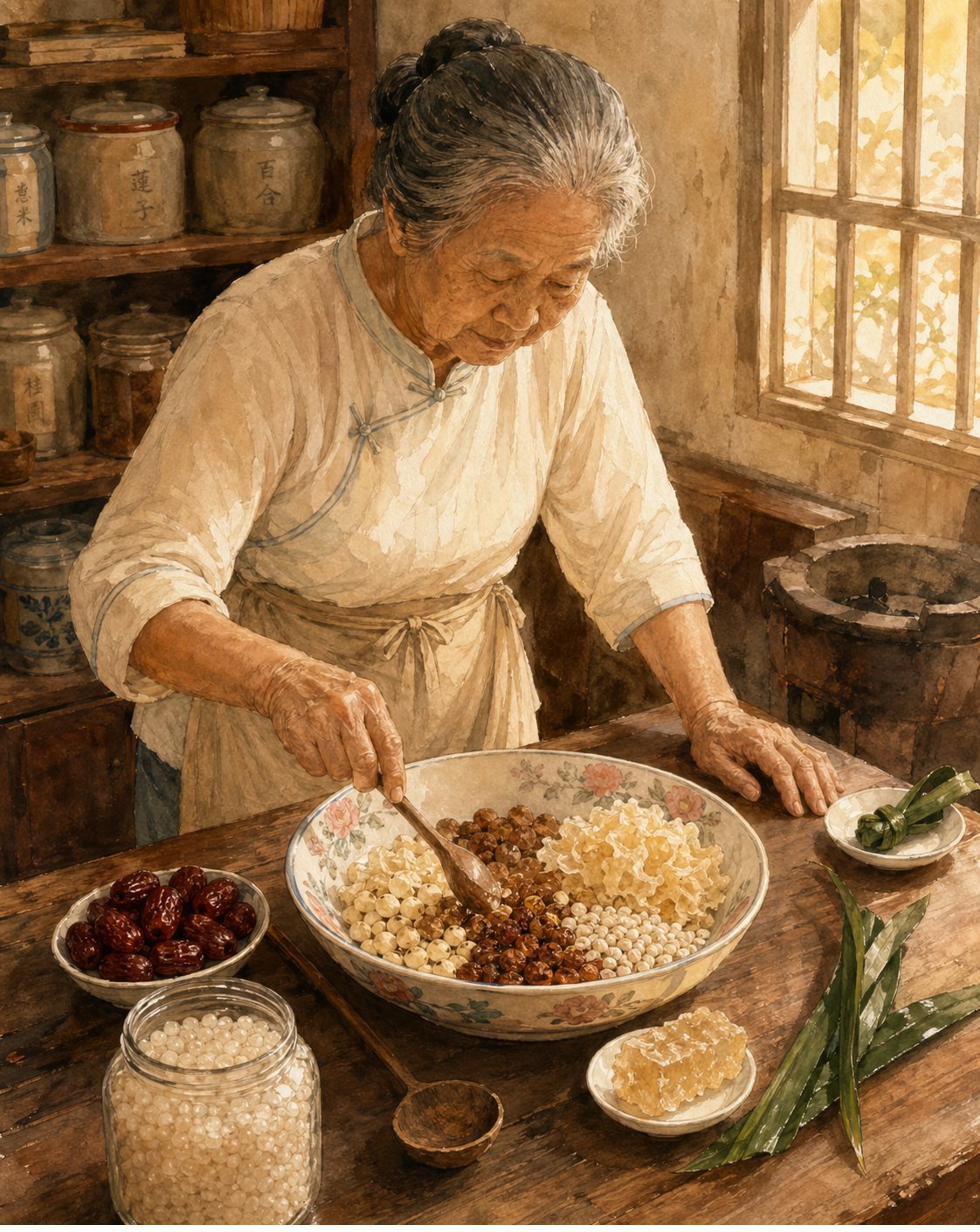
This is my mother's chapter, and this is the dish she made on the hottest afternoons of my childhood. When the air went still and the cement floor of the kitchen was too warm to walk on barefoot, she would stand at this same counter and tell me to bring her the bowls.
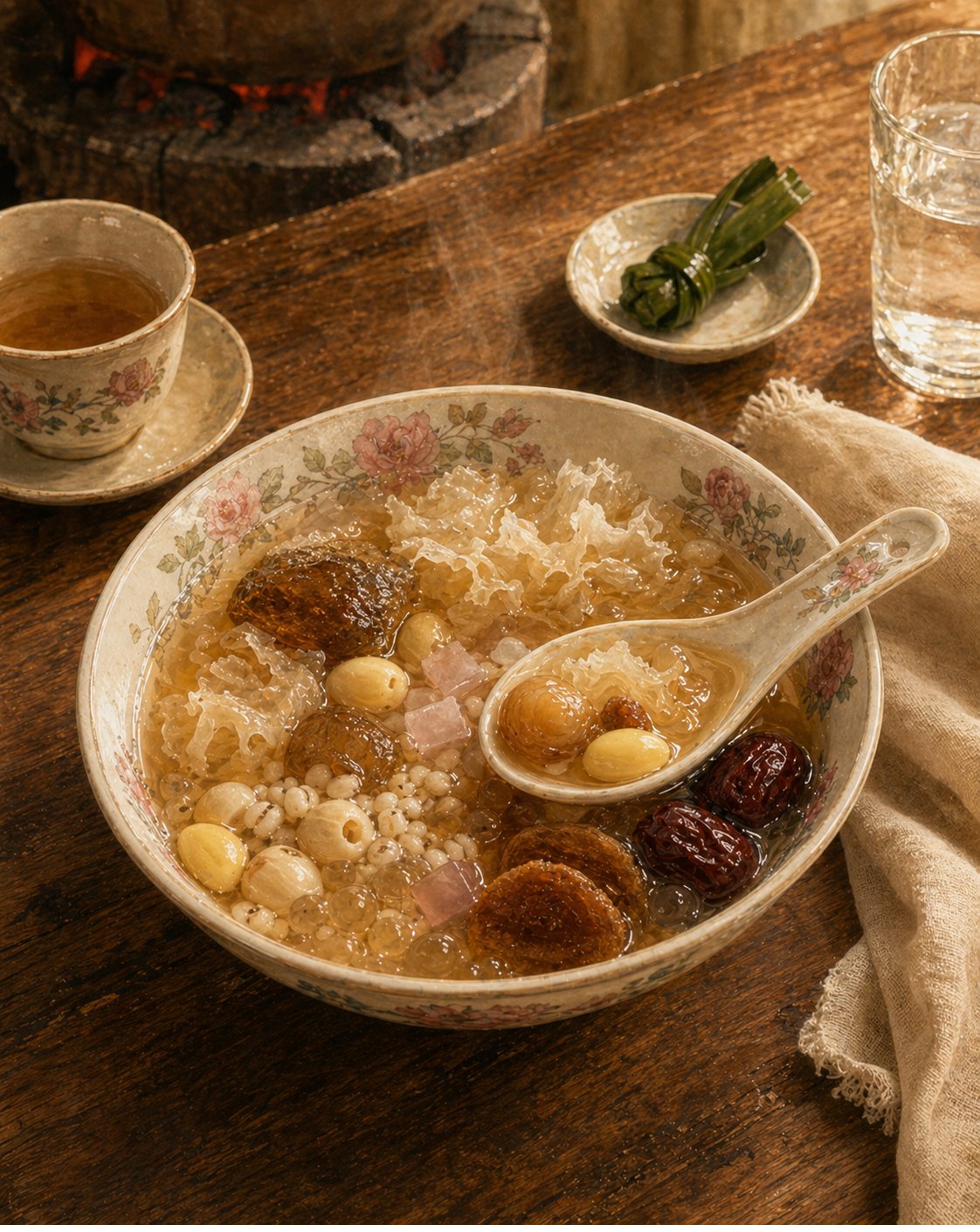
Cheng tng — qīng tāng (清汤) in Mandarin, literally "clear soup" or "clear broth" — is the heritage Singapore dessert of the long hot afternoon. The dish is a clear amber broth carrying a textural medley of dried-goods — white fungus, longan, lotus seeds, pearl barley, ginkgo, red dates, pang da hai, sago, persimmon, agar jelly — sweetened lightly with rock sugar and perfumed with pandan. It is served warm in cool weather and cold in hot weather. Singapore being what it is, the cold version is what most people know.
Two heritage notes worth establishing carefully. First — the dialect attribution is genuinely contested. Reportedly Singapore food writers most often attribute cheng tng to Teochew tradition, citing the Hokkien-Teochew romanisation "cheng tng" itself as evidence. But there is a parallel theory — reportedly the dish evolved from a Cantonese savoury clear-broth tradition that was adopted into Singapore-Chinese dessert culture across multiple dialects. The truth is probably both: a cross-dialect Singapore evolution settled into the form we know now. I will not pretend to settle this. My mother called it cheng tng, and so do I.
Second — the ingredient list is genuinely flexible. Heritage Singapore stalls carry between six and eleven ingredients in any given bowl. Ye Lai Xiang Cheng Tng at Bedok Food Centre, operating since 1939, runs an eleven-ingredient version; Four Seasons Ching Tng across multiple outlets runs a leaner heritage form. There is no canonical fixed ingredient list — each family runs its own. I will give you the version my mother made, which carries nine ingredients. The cheng tng you make for yourself becomes yours.
The dish ends every long hot afternoon at this kitchen table. My mother served it in small heritage tong sui bowls with floral-rim porcelain spoons. We ate it slowly, the broth cooling in front of us, the textures shifting as the bowl emptied. Reportedly the Chinese cooling-soup tradition holds that cheng tng "disperses heat" and "resets the body" against the long humid afternoon. I cannot speak to the medical claim. I can speak to the way the bowl emptied. By the third spoonful you would feel the air loosen.
This is the dish that opens the dessert chapter because it is the dish my mother made first. Everything else in the chapter is something we ate after this.
🛒Ingredients
Patience is the technique. The longan does the colour work; the rock sugar lifts; the pre-cooks protect the broth's amber clarity.
For the Broth Base
| Filtered water | 2.5 L | Filtered or boiled-and-cooled gives the cleanest broth-clarity. |
| Rock sugar (bīng táng) | 80–120 g | Heritage sweetener — gives the cleanest amber clarity. Substitute: gula melaka or brown sugar — both heritage-acceptable but darker. |
| Pandan leaves | 2 large | Tied into a tight knot. |
The Heritage Textural Medley nine canonical — reduce to six if needed
| Dried white fungus (yín ěr / 银耳) | 2 rosettes (~30 g dry) | Soaked overnight to bloom from rough-cream-tight to soft-translucent-frilly. The bloom is the centrepiece. |
| Dried longan (lóng yǎn / 龙眼) | 50 g | The defining flavour-note. Releases the warm-amber colour and gentle floral-sweet base. |
| Dried lotus seeds (lián zǐ / 莲子) | 60 g | Pre-cooked separately to gentle-Q. Salted-storage variety: rinse and pre-cook twice; unsalted: once. |
| Pearl barley (yì mǐ / 薏米) | 50 g | Rinsed thoroughly. Anchors the bowl with soft-Q grain register. |
| Ginkgo nuts (bái guǒ / 白果) | 60 g (~30 nuts, shelled and skinned) | Pre-cooked in light sugar-water. Remove the green embryo (slightly bitter, traditionally not for pregnant women). |
| Red dates (hóng zǎo / 红枣) | 8 dates | Lightly slit each one before adding so the broth can extract the date's depth. |
| Pang da hai / malva nut (pàng dà hǎi / 胖大海) | 4 seeds | Soaked overnight to swell open. Heritage cooling-soup register. Avoid for pregnant women. |
| Large sago pearls (xī mǐ / 西米) | 60 g | Pre-cooked separately — boiling sago in the main broth clouds it. |
| Dried persimmon (shì bǐng / 柿饼) | 4 thin coins | Sliced thin. Adds deep-amber sweetness with leather-chew. Substitute: candied winter melon. |
🌶️Shifu's Lift
choose one path — see "Shifu's Secret" chapter for the philosophy- Old-school path: A small pinch of salt with the rock sugar — sharpens the longan-amber. Counterintuitive, heritage-Cantonese-tong-sui practice.
- Modern hawker path: 2 tbsp dried osmanthus blossoms (guì huā) in a muslin pouch, steeped for the last 10 minutes. Floral perfume that lifts the longan-base.
- Heritage purist: A small piece of dried tangerine peel (chén pí) for the last 15 minutes. The citrus-bitter edge lifts the broth's clarity-perception. My mother did this.
For the Cold-Version Finish optional
| Pale-pink agar jelly cubes | 100 g, small dice | Heritage Singapore-stall textural-contrast. Skip for warm version. |
| Crushed ice | a handful | For the cold version only. |
👨🍳Method
Five stages. Soak, pre-cook, build, gentle-add, serve. Patience is the discipline; gentle-simmer is the rule.
The Overnight Soak the night before
Three ingredients need overnight soaking to bloom and release their heritage textures.
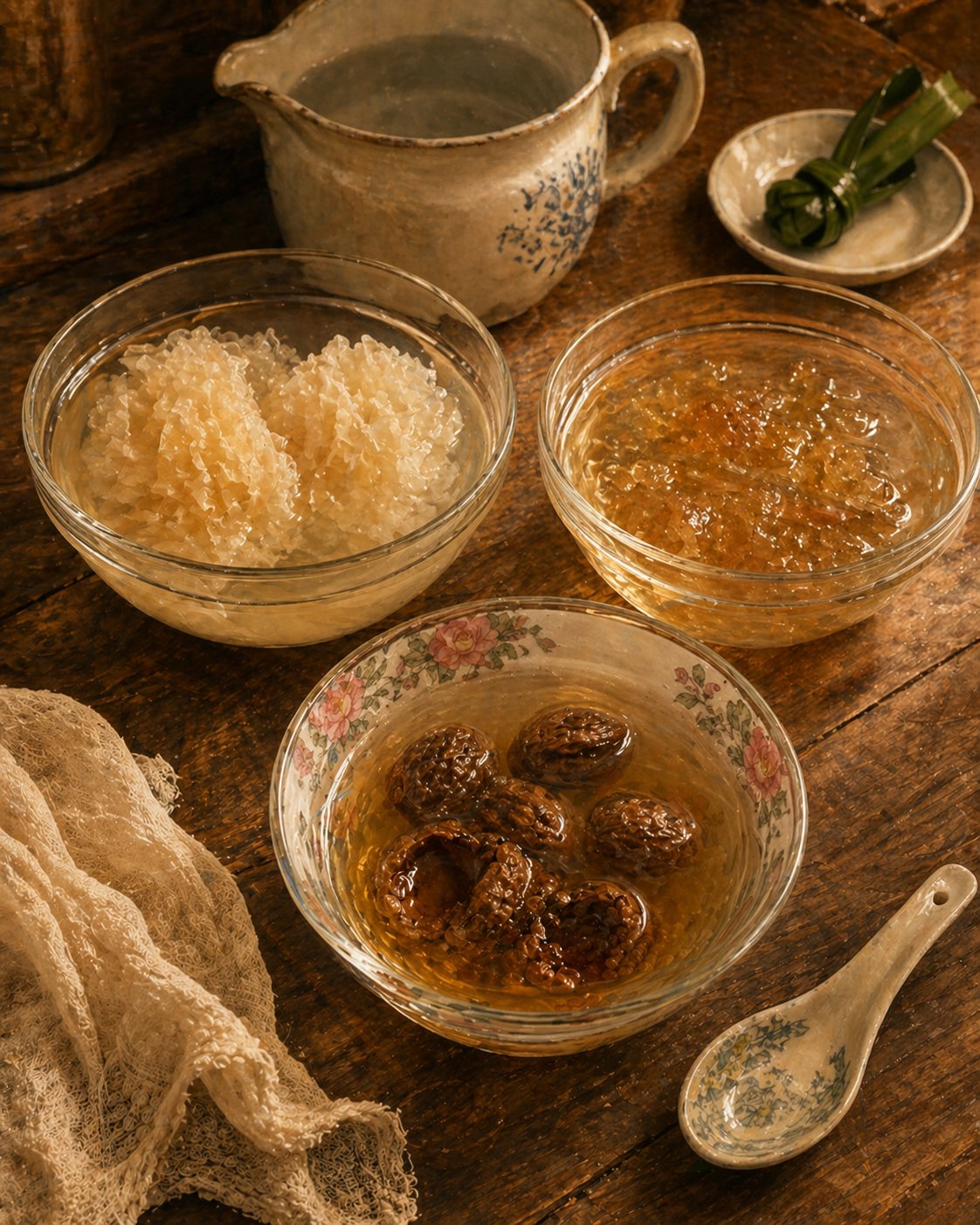
White fungus: Place 2 rosettes in a heritage clear-glass bowl, cover with 1 litre cool water. The fungus blooms from rough-cream-tight to soft-translucent-frilly over 12 hours. Reportedly heritage Singapore stalls soak 18 hours for maximum bloom; 12 is the home-cook minimum.
Pang da hai: Place 4 seeds in a small bowl with 200 ml cool water. The seeds swell and crack open, releasing their gelatinous brown-translucent interior into faint amber tea-stained water around them.
Cover both bowls with a clean muslin cloth. Leave on the counter overnight, away from direct sunlight.
Pre-Cook the Lotus Seeds, Ginkgo, and Sago the next morning
Three ingredients must be pre-cooked separately — this preserves their textures and protects the broth's clarity.
Lotus seeds: Rinse thoroughly (twice for salted-storage variety). Place in a small saucepan covered with cold water by 2 cm. Gentle simmer 25–30 minutes until tender-Q (yields to pressure but holds shape). Drain and set aside.
Ginkgo nuts: Shell, skin, and slit each nut to remove the green embryo. Place in a small saucepan with 200 ml water and 15 g rock sugar. Gentle simmer 10 minutes, then turn off and steep in the warm sugar-water until the broth is ready.
Sago pearls: Bring water to rolling boil. Drop pearls in directly (do NOT rinse first). Boil 15 minutes, stirring occasionally. Turn off, cover, let residual heat finish the centres for 30 minutes — should be fully translucent. Drain, rinse briefly under cold water.
Build the Broth Base the cartouche moment — TONG SUI SIMMER
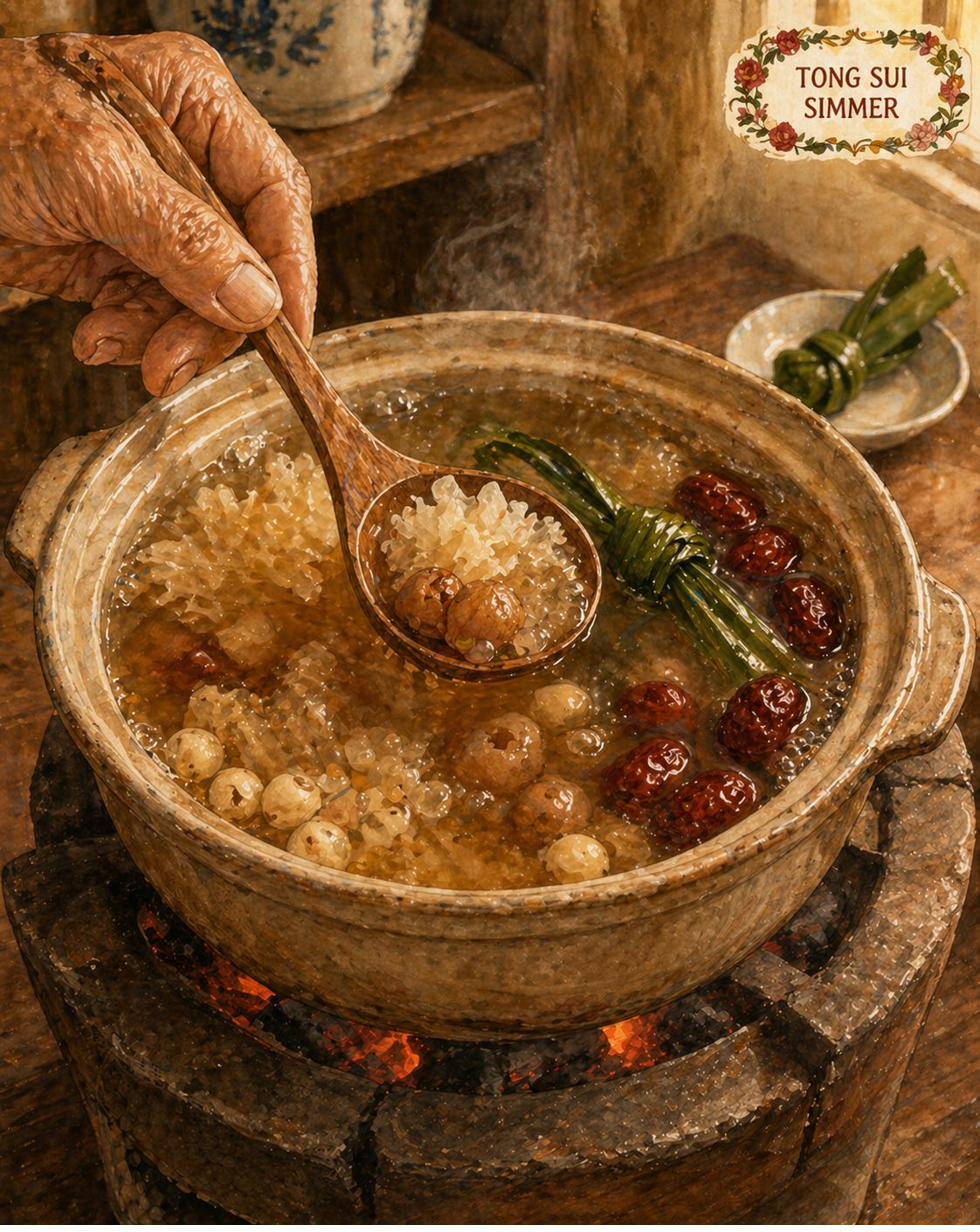
In a heavy stoneware simmer pot, combine 2.5 litres filtered water, the bloomed white fungus (drained, torn into florets, tough yellow base discarded), 50 g longan, 50 g pearl barley (rinsed), 8 lightly-slit red dates, the knotted pandan, and 80 g rock sugar.
Bring to a boil over high heat, then immediately reduce to gentle simmer — small bubbles rising gently around the rim, NEVER a rolling boil. The rolling boil is the failure mode. Aggressive bubbling clouds the broth, breaks the white fungus into ragged shreds, and dilutes the heritage clarity register.
Simmer gently, uncovered, for 45 minutes. The broth gradually takes on its amber-tint as the longan and red dates release their colour. Stir occasionally with a wooden ladle, gently. The ladleful test: at 45 minutes, lift a single ladleful into the air. The broth should read as faintly amber-tinted-clear, the ingredients visible at varying depths through the broth.
Add the soaked pang da hai (with its gelatinous interior) and the dried persimmon coins. Simmer 10 more minutes.
Add the Pre-Cooked Stages the gentle build
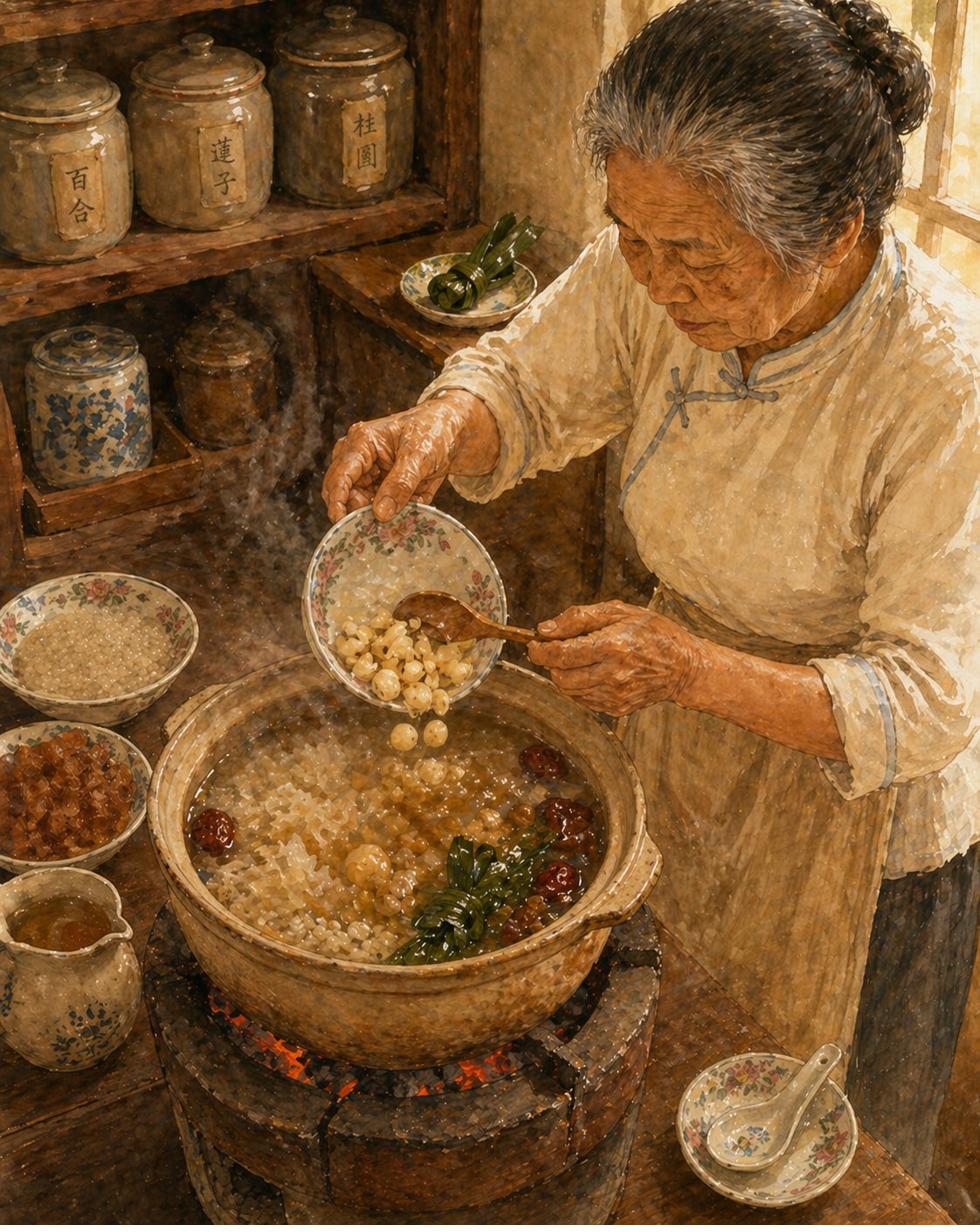
With the broth at gentle simmer, add the pre-cooked stages one at a time, gently coaxing each into the broth without disturbing the simmer.
Lotus seeds first — gently spoon them in around the perimeter so they settle. Wait 30 seconds for the simmer to recover. Then ginkgo nuts with their sweet steeping water — pour both in. Wait 30 seconds. Then cooked sago pearls — gently fold them in. The pearls rise to the surface and float there.
Apply your Shifu's Lift choice here. Simmer 10 more minutes. Taste and adjust rock sugar by 10 g at a time. The broth should read as gently sweet, lifted by the longan-amber, NOT cloyingly sweet.
Discard the pandan-leaf knot, the dried tangerine peel (if used), and the muslin osmanthus pouch (if used) before serving.
Serve, Warm or Cold
For the warm version: Ladle directly from the simmer pot into small heritage tong sui bowls. Each bowl carries a generous spoonful of textural medley plus enough broth to swim them. Serve with heritage porcelain spoons. Steam should rise gently.
For the cold version: Cool to room temperature (about 90 minutes), then chill 4 hours minimum. Just before serving, stir in the agar-jelly cubes. Ladle into bowls, optionally with a small handful of crushed ice on top.
🎯The Three Tips
Heritage. Master's. Mistake.
🏛 Heritage Note
The Broth Is Your Business
Cheng tng's heritage form holds that the broth must read as faintly amber-tinted-clear — NOT cloudy, NOT dark-tea-coloured. The clarity is the dish's signature.
Two reasons for cloudy broth: rolling-boiling instead of gentle-simmering (aggressive bubbles pull starch from lotus seeds and pearl barley into the broth), and cooking sago and ginkgo in the main broth instead of separately. Pre-cook the cloud-makers; gentle-simmer the broth; let the longan do its colour work undisturbed.
For young hawkers thinking about a heritage dessert stall: the textural medley can vary; the broth's amber clarity is what your customers will remember.
👨🍳 Master's Tip
The Longan Is the Recipe
One ingredient defines whether your cheng tng has body or whether it is sweet-water with stuff in it: the dried longan.
Cheap dried longan is dry, light, and has thrown its sugars into storage. Heritage dried longan is heavy, glossy, slightly tacky to the touch, and smells faintly floral when you bring it to your nose. A 50 g handful of heritage longan releases more depth than 200 g of cheap.
Find a good Chinese-medicine hall or heritage dry-goods stall. Pay more, use less, get a better dish. The same principle applies to white fungus, lotus seeds, ginkgo, and pang da hai. Heritage dry-goods are not interchangeable with supermarket dry-goods. The dish is the dry-goods.
⚠ Common Mistake
Three Failure Modes
- Over-sweetening. Heritage cheng tng is gently sweet. Start with 80 g rock sugar in 2.5 litres and adjust upward — far easier to add than to dilute.
- Skipping the overnight soak on white fungus. A short-soak gives a rough-textured fungus that reads as undercooked. The 12-hour soak is what gives the bloom its frilly-translucent heritage texture.
- Adding agar jelly to the warm version. The jelly melts at warm temperatures. Add jelly only to the cold version, after the broth has fully chilled.
📈 Scaling for Hawker Service
For a heritage dessert stall doing 100–250 bowls a day
Most surviving Singapore heritage stalls — Ye Lai Xiang Cheng Tng (since 1939), No Name Dessert at Bedok South, Four Seasons Ching Tng across multiple outlets, Geylang Serai Chee Kong — built their reputation on this single bowl. The discipline is volume-batched simmering: a single large stockpot carries 80–120 bowls' worth, simmered fresh each morning, with pre-cooked ingredients held warm separately and assembled to order.
- Daily prep cycle: Night before — overnight soak. 5–7am — pre-cook lotus seeds, ginkgo, sago in three separate pots. 7–9am — build the heritage broth, simmer 1 hour. 9am–8pm — hold broth warm-but-not-boiling, ladle to order, add pre-cooked stages at the bowl.
- Cost (Singapore 2026): ~SGD 0.80 per bowl (broth 0.30 + medley 0.45 + aromatics 0.05). Sells SGD 1.80–3.50. Margin: 55–65%.
- For home cooks: The 6-bowl batch keeps refrigerated 3 days for the cold version, 2 days reheated for warm. Pre-cooked components hold separately for longer — assemble at the bowl.
The cheng tng I make is the same cheng tng my mother made. The longan is the same longan. The pandan is the same pandan. The sugar is the same sugar. The only thing that changes is who is sitting at the table. That is enough.