Hong Dou Sha
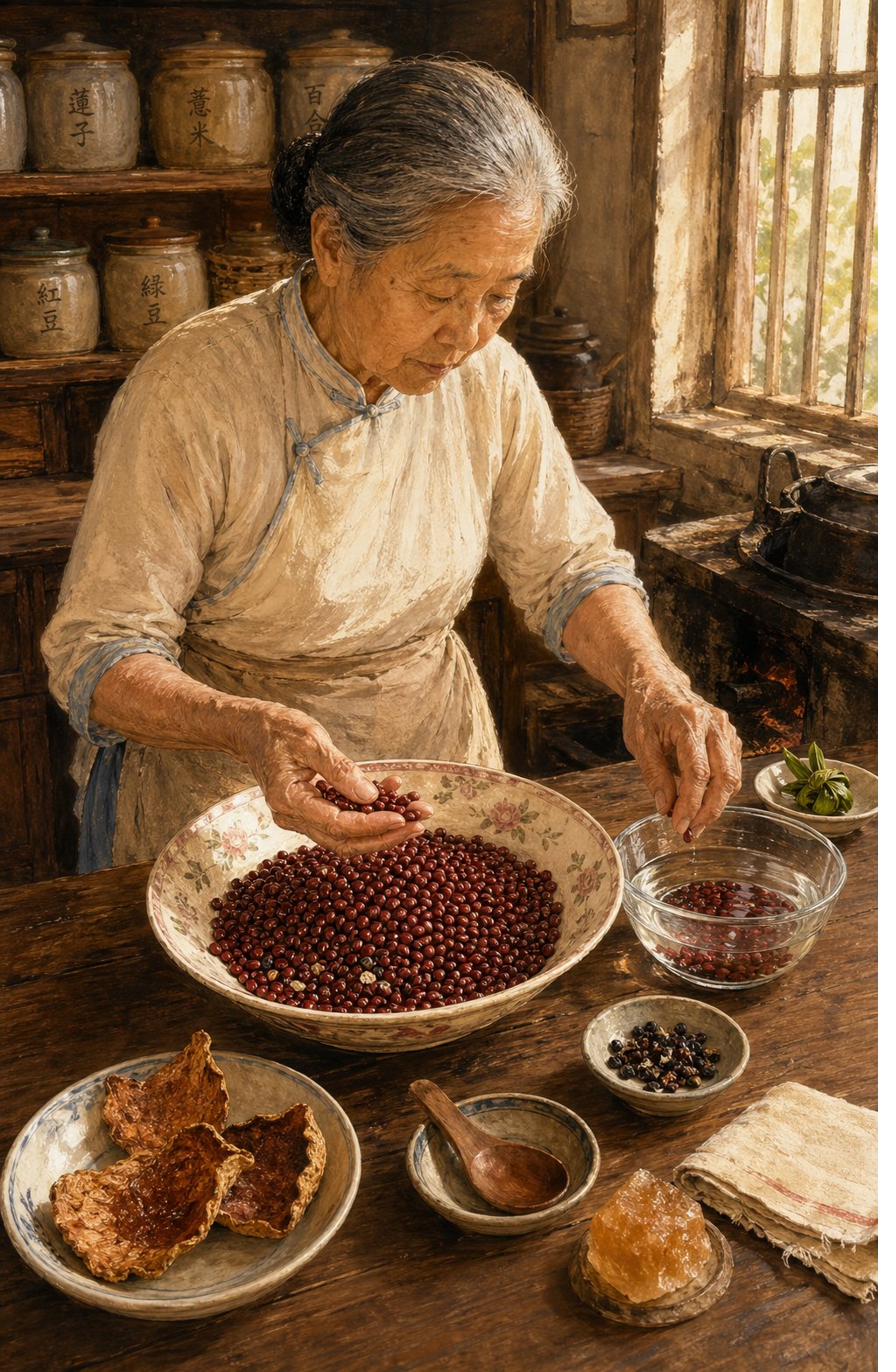
My mother's hong dou sha was always served warm, even in Singapore weather, even when the rest of us would have preferred it cold. She said the warm bowl was for the banquet's end, the cold bowl was for the afternoon. She rarely made the afternoon kind. Hong dou sha was for finishing.
Hong dou sha — hóng dòu shā (红豆沙), literally "red bean sand" — is the heritage Cantonese tong sui that closes a Chinese banquet. Reportedly it is the dish you eat last in a long Cantonese dinner: the broth is sweet, the beans have given everything to the broth, the chenpi has perfumed the room, the conversation has slowed. The bowl arrives, and the meal ends with it.
A note on naming. The dish has three Mandarin names that overlap: hong dou tang (红豆汤, "red bean soup") — the broth-style with whole-beans floating, often homestyle. Hong dou sha (红豆沙, "red bean sand") — the Cantonese banquet-style with beans broken down into the broth until it carries body, the sha (沙, "sand") describing the texture of broken-down bean-flesh suspended. Hong dou shui (红豆水, "red bean water") — the casual Hokkien-Cantonese homestyle name. My mother used all three interchangeably depending on whether she was speaking to her mother, her sisters, or her children. The dish is the same.
The dish has three heritage technical-discipline rules that separate a careful hong dou sha from a careless one. Each one is non-negotiable.
Rule one — never add sugar before the beans bloom. Sugar in the broth binds the bean-skins and prevents the beans from bursting and breaking down. Reportedly the most common failure-mode for first-time makers is dissolving the rock sugar at the start of the simmer; the result is two hours of patient simmering and beans that still won't disintegrate. Add the rock sugar AFTER the beans have bloomed (about half visibly burst); only then will the dissolved sugar suspend cleanly into the broth.
Rule two — chenpi is not optional. The aged dried tangerine peel is the dish's heritage-Cantonese signature. A hong dou sha without chenpi is a homestyle red bean soup; a hong dou sha with aged chenpi is a Cantonese-banquet dessert. The peels carry citrus-bitter complexity that lifts the rock-sugar sweetness and balances the bean-starch heaviness. Use 3 pieces of medium-aged peel for a 6-bowl batch.
Rule three — half the beans are mashed, half are reserved. This is the heritage Cantonese texture-discipline. After the long simmer, half the cooked beans are pressed through a heritage round-mesh strainer with a wooden masher — bean-flesh falls through as deep-mahogany-red mashed-paste; bean-skins accumulate and are discarded. This thickens the broth into the signature sha consistency. The reserved whole beans return for textural contrast. The bowl that arrives carries both the sha-thickened broth AND the whole-bean texture in the same spoonful.
The chenpi my mother used was always the same: aged peels she bought from a wet-market vendor in Chinatown who knew her by name and saved the older grade for her. Reportedly she paid more than the supermarket would have charged. Reportedly she said the supermarket peels would not do.
This is the dish that closes the banquet. In Chapter 8, it sits second because Hock Ko's mother always served it second — after the cooler cheng tng of the long afternoon, before the steamed-egg-pudding warmth of the colder evening. The chapter holds her ordering.
🛒Ingredients
Three rules. Sugar after bloom. Chenpi the signature. Half-mash the texture-discipline.
For the Broth Base
| Dried adzuki beans (hóng dòu / 红豆) | 300 g (~1.5 cups) | Deep-burgundy-red Chinese adzuki. Do NOT substitute kidney beans or other red beans — flavour and texture are completely different. |
| Water | 2.5 L | For the long simmer; will reduce as beans break down. |
| Aged dried tangerine peel (chén pí) | 3 pieces, medium-aged (or 2 pieces, well-aged 10+ years) | Soaked overnight, then pith-scraped before adding. The pith-scrape is non-negotiable. |
| Pandan leaves | 2 large | Tied into a knot. Heritage Singapore-Cantonese practice. |
| Rock sugar (bīng táng) | 100–140 g, to taste | Heritage Cantonese sweetener of choice. Substitute: sliced sugar (片糖) for a more caramel register. |
For the Heritage Cantonese Pairing canonical
| Dried lotus seeds (lián zǐ / 莲子) | 60 g | Pre-soaked overnight, pre-cooked separately to gentle-Q. Remove the green embryo before pre-cooking. |
Optional Textural Add-Ins
| Large sago pearls | 60 g | Pre-cooked separately. Optional — heritage Cantonese banquet practice does not always include sago. |
| Glutinous rice balls (tāng yuán) | 12 small | Heritage Lunar New Year and Dongzhi Festival pairing. |
| Coconut cream | 1 tbsp per bowl | Modern Hong Kong tong sui shop variation — swirled at table. |
🌶️Shifu's Lift
choose one path- Old-school path: A small pinch of salt with the rock sugar — heritage Cantonese-grandmother technique that sharpens the bean-amber perception.
- Modern hawker path: A 4th piece of aged chenpi added in the final 10 minutes — pushes the citrus-bitter to the front of the bowl. Use a younger-grade peel for this lift.
- Heritage purist: Add 20 g dried lily bulb (bǎi hé / 百合) to the simmer with the lotus seeds — soft-translucent textural counterpoint. My mother did this for older relatives.
Equipment
| Heritage round-mesh strainer | 1 | Woven bamboo or fine wire-mesh, for the half-mash. |
| Heritage wooden masher | 1 | Or the back of a heavy wooden spoon. |
| Wide ceramic catch-bowl | 1 | For the mashed-paste. |
👨🍳Method
Five stages. Soak, pre-cook, long-simmer, half-mash, serve. The sugar enters at bean-bloom, not before.
The Overnight Soak the night before
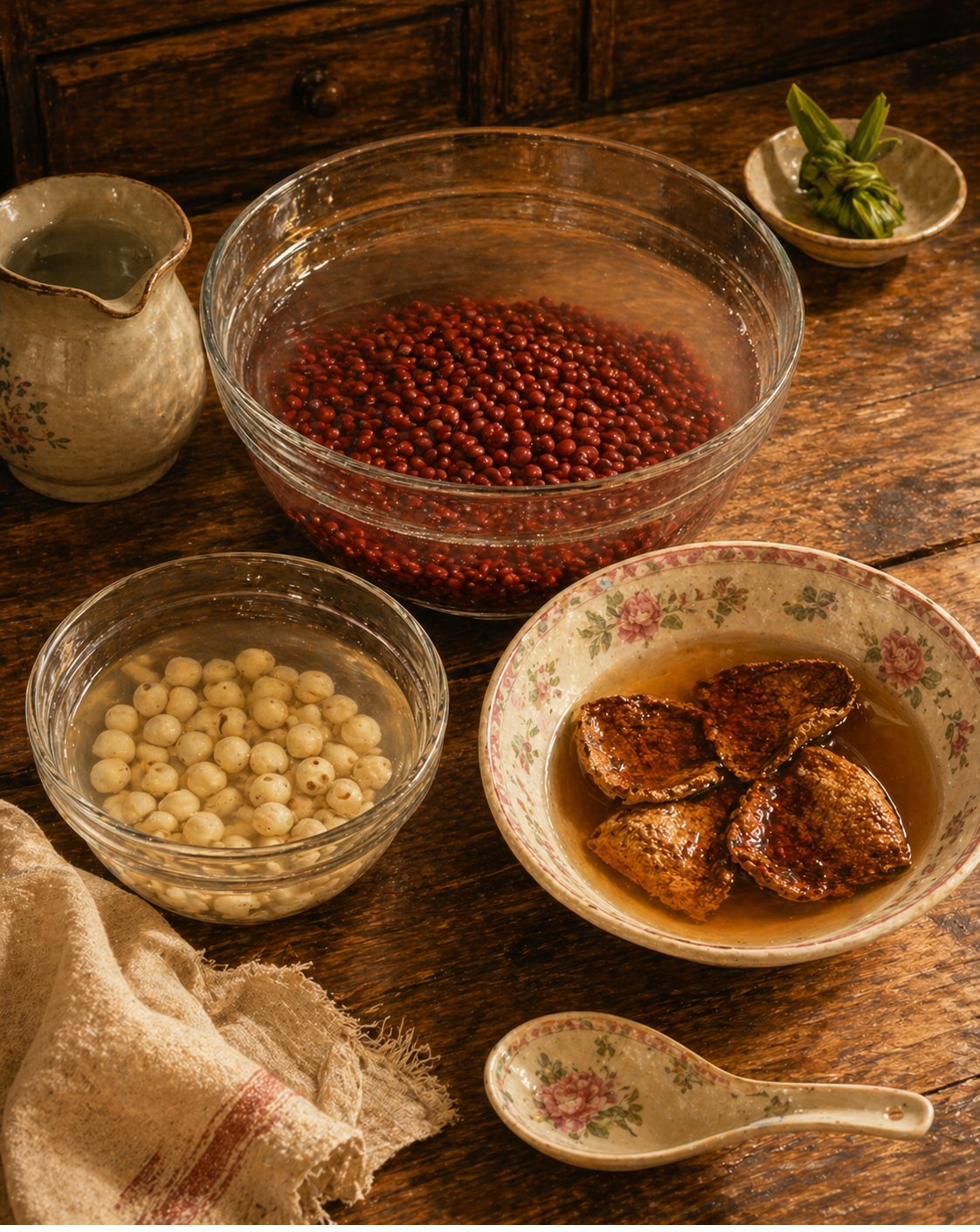
Three ingredients need overnight soaking.
Adzuki beans: Rinse thoroughly, discarding any stones. Place in a heritage clear-glass bowl, cover with at least 1.5 litres cool water (the beans absorb significantly).
Lotus seeds: Rinse, place in a small bowl with 500 ml cool water.
Aged chenpi: Place 3 pieces in a small heritage bowl with 200 ml cool water. The peels soften and tint the water faintly amber as the citrus oils release. Reportedly heritage Cantonese practice uses the chenpi-soak water in the broth simmer — adds another half-register of perfume. My mother did this.
Cover all three with a clean muslin cloth. Leave on the counter overnight.
Pre-Cook the Lotus Seeds and Sago the next morning
Lotus seeds: Drain, slit each seed and remove the green embryo. Gentle simmer in 400 ml water for 25–30 minutes until tender-Q. Drain.
Sago (if using): Bring water to rolling boil, drop pearls in directly. Boil 15 minutes, stirring occasionally. Turn off, cover, residual-cook 30 minutes. Drain, rinse cold.
Build the Long Simmer the cartouche moment — BEAN BLOOM
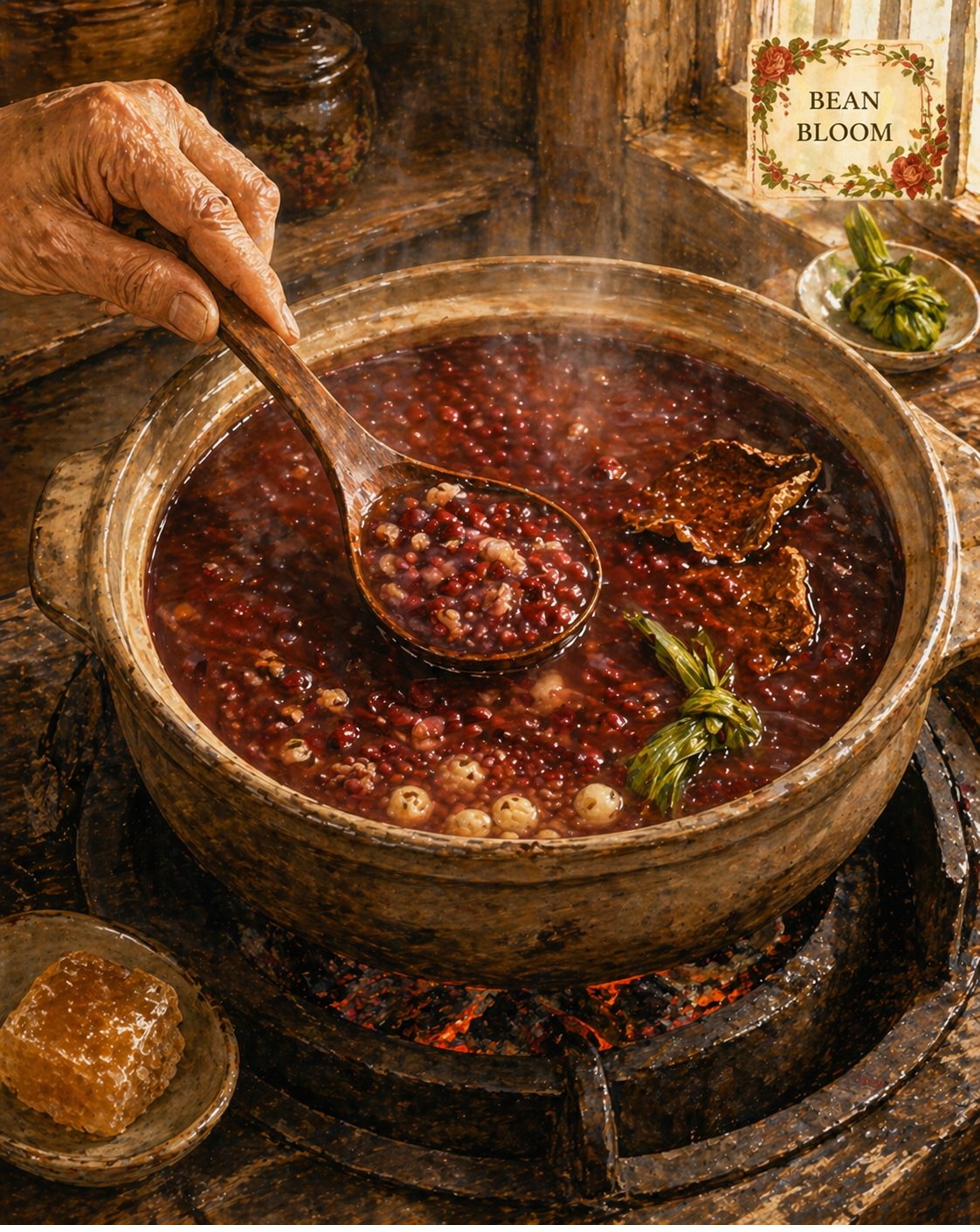
In a heavy stoneware pot, combine the drained beans (discard the soaking water — it carries bean-anti-nutrients), 2.5 litres fresh water, the pith-scraped chenpi, and the knotted pandan. NO ROCK SUGAR YET — heritage rule one.
Hard boil 5 minutes, then reduce to medium-low simmer — steady gentle simmer with active small bubbles around the rim, NOT a rolling boil. The broth goes from clear-water to faintly-amber within the first hour.
Simmer 1.5 to 2 hours, stirring occasionally. The transformation happens in waves:
- Hour 1: Beans plump, broth amber-tinting, no bean-burst yet
- Hour 1.5: First beans split open along their seam — burst-beans visible at the surface, pale-cream interior exposed
- Hour 2: About HALF the beans have visibly burst and started to disintegrate; the broth is now deep-mahogany-red and visibly thickening from the released starch
THIS IS THE BEAN-BLOOM MOMENT. Lift a single ladleful and inspect: it should catch BOTH whole-beans AND burst-beans. If only whole, simmer 20 more minutes. If all disintegrated, the simmer went too long — note for next time.
At bean-bloom: add the rock sugar (start with 100 g). Stir gently to dissolve. The dissolved sugar suspends cleanly into the broth, NOT bind the remaining bean-skins.
The Half-Mash heritage Cantonese texture-discipline
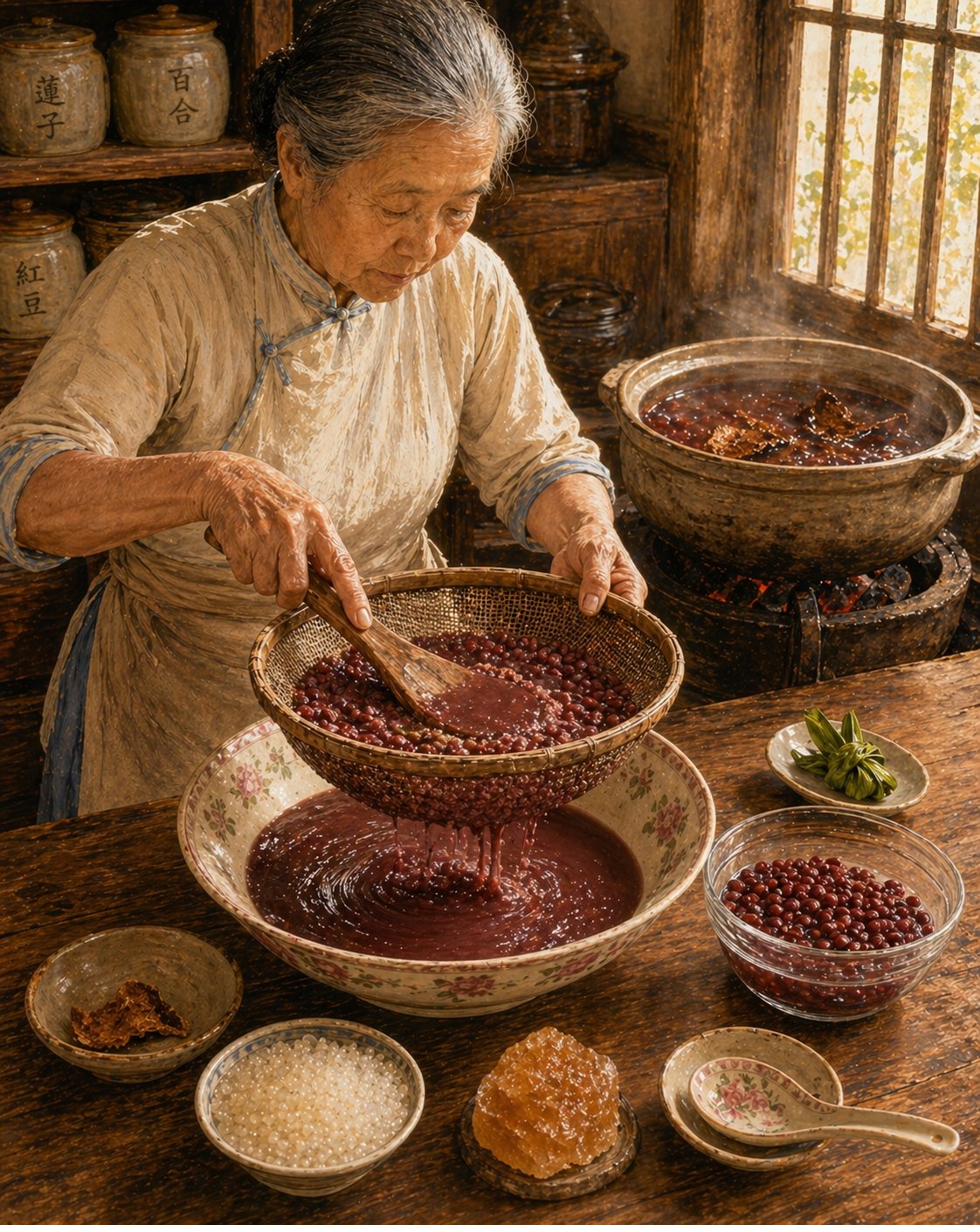
Once the sugar dissolves (~5 minutes of stirring), lift HALF the cooked beans out using a wide slotted spoon. Place in a heritage round-mesh strainer over a wide ceramic catch-bowl.
Press the beans through with a heritage wooden masher. The cooked-tender bean-flesh falls through as deep-mahogany-red mashed-paste; the bean-skins accumulate at the top of the strainer — discard these, they have given everything to the dish.
Pour the mashed-paste back into the simmer pot. Stir gently. The broth thickens visibly, taking on the signature sha consistency. The remaining whole beans provide the textural contrast that defines heritage Cantonese hong dou sha.
Apply your Shifu's Lift choice here. If using sago: stir in now. If using glutinous rice balls: cook separately until they float, then transfer into the broth.
Simmer 10 more minutes. Taste and adjust rock sugar. The broth should read as deeply sweet, lifted by the chenpi-citrus, balanced by the bean-starch heaviness.
Serve, Warm
Discard the chenpi pieces and the pandan-leaf knot. Add the pre-cooked lotus seeds to the broth. Stir gently to integrate.
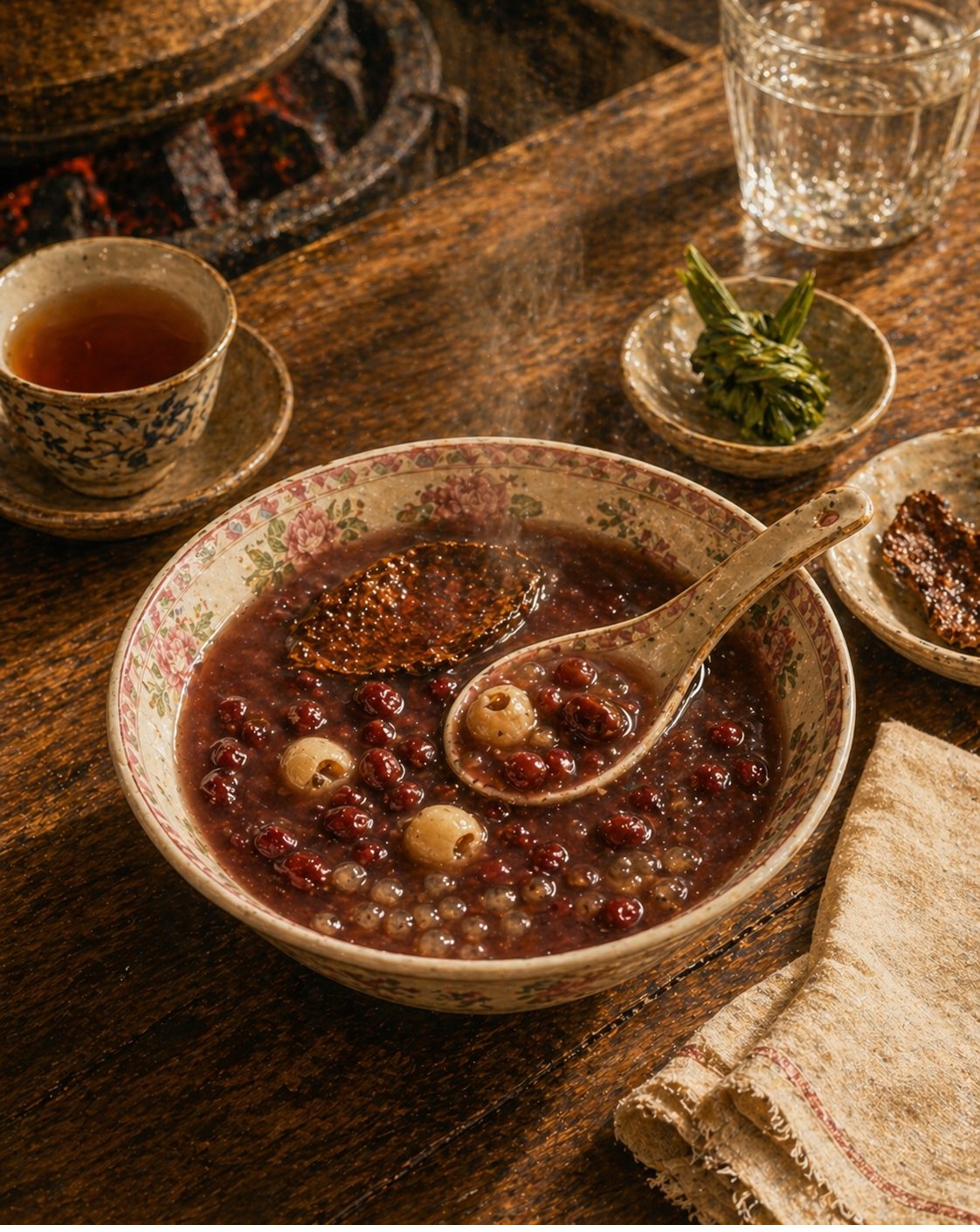
Ladle into small heritage Cantonese tong sui bowls. Each bowl carries: 1 piece of aged chenpi at the centre as a heritage garnish (visual signature), a generous spoonful of the sha-thickened broth, whole-bean texture suspended throughout, lotus seeds floating, and any optional add-ins. Serve warm with heritage porcelain spoons.
🎯The Three Tips
Heritage. Master's. Mistake.
🏛 Heritage Note
The Chenpi Is Your Story
Hong dou sha's heritage form holds that the broth must read as deep-mahogany-red and visibly thickened with the sha suspension, NOT thin clear-broth-with-beans-floating. The thickness is the dish's signature.
Two reasons for under-thickened bowls: the simmer ended before bean-bloom (push to the half-and-half mark even if it takes 30 more minutes), and the mash was done too gently (heritage practice presses firmly — bean-skins must visibly separate at the top while bean-flesh falls through).
For young hawkers thinking about a heritage tong sui stall: the chenpi is your story. A stall with younger-grade chenpi reads as a tong sui shop. A stall with 10+ year peel reads as a heritage-Cantonese banquet stall. Customers cannot articulate the difference but they can taste it.
👨🍳 Master's Tip
The Wet-Market Vendor
One place to buy your chenpi, and it is not the supermarket: the heritage wet-market dried-goods stall, or the Chinese-medicine hall in Chinatown.
Supermarket chenpi is almost always 1–3 year peel — dried, brittle, lighter in flavour. The heritage wet-market vendor carries 5–10 year peel as standard, with older grades behind the counter. The 10+ year peel is dramatically more expensive (sometimes 5–10× supermarket price), but a 6-bowl batch only needs 2 small pieces. Cost-per-bowl is still under 30 cents.
Find a vendor who knows you. Reportedly my mother's vendor in Chinatown knew her by face and would set aside the older grade when a new shipment came in — she would pay him for two pieces and he would give her three. The relationship matters.
⚠ Common Mistake
Three Failure Modes
- Sugar before bean-bloom (catastrophic). Adding rock sugar at the start binds the bean-skins and the beans stop bursting. The rescue: blend the cooked beans aggressively in a food processor with a cup of broth and return the slurry — passable, but you lose the half-and-half discipline.
- Unscraped chenpi pith. The white pith carries bitter-aromatic compounds that overwhelm the dish if not scraped. Scrape with a metal spoon after the peel softens in its overnight soak.
- Wrong bean. Substituting kidney beans, dark-red small beans, or "red beans" labelled by Western groceries. They will NOT soften the same way. Find the Chinese dried-goods stall and ask for hóng dòu or "adzuki." Do not substitute.
📈 Scaling for Hawker Service
For a heritage tong sui shop or Cantonese restaurant doing 80–200 bowls a day
Heritage Cantonese tong sui shops carry hong dou sha as one of 5–8 tong sui options on the menu — alongside green bean soup, black sesame paste, peanut paste, white fungus and longan. Hong dou sha is the strongest single seller in cooler weather. Heritage Cantonese-banquet restaurants in Singapore carry it as the closing course on every multi-course menu, regardless of season.
- Daily prep cycle: Night before — overnight soak adzuki, lotus seeds, chenpi. 5–7am — pre-cook lotus seeds, sago. 7–10am — long simmer (2 hours) with bean-bloom inspection at 1.5 hours. 10–10:30am — half-mash, return paste, sugar adjust. 11am–9pm — hold warm-but-not-boiling, ladle to order with chenpi at the bowl.
- Cost (Singapore 2026): ~SGD 0.65 per bowl (adzuki 0.30 + chenpi 0.10 + lotus 0.15 + aromatics 0.10). Sells SGD 2.00–4.00. Margin: 65–75%.
- For home cooks: The 6-bowl batch keeps refrigerated 4 days for cold, 3 days reheated for warm. The sha texture actually improves with one overnight rest.
My mother said the chenpi was older than I was. I never asked her how she knew. The chenpi knew her, the way the salt knows the soup. By the time I was old enough to ask, she had already finished teaching me.