Tau Hwey
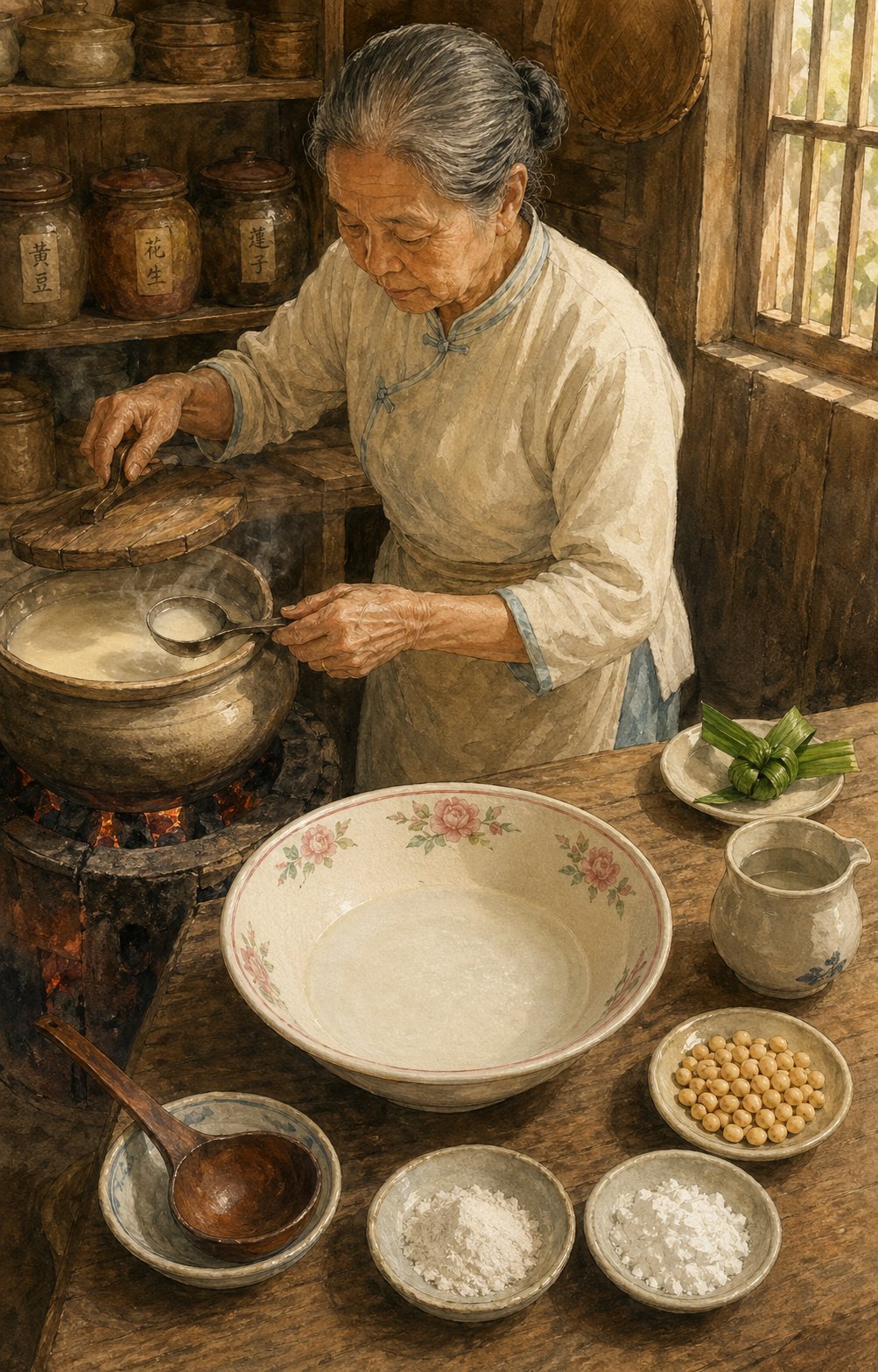
My mother made tau hwey for breakfast. Not always — not even most mornings — but on the mornings she did, the kitchen filled with the quiet roar of soybeans grinding and the patience of long simmering. By seven o'clock the bowl on the counter held the just-set pudding, and she would skim the first sliver onto a plate for me to taste before she warmed the syrup. The first sliver was always mine. I did not understand for many years why this mattered to her. I understand now.
Tau hwey — also tau huay (Hokkien-Singapore) / tau foo fah (Cantonese) / dòu huā (豆花) in Mandarin — is the heritage Singapore-Chinese silken soybean-pudding dessert. The dish is pan-dialect in Singapore practice: every Chinese dialect-community claims it, every dialect-community has a romanisation for it, and every dialect-community will tell you their version is the original one. The dish lives at hawker centres, kopitiams, Chinese dessert houses, and home kitchens across all dialect lines. This recipe gives the heritage Hokkien-Singapore form because that is the form Hock Ko's mother made.
A note on the heritage coagulant. The dish is defined by the moment soy milk meets a setting agent — and the setting agent choice carries register.
- Gypsum (石膏 / shí gāo) — heritage Hokkien-Singapore choice, used by Whampoa Soya Bean (Michelin-listed) and Rochor Original Beancurd (founded 1955). Produces the firmest, silkiest, most "structured" set.
- GDL (glucono delta-lactone) — modern commercial-Singapore choice. Produces a softer, more uniformly-silken set; some practitioners regard it as less honest to the dish's history but it is widely accepted.
- Agar / gelatine — home-cook accessible alternative when gypsum is unavailable. Produces a different dish entirely — closer to panna cotta — but forgiving for first-time makers.
This recipe gives the gypsum form as primary, with agar-substitution acknowledged in Scaling.
The dish has THREE heritage technical-discipline rules. Each one is non-negotiable.
Rule one — boil the soy milk fully, then cool slightly before pouring. Heritage practice brings the freshly-pressed soy milk to a hard rolling boil for 5–7 minutes, then lets it cool 1–2 minutes (off heat) so the temperature drops just below boiling — about 90–92°C. Boiling-hot soy milk poured directly onto gypsum slurry will curdle 50% of the time. The failure-mode prevented: curdled-not-set tau hwey that breaks into curds-and-whey.
Rule two — pour from height, then stop stirring. Heritage practice pours the cooled-but-still-very-hot soy milk into the bowl from a height of about 30 centimetres (a foot), in a single concentrated stream that hits the gypsum-cornstarch slurry at the bottom. The kinetic energy of the pour distributes the gypsum evenly through the soy milk in a way that hand-stirring cannot match. After the pour, the cook gives ONE quick gentle swirl (10–15 seconds maximum) — and then stops. The failure-mode prevented: streaky-set with visible curd-bands instead of uniform silken pudding.
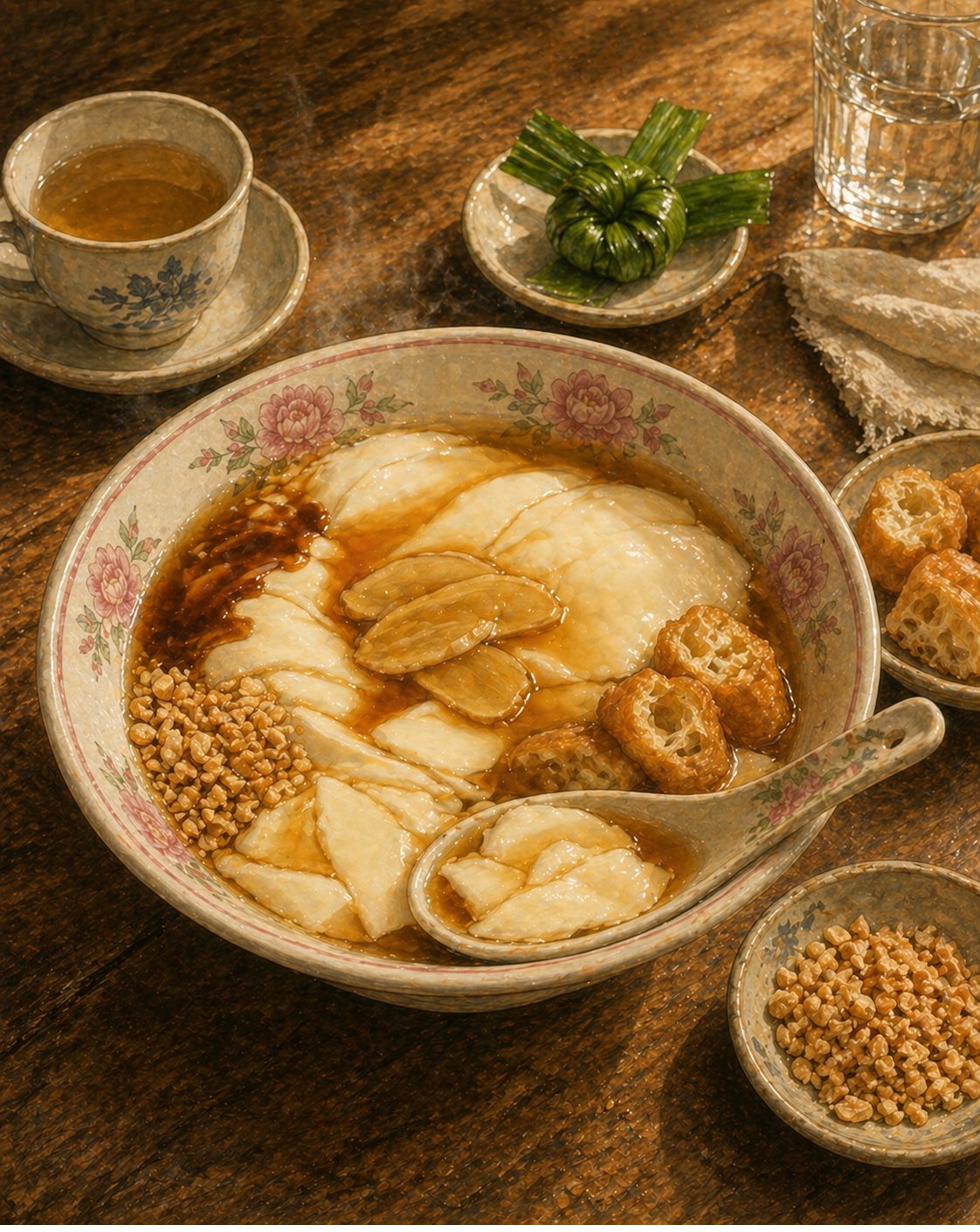
Rule three — skim, do not scoop. The heritage Hokkien-Singapore signature is the skim — a heritage flat skim-ladle (wide, paddle-shaped, thin flat edge) is run horizontally across the surface of the just-set tau hwey, lifting thin sheets (about 5 mm thick) from the top down. Each skim-stroke harvests one thin sliver, which folds gently as it transfers to the serving-bowl. Heritage practice ladles 4–6 thin slivers per serving-bowl, layering them into a soft cloud-like stack. The failure-mode prevented: chunked-broken-uneven serving that eats like a regular soft-tofu instead of the heritage cloud-layered pudding.
Two final notes. The syrup carries register. Heritage Hokkien-Singapore practice serves tau hwey with ginger syrup — most traditional, most throat-soothing. Heritage Peranakan-Singapore variation uses gula melaka syrup. My mother used ginger in the morning, gula melaka in the afternoon. Reportedly the choice was about temperature and time of day, not preference — ginger warms, gula melaka cools.
The toppings carry the breakfast-or-dessert register. Tau hwey for breakfast comes with you tiao (油条 / Chinese fried-dough fritter) for dipping. Tau hwey for late-afternoon dessert comes with gula melaka shards, crushed peanuts, or glutinous rice balls. The same dish, served two ways depending on the hour.
This is the dish that occupies the second-to-last position in Chapter 8 because it is the dish my mother made the morning before she made anything else. It opens the day. The technique has nowhere to hide. The careful is the dish.
🛒Ingredients
Three rules. Boil-then-cool. High-pour. Skim, don't scoop. The technique has nowhere to hide.
For the Heritage Homemade Soy Milk primary path
| Dried yellow soybeans (huáng dòu / 黄豆) | 200 g | Find at any Chinese dried-goods stall. Substitute: 1 litre good-quality unsweetened soy milk — skip soak-blend-strain and proceed from Stage 3. Heritage practitioners will tell you homemade produces noticeably better tau hwey; the difference is real but small. |
| Filtered water | 1.2 L | For blending and cooking. Tap water with strong mineral content can affect the gypsum's setting behaviour. |
For the Coagulant heritage gypsum form
| Food-grade gypsum powder (shí gāo / 石膏) | 3 g (~¾ tsp) | Heritage Hokkien-Singapore choice. Find at Chinese-medicine halls or heritage dry-goods stalls (often labelled "tofu coagulant" or "food-grade gypsum"). For thinner store-bought soy milk, increase to 3.5 g. |
| Cornstarch (yù mǐ fěn) | 4 g (~1 tsp) | Heritage practice mixes cornstarch into the gypsum slurry for added smoothness. Substitute: tapioca or sweet-potato starch. |
| Hot water | 2 tbsp | For dissolving the slurry. Must be hot — gypsum dissolves poorly in cold water. |
For the Ginger Syrup heritage Hokkien-Singapore
| Fresh ginger root | 50 g (thumb-sized) | Sliced into thin coins. Heritage practice favours older "old-skin" ginger (lǎo jiāng) for its sharper warmth. |
| White cane sugar or rock sugar | 60 g | Cane gives a clear-amber syrup; rock gives slightly more refined sweetness. |
| Water | 250 ml | For the syrup base. |
For the Gula Melaka Syrup heritage Peranakan-Singapore alternative
| Gula melaka (palm sugar) | 80 g | Heritage Peranakan-Singapore palm-sugar. Find at heritage wet-market vendors. Solid blocks of deep-amber-bronze sugar; chop coarsely. |
| Pandan leaves | 2 large | Tied into a knot. Adds floral perfume. |
| Water | 100 ml | For melting the gula melaka. |
For Heritage Toppings choose your register
| You tiao sticks (for breakfast) | 2, cut into 2-cm pieces | Chinese fried-dough fritters. Heritage Singapore-kopitiam breakfast pairing. |
| Crushed roasted peanuts (for dessert) | 30 g | |
| Gula melaka shards (for dessert) | 30 g | Chopped from a solid block. |
| Glutinous rice balls (Lunar New Year) | 12 small unfilled | Heritage Lunar New Year pairing. |
🌶️Shifu's Lift
choose one path- Old-school path: Gypsum + cornstarch, pour-method, served warm with plain cane-sugar syrup only — austere heritage Hokkien-Singapore form. Reportedly the Whampoa Soya Bean signature register.
- Modern hawker path: Use GDL (4 g) instead of gypsum, steam-set in individual rice bowls (10 minutes at medium-low) — heritage Singapore commercial-modern form. Reportedly the Lao Ban Soya Beancurd signature texture.
- Heritage purist: Whampoa Soya Bean practice — small splash of cool water in the gypsum slurry to slow the setting reaction by ~20 seconds, giving longer working window for the high-pour. About 1 tbsp extra cool water. My mother did this for festival-volume batches.
Equipment
| Heritage round-bottomed wide setting bowl | 1 (~8-inch diameter) | For the set. |
| Heritage flat skim-ladle | 1 | Wide, paddle-shaped, thin flat edge. Substitute: stainless-steel pancake-spatula. |
| Heritage glass pouring-jug | 1 (~1 L capacity) | With a clean pouring-lip. |
| Folded muslin cloth | 1 | For handling the hot pouring-jug. |
👨🍳Method
Five stages. Soak, grind, slurry, high-pour, skim. The technique has nowhere to hide.
The Overnight Bean Soak homemade soy-milk path
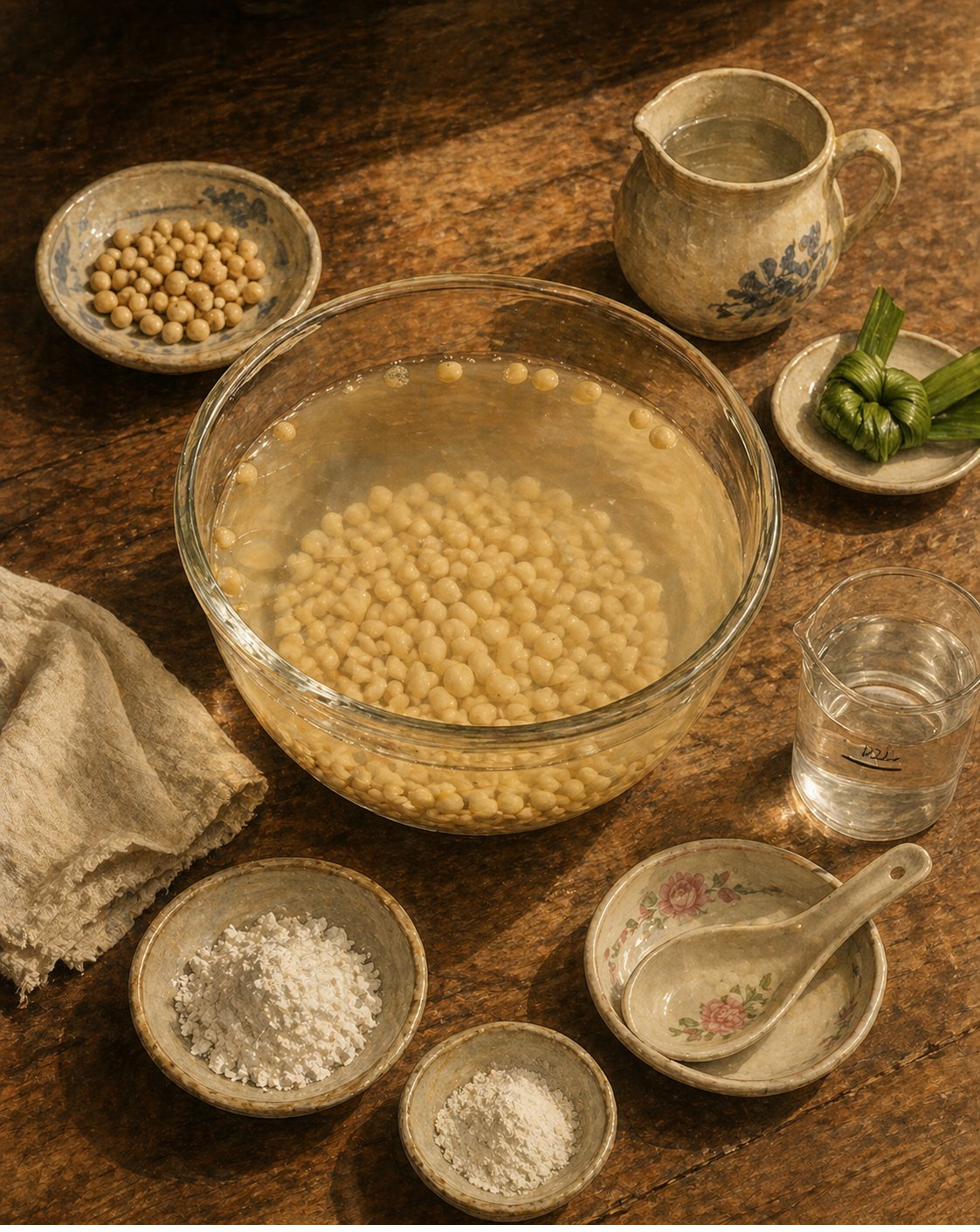
Rinse 200 g dried yellow soybeans in cool water. Place in a large heritage clear-glass bowl, cover with at least 800 ml cool water. Cover with a clean muslin cloth and leave on the counter overnight.
By morning, the soybeans should have nearly doubled in volume. They should be plump, soft to a fingernail-press, and pale-cream-yellow with a faint floral-bean smell.
Make the Soy Milk the next morning
Drain the soaked soybeans, discarding the soak-water. Transfer to a high-speed blender with 1 litre fresh filtered water. Blend 2–3 minutes until smooth and creamy-white.
Strain through a fine-mesh strainer or cheesecloth-lined colander into a heavy stoneware pot. Press the bean-pulp gently to extract maximum soy milk; discard the spent pulp (or save for soy-milk-pulp pancakes — heritage Singapore home practice).
Add another 200 ml filtered water to reach the heritage 1.2-litre target.
Bring the soy milk to a HARD ROLLING BOIL over medium-high heat, stirring frequently (the soy milk will catch and burn at the bottom if unattended). Once boiling, reduce heat to medium and continue boiling for 5–7 minutes — heritage practice insists on the full boil.
While the soy milk boils, prepare the gypsum slurry (Stage 3).
Prepare the Gypsum Slurry while the soy milk boils
In the heritage round-bottomed wide setting-bowl (the one the tau hwey will set IN), measure and add:
- 3 g food-grade gypsum powder (¾ tsp)
- 4 g cornstarch (1 tsp)
- 2 tbsp HOT water (just below boiling)
Stir with a wooden spoon until fully dissolved. The slurry should read as cloudy-white, slightly thickened from the cornstarch, with no visible gypsum lumps. Heritage practice: lift the spoon and let the slurry drip back — there should be NO gritty texture, NO sediment falling separately. If you see lumps, add another tablespoon of hot water and stir until fully dissolved.
The slurry sits in the bottom of the setting-bowl, waiting for the high-pour. Heritage rule: prepare the slurry only when the soy milk is within 2 minutes of the pour-moment.
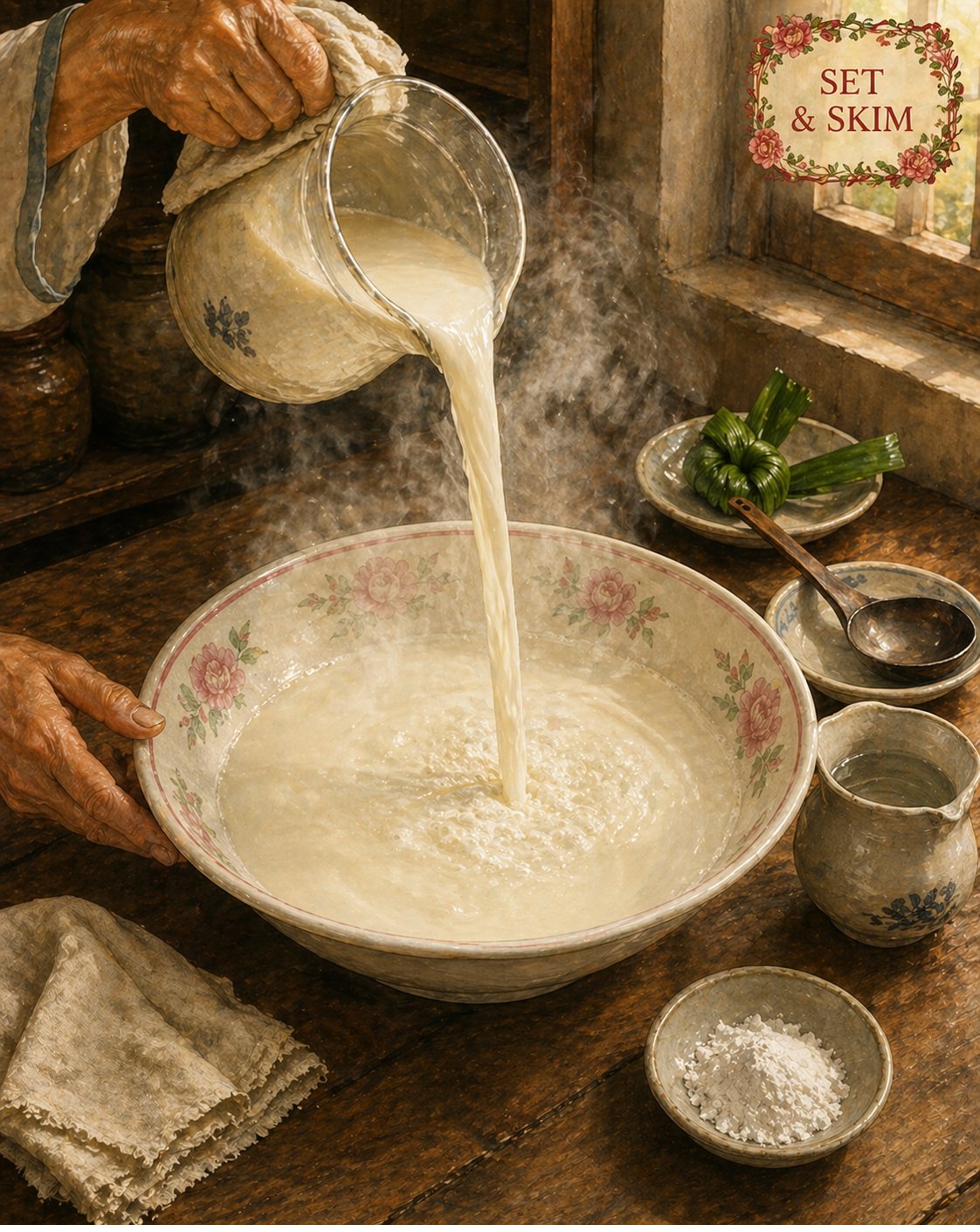
The High-Pour and the Set the cartouche moment — SET & SKIM
When the soy milk has had its 5–7 minute hard rolling boil, turn off the heat. Wait 1–2 minutes for the temperature to drop just below boiling (~90–92°C). Heritage rule one: full boil, then brief cool, NEVER pour boiling hot.
Pour the cooled-but-still-very-hot soy milk into the heritage glass pouring-jug (use the muslin cloth to handle — the jug will be very hot).
Holding the pouring-jug at 30 cm above the setting-bowl (a foot — heritage rule two), pour the soy milk in a single concentrated stream directly onto the gypsum slurry at the bottom. The kinetic energy of the high-pour distributes the gypsum evenly through the soy milk in a way that hand-stirring cannot match.
After the pour: ONE quick gentle swirl with a spoon (10–15 seconds maximum) — and then STOP. Reportedly every additional second of stirring after the gypsum has begun working introduces uneven-set zones. Cover the bowl immediately and leave it undisturbed for 15–20 minutes.
The tau hwey is set when the surface reads as smooth-glossy-pale-cream-yellow, fully-set, holding a clean line when a spoon is gently pressed against the edge.
The Skim and the Serve heritage rule three
While the tau hwey sets, prepare the syrups.
Ginger syrup: Combine 50 g sliced ginger, 60 g sugar, and 250 ml water in a small saucepan. Bring to gentle simmer, then reduce to low and simmer 15 minutes until the syrup is a clear amber. Strain and reserve warm.
Gula melaka syrup: Combine 80 g chopped gula melaka, 100 ml water, and 2 knotted pandan leaves in a small saucepan. Heat over medium-low, stirring, until the gula melaka fully dissolves (~8 minutes). Strain and reserve warm.
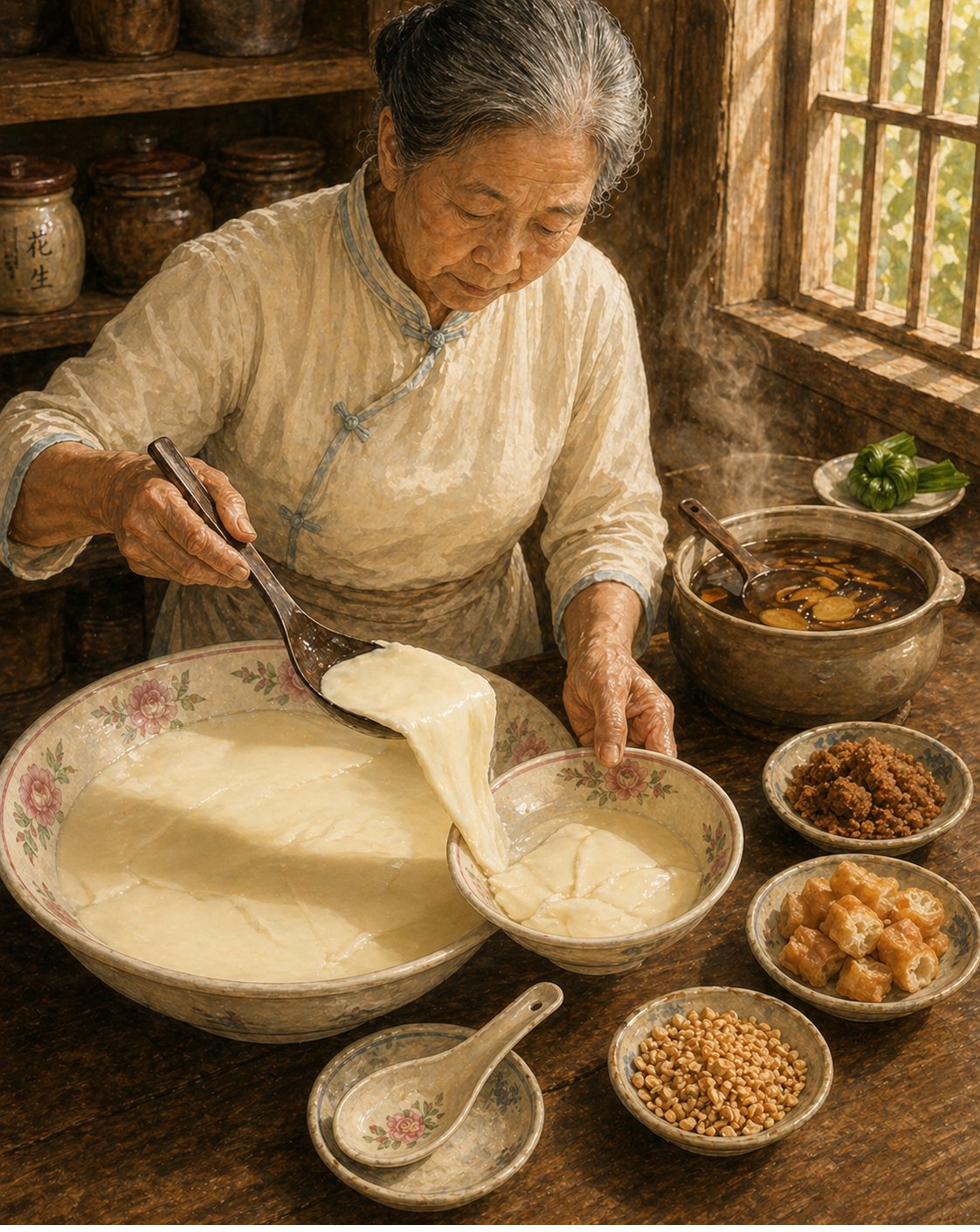
Once set, take a heritage flat skim-ladle. Run it horizontally across the surface of the tau hwey, lifting thin sheets (about 5 mm thick) from the top down. Each skim-stroke harvests one thin sliver, which folds gently as it transfers to the serving-bowl. Layer 4–6 thin slivers per bowl into a soft cloud-like stack.
Pour warm ginger syrup or gula melaka syrup over the layered slivers. Add toppings: you tiao for breakfast; peanuts, gula melaka shards, or rice balls for dessert.
🎯The Three Tips
Heritage. Master's. Mistake.
🏛 Heritage Note
The Morning Is Your Business
The heritage form holds that the surface of a careful tau hwey must read as smooth-glossy-pale-cream-yellow, fully-set, with NO curdling, NO weeping, and that the served bowl must show the layered-slivers cloud-stack that comes only from the heritage flat-ladle skim.
The heritage Singapore-Chinese breakfast register holds something many young hawkers miss: tau hwey is also a breakfast dish, not only a dessert. Heritage stalls open from before dawn — Whampoa Soya Bean opens at 7:15am, Rochor Beancurd House operates 24 hours, Tiong Bahru Teck Seng opens at 5am — because the Singapore-Chinese morning includes warm tau hwey with you tiao on the way to work.
For young hawkers thinking about a heritage tau hwey stall: the morning is your business. The dessert customers come in trickles in the afternoon. The breakfast customers come in waves from 6:30am to 9am. Open early. Make the soy milk fresh.
👨🍳 Master's Tip
The Gypsum Vendor
Food-grade gypsum is not a supermarket ingredient. Heritage Singapore practice sources it from Chinese-medicine halls or heritage dried-goods stalls in Chinatown — the same vendors who sell aged chenpi for hong dou sha. Reportedly the supply has tightened in recent decades as commercial stalls shifted to GDL.
Find a vendor who knows the dish. A Chinese-medicine hall proprietor who can answer "do you carry shí gāo for tau hwey?" without confusion is a vendor worth keeping. Buy enough for 6–12 batches at once — it stores indefinitely in a sealed jar.
If your vendor only stocks GDL: take it. The dish is heritage-acceptable with GDL. The texture-shift is real but not large enough to disqualify the practice. Lao Ban built its modern silken-set reputation entirely on GDL.
If neither: agar (1 g per litre) gives a panna-cotta-like home-version that is not the heritage dish but is honest about what it is.
⚠ Common Mistake
Three Failure Modes
- Boiling-hot soy milk poured directly onto gypsum. The most catastrophic first-time failure. Soy milk at 100°C poured onto gypsum slurry curdles 50% of the time — instant cottage-cheese curd separation, no recovery. Heritage rule one: full boil, then 1–2 minutes off-heat, THEN pour.
- Gentle pouring instead of high-pour. A timid 5-cm gentle pour does not distribute gypsum evenly through the soy milk; the result is streaky-set with visible curd-bands. The high-pour from 30 cm is the technique — it cannot be replaced with stirring.
- Scooping with a regular ladle instead of skimming with a flat ladle. A regular ladle breaks the just-set tau hwey into chunks; the result is soft-tofu-like cubes rather than the heritage cloud-stack. If you cannot find a flat skim-ladle, use a stainless-steel pancake spatula. Skim, not scoop.
📈 Scaling for Hawker Service
For a heritage tau hwey stall doing 200–400 bowls a day
The heritage Singapore tau hwey stall is one of the country's most established hawker traditions. Surviving heritage stalls — Whampoa Soya Bean & Grass Jelly Drinks (Michelin-listed, second-generation), Rochor Original Beancurd (founded 1955, three-generation), Selegie Soya Bean (multi-outlet heritage chain), Tiong Bahru Teck Seng — all built their reputations on the same pan-dialect dish, differentiated by coagulant choice (gypsum vs GDL), syrup register, and topping repertoire.
- Daily prep cycle (250-bowl volume, gypsum-set): Night before — 4 kg dried soybeans soaked. 4:30–6am — drain, blend, strain in batches; build 4–5 large soy-milk batches (5 L each). 6–6:30am — gypsum-cornstarch slurries; high-pour each batch; cover and rest 20 minutes. 6:30–7am — skim into serving-volume containers; prepare syrups, you tiao, peanut, gingko/red-bean toppings. Service 7am–9am — breakfast peak. 9am–4:30pm — afternoon dessert and lunch-time customers. Replenish-batch cycle every 2 hours.
- Cost (Singapore 2026): ~SGD 0.40 per bowl (soybeans 0.20 + gypsum 0.05 + cornstarch 0.02 + syrup 0.08 + topping 0.05). Sells SGD 1.30–3.20 (Whampoa: hot beancurd $1.30, gingko $2.20, trio $3.20; Selegie: gula melaka $2.60). Margin: 65–80%.
- For home cooks: The 4–6 bowl batch keeps refrigerated covered for 2 days for cold; 1 day for warm-reheated (steam 5 minutes from cold). Do NOT freeze — the gypsum-set tau hwey breaks irrecoverably on thaw.
The first sliver was always mine. The second was for whoever came down the stairs after me. The third, the fourth — those were for the rest of the household. By the seventh sliver the bowl was nearly empty and my mother would already be reaching for the second setting. She made tau hwey twice every morning she made it. The first batch was practice. The second was the one she served. I did not know this until I was thirty.