Ang Chao Wine
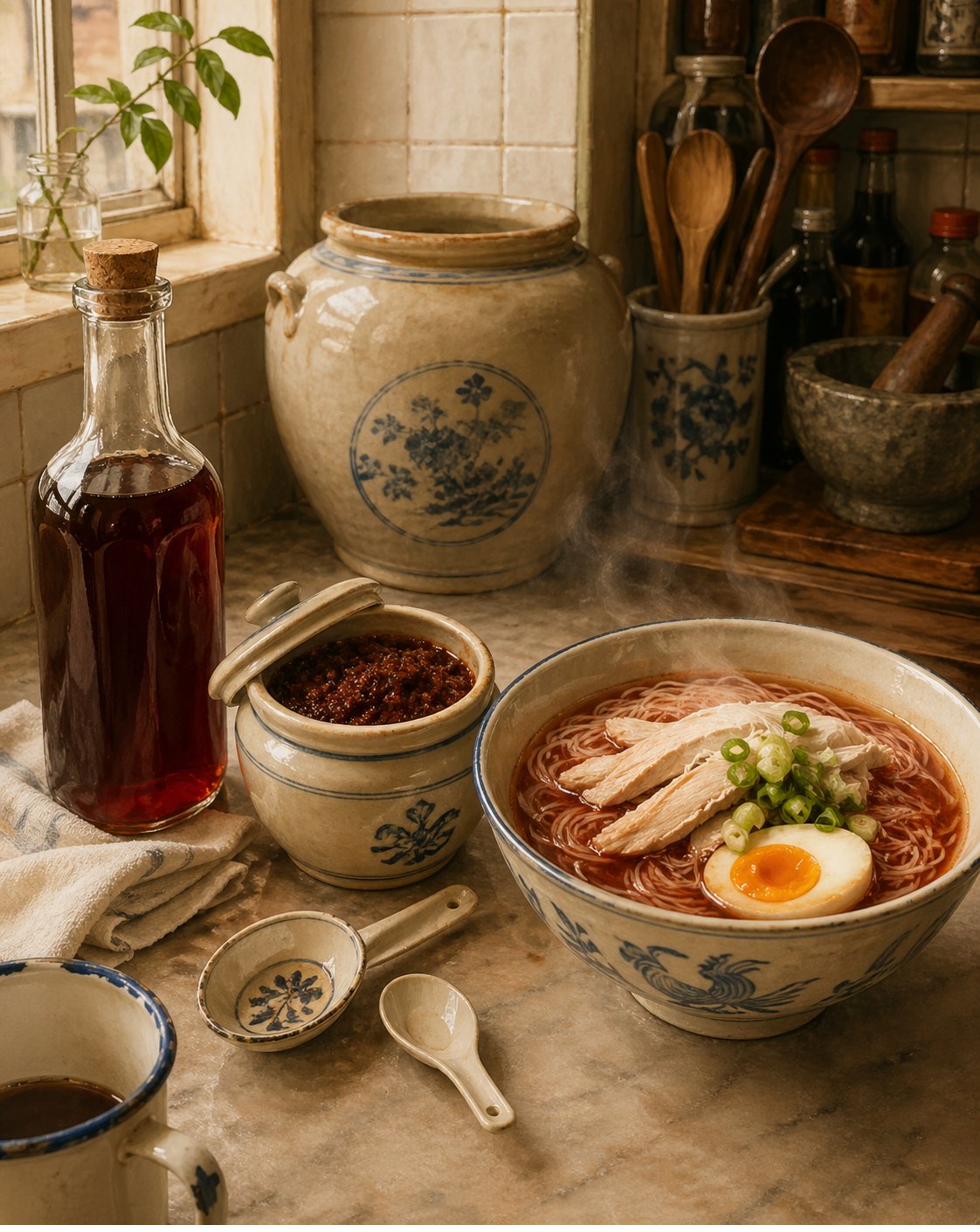
Forty-five days. That is the whole recipe. You make a bowl of rice on day one, you mix in two ingredients, you seal the jar, and then you wait. You stir gently every three or four days with a clean wooden chopstick. You watch for the bloom — the day the colourless rice and the dry red yeast become a deep wine-red liquid in the jar, and you know the fermentation is alive. On day forty-five you strain. The wine goes into bottles. The lees goes into a small jar. Both keep for years in the refrigerator. From one fifteen-minute morning of work and forty-five days of patience, you have a year of Foochow cooking. Red wine chicken mee sua for Chinese New Year. Ang chao razor clams for the heritage Foochow seafood platter. Ang chao chicken for any Sunday lunch. The wine and the lees are how Foochow households quietly anchor a year of meals.
Ang chao wine — ang jiu (the wine, 红酒), ang chao / hong zao (the lees, 红糟), 红糟酒 collectively in the Foochow heritage register — is the heritage Foochow red-glutinous-rice fermentation that produces TWO outputs from a single 45-60 day batch. The dish is a Source recipe in the technical sense — referenced from Recipe 33 (Red Wine Chicken Mee Sua, which uses the wine), Recipe 34 (Foochow Razor Clams, which uses the lees), and Recipe 35 (Foochow Ang Chao Chicken, which uses the lees as the dish's defining ingredient).
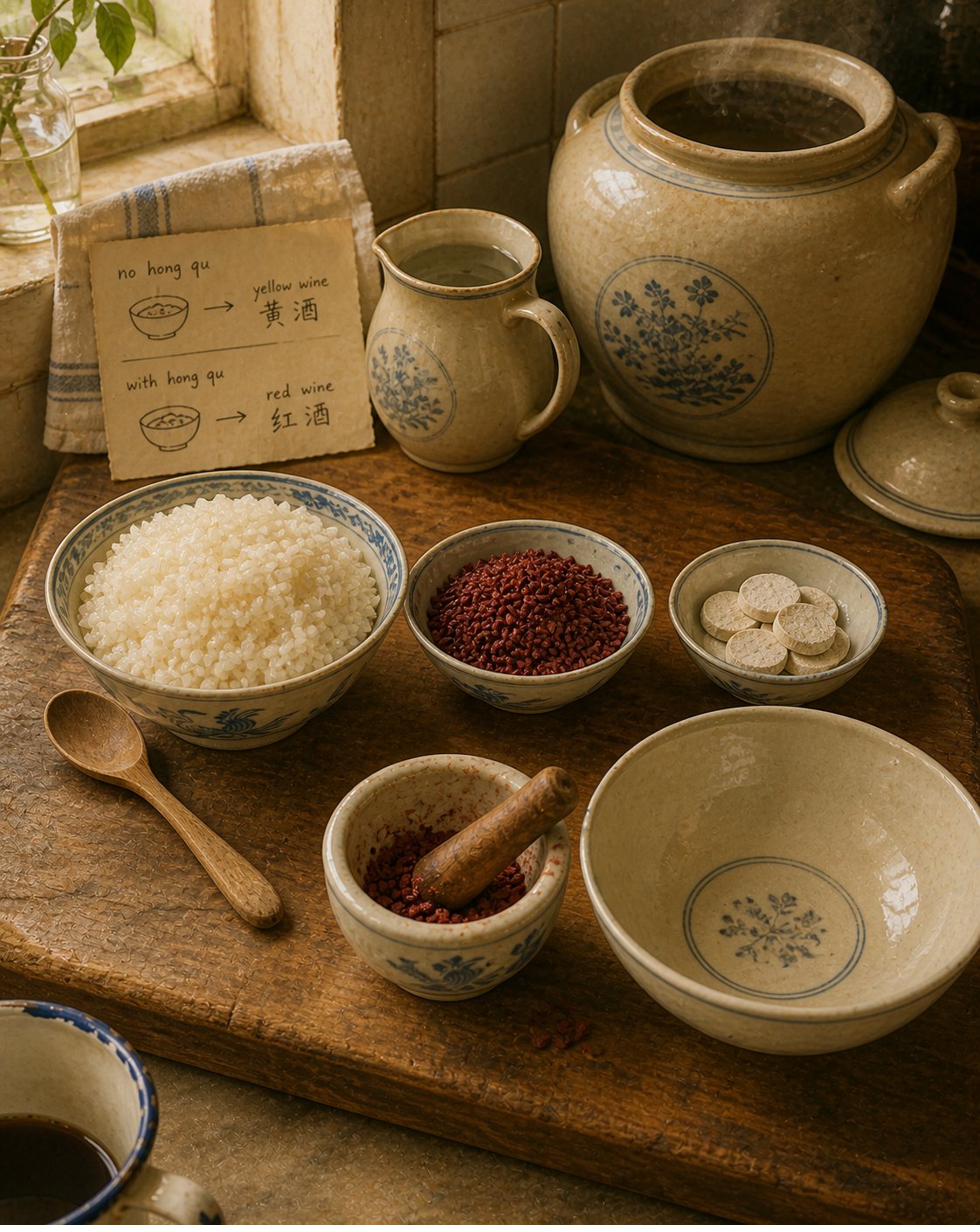
A note on heritage cross-culture worth establishing carefully, because this matters more than for any other recipe in this book. The same fermentation process produces a different heritage wine depending on whether or not you add red yeast rice (hong qu mi, 红麯米). Without the hong qu, the fermentation produces Hakka yellow rice wine (黄酒, huangjiu) — paler, milder, slightly sweet. With the hong qu, the fermentation produces Foochow red rice wine (红酒, hongjiu) — deeper, bolder, slightly tart with the characteristic monascus-yeast colour-and-character. (Source note: documented across Ye Traditions' "Red vs Yellow Rice Wine" canon and Singapore Noodles substack.) This is the recipe's central content insight: the same recipe, with one ingredient changed, becomes a different heritage wine. Hock Ko's home form is the Foochow red — what his Foochow grandmother taught him — but a reader who omits the hong qu and uses the same rice and yeast will produce a perfectly heritage-correct Hakka yellow wine. Both are heritage; both are real.
A note on the dual outputs and what each one is actually for. The 45-day fermentation produces:
Output A — Ang jiu (红酒, the wine). The strained liquid: deep ruby-mahogany-red, ~14-15% alcohol by volume, sweet-and-slightly-tart, fragrant. The wine is the heritage CNY-mee-sua ingredient — Foochow CNY breakfast tradition is mee sua in kampung chicken broth fortified with ang jiu, and the deep wine-red broth signifies prosperity and a long, joyous life. Reportedly heritage Foochow CNY practice serves the mee sua on the morning of the first day of CNY before the stream of visitors and relatives arrives — the most important meal of the year. The wine is also the heritage confinement-diet ingredient — Foochow mothers post-childbirth drink chicken broth fortified with ang jiu for 30 days.
Output B — Ang chao / hong zao (红糟, the lees). The strained-out fermented rice residue: brick-red-mahogany, coarse-textured paste with visible rice-grain structure, fragrant-and-slightly-tart. The lees is the heritage Foochow seafood-and-poultry-cooking ingredient — used as a marinade, a stir-fry base, and a braising medium across Foochow home cooking. Recipe 34 uses the lees as the dousing-medium that gives the razor clams their heritage Foochow character; Recipe 35 uses the lees as the marinade-and-braise that defines ang chao chicken's name. The lees also makes the famous Foochow preserved vegetable Chow Chai (糟菜) when packed with vegetables for further fermentation. (Source note: Noob Cook's heritage canon: "Both the wine lees and the wine are used to cook traditional Foochow dishes. They keep for years in the fridge — and according to my mum, they 'never' spoil.")
The same dual-output ferment is used in three distinct Foochow heritage cooking registers: CNY festival cooking (mee sua, reunion-table seafood, auspicious-symbol dishes); confinement-diet cooking (ang-jiu-fortified chicken broth for new mothers post-childbirth); and everyday Foochow cooking — a tablespoon of ang jiu deglazes a stir-fry; a tablespoon of ang chao seasons a chicken braise; a slosh of ang jiu finishes a steamed fish. Hock Ko's home form sits in the everyday register — a year of cooking ahead, anchored by one batch.
The dish has THREE heritage technical-discipline rules. Each one is non-negotiable, and each one prevents a specific failure-mode.
Rule one — sterile vessel, dry hands, cooled rice. Heritage Foochow practice is unforgiving on contamination discipline. The fermentation jar must be boiled-clean and fully dried before the rice goes in. The cooked glutinous rice must be fully cooled to room temperature. The cook's hands must be clean and dry during the massage step. The failure-mode prevented: contaminated jars produce vinegar, mould-floats-on-the-surface, or sour wine. Heritage signal of failure: black mould floating on the wine surface — NOT to be confused with the white-or-pale-mouldy substance that appears in the first 24-48 hours, which is normal fermentation activity and self-resolves once alcohol levels rise.
Rule two — heritage rice-cooking technique: steamed, NOT rice-cookered, never mushy. Heritage Foochow practice steams the glutinous rice over boiling water for 30-40 minutes, NOT cooked in a rice cooker. (Source note: Echo's Kitchen heritage canon: "It is better not to cook the glutinous rice using rice cooker as the cooker normally over cooks the rice and make it mushy, mushy rice made sourish wine.") Heritage register: the cooked rice should be distinctly grainy with each grain visible and intact, NOT a mushy uniform mass. The failure-mode prevented: mushy rice produces a sour wine because the over-cooked starches break down too rapidly during fermentation.
Rule three — gentle stirring every 3-4 days, lid loose to release CO2. Heritage Foochow practice stirs the fermenting mass gently with a clean dry wooden chopstick every 3-4 days during the first 2 weeks (primary fermentation), then weekly during the second 2 weeks (secondary fermentation), then leaves it alone for the final week (settling). The jar lid is placed on but NOT tightened — the fermentation produces significant CO2, and a tightened lid will burst the jar or spray wine across the kitchen. The failure-mode prevented: a tightened jar is an explosion hazard during primary fermentation; un-stirred mass develops uneven fermentation; over-stirred mass aerates excessively and risks vinegar conversion.
Two final notes worth establishing. The heritage Foochow taboos. Reportedly heritage Foochow practice in Sibu, Sitiawan, and other diaspora communities maintains a body of taboos around the wine-making — women who are menstruating are traditionally not allowed to take part in winemaking or be in contact with the wine jars during fermentation, for fear of contaminating the wine; some families also keep the wine hidden from view until the final product is ready. (Synthesis note: these taboos are heritage-traditional and reflect older cultural beliefs about ritual purity rather than modern scientific understanding of fermentation. Different heritage Foochow households observe the taboos to different degrees.)
The modern Foochow yellow wine substitution problem. Heritage Foochow red wine is increasingly hard to find at commercial Singapore-Malaysia supermarkets — most stocked "Foochow wine" is yellow, not red, and lacks the heritage hong-qu colour-and-character. The yellow commercial wine is a serviceable substitute but does NOT carry the same colour-anchor — dishes that depend on the heritage red colour register (CNY mee sua, ang chao chicken's defining colour) will not look right with yellow wine. The home-made heritage form below is the only reliable way to get the genuine deep wine-red.
This is the recipe that the Foochow chapter rests on. Recipe 33's red wine chicken mee sua. Recipe 34's razor clams. Recipe 35's ang chao chicken. None of them work without the wine and the lees from this jar. Forty-five days is a long time, but it is fifteen minutes of work followed by patience, and at the end of it the year is anchored.
🛒Ingredients
Three core ingredients. Forty-five days. Two outputs.
For the Foochow Red Wine Form Form A — with hong qu mi
| White glutinous rice (round-grain, NOT long-grain) | 1.2 kg | Heritage Foochow practice uses round-grain (short-grain) glutinous rice — the heritage register holds shape through fermentation. Long-grain glutinous rice is acceptable but breaks down faster. Available at any Singapore-Malaysia wet market or Asian grocery as 圆糯米. |
| Hong qu mi (red yeast rice, 红麯米) | 150g | THE COLOUR-AND-CHARACTER DETERMINING INGREDIENT. Heritage register: deep brick-red-purple grains, distinctly red-purple-toned (NOT brown, NOT pink, NOT bright-red), dry and slightly papery-textured. Available at heritage Singapore-Malaysia Chinese medicine shops and Foochow-area grocery stores. OMIT THIS INGREDIENT to make Form B (Hakka yellow rice wine, 黄酒) — same recipe in every other respect, different heritage wine tradition. |
| Wine biscuit (jiu bing / jiu qu, 酒饼) | 1 ball or about 1 tsp | Heritage Chinese rice wine starter. Small round flat off-white tablets, faintly cracked-and-crumbly surface. Available at heritage Chinese medicine shops and at the same shops that stock hong qu mi. Heritage practice grinds the wine biscuit to a fine powder before mixing. |
| Cooled boiled water (or distilled water) | 2.5 litres | Heritage register: water must be PRE-BOILED-AND-COOLED to room temperature, OR distilled, to prevent contamination. Tap-water-out-of-the-tap introduces chlorine and contamination risk. |
Optional Heritage Additions
| Honey wine cake (蜂蜜酒饼) | 1 piece (optional) | Some heritage Foochow households add honey wine cake alongside the standard wine biscuit for a sweeter wine. |
| Chinese white wine (高粱酒 or similar) | 50ml at end of fermentation (optional) | Some heritage Foochow practices add a small amount of Chinese white wine at the final stage to sweeten the wine further and lock the alcohol content. |
Equipment
| Heritage ceramic Foochow fermentation jar (4-5 litre capacity, round-bellied, narrow-necked, glazed) with ceramic lid | 1 | Heritage register vessel. Plastic food-grade fermentation buckets are an acceptable modern substitute; glass demijohns also work. The heritage ceramic jar is the right register for the recipe. |
| Bamboo steamer or large stockpot with bamboo insert | 1 | For steaming the glutinous rice. Heritage practice — NOT a rice cooker. |
| Clean dry mortar and pestle (small) | 1 | For grinding the hong qu mi and crushing the wine biscuit. |
| Long clean dry wooden chopstick | 1 | For stirring during fermentation. Must be wooden — metal contamination affects fermentation. |
| Fine-mesh strainer + heritage muslin cloth (or cheesecloth) | 1 set | For straining at day 45. |
| Clean glass bottles with corks (recycled beer bottles or vintage Chinese bottles) | 4-5 | For the strained wine. Each bottle should be washed, dried, and have a small amount of finished ang jiu poured in and discarded before final filling — heritage discipline that extends shelf life. |
| Small earthenware ceramic jar with lid | 1 | For the strained lees. |
🌶️Shifu's Lift
choose one path- Old-school path: Steam the glutinous rice over boiling water; cool to room temperature on a flat tray; lightly grind the hong qu mi in a mortar; crumble the wine biscuit; mix everything by hand into the rice; transfer to the heritage ceramic Foochow fermentation jar; cover with the lid loosely; ferment at room temperature for 45-60 days; strain through muslin cloth; bottle the wine, jar the lees. This is the heritage register.
- Modern hawker path: Use a bamboo steamer over a heritage Singapore-Hokkien stockpot; use a glass demijohn fermentation vessel with airlock for cleaner CO2 management (some heritage Sibu-Sarawak Foochow households have moved to glass-and-airlock for hygiene); strain through a coffee filter for clearer wine. Convenience-form delivers ~95% of the heritage register.
- Heritage purist path: Use heritage Sibu-Sarawak Foochow round-grain glutinous rice; ferment for 60 days minimum (heritage CNY register — set up the batch on the day after Mid-Autumn Festival in October, strain on the day before CNY in late January-early February); add the heritage honey wine cake AND finish with 50ml Shaoxing wine at day 45 for a heritage celebration-register sweeter wine.
👨🍳Method
Five stages across forty-five days. Sterilise. Massage. Watch. Settle. Strain.
Day 1 — Setup, Sterilise, Steam 15 min active + 40 min steam + 45 min cool
The heritage Rule One discipline starts here.
Sterilise the fermentation jar (10 min):
- Wash the heritage ceramic Foochow fermentation jar thoroughly with hot water and a clean cloth. NO soap residue — soap kills the yeast.
- Boil 1 litre of water and pour into the jar; let stand 5 minutes; pour out.
- Invert the jar on a clean dry tea-towel and let air-dry completely. The jar must be FULLY DRY before the rice goes in. Repeat for the ceramic lid.
Steam the glutinous rice (40 min + 45 min cool):
- Rinse the 1.2 kg glutinous rice under cold running water until the water runs clear (about 4-5 rinses).
- Soak the rice in cold water for at least 2 hours, ideally 4-6 hours. Heritage discipline — the soak softens the grains for even steaming.
- Drain the rice thoroughly.
- Set up a bamboo steamer or stockpot with bamboo insert over boiling water; line the steamer with cheesecloth or a clean cotton cloth; spread the drained rice in an even layer (about 3-4cm deep).
- Steam over high heat for 30-40 minutes until the rice is fully cooked, distinctly grainy with each grain visible and intact, NOT mushy. Heritage Rule Two.
- Spread the cooked rice on a large flat tray and cool to room temperature — about 30-45 minutes. Heritage discipline; warm rice kills the yeast.
While the rice cools: lightly grind the 150g hong qu mi in a mortar with a few light pestle-strokes — the goal is to lightly crack the grains for better colour-release, NOT to powderise them. Crumble the wine biscuit by hand or pound briefly to a fine powder.
Day 1 — The Massage and Transfer 15 min
The heritage tactile discipline beat. Wash and thoroughly dry your hands before starting.
- Sprinkle the lightly-ground hong qu mi over the cooled rice.
- Sprinkle the crumbled wine biscuit over the rice.
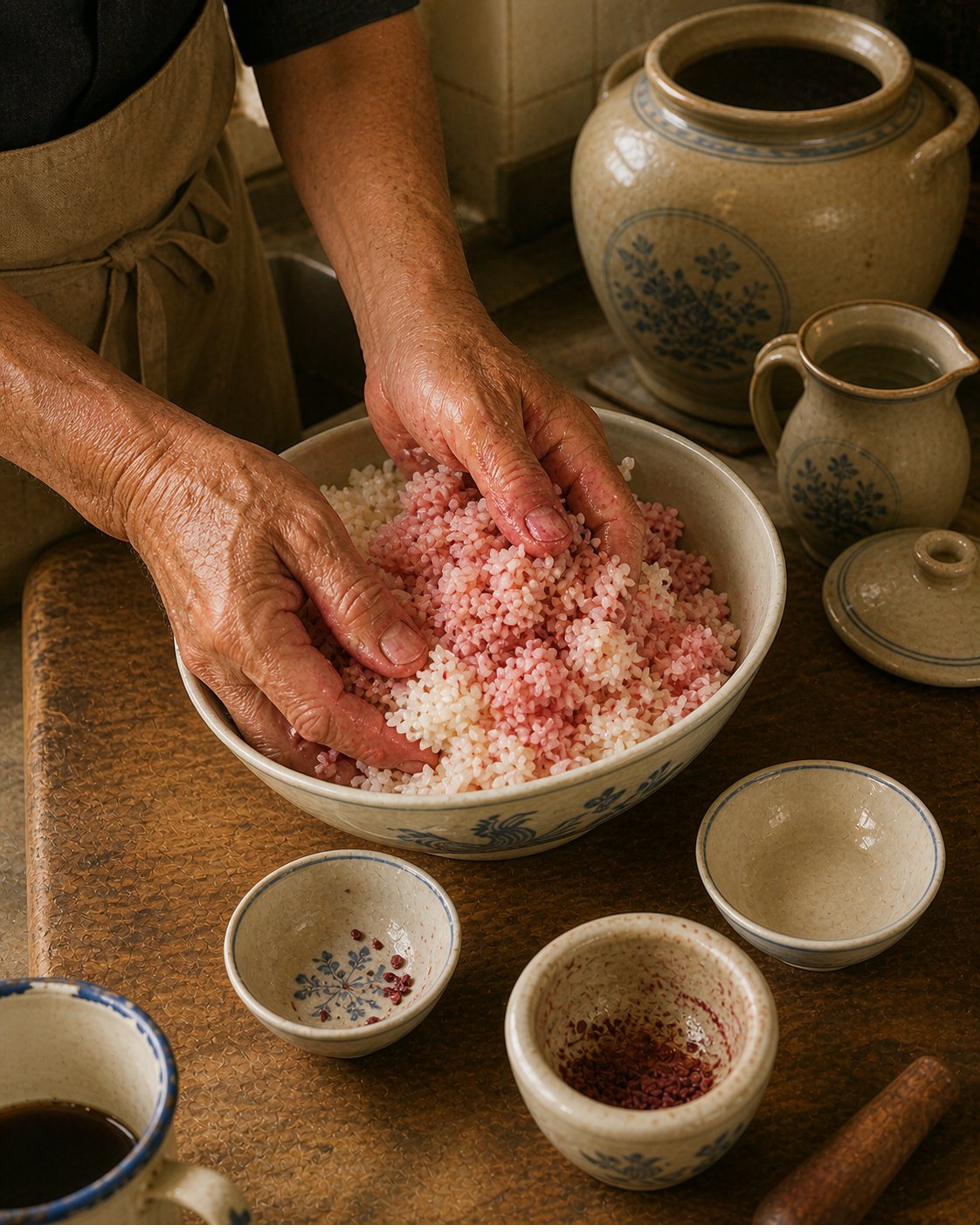
- Massage by hand, gently turning the rice over and through itself, working the hong qu mi colour into the rice grains. Heritage signal: the rice transitions through a visible streaky-and-marbled mid-state (cream-white streaking with rose-pink-red as the colour binds to grain surfaces) and finally toward a more uniform pink-red mass. The massage takes about 5 minutes; the colour will continue to develop over the next 24 hours, so do not over-massage trying to force uniformity at this stage.
- Transfer the massaged rice mixture into the sterilised dry fermentation jar. Use a clean dry spoon or your hands; pack gently — do NOT compress hard.
- Pour the 2.5 litres cooled boiled water over the rice mixture in the jar. The water should cover the rice by about 2cm.
- Stir gently with a long clean dry wooden chopstick to distribute the water and break up any pockets.
- Place the ceramic lid on the jar BUT DO NOT TIGHTEN — heritage Rule Three. The lid sits loose to release CO2.
- Move the jar to its fermentation location: a well-ventilated place at stable room temperature (22-28°C heritage range), away from direct sunlight, away from heat sources, away from refrigerators (vibration affects fermentation).
Days 2-14 — Primary Fermentation the cartouche moment — WINE BLOOM
The heritage stir-and-watch discipline. Heritage Rule Three.
- Every 3-4 days, lift the lid; gently stir the fermenting mass with a clean dry wooden chopstick (a different one each time, OR the same one washed and dried thoroughly). The stir releases trapped CO2 and ensures even fermentation. About 10-20 seconds of gentle stirring per session.
- Replace the lid loosely.
Heritage signals during primary fermentation:
- Days 1-2: a thin pale-mouldy substance may appear on the rice surface — this is normal early fermentation activity and self-resolves once alcohol levels rise. Stir it back in; the alcohol will kill it.
- Days 3-7: the mass should be visibly bubbling, with fermentation aroma rising from the jar. The colour deepens from rose-pink toward red-mahogany.
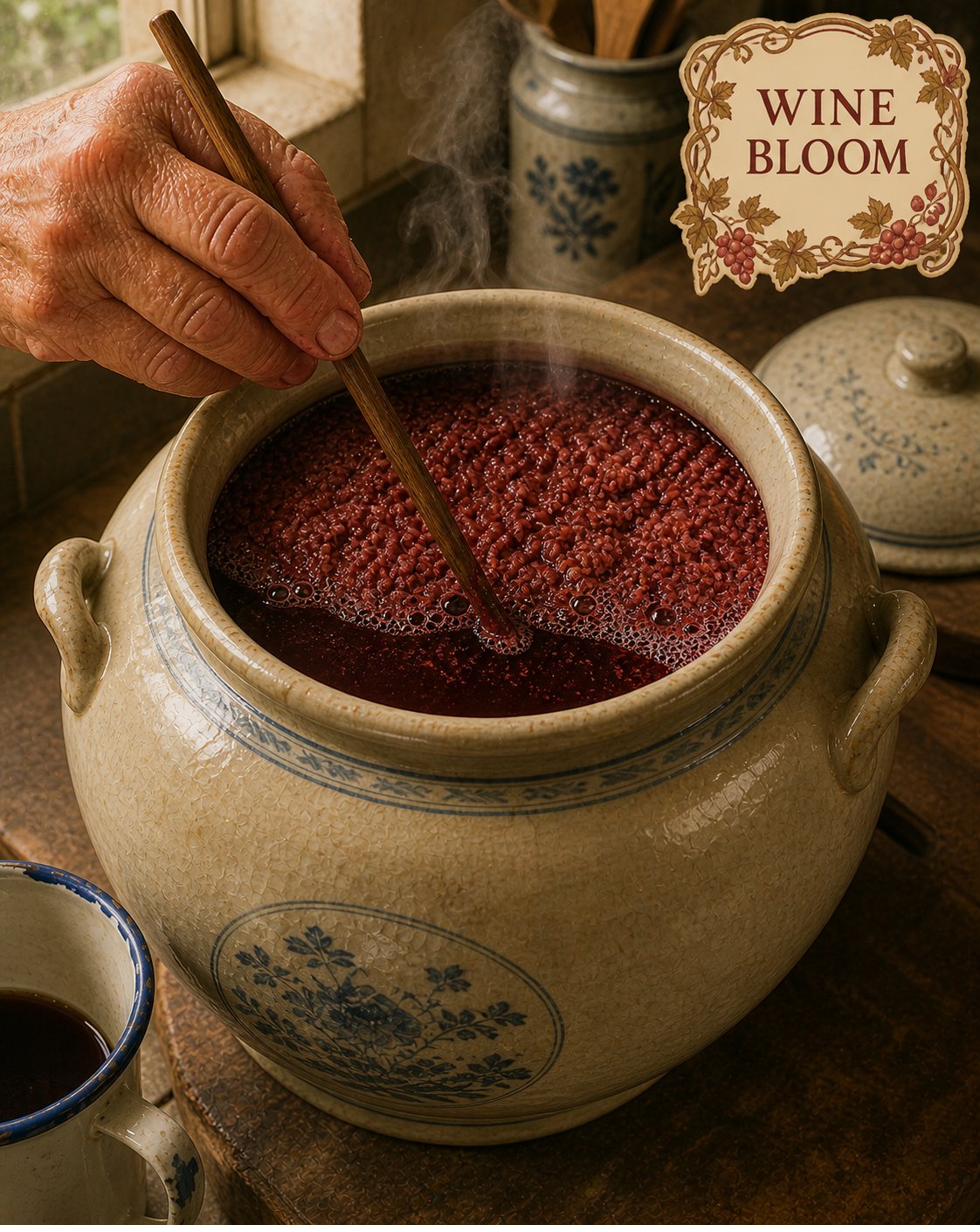
- Days 8-14: the wine bloom — at some point in this window, the bottom third of the jar visibly contains DEEP WINE-RED LIQUID, with the fermented rice mass floating on top stained brick-red. This is the heritage signature that the fermentation is alive and proceeding correctly.
Days 15-45 — Secondary Fermentation and Settling 30 days total
Days 15-30 — Secondary fermentation (5 min weekly):
- Stir gently once a week during this phase. The bubbling should slow noticeably as the primary sugar conversion completes.
- The colour deepens further — by day 30 the wine should be a deep ruby-mahogany-red, the fermented rice mass should be visibly broken down and fully stained.
Days 31-45 — Settling (no stirring):
- Leave the jar undisturbed for the final 14 days. The fermented rice mass settles partially; the wine clarifies slightly.
This is the patience phase. Trust the jar. Forty-five days is forty-five days.
Day 45 — Strain, Bottle, Jar 15 min
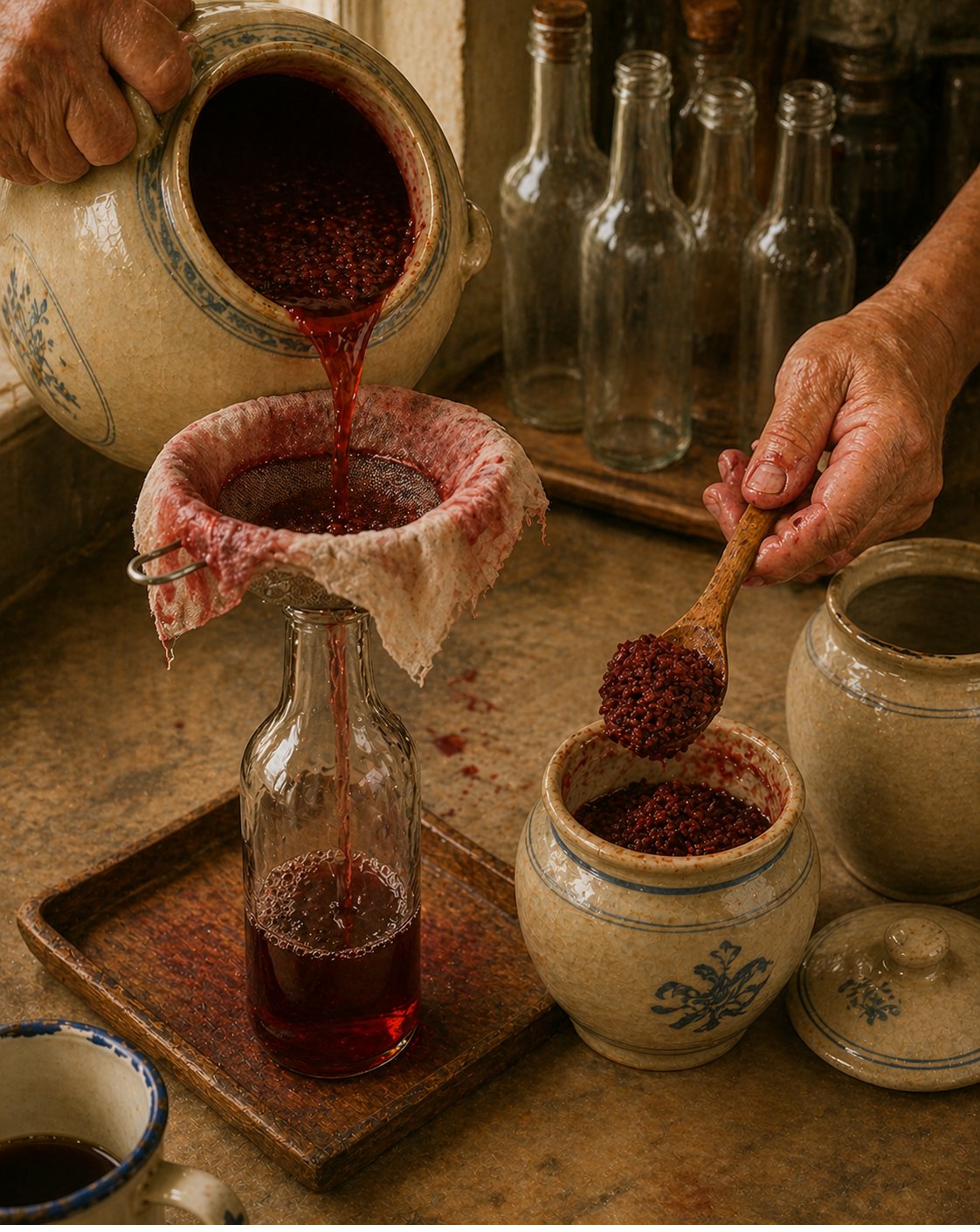
- Set up the straining station: place a fine-mesh strainer over a clean dry sterile glass bottle on a small wooden tray; line the strainer with a heritage muslin cloth (or 2-3 layers of cheesecloth).
- Prepare the lees jar: a small earthenware ceramic jar, washed and fully dried, with the lid ready beside.
- Pour the fermentation slowly, holding the heritage ceramic Foochow fermentation jar at a controlled tilt, allowing the strained wine to flow through the muslin into the bottle. The deep wine-red liquid drips through; the fermented rice mass is captured in the muslin.
- Continue pouring until the bottle is full (about 750ml-1 litre); transfer the muslin-and-lees to a clean bowl temporarily; insert a fresh sterile bottle on the tray and continue.
- Cork or stopper each filled bottle. Heritage discipline: pour a small amount of finished ang jiu into the empty bottle and discard before final filling — extends shelf life.
- After all wine is bottled, transfer the lees from the muslin into the small earthenware ceramic jar with a clean wooden spoon. Press gently to remove residual liquid. Cover with the ceramic lid.
- Refrigerate both the wine and the lees. Heritage shelf life: wine keeps for years refrigerated, reportedly improving with age up to 5 years; lees keep for years refrigerated, reportedly "never spoils" per heritage Foochow grandmother documentation.
The wine and the lees are now ready for use across the year ahead. See Recipe 33 (Red Wine Chicken Mee Sua) for the wine's heritage CNY-mee-sua register; see Recipe 34 (Foochow Razor Clams) and Recipe 35 (Foochow Ang Chao Chicken) for the lees's heritage Foochow seafood-and-poultry-cooking register. A heritage Foochow household typically uses about half the wine and half the lees within 6 months and the rest across the second 6 months.
🎯The Three Tips
Heritage. Master's. Mistake.
🏛 Heritage Note
Writing It Down Is Itself an Act of Preservation
The 45-day Foochow ferment sits in a peculiar place in heritage Singapore-Malaysia home cooking — it is one of the few heritage recipes where the cook's role is mostly to wait. Heritage Foochow grandmothers in Sibu (Sarawak), Sitiawan (Perak), and the Singapore Foochow communities have made this wine for generations; the technique is unchanged across the diaspora; the failure modes are well-known and well-managed.
What modernity has changed is the commercial availability of substitutes — Foochow yellow wine is now stocked at every Singapore-Malaysia supermarket; the heritage red is increasingly rare. Reportedly younger generations in the diaspora are letting the home-fermenting practice lapse — Periuk.my's documentation: "This practice is very common back in my mom, my grandma and her grandma's days! Not so much in my generation anymore." The recipe sits on Hock Ko's Bonus Table partly because it is a heritage Source recipe, and partly because writing it down is itself an act of preservation against the practice slipping out of living memory.
👨🍳 Master's Tip
The Patience-Watch
The single technique-anchor that separates a beginner's ang chao wine from a heritage one is watching the jar without interfering with it. Heritage Foochow practice keeps the jar in a corner of the kitchen where the cook walks past it daily — the jar is checked visually every morning (lid loose, no black mould, gentle bubbling visible through the cream glaze), stirred gently every 3-4 days during weeks 1-2, then weekly weeks 3-4, then left alone for the final 2 weeks.
The temptation, especially for first-time fermenters, is to stir more often, taste the wine before it is ready, or panic at the early-fermentation pale-mould (which is normal and self-resolves). Hock Ko's heritage advice: trust the jar. Forty-five days is forty-five days. The fermentation knows what it is doing; the cook's job is to give it sterility on day 1, gentle stirs on days 2-30, and patience on days 31-45.
⚠ Common Mistake
Three Failure Modes
- Vinegar / black-mould / spoilage. Contamination at day 1 (un-sterilised jar, wet rice, warm rice, dirty hands) or during fermentation. Heritage signals of failure: black mould floating on the wine surface (NOT the early pale-mould of days 1-2 which is normal), strong vinegar smell rather than sweet-fermentation aroma, lack of bubbling activity by day 7. The fix: there is no fix. A spoiled batch is unrecoverable; discard, sterilise the jar thoroughly, start over. Heritage prevention: rigorous Rule One discipline on day 1.
- Sour wine. The cook used a rice cooker for the rice (mushy texture), or steamed too long, or added warm rice. The wine ferments but tastes sour rather than sweet-fermented. The fix: sour wine is partially recoverable — it can be used as a cooking-vinegar in heritage Foochow stir-fries, but it is not fit for CNY mee sua or as a table wine. Heritage prevention: steam the rice in a bamboo steamer for 30-40 minutes, cool to room temperature on a flat tray, do not use a rice cooker.
- Explosion or spray. The cook tightened the lid completely (heritage Rule Three violation). During primary fermentation (days 3-10), CO2 production peaks at 50-100 ml per hour; a sealed jar pressurises rapidly and either bursts or sprays wine across the kitchen when opened. The fix: never tighten the lid. Place the lid on but rest it loose; or use a fermentation airlock (modern adaptation) which permits CO2 escape but blocks contamination ingress.
📈 Scaling for Hawker Service
The 45-day ferment is the bottleneck at any scale
A hawker stall or restaurant cannot produce ang chao wine on demand and must pre-batch. Reportedly heritage Foochow restaurants in Sibu, Sitiawan, and Singapore typically run 20-40 fermentation jars in continuous rotation — set up a new batch every 3-7 days, strain a finished batch every 3-7 days, maintain a steady supply of wine and lees across the year.
- Home-kitchen scaling: 1.2 kg rice (this recipe) produces enough wine and lees for a year of home Foochow cooking; double the recipe (2.4 kg rice, 6-litre fermentation jar) for a year of larger-family cooking or for gifting.
- Beyond home scale: heritage practice splits into multiple parallel jars rather than one larger jar — the contamination-discipline becomes harder to maintain in a single 10-litre vessel than in two 5-litre vessels. Heritage Sibu-Sarawak practice is "two jars, two-week-staggered" rather than one large vessel.
- Restaurant scale: industrial stainless-steel tanks with airlocks; home-scale heritage uses ceramic jars with loose lids; both work, the heritage character lives in the ceramic.
Forty-five days is a long time. But it is fifteen minutes of work followed by patience, and at the end of it the year is anchored.