Sambal Belacan
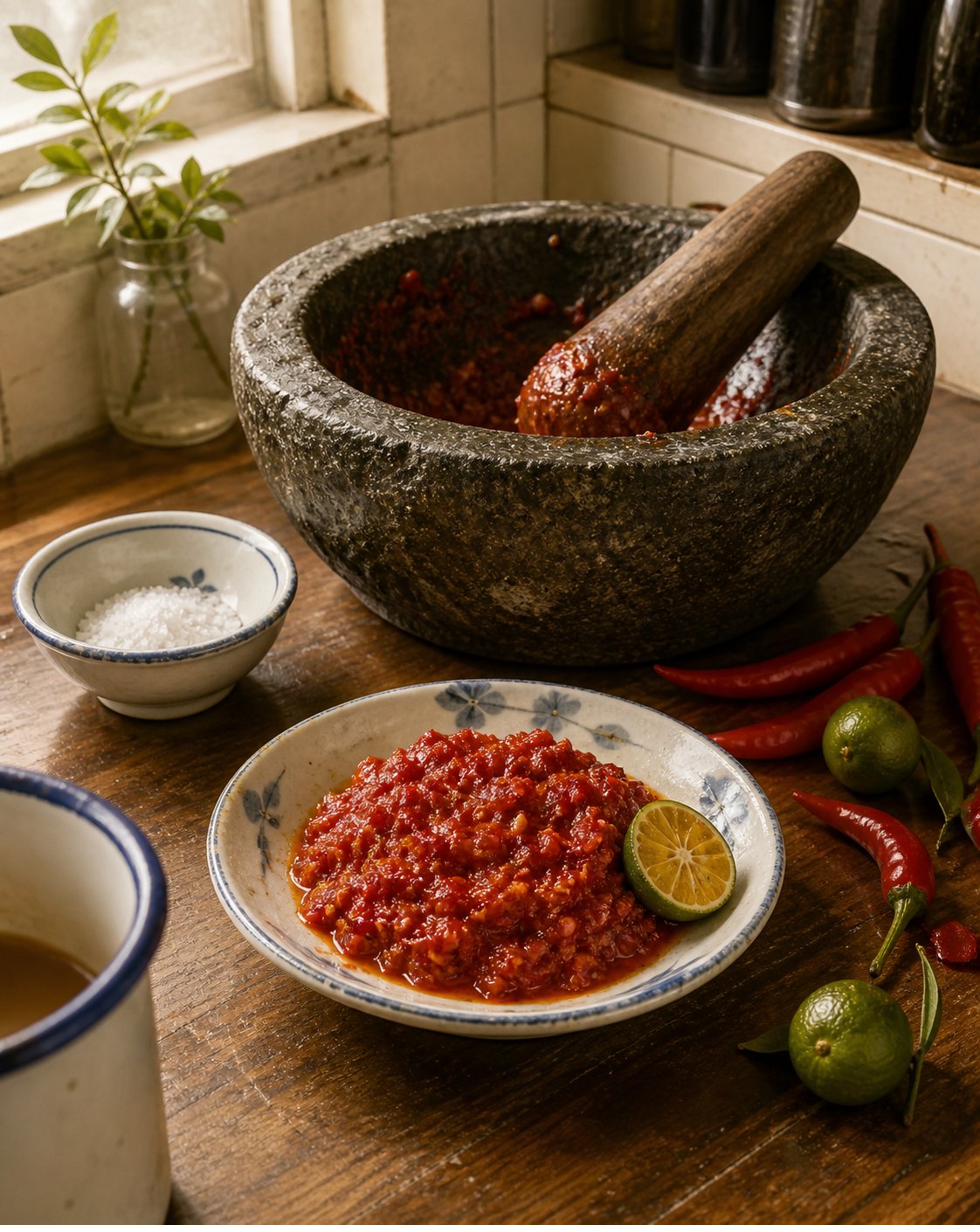
This is the first thing I make on most mornings. Before the rice is on, before the kettle whistles, before anyone in the house is awake — the mortar, the toasted belacan, the chillies, the pestle. Eight minutes of work, then a small dish of sambal that flavours the rest of the week. It is the source paste. Without it, half this cookbook does not work. The Peranakan rempahs need it as a base. The kangkung belacan needs it. Ayam buah keluak needs it. Babi pongteh needs it. The morning ritual is not for me — it is a service to the days ahead. The kitchen is quiet at six in the morning. The pestle is the loudest thing in the building. By the time I am done, the day has begun.
Sambal belacan — sambal belachan, sambal terasi in Indonesian register, 參峇峇拉煎 in Singapore-Peranakan-Hokkien written register — is the heritage Peranakan-Malay toasted-shrimp-paste-and-chilli sambal that sits at the foundation of half the savoury cooking in this book. It is a Source recipe in the technical sense — referenced from Recipe 26 (Ayam Buah Keluak), Recipe 27 (Babi Pongteh), Recipe 28 (Itek Tim), Recipe 30 (Nyonya Laksa), and used as the table sambal for Recipe 41 (Pong Pong Prawns) and Recipe 42 (Mee Hoon Kueh).
A note on heritage cross-culture worth establishing carefully. Sambal belacan demonstrates the Peranakan synthesis directly: the technique is heritage Malay (toasted-belacan-and-chilli, pestle-and-mortar discipline, calamansi-finish), the household register is heritage Peranakan-Chinese (the cook is a Singapore-Chinese cook adapting Malay heritage into a daily-condiment register), and the modern stall-and-restaurant register is now Singapore-and-Malaysia-and-Indonesia-shared. Reportedly the dish travelled from heritage Malay coastal fishing-village practice (where belacan was fermented and pressed into cakes for keeping) through Peranakan kitchens (where the belacan + chilli + lime trinity was codified as a daily-condiment register) into Singapore-Chinese-Malaysian everyday cooking.
A note on the dish's three core ingredients. Heritage sambal belacan is fresh red chillies + toasted belacan + lime juice (calamansi or regular lime). That is the foundation form. Salt and sugar are heritage-optional additions — some heritage cooks add a small pinch of each, others (including Hock Ko's mother-in-law, who taught him) add neither and let the belacan's own salt and the chilli's own sweetness carry the dish. Garlic and shallot are heritage-optional aromatics. (Synthesis note: heritage Malaysian Chinese Kitchen documentation explicitly: "There are many versions of Sambal Belacan but these 3 ingredients are essential — red chilies, belacan, and lime juice. Salt and sugar to taste is optional." Hock Ko's home form below adds garlic and shallot for a slightly fuller register; the strict three-ingredient form is heritage-acceptable.)
A note on parallel forms. Two heritage forms exist and they serve different purposes:
Form A — Fresh sambal belacan (the form below). Pounded, mixed with lime juice at the table, served fresh; refrigerator life 2-3 days. This is the heritage daily-condiment form — what most Singapore and Malaysian households make on weekend mornings or as-needed. The lime juice goes in at the table or just before serving, NOT in advance.
Form B — Sambal tumis / cooked sambal (the parallel form, NOT covered below). Heritage Malay-Indonesian practice cooks the pounded sambal paste in oil over low heat for 10-15 minutes (until the oil separates and the paste deepens to a brick-mahogany colour); this drives off moisture, develops Maillard-browning umami, and extends refrigerator life to 2 weeks (or 2 months frozen). The cooked form is the heritage register for sambal-as-cooking-ingredient. The recipe below gives Form A with a note at the end on how to convert to Form B for storage and rempah-use.
The dish has THREE heritage technical-discipline rules. Each one is non-negotiable, and each one prevents a specific failure-mode.
Rule one — toast the belacan to dry-and-crumbly, NEVER burned-bitter. Heritage practice toasts the raw belacan in a dry pan over LOW heat for 3-5 minutes until the belacan transforms from its raw moist-and-pliable register into the toasted register: deeper brick-purple, dry-and-crumbly texture, a thin curl of aromatic steam-or-smoke rising from the pan as the heritage signal that the toast is ready. The failure-mode prevented: over-toasted belacan goes bitter-and-acrid, the bitterness propagates through the entire sambal, and the dish is unrecoverable — the only fix is to start over with fresh belacan. Heritage cooks watch the pan continuously through the 3-5 minutes and remove the belacan from heat at the FIRST sign of the steam/smoke curl, not the second.
A heritage colour-and-texture note for cooks who have not bought belacan before. Heritage belacan in its raw form is a dense paste-cake, sold as a brick-shaped block or a cylindrical roll, brick-purple-grey to deep-purple-brown in colour, with a faintly purple undertone that distinguishes it from generic shrimp paste. After toasting, the colour deepens slightly toward brick-mahogany-purple and the texture becomes drier-and-crumbly. If your belacan looks bright-pink (Cantonese-style fermented shrimp paste, different ingredient), or pale-tan-brown without the purple undertone (Thai-style kapi, different ingredient), or bright-red (chilli-paste, different ingredient entirely), it is not heritage Malaysian-Singapore belacan.
Rule two — pestle-and-mortar, coarse-pounded, NEVER smooth-blended. Heritage practice pounds the chillies first to a coarse paste, then adds the toasted-and-cooled belacan and continues pounding until the paste is heritage-coarse — visible chilli-skin flecks, visible brick-coloured belacan flecks, NOT a uniform smooth red paste. The failure-mode prevented: a smooth-blended sambal reads as commercial-jarred-sauce rather than home-made; the visible texture is the heritage signature that signals this is hand-pounded fresh.
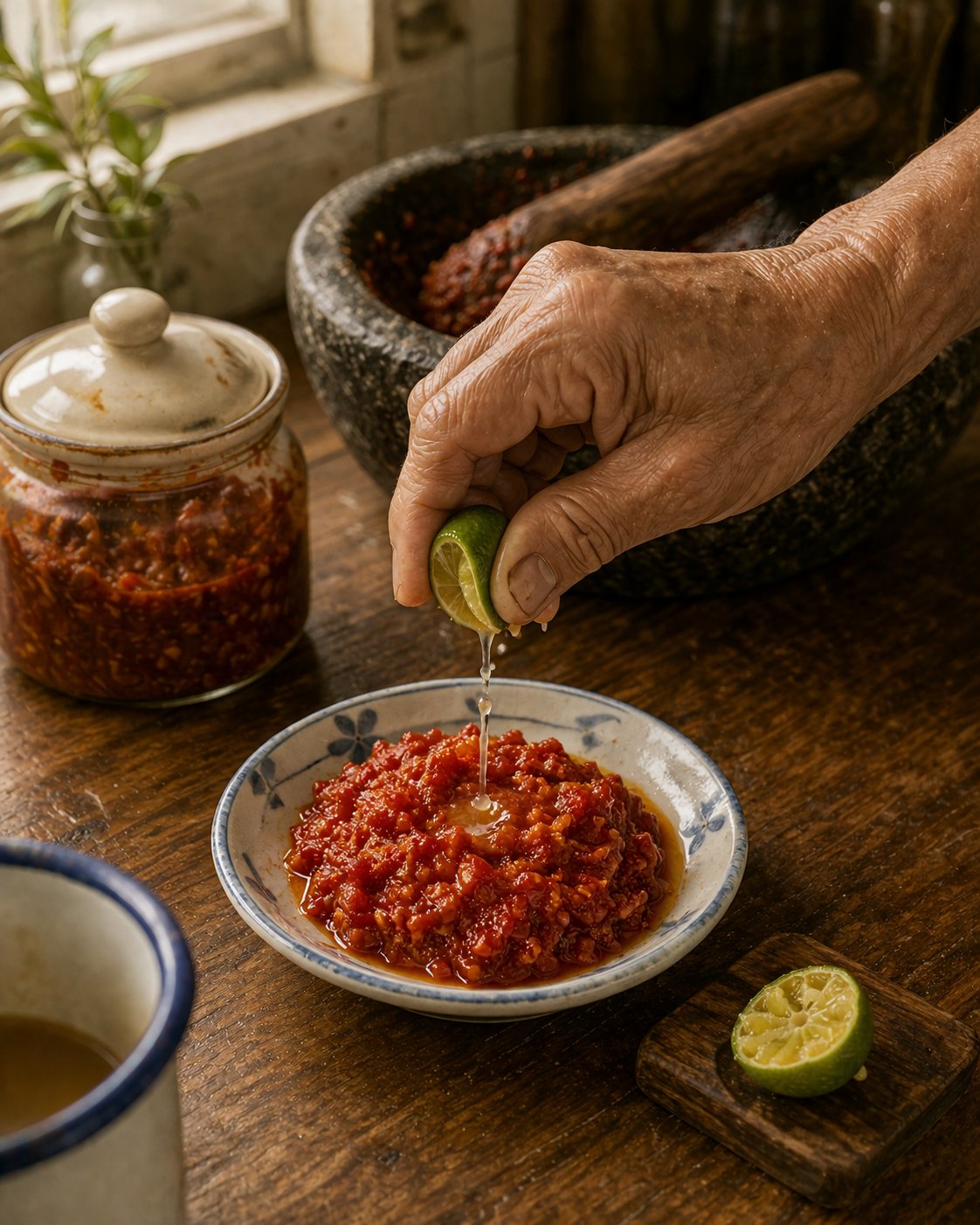
Rule three — lime juice goes in at the END, ideally AT THE TABLE. Heritage Singapore-Peranakan practice keeps the calamansi juice OUT of the sambal until the moment of serving. Some heritage cooks pound the lime juice in at the very end of the pestle work; others (including Hock Ko's mother-in-law) put a wedge of fresh calamansi on the saucer and let the eater squeeze it over directly at the table. The reason: lime juice loses brightness and freshness within 2-3 hours of mixing, and the sambal goes from bright-and-alive to flat-and-cooked-tasting. The failure-mode prevented: a sambal that loses its bright lift within hours of mixing; a refrigerator-stored sambal that has gone flat by day two.
Two final notes worth establishing. The heritage chilli choice matters. Heritage Malaysia-Singapore practice uses long red spur chillies (cabai merah) — about 10cm long, bright red, glossy skin, moderate heat (around 1,000-3,000 SHU). For extra heat, heritage practice adds 2-3 chilli padi (bird's-eye chillies). The default is long red spur; chilli padi is the optional heat-up.
The morning-routine register has a specific time-discipline. Heritage Singapore-Peranakan home practice makes a fresh batch once a week (typically Saturday morning) for the week's table-condiment use, and converts a portion to Form B for the week's cooking-ingredient use. The whole work cycle takes about 25-30 minutes — toast the belacan, prep the chillies, pound, jar. Sunday-Friday morning Hock Ko's practice is to put a small heaped tablespoon of the week's fresh sambal into a saucer, set a wedge of calamansi beside it, and put it on the breakfast rice-table. The morning ritual is a service to the rest of the week.
This is the morning's gift to the week. The pestle is the loudest thing in the building at six in the morning. The kitchen earns its quiet afterward.
🛒Ingredients
Three core. Two optional aromatics. The lime stays separate.
For the Sambal
| Fresh long red spur chillies (cabai merah / red spur chilli) | 12-15 chillies (≈150g) | Heritage Malaysia-Singapore default. About 10cm long, bright red, glossy skin. NOT bird's-eye chillies (chilli padi) which are the optional heat-up; NOT bell peppers; NOT dried chillies. Heritage practice removes about half the seeds for moderate heat. For extra heat, add 2-3 bird's-eye chillies. |
| Belacan (heritage Malaysian-Singapore fermented shrimp paste, raw) | 30-40g (a piece roughly 4cm × 4cm × 1cm) | HERITAGE COLOUR-AND-TEXTURE: brick-purple-grey, dense paste-cake, firm-but-slightly-yielding when pressed. NOT bright-pink (Cantonese fermented shrimp paste); NOT pale-tan-brown without purple undertone (Thai kapi); NOT bright-red (chilli-paste). Heritage Singapore-Malaysia brands include Hae Bee Hiam, Penang Belacan, Tan Kim Soon's wet-market brand. After toasting (Stage 1) the colour deepens to brick-mahogany-purple and the texture becomes dry-and-crumbly. Raw belacan is unsuitable to eat directly. |
| Garlic cloves (peeled) heritage-optional | 2-3 | Heritage Peranakan home register; some heritage practices skip; the strict three-ingredient form (chilli + belacan + lime) is heritage-acceptable. Hock Ko includes them because his mother-in-law taught him. |
| Shallot (peeled) heritage-optional | 1 small | Heritage Peranakan home register addition. |
| Calamansi (limau kasturi) | 4-6 limes | 2 for pounding-in if using; 2-4 reserved for table-service squeeze. Heritage Singapore-Peranakan default. Acceptable substitute: 1-2 regular limes (Tahiti or key lime). NOT lemons. |
| Fine sea salt heritage-optional | a pinch | The belacan already contains substantial salt; heritage register considers additional salt unnecessary. Hock Ko skips; his mother-in-law skipped. |
| Granulated sugar heritage-optional | a pinch | Heritage register considers added sugar unnecessary; the chilli's own sweetness carries the dish. |
🌶️Shifu's Lift
choose one path- Old-school path: Toast the belacan in a dry cast-iron skillet over low gas-flame for 3-5 minutes until dry-and-crumbly with the heritage steam/smoke curl rising; pound chillies first in the heritage stone mortar to coarse paste; add toasted belacan and aromatics; pound to heritage-coarse texture; serve fresh with calamansi wedge at the table. This is what Hock Ko does most mornings.
- Modern hawker path: Toast the belacan in an air fryer at 160°C for 10 minutes (heritage Nomadette-documented modern adaptation; reportedly cleaner-and-less-pungent than dry-pan toasting); use a food processor or blender on PULSE mode for the chilli-and-belacan grinding (do NOT smooth-blend — pulse only, retain coarse texture). The convenience-form delivers ~85% of the heritage register.
- Heritage purist path: Use heritage Penang-style belacan (slightly stronger fermentation register); add 1 stalk of finely-minced lemongrass (white part only) to the pound for a heritage Peranakan-aromatic lift; finish with 2-3 finely-shredded torch ginger flower (bunga kantan) leaves at the saucer for a heritage festival-or-special-occasion register.
👨🍳Method
Four stages. Toast, prep, pound, plate. Eight minutes of work; a week's worth of flavour.
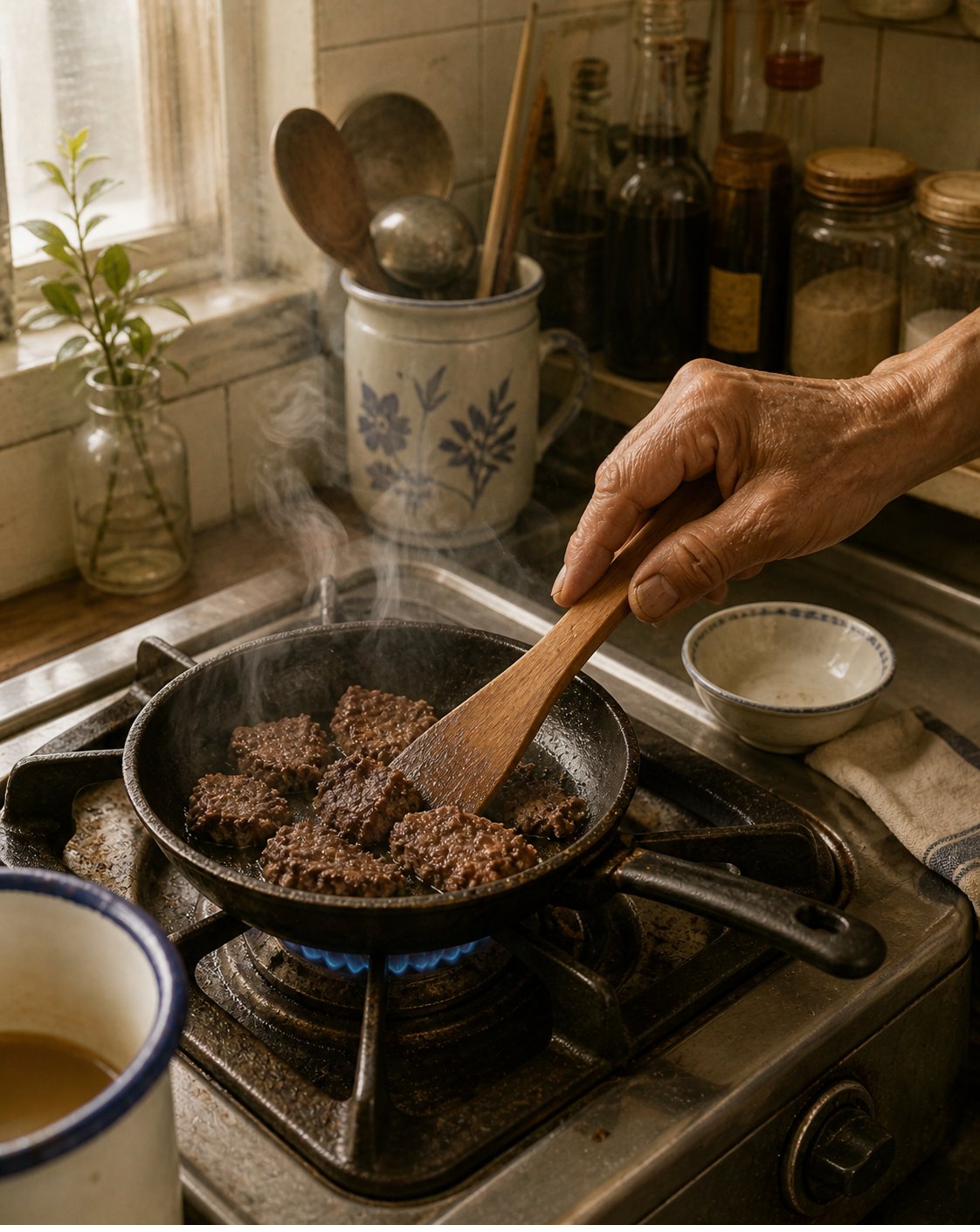
Heritage Belacan Toast 5 min — Rule One
Open a kitchen window or turn on the extractor fan — the toast releases a strong aromatic vapour that will perfume soft furnishings if not ventilated. Heritage Singapore home register: do this BEFORE you start, not during.
- Cut the belacan into 4-5 rough chunks, roughly 2-3cm each. Heritage practice: do NOT crumble in advance — the chunks expose more surface to the heat as they break down during toasting.
- Heat a small dry pan (heritage cast-iron or carbon-steel; NOT non-stick — non-stick coatings degrade at sustained low heat) over LOW gas-flame. The pan should be just barely warm-to-touch when you lower your hand 3cm above it; if it's hot enough that your hand recoils, the heat is too high.
- Add the belacan chunks to the dry pan. Use a small wooden spatula to GENTLY press-and-break the chunks against the pan surface every 30-45 seconds — this exposes more surface to the heat and allows the toast to develop evenly.
- Watch continuously for 3-5 minutes. Heritage signals to track:
- The colour deepens slightly toward brick-mahogany-purple (still distinctly purple-toned, NOT pure dark-brown)
- The texture goes from raw-moist-pliable to dry-and-crumbly — the chunks break apart easily under the spatula
- A thin curl of aromatic steam/smoke rises from the pan — THIS IS THE HERITAGE READY-SIGNAL. Remove the pan from the heat at the FIRST sign of the curl, not the second
- Transfer the toasted belacan immediately to a small ceramic pinch-bowl to halt the cooking. Let cool 5 minutes — the belacan will dry further as it cools.
Chilli Prep and Mortar Setup 5 min
While the belacan cools:
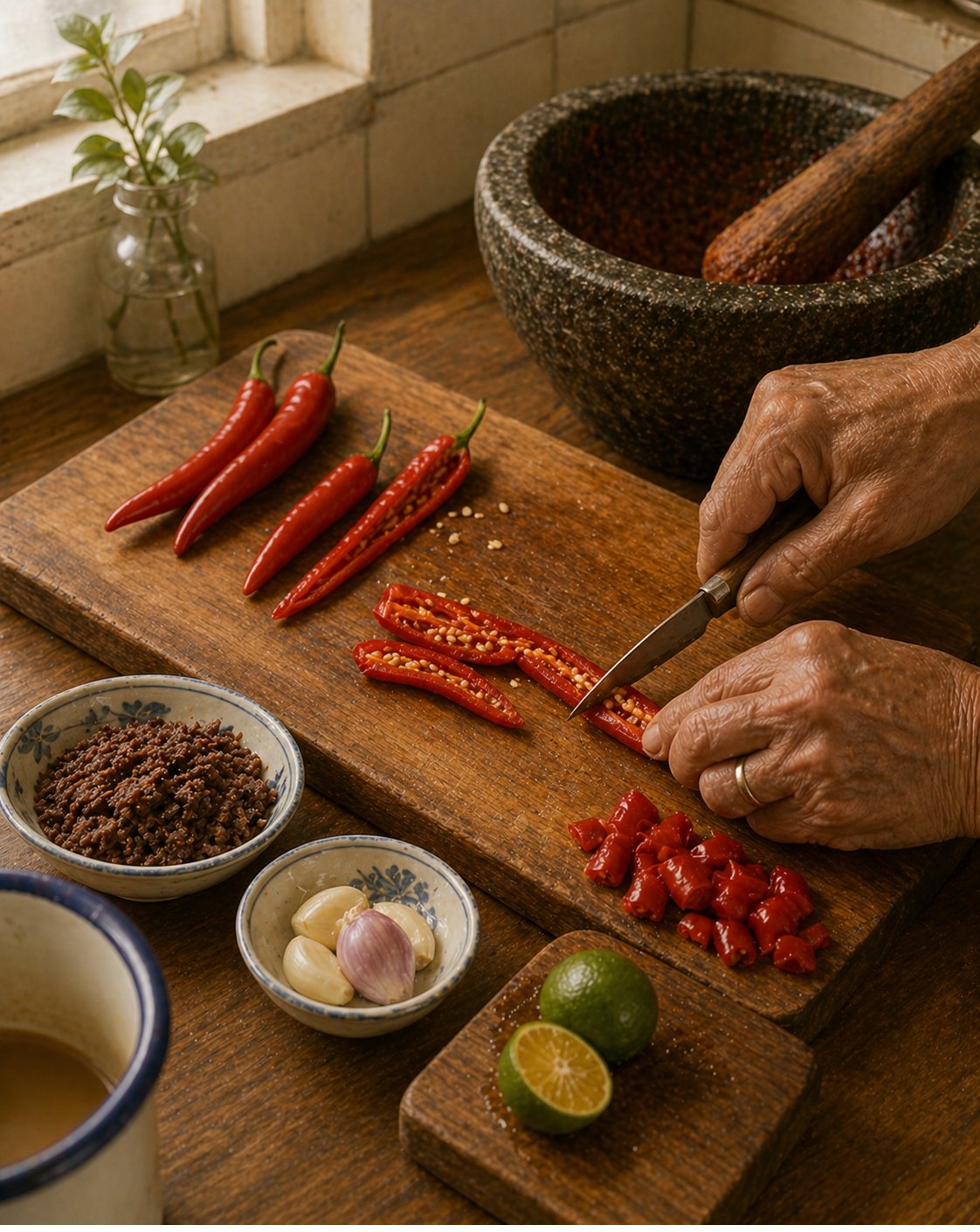
- Wash and dry the long red chillies thoroughly. Wet chillies will dilute the pound and make the paste runny.
- Remove the stems; halve each chilli lengthways. Use the knife-tip to scrape out about half the seeds — heritage moderate-heat register; keep more seeds in for hotter, remove all for milder.
- Roughly chop the deseeded chillies into 1cm pieces. The pre-chop reduces pound time and prevents the mortar overflowing with whole chillies.
- Peel and roughly chop the garlic cloves and shallot (if using). Heritage practice keeps both relatively coarse — they will pound down.
- Position the heritage stone mortar on the workbench, the wooden pestle ready beside it.
- Cut 2 calamansi limes in half and reserve on a small wooden coaster — these are for the optional pound-in or for the table-service squeeze.
The Pound 8-10 min — the cartouche moment, TOAST & POUND
The heritage rhythm-and-force discipline:
- Add the chillies to the mortar first (about 1/3 at a time so the mortar doesn't overflow; pound the first batch down before adding the next).
- Pound with full-palm grip on the pestle — heritage Peranakan-Malay grip is full-palm, NOT pinch-grip; weight transfers from the shoulder through the elbow into the wrist. Each strike is firm-but-not-violent; the pestle should make a clear "tok" sound against the mortar as it strikes.
- Continue until chillies are coarse-paste — the chilli-skin should be visibly broken down, the seeds partly mashed, but the texture still distinctly chunky-coarse. About 3-4 minutes of pounding.
- Add the cooled toasted belacan and the garlic-and-shallot (if using). Continue pounding.
- The heritage signal of correct pound-pressure: a fine spray of paste-droplets rises from the impact zone of each strike. If you see no spray, your pound is too gentle — increase force. If the spray is excessive (large droplets flying out of the mortar), you're pounding too hard — moderate.
- Continue 4-5 more minutes until heritage-coarse: visible chilli-skin flecks, visible brick-coloured belacan flecks, the paste cohesive but distinctly textured. NOT smooth-uniform; NOT a thin liquid; a coarse-pounded paste.
- Optional: at this point pound in the juice of 1-2 calamansi (or stir it in by hand). Heritage Hock Ko practice does NOT pound in the lime — he puts a wedge on the saucer at table-service.
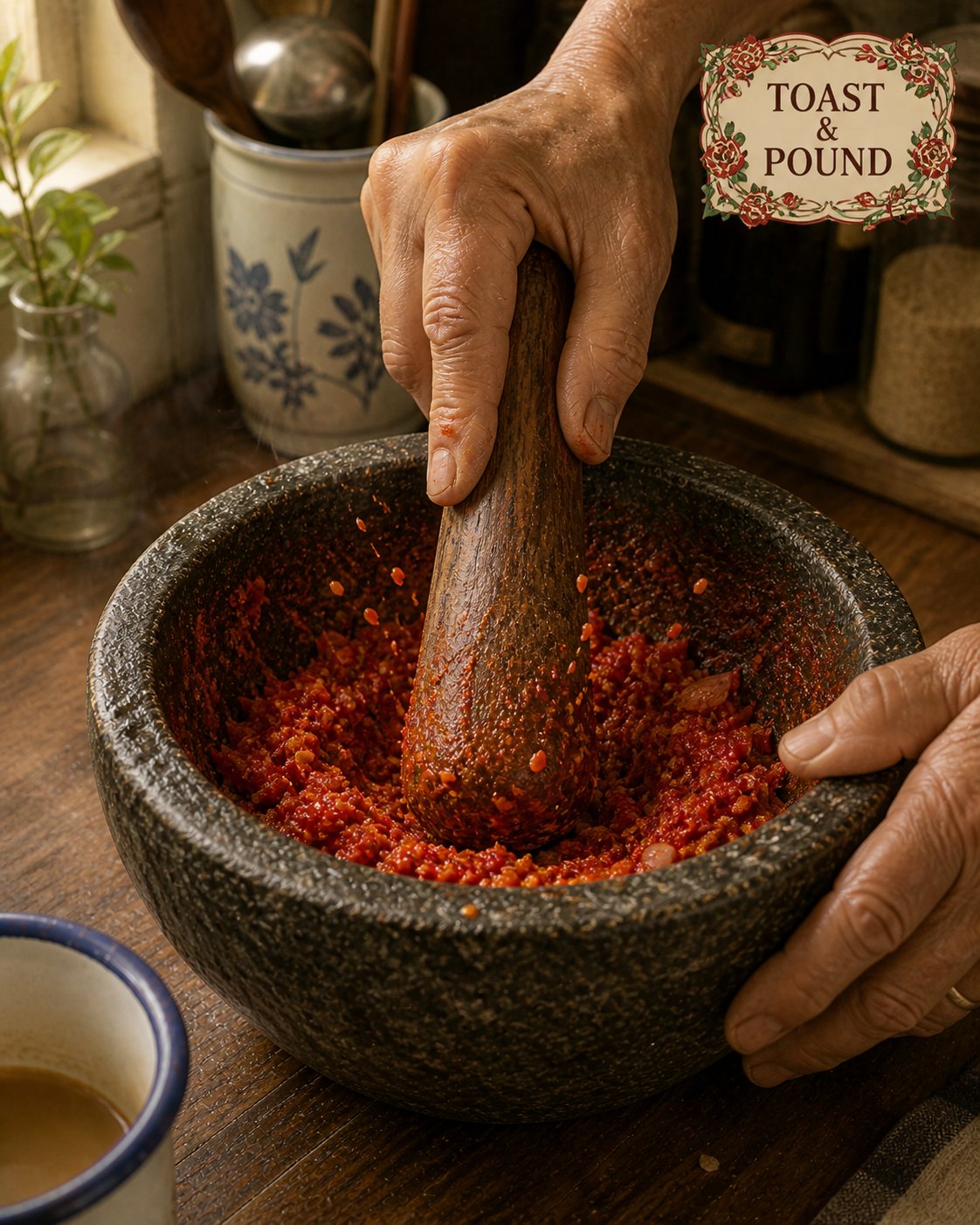
Plate and Serve, or Jar for the Week 3 min — Rule Three
For breakfast-table-condiment service:
- Spoon a heaped tablespoon of fresh sambal into a small heritage cream-and-pale-blue Singapore-everyday sambal-saucer.
- Place a calamansi half cut-side-up on the saucer rim.
- Set on the breakfast rice-table; let the eater squeeze the calamansi over directly. Heritage Rule Three.
For week-storage:
- Transfer the remaining sambal to a clean dry glass jar with a tight-fitting lid.
- Refrigerate. Heritage shelf life: 2-3 days for the fresh form. The colour will dull slightly from bright-red toward brick-red-deeper after 24 hours; this is normal heritage behaviour, NOT spoilage.
- To convert to Form B (sambal tumis, 2-week refrigerator life): heat 2 tbsp neutral oil in a small wok over low heat; add the sambal; cook 10-15 minutes, stirring, until the oil separates and the paste deepens to brick-mahogany. Cool fully before jarring.
🎯The Three Tips
Heritage. Master's. Mistake.
🏛 Heritage Note
The Yardstick of Peranakan Cooking
Sambal belacan is one of the rare Source recipes whose heritage form is faithfully preserved by both heritage hawker stalls AND heritage home kitchens — the technique is identical at scale, the ingredients are identical, the discipline is the same. The only thing that varies between Loo's Hainanese curry rice's table-sambal, the Peranakan-restaurant kitchen's rempah-base-prep sambal, and Hock Ko's home morning sambal is the QUANTITY produced (Loo's makes 5 litres a week, the Peranakan kitchen makes 20 litres, Hock Ko makes 250ml).
This is why sambal belacan sits at the foundation of so much Singapore-Malaysia cooking — it's a paste that scales perfectly across stall, restaurant, and home registers without losing its heritage character. Per heritage Camemberu documentation: sambal belacan is "the yardstick by which we judge Peranakan restaurants and chefs." The same yardstick applies to heritage home cooks.
👨🍳 Master's Tip
The Toast-Watch
The single technique-anchor that separates a beginner's sambal belacan from a heritage one is the patience of the belacan toast. Heritage practice keeps the cook's eyes on the pan for the full 3-5 minutes — heritage cooks do NOT step away to do other things while the belacan toasts. The window between "perfectly toasted" and "just slightly over-toasted and bitter" is about 30 seconds; the window between "slightly over" and "burned-acrid-unrecoverable" is another 30 seconds after that.
The fix is simple: stand at the stove, watch the pan, smell for the heritage steam/smoke curl, remove at the first signal. Hock Ko's heritage advice: do not start the belacan toast unless you can give it your undivided attention for the next 5 minutes. If the kettle whistles, let it whistle. If the phone rings, let it ring. The toast is the foundation; everything else can wait.
⚠ Common Mistake
Three Failure Modes
- Burned-bitter belacan. The cook either uses too high a heat, or steps away during the 3-5 minute toast. The bitterness propagates through the entire sambal and is unrecoverable. The fix: start over with fresh belacan; the burned batch cannot be rescued by adding sugar, lime juice, or anything else. Heritage prevention: keep the heat LOW (just barely warm-to-touch), watch continuously, remove at the first steam/smoke curl.
- Smooth-blended sambal. The cook uses a blender on continuous high speed and produces a uniform smooth red paste. The sambal reads as commercial-jarred-sauce, lacks the heritage texture-anchor, and tastes flatter because the chilli-skin and belacan flecks haven't been left to release their oils discretely. The fix: if a blender is the only available tool, use PULSE mode — short bursts of 2-3 seconds, stopping to check texture, until the paste is heritage-coarse.
- Flat sambal by day two. The cook pounds in the lime juice with the rest of the sambal and stores the whole thing in the refrigerator. The lime brightness fades within 6-8 hours and by 24 hours the sambal tastes flat and slightly cooked. The fix: keep the lime juice OUT of the bulk sambal. Add lime juice only to the portion being served at that meal; store the un-limed bulk sambal in a clean dry jar. Heritage Singapore-Peranakan table-service: a wedge of fresh calamansi on the saucer, squeezed by the eater at the moment of eating.
📈 Scaling for Hawker Service
The pestle is the bottleneck
The pestle-and-mortar is the bottleneck at hawker-stall and restaurant scale — heritage stalls and Peranakan restaurants typically use a heritage-large stone mortar (40cm diameter or larger) operated by the senior cook for the day's batch.
- Form A (fresh) does not scale beyond about 2-3 litres per pound-session because the heritage-coarse texture cannot be maintained at larger volumes; restaurants making 10+ litres a week typically pound 2-3 batches in series rather than scaling a single batch.
- Form B (sambal tumis) scales more readily because the cooking step homogenises texture; restaurants and stalls running heritage Peranakan menus typically make Form B in 5-litre batches and hold for the week.
- Heritage Singapore-Peranakan restaurants like Candlenut, Blue Ginger, and Violet Oon's Bukit Pasoh use Form B as the rempah-base for their nyonya-cuisine menus; Form A fresh sambal is made daily on a smaller pestle for table-service.
- Home-kitchen scaling: 250ml per batch is the heritage Singapore household quantity; double for a larger family or for Form B conversion. Beyond 1 litre, heritage practice splits into multiple pound-sessions to maintain texture-discipline.
The pestle is the loudest thing in the building at six in the morning. The kitchen earns its quiet afterward.