White Bee Hoon
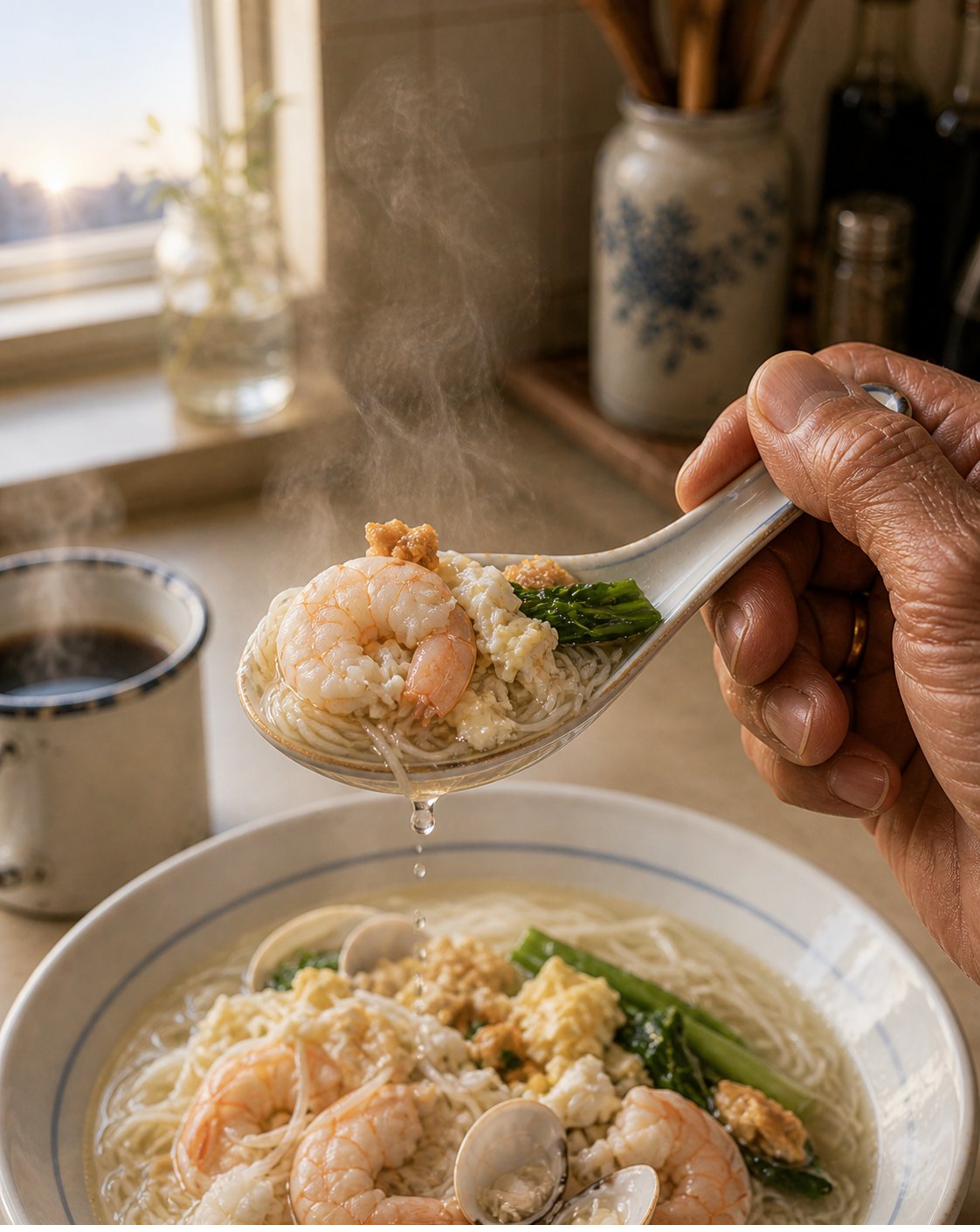
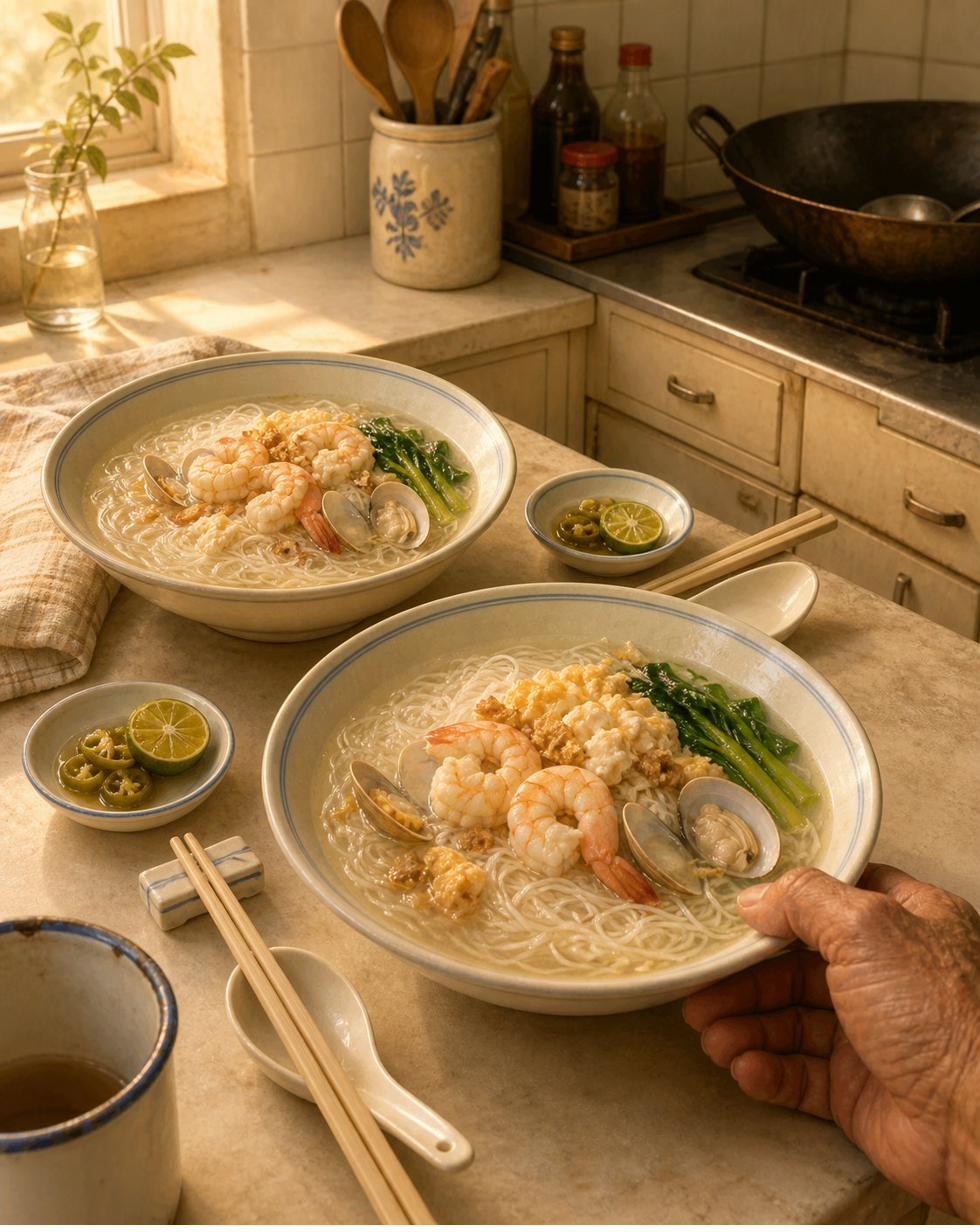
This morning there was breakfast to cook. My wife was still asleep down the corridor. The kitchen was the first room awake — it usually is. I built the stock the night before, while we were watching television; the stock simmered while we slept. By dawn the stock was ready and the seafood was ready and the bee hoon needed only five minutes in the wok. Two bowls, the workbench-table, the day not yet started. White bee hoon is a quiet dish. It is what we eat when there is nothing to celebrate and nothing to mourn — when the day is just the day, and breakfast is just breakfast, and the kitchen is doing what it has always done.
White bee hoon — bai mi fen (白米粉) in Mandarin, bee hoon putih in Malay, "white rice vermicelli" in heritage Singapore-English register — is the heritage Sembawang seafood-and-stock rice vermicelli dish, made famous by You Huak Restaurant in Sembawang and carried forward across Singapore's hawker scene by stalls including Soon Heng. The dish is the chapter's closing payoff and the book's final recipe — the white-and-cream foreground that the chapter's colour-arc has been building toward across Recipe 41 through Recipe 44.
A note on heritage worth establishing carefully, because three parallel forms exist and a reader who has eaten "white bee hoon" in Singapore may have eaten any one of them.
Form A — Heritage Sembawang seafood white bee hoon (the form below, You Huak / Soon Heng lineage). Rice vermicelli is simmered in robust seafood-and-pork-bone stock until the noodles absorb the broth and become glossy-translucent-white; the dish is wet, gravy-laden, glossy-white, with prawns, lala clams, soft scrambled egg, and yu choy. The heritage Sembawang signature is the slow-simmered stock — chicken bones + prawn heads-and-shells + soya beans + sometimes pork bones, simmered for hours until the umami foundation is fully rendered. (Source note: per Beyond Norm: "the secret of turning bland beehoon into a tasty dish lies in a robust stock!!" Per The Meatmen, the heritage homemade stock is "made with chicken carcasses, chicken feet, soya beans, prawn heads and shells.") This is the form Hock Ko cooks; this is the form below.
Form B — Stir-fried white bee hoon (heritage everyday-home register, bee hoon putih). Rice vermicelli is stir-fried with chicken stock and ingredients; the dish is drier, lighter, paler-white. Heritage Singaporean home register; differentiates from the dark-soy-tinted Hokkien stir-fried bee hoon by deliberate omission of dark soy sauce. Closer to a dry stir-fried noodle than to the heritage Sembawang wet-and-glossy register.
Form C — Heng Hwa fried bee hoon (heritage Putian Heng Hwa register, separate dish-family). A parallel heritage form from the Putian / Heng Hwa minority dialect group of coastal Fujian. The dish uses sun-dried artisanal Heng Hwa bee hoon — finer and silkier than standard rice vermicelli, sun-dried by hand — braised in pork-bone stock and fried with prawn, clams, fried peanuts, and famous Heng Hwa seaweed. (Synthesis note: Form C uses the same name colloquially but is a distinct heritage Heng Hwa dish with its own technique and ingredient profile. Readers eating "white bee hoon" at PUTIEN are eating Form C; readers at You Huak / Soon Heng are eating Form A; readers stir-frying at home are typically eating Form B. All three are heritage-correct.)
A note on what makes this dish "white" and why that matters. The "white" in white bee hoon is a deliberate omission, not just a colour register. Heritage Singapore-Hokkien stir-fried bee hoon traditionally uses dark soy sauce for colour and umami depth, producing a brown-or-mahogany-tinged dish. White bee hoon refuses the dark soy. Reportedly the heritage Sembawang You Huak form was developed specifically to showcase the seafood-and-stock register without the dark-soy colour interference — the slow-simmered stock carries enough umami that the dark soy is not needed; omitting it lets the pale-amber stock and the white bee hoon read clearly. The visual register and the flavour register are the same insight: what is left out matters as much as what is put in. The chapter's closing-payoff colour-arc — white-and-cream foregrounded — lives in this exact insight. The dish is white because the cook chose not to add the soy.
The dish has THREE heritage technical-discipline rules. Each one is non-negotiable, and each one prevents a specific failure-mode.
Rule one — the stock IS the dish; build it slow, build it clear. Heritage Sembawang practice builds the white stock from chicken bones (carcasses, knuckles, feet) + prawn heads-and-shells + soya beans + ginger + spring onion white, simmered over LOW heat for at least 90 minutes (heritage register; restaurant register simmers 3-4 hours). The stock must read as clear pale-amber-cream, NOT milky-white (Cantonese emulsion register), NOT yellow-chicken-broth-only (Western register), NOT red-or-soy-tinted. Heritage Singapore-Hokkien register: the soya beans are the heritage stock-clarification ingredient, contributing saponins that clarify the broth and add a subtle umami sweetness. The failure-mode prevented: a milky-white broth reads as Cantonese rather than heritage Sembawang and loses the clear-amber visual signature; a yellow-chicken-only broth lacks the seafood-umami foundation and tastes thin.
Rule two — soak the bee hoon, NEVER boil it. Heritage Singapore practice soaks dried rice vermicelli in HOT (not boiling) water for 5-10 minutes until softened, then drains thoroughly. The bee hoon must be soft-and-pliable but NOT cooked-through — it will finish cooking in the stock during the wok-cook stage. The failure-mode prevented: boiled-through bee hoon turns mushy in the wok-cook stage and disintegrates into the stock; under-soaked bee hoon stays brittle and refuses to absorb stock during the cook.
Rule three — the wok is hot, the stock is fast, the bee hoon absorbs. Heritage Sembawang practice heats the wok over medium-high heat with neutral oil + minced garlic; adds the pre-soaked bee hoon and tosses briefly to coat; pushes the bee hoon to one side and adds soft-scrambled-egg + raw prawns + lala clams; pours in a generous ladle of the heritage Sembawang stock; covers the wok briefly to let the stock simmer-cook the seafood; uncovers, adds blanched yu choy, lightly tosses the whole thing together so the bee hoon absorbs the stock; finishes with a generous scatter of crispy lard pieces and a drizzle of shallot-oil. The whole wok-cook is 5-7 minutes maximum. The failure-mode prevented: a slow wok-cook over-cooks the seafood (rubbery prawns, tough clams) before the bee hoon absorbs the stock; an under-stocked wok leaves the bee hoon dry and the dish closer to dry stir-fried than to heritage Sembawang wet-and-glossy.
Two final notes worth establishing. The heritage signature lard pieces (zhu you zha, 猪油渣). Heritage Sembawang You Huak / Soon Heng stalls finish each bowl with a generous scatter of pale-golden crispy lard pieces. The lard pieces are the heritage Sembawang-stall signature; without them the dish reads as generic seafood vermicelli rather than heritage Sembawang white bee hoon. Hock Ko renders his own lard at home and keeps the zhu you zha in a small jar; commercial-rendered lard from heritage Singapore wet-market vendors is acceptable substitute.
The heritage Singapore breakfast-and-supper register. Heritage You Huak originally served white bee hoon as both a breakfast dish and a late-supper dish — the slow-simmered stock made early-morning was kept warm through the day and the dish was wok-cooked to order at any meal. The home form below sits in the breakfast register specifically — Hock Ko cooks this for himself and his wife at dawn, the day's first meal, the pale-gold morning light catching the steam from the bowls. The book closes here because this is what the kitchen does in the morning when the household is just waking, when there is nothing to celebrate and nothing to mourn, when the day is just the day. Most cookbooks close on a celebration dish; Hawker Tales closes on a quiet one.
This is the dawn dish. The book opens with hawker-stall cooking for the public and travels through chapters of family, regional, and ancestral cooking — and closes here, on the most private register a long-married home cook has: feeding the person you have cooked for the longest, on the morning that has just arrived. The reader fills the empty place at the workbench-table.
🛒Ingredients
The stock is the dish. Everything else assembles fast around it.
For the Heritage Sembawang White Stock makes ~1.5 litres
| Chicken bones (carcasses, knuckles, feet) | 600g | Heritage Sembawang practice uses a mix — carcasses for body, feet for collagen, knuckles for marrow. Ask the wet-market butcher for "soup bones" or "stock bones". |
| Prawn heads and shells | 200g (from peeling about 400g whole prawns) | Heritage Sembawang seafood-anchor; reserve from peeling the prawns for the wok-cook step. The shells are the heritage umami foundation; the dish does not work without them. |
| Soya beans (dried, raw) | 80g | Heritage Hokkien stock-clarification ingredient. Soak in cold water for 4-6 hours before adding to the stock; the soaked beans contribute saponins that clarify the broth. |
| Yellow onion | 1 large (peeled, halved) | Heritage sweetness anchor. |
| Fresh ginger | 4 thick slices | Heritage Hokkien register; cuts the seafood richness. |
| Spring onion white | 2 stalks (knotted) | Heritage aromatic. |
| Water | 2.5 litres | Cold water at the start. |
| Fine sea salt | to taste at end | Season AFTER the stock has reduced, not at the start — heritage discipline. |
For the Wok-Cook
| Dried rice vermicelli (bee hoon) | 200g | Heritage Singapore practice uses thin-strand rice vermicelli; available at any Asian grocery as 米粉. Avoid Heng Hwa bee hoon (Form C) and avoid thick rice noodles. |
| Fresh medium prawns (peeled, tails on, deveined) | 400g (about 16-20 prawns) | Heritage Singapore wet-market sourcing. The tails-on heritage stall register; reserve heads-and-shells for the stock. |
| Lala clams | 300g (about 16-20 clams) | Heritage Singapore Hokkien shellfish — the heritage Sembawang signature shellfish. Cream-and-grey ridged shells, sweet-and-saline white flesh. Purge in salted water for 30 minutes before cooking. Substitute with cockles or Manila clams if lala unavailable. |
| Eggs (large) | 2 | For the soft-scramble heritage register, 80%-cooked-still-soft. |
| Yu choy | 1 small bunch (200g) | Heritage Singapore-Hokkien register — the only major colour relief on the plate. Cut into 4cm lengths; blanch briefly in boiling water before adding to the wok. |
| Garlic | 4 cloves (minced) | For the wok-base aromatic. |
| Neutral oil | 2 tbsp | For the wok-cook. |
| Heritage shallot-oil (rendered from frying shallots) | 1 tbsp | Heritage finishing-flourish; reserve from Recipe 42 (Mee Hoon Kueh)'s heritage shallot-frying step or render fresh. Drizzled over the finished dish at plate-up. |
| Crispy lard pieces (zhu you zha) heritage Sembawang signature, NOT optional | 2-3 tbsp | HERITAGE SEMBAWANG SIGNATURE. Render at home from heritage Singapore-Hokkien lard-making, or buy from heritage wet-market vendors. The lard pieces are what makes this dish heritage Sembawang white bee hoon rather than generic seafood vermicelli. |
| Fine sea salt | ½ tsp | For final seasoning at the wok. |
| Ground white pepper | ¼ tsp | Heritage Hokkien register — NOT black pepper. |
For Service
| Calamansi (limau kasturi) | 2 limes (halved at table) | Heritage Sembawang-stall service signature. Cut at the table; the eater squeezes over their own bowl. |
| Sliced pickled green chillies in light vinegar | 4-6 slices per bowl | Heritage Sembawang-stall service signature; the colour-and-acid relief. |
🌶️Shifu's Lift
choose one path- Old-school path: Build the heritage Sembawang white stock from scratch over 90 minutes (chicken bones + prawn shells + soya beans + aromatics); render lard at home for the heritage zhu you zha signature; soak bee hoon, scramble eggs to 80%, wok-cook in 5-7 minutes; plate with lard pieces, shallot-oil drizzle, calamansi-and-pickled-chillies on the side. This is what You Huak does, and what Hock Ko does at home.
- Modern hawker path: Use a heritage-quality commercial chicken-and-prawn stock concentrate at 1:1 dilution simmered 20 minutes with fresh prawn shells and soya beans (heritage shortcut delivers ~85% of the heritage register); buy heritage-rendered lard from heritage Singapore wet-market vendors rather than rendering at home; use commercial fried shallot-oil. The convenience-form is what most Singapore home cooks use on weeknights when time is short.
- Heritage purist path: Build the stock with heritage Sembawang-style addition of dried scallops (jiang yao zhu, 江瑶柱) — 30g rehydrated — for an extra umami layer; add bonito flakes (reportedly used at the original You Huak stall); finish with a heritage drop of Foochow ang jiu (see Recipe 44) for a heritage Singapore-Foochow-Hokkien convergence register.
👨🍳Method
Four stages. The slow stock loads onto the night before; the fast wok-cook flows through the dawn.
Heritage Sembawang White Stock Build 15 min active + 90 min simmer
Start the stock the night before, OR in the very early morning if cooking the dish at dawn. The stock is the dish; everything else assembles fast around it.
- Soak the soya beans in cold water for 4-6 hours (overnight is ideal). The soaked beans should be visibly swelled and pale-golden.
- Blanch the chicken bones: bring a pot of water to a boil, add the bones, simmer 5 minutes (skim foam vigorously), drain, rinse under cold water. Heritage discipline — this removes surface scum that would otherwise cloud the stock.
- Toast the prawn shells lightly: in a dry pan over medium heat, toast the prawn heads-and-shells for 2-3 minutes, swirling, until fragrant and lightly orange-pink-deepened. Heritage practice — toasting deepens the umami foundation.
- Build the stock: in a 4L stockpot, combine the blanched chicken bones, toasted prawn shells, soaked soya beans, halved yellow onion, ginger slices, knotted spring-onion white, and 2.5 litres cold water. Bring to a gentle boil over medium-high heat, then reduce to LOW SIMMER — heritage Rule One discipline. Simmer 90 minutes uncovered, skimming foam every 15-20 minutes. Do NOT boil hard — boiling hard emulsifies the fat and clouds the broth.
- Strain at the end: pour the stock through a fine-mesh strainer into a clean pot; reserve the bones for picking-meat-off if desired; discard the spent prawn shells, soya beans, and aromatics. Season with fine sea salt to taste.
- Hold the stock at low simmer until ready to use; refrigerate any surplus for next-night cooking (keeps 3 days refrigerated, 3 months frozen in 200ml portions).
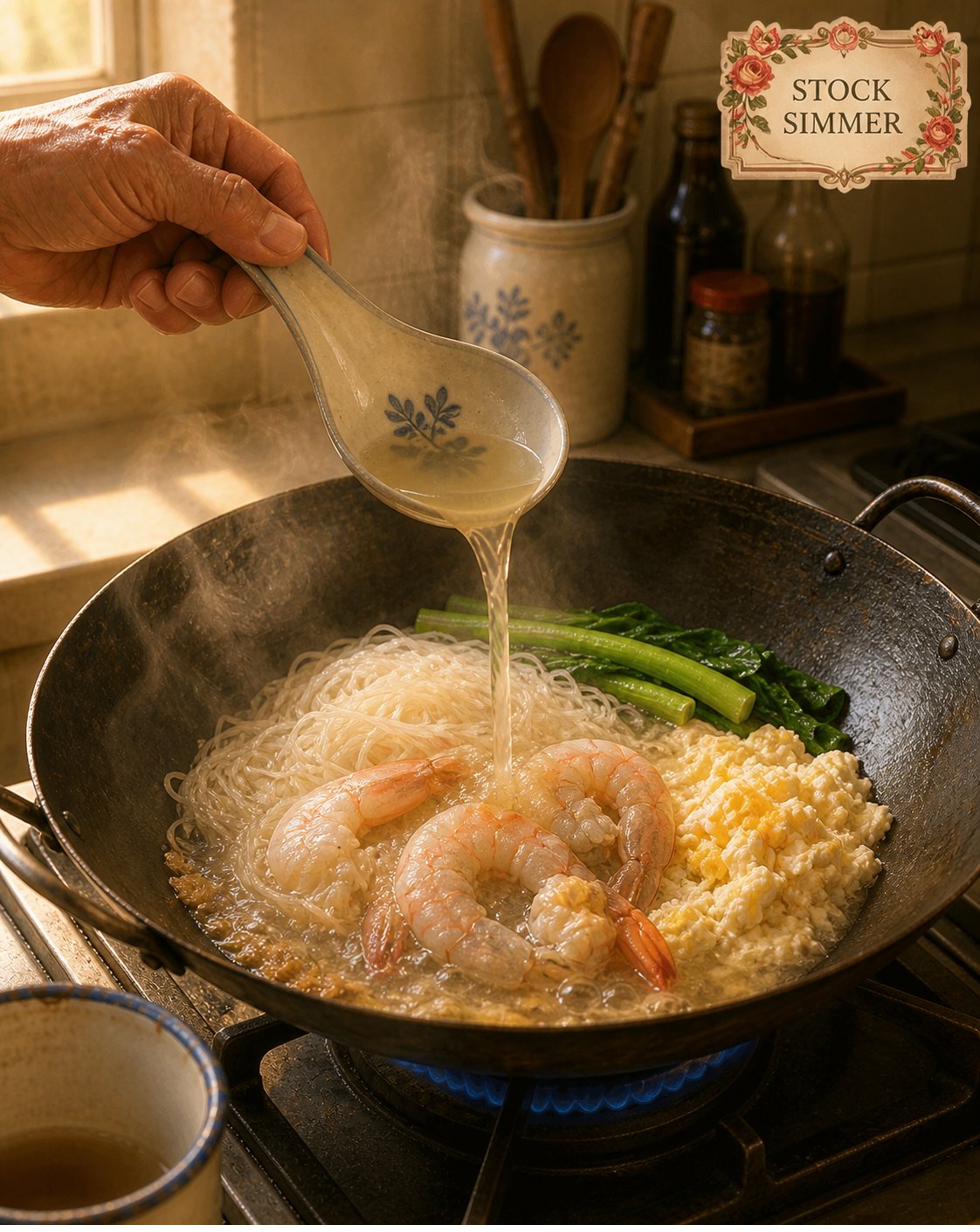
Bee Hoon Soak and Seafood Prep 10 min active, parallel with stock
While the stock simmers (or holds at low simmer the morning of cooking):
- Soak the bee hoon in HOT-but-not-boiling water for 5-10 minutes until soft-and-pliable. Do NOT exceed 10 minutes. Drain thoroughly and set aside; rinse briefly under cold water to stop residual cooking and to remove excess starch.
- Devein the prawns: with a small sharp knife, slit shallowly along the back of each prawn and lift out the dark vein; rinse briefly under cold water and pat thoroughly dry with kitchen paper. Reserve the heads-and-shells from peeling for the stock if you have not used them already.
- Purge the lala clams: place the clams in a bowl of salted water (1 tbsp salt to 500ml water) for 30 minutes; the clams will spit out their sand. Drain and rinse; discard any clams that are open and do not close when tapped (these are dead and unsafe).
- Crack the eggs into a small bowl; lightly beat with chopsticks (do NOT whisk to homogeneity — heritage soft-scramble register wants visible white-and-yolk separation).
- Blanch the yu choy in boiling water for 30-45 seconds until bright-green-tender; lift out with a slotted spoon; refresh briefly in cold water; drain.
- Mince the garlic.
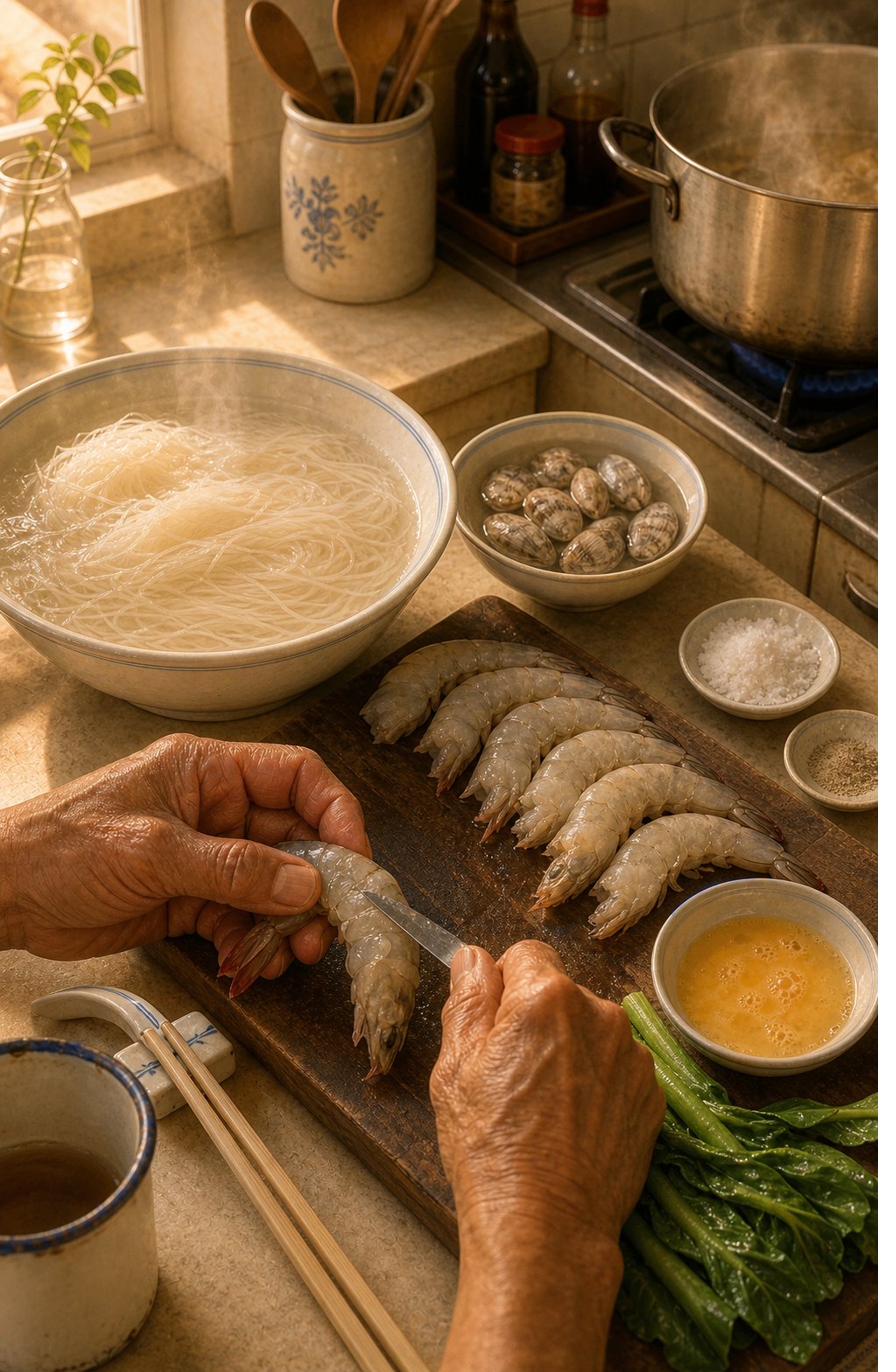
The Wok-Cook 5-7 min — the cartouche moment, STOCK SIMMER
Heritage Rule Three. Have everything ready beside the wok before you start — the wok-cook is fast and unforgiving of mid-cook ingredient-search.
- Heat the wok over medium-high heat until a drop of water evaporates within 2 seconds of contact (heritage Singapore-Hokkien wok-test).
- Add 2 tbsp neutral oil and swirl to coat. Add the minced garlic and stir-fry 15-20 seconds until pale-golden-fragrant. Do NOT brown the garlic — burnt garlic ruins the dish.
- Push the garlic to one side; add the lightly-beaten eggs. Let the eggs set undisturbed for 20-30 seconds, then gently break up with a spatula into soft scramble — heritage 80%-cooked-still-soft register. Push the egg-scramble to the side.
- Add the prawns to the wok directly; stir 30-45 seconds until the prawns just start to turn pink at the edges (still mostly raw at the centre).
- Add the lala clams and stir briefly. Add the pre-soaked drained bee hoon to the wok, tossing to coat with the wok-oil-and-garlic; the bee hoon should now be on top of the prawns-and-clams-and-egg.
- Pour in 600ml of the heritage Sembawang white stock over the bee hoon; cover the wok with a lid and reduce heat to medium. Let the wok simmer-cook for 60-90 seconds — the bee hoon absorbs the stock; the lala clams open; the prawns finish cooking; the egg integrates.
- Uncover. The bee hoon should now be glossy-translucent-white, soft-but-still-distinctly-stranded, with about 1cm of stock still pooled in the wok base (heritage Sembawang wet-and-glossy register).
- Add the blanched yu choy. Toss gently to combine. Season with the ½ tsp fine sea salt and ¼ tsp ground white pepper. Discard any clams that did not open during the cook.
- Drizzle 1 tbsp heritage shallot-oil over the surface — heritage finishing flourish.
- Turn off the heat.
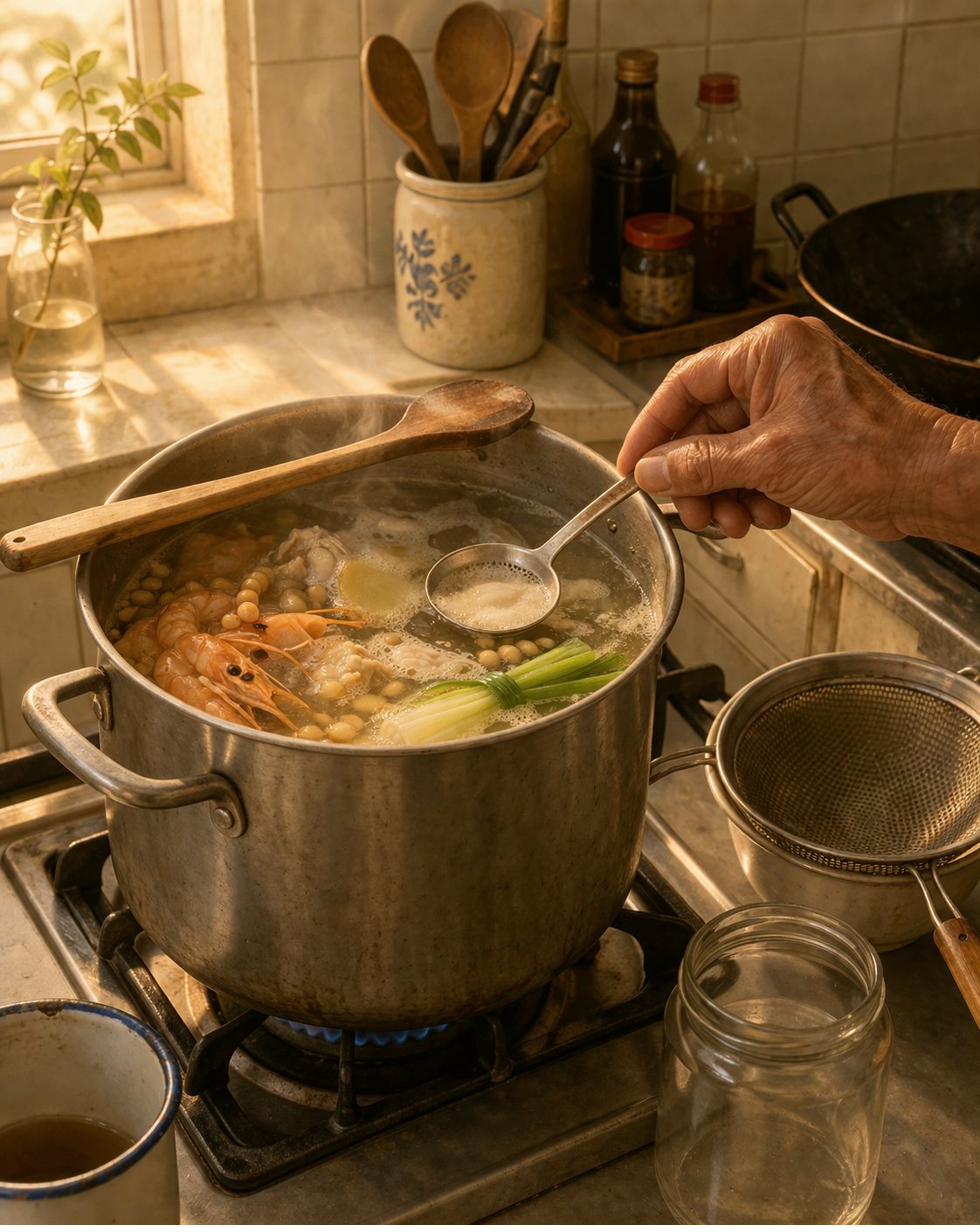
Plate and Serve 3 min — the book closes here
For each bowl:
- Tong a generous mound of the cooked bee hoon-and-stock into a heritage cream-and-pale-blue Singapore-everyday deep soup bowl.
- Top with prawns, lala clams, yu choy stalks (arrange the yu choy at one edge of the bowl for the heritage colour-relief register), and the soft scramble-egg mound at the centre.
- Scatter generously with crispy lard pieces (zhu you zha) across the top — heritage Sembawang signature.
- Place a small dish at the bowl's edge containing: a calamansi half (cut-side-up), 2-3 sliced pickled green chillies in light vinegar.
- Set on the workbench-table with a heritage Singapore-Hokkien ceramic soup spoon and a pair of pale-wood chopsticks on a small chopstick-rest.
- Serve immediately — heritage register is best within 5 minutes of plate-up; the bee hoon continues absorbing stock and gets drier-and-sticker the longer it waits.
🎯The Three Tips
Heritage. Master's. Mistake.
🏛 Heritage Note
From One Coffeeshop to a Singapore-Wide Register
Heritage Sembawang white bee hoon sits in a peculiar place in Singapore's hawker landscape — it is one of the few heritage dishes whose origin can be precisely attributed to a single coffeeshop and a single owner. You Huak Restaurant in Sembawang, established as a coffeeshop with a single white bee hoon stall, is documented across Singapore food-heritage canon as the originator of the wet-and-glossy seafood-and-stock form.
The form spread across Singapore's hawker scene through Soon Heng and other heritage-adopting stalls; it has now become a Singapore-wide Hokkien-and-Cantonese hawker dish; and in the home register it has converged with the everyday stir-fried bee hoon putih form (Form B) to the point that many younger Singaporeans use the names interchangeably. This kind of single-origin precision is rare in heritage Singapore-Malaysia hawker cooking, where most dishes have diffuse multi-stall origins and contested attributions. White bee hoon's specific lineage is part of its heritage character. The dish is what it is because You Huak's cook chose to leave the dark soy out and let the stock carry the dish.
👨🍳 Master's Tip
The Stock-Pour Moment
The single technique-anchor that separates a beginner's white bee hoon from a heritage one is the stock-pour moment — the instant the heritage Sembawang white stock meets the bee hoon-and-seafood in the hot wok. Heritage practice pours the stock generously enough that the bee hoon is fully submerged but NOT swimming — about 600ml of stock for 200g of bee hoon. Pour too little, and the bee hoon dries out. Pour too much, and the dish becomes a soup rather than a heritage Sembawang absorbed-stock register.
The visual signal: at the moment of stock-pour, the wok-content should sit JUST submerged, with the stock visibly bubbling around the bee hoon's outer strands; after the 60-90-second covered simmer-cook, about 1cm of stock should remain pooled in the wok base. That 1cm of remaining stock is the heritage Sembawang signature. It is not too dry, not too wet, glossy without being soupy. Hock Ko's heritage advice: measure your stock ladle the first three times you cook this. After that the eye learns the right level and the ladle becomes optional.
⚠ Common Mistake
Three Failure Modes
- Milky-white or yellow-only stock. The cook either boils the stock hard during the simmer (causing fat emulsification and milky cloudiness) or skips the prawn shells entirely (yielding a chicken-only stock that lacks heritage seafood-anchor). The bowl reads as Cantonese-style emulsion rather than heritage Sembawang clear-amber, OR as plain chicken-noodle soup. The fix: keep the simmer LOW for the full 90 minutes; toast the prawn shells before adding for deeper umami; if the stock has gone milky, strain through a coffee filter or muslin-cloth-lined sieve to recover clarity.
- Mushy or brittle bee hoon. The cook either over-soaks the bee hoon (more than 10 minutes in hot water, or accidentally boils it) producing mushy strands that disintegrate, OR under-soaks the bee hoon (less than 5 minutes, or in cold water) leaving brittle strands that refuse to absorb stock. The fix: soak in HOT-but-not-boiling water for exactly 5-10 minutes; drain thoroughly; rinse briefly under cold water; the bee hoon should be soft-and-pliable but distinctly al-dente, not cooked-through. If over-soaked, discard and start with fresh bee hoon.
- Dry-or-soupy wok finish. The cook either pours too little stock at the wok-cook stage (under 400ml for 200g bee hoon, leaving the dish dry) or too much (over 800ml, leaving the dish swimming). The fix: measure stock at 600ml for 200g of bee hoon; pour all in one go; check at the 60-second mark — if the wok looks dry, add another 100ml stock; if it looks soupy, uncover and let the stock reduce for 20 seconds before serving. The 1cm-of-stock-pooled-at-the-bottom rule is the heritage signature.
📈 Scaling for Hawker Service
The slow work loads onto the weekend; the fast work flows through the weeknights
Heritage You Huak / Soon Heng practice serves white bee hoon to-order in single-bowl batches — a single wok cooks a single bowl in 5-7 minutes. The stock is the bottleneck at scale, not the wok-cook; heritage Sembawang stalls run a 20-litre stockpot at continuous simmer through the day, replenishing with fresh bones-and-shells every few hours, and ladle stock from the pot directly into the wok at each order.
- Home double-batch: this recipe (200g bee hoon, 600ml stock) serves 2 bowls; double for 4 bowls. The wok handles up to 4 bowls' worth in a single cook before the wok becomes overcrowded and the bee hoon doesn't absorb evenly.
- Beyond 4 bowls: run sequential wok-cooks rather than scaling a single batch; this is how heritage stalls operate.
- Weekend stock-batch, weeknight wok-cook: The stock keeps refrigerated for 3 days and freezes well in 200ml portions. Heritage Singapore-home practice: make a large stock batch on the weekend, freeze in single-bowl portions, wok-cook fresh during the week.
Once the stock is made, the dish is fast forever. This is what makes heritage Sembawang white bee hoon a home-cook-friendly heritage dish despite its heritage 90-minute stock-build.
Tomorrow there is breakfast to make.