Pong Pong Prawns
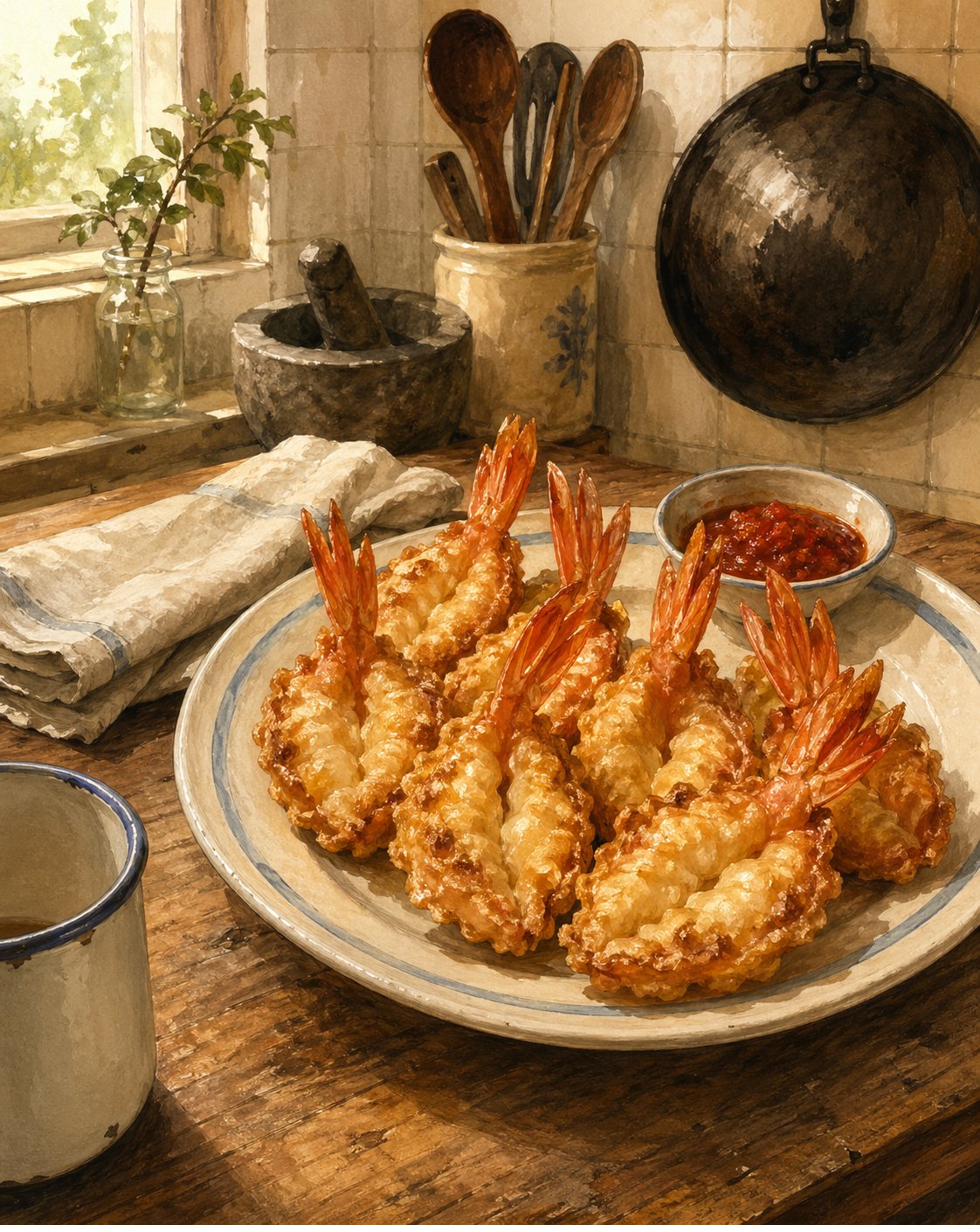
The Bonus Table is for the dishes that wouldn't fit. Some are orphans — the side-dish that lives at someone else's stall but never gets its own page. Some are sources — the foundation-recipes that show up in five other dishes but never get taught. Some are home-tables — the dishes I cook at home, for my family, that never made it to the hawker stall because they belong in the home. Pong pong prawns are home-table. My daughter asks for them when she opens her tiffin at school. I make them on Saturday mornings. The tail must stay dry. That is the only rule that matters.
Pong pong prawns — also called phoenix-tail prawns (鳳尾蝦, fèng wěi xiā), fantail shrimp, crispy batter prawns, bubble prawns, prawn puffs — are the heritage Chinese deep-fried-battered-prawn dish in which the prawn body is shelled and butterflied while the tail-fan is left fully ON and INTACT. (Source note: the multi-name register is documented across heritage Chinese home-cooking sources, Cantonese-American restaurant tradition, and Singapore home-kitchen blogs. The names are interchangeable; the dish is one.) The dish is the chapter's opening because it is the dish Hock Ko cooks first on most weekend mornings — the home-table register that defines Chapter Nine.
A note on heritage worth establishing carefully. The phoenix-tail-prawn form is pan-Chinese, not Cantonese-exclusive, and its origin is contested across multiple regional cuisines. Reportedly the dish appears in late-Qing / early-Republican Jinling (Nanjing) cuisine — the prawn-shell-removed-from-the-upper-half-only stir-fried form, where the contrast between the white body and the red tail-fan resembled the flowing feathers of a phoenix's tail and gave the dish its elegant name. Reportedly the deep-fried-battered form — the form Hock Ko cooks — is more strongly associated with Anhui cuisine and with the Cantonese-restaurant adaptation that travelled overseas as "fantail shrimp" on mid-twentieth-century Cantonese-American Pu Pu platters. (Synthesis note: heritage sources disagree on whether the original phoenix-tail prawn was the Jinling stir-fried-shelled-half form or the Anhui deep-fried-battered form. Both forms exist; both are historical; both use the tail-fan-on signature. The Singapore home-kitchen form descends from the Cantonese-restaurant deep-fried-battered version, which is what Hock Ko cooks below.)
A note on naming. Pong pong is Singapore-Cantonese-English vernacular, an onomatopoeia for the puff the batter makes when the prawn hits the hot oil — pong pong, the sound of bubbles erupting and the batter setting into its puffed crust. (Synthesis note: the pong pong name is colloquial Singapore home-kitchen register; it is not a heritage Mandarin or Cantonese term. The formal heritage names are 鳳尾蝦 / fèng wěi xiā / phoenix-tail prawn.) The vernacular name is what most Singapore households call the dish; the heritage name is what cookbooks call it. Hock Ko uses both, and treats the names as the same dish.
A second note on parallel forms. The phoenix-tail / pong pong prawn form (Form A — the form below) is the Cantonese-banquet-and-home-kitchen register: each prawn is its own fritter, the tail held proud, the body butterflied and battered. A parallel form exists — the heritage Hainanese-curry-rice prawn fritter (Form B), reportedly known as hae piah or cucur udang — a flat round batter-disc with a single peeled prawn pressed into the surface as the disc cooks. The disc is the fritter; the prawn is the inclusion. The two forms share the deep-fried-battered-prawn family identity but are different dishes and serve different functions. See Recipe 18 — Hainanese Curry Rice — for the ecosystem in which Form B lives. Hock Ko's daughter prefers Form A, which is why this is the recipe.
The dish has THREE heritage technical-discipline rules. Each one is non-negotiable, and each one prevents a specific failure-mode.
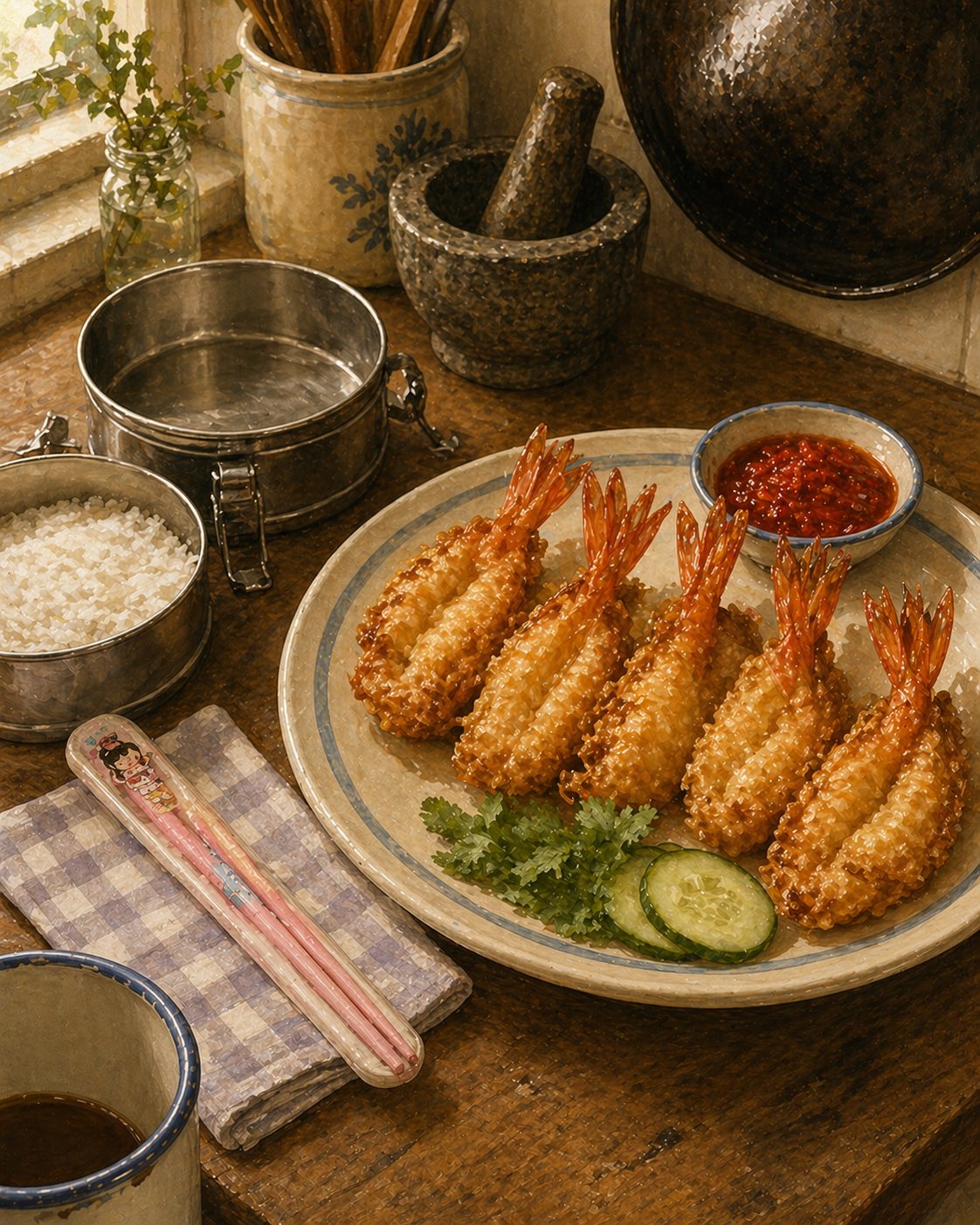
Rule one — leave the tail-fan ON, INTACT, and DRY through every step. Heritage Cantonese-banquet practice removes the body shell from the head-end down to (but NOT including) the last tail segment — the segment-and-fan stays fully ON. The body is butterflied open along the belly, salt-rubbed, dredged in dry cornstarch, dipped in batter — but the tail-fan is held by hand throughout, kept dry of dredge and dry of batter, and at the moment the prawn is lowered into hot oil, the tail-fan stays held above the oil surface, dry and proud. The failure-mode prevented: a tail submerged or battered cooks into a curled-and-burned char-stub, loses its bright orange-pink colour, and forfeits both the visual signature and the technical name of the dish. The phoenix has no tail.
Rule two — ice-cold batter, rested 30 minutes, applied at the moment of frying. Heritage practice mixes cornstarch + plain flour + a pinch of baking powder + ice-cold water into a thick-but-pourable batter, rests the batter 30 minutes in the refrigerator (the gluten relaxes, the cornstarch hydrates, the cold suppresses oil-absorption when the prawn hits the wok), and applies the batter to the dredged prawn IMMEDIATELY before it goes into the oil. The failure-mode prevented: warm-or-fresh batter absorbs more oil and produces a greasy heavy crust; un-rested batter produces a tough chewy crust because the gluten hasn't relaxed.
Rule three — oil at 170°C, two-stage frying, drain on rack NOT paper. Heritage practice heats neutral oil to 170°C — verified by the chopstick test: a wooden chopstick dipped vertically into the oil should produce fine vigorous bubbles around the tip but NOT large rolling boils. The prawn goes in, bubbles erupt, the batter sets and puffs in 60-90 seconds — Hock Ko then lifts the prawn out, lets the oil rebound to temperature for 30 seconds, and returns the prawn for a 20-second second fry to lock the crust into its permanent crispness. Drain on a wire rack over a sheet tray, NOT on kitchen paper — paper traps steam against the underside and softens the crust within minutes. The failure-mode prevented: under-temperature oil produces greasy soggy crust; single-fry produces crust that softens within 30 minutes; paper-drained prawns soften from below and lose half their crispness before they reach the table.
Two final notes worth establishing. The prawn size matters. Heritage practice uses medium-to-large prawns, around 16-20 per kilogram. Smaller prawns disappear into the batter; larger prawns over-batter and the body cooks unevenly before the batter sets. The auspicious-symbol register. Reportedly the dish carries the heritage Cantonese pun on 蝦 (hā, prawn) and 哈 (hā, the sound of laughter) — eating prawns brings laughter; phoenix-tail prawns at Chinese New Year double the auspicious symbol (phoenix + laughter). Hock Ko cooks them on Saturday mornings rather than CNY because the auspicious register is for festivals; the home-table register is for daughters with school lunches.
This is the dish that opens the Bonus Table because it is the dish I made for my daughter the morning I knew Chapter Nine was the right name for the chapter. The book begins to close here. The tail must stay dry.
🛒Ingredients
Three rules. The tail must stay dry.
For the Prawns
| Fresh medium-to-large prawns (size 16/20) | 12-16 prawns (≈500g) | Heads-on-shell-on at purchase. Heritage Singapore wet-market practice: select prawns with clear unclouded eyes, firm bodies, intact shells, and a clean sea-smell — no ammonia. Tiger prawns or king prawns are heritage-traditional; whatever is fresh that morning is acceptable. |
| Fine sea salt | 1 tsp | For the salt-rub before dredging. Heritage practice uses sea salt rather than table salt for cleaner mineral character. |
| Ground white pepper | ½ tsp | Heritage Cantonese white-pepper register — NOT black pepper, which would visibly speck the white batter. |
| Shaoxing wine optional, heritage register | 1 tsp | For the marinade. Heritage Cantonese-banquet practice; some Singapore home cooks skip this. Hock Ko includes it. |
For the Cornstarch Dredge
| Cornstarch | 4 tbsp | Spread on a flat plate for dredging the salt-rubbed prawns before batter. The dredge is the heritage discipline that helps the batter ADHERE to the prawn rather than slide off in the oil. |
For the Heritage Cold-Rested Batter
| Cornstarch | 80g | Half of the dry-flour weight. The cornstarch is what produces the heritage craggy-crispy crust register; it does not develop gluten and stays light. |
| Plain flour | 80g | The other half. Provides body and a thin gluten-network for batter cohesion. |
| Baking powder | ½ tsp | Produces the puff. Heritage Singapore home-kitchen quantity — enough for visible bubble-eruption when the prawn hits the oil; not so much that the batter tastes alkaline. |
| Fine sea salt | ½ tsp | Seasons the batter itself; heritage discipline. |
| Ice-cold water | 220ml | MUST be ice-cold, refrigerated minimum 30 minutes before mixing. Heritage discipline — see Rule Two. |
| Neutral oil for batter | 1 tbsp | Stirred into the rested batter just before frying — produces a slightly crisper crust and helps the batter release from the wooden chopstick when the prawn is lowered. |
For Frying
| Neutral oil for deep-frying (rice-bran, peanut, or refined groundnut) | 1 litre (4 cups) | Enough to fully submerge the prawn body while keeping the tail-fan above the oil — this is the depth-rule that supports Rule One. Heritage Singapore home practice uses a deep cast-iron wok; a deep saucepan also works. |
For Service
| Sambal-chilli dipping sauce | 4-6 tbsp | Heritage Singapore home-table register — bright-red sambal with belacan base. See Recipe 43 for Hock Ko's heritage sambal belacan; commercial sambal is acceptable. Cantonese-banquet alternative: sweet-chilli sauce. |
| Cucumber | 1 small (sliced) | Heritage home-plate garnish. |
| Coriander or curry-leaf sprigs | a few | Heritage home-plate garnish. |
🌶️Shifu's Lift
choose one path- Old-school path: Mix the batter from cornstarch + plain flour + baking powder + ice-cold water with a wooden chopstick — heritage Singapore home-kitchen tool that aerates more gently than a whisk and produces a smoother batter — rest 30 minutes in the refrigerator, and stir in the neutral oil only at the moment of frying.
- Modern hawker path: Replace the cornstarch + plain flour + baking powder mix with commercial Singaporean tempura-style flour or self-raising flour at 1:1 with cornstarch — the convenience-form delivers ~85% of the heritage register. Acceptable for weeknight pace; heritage register is fully delivered only by the from-scratch form.
- Heritage purist path: Add 1 tsp finely-minced dried shrimp (hae bee) to the batter for a heritage-Singapore-pong-pong-prawn umami amplification. Reportedly this is the form Hock Ko's mother-in-law made; Hock Ko sometimes does it for adults but skips it for his daughter's tiffin because her school discourages strong shrimp aromas in lunchboxes.
👨🍳Method
Four stages. Butterfly, batter, fry, plate. The tail-pinch is the whole dish.
Butterfly and Tail-Fan Prep 10 min
Lay the prawns out on a wooden chopping board. Working one at a time:
- Pull off the head with a clean twist. Reserve heads for stock — see Recipe 5 (Hae Mee) and Recipe 31 (Foochow Fishball Soup) for the prawn-head-stock heritage.
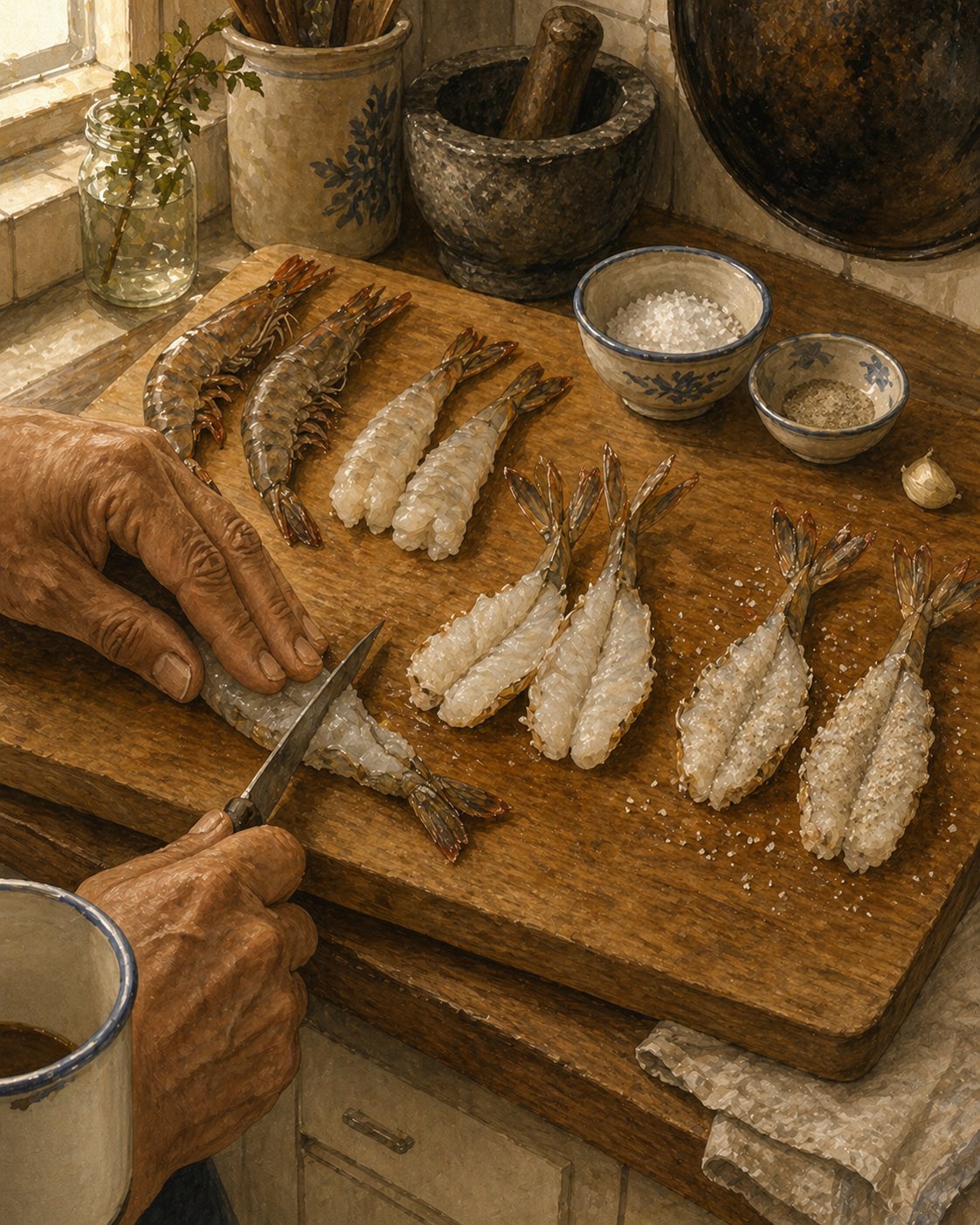
- Peel the body shell carefully from the head-end, working segment by segment toward the tail — but STOP at the last tail segment. The last segment AND the tail-fan stay fully ON, intact and unbroken. This is the heritage handle for the entire dish.
- Devein by making a shallow slit along the back (dorsal side) and lifting out the dark vein; rinse briefly under cold water and pat thoroughly dry with kitchen paper. The body must be DRY before salt-rub or the salt won't adhere.
- Butterfly the body by laying the prawn on its side and making a deep slit along the BELLY (ventral side, NOT the back) — slit through the body deeply enough to let the prawn open into a flat butterflied shape, but NOT through the dorsal side, which keeps the two halves hinged. Heritage practice scrapes the tail-shell lightly with a knife-back to remove any liquid trapped inside the tail — the sushi-chef technique that prevents oil-spitting when the prawn hits the wok.
- Salt-rub with the fine sea salt, ground white pepper, and Shaoxing wine (if using); let rest 5 minutes while you prepare the batter.
Heritage Cold-Rested Batter 5 min active + 30 min rest
In a medium mixing bowl, sift together the cornstarch, plain flour, baking powder, and fine sea salt. Make a well in the centre. Pour in the ice-cold water gradually, stirring with a wooden chopstick — heritage Singapore home-kitchen tool — until you have a thick-but-pourable batter (the consistency of single cream). The batter should coat the back of the chopstick when lifted, and drip back in a slow ribbon.
Rest the batter in the refrigerator for 30 minutes minimum. Do not skip this step — heritage Rule Two. The gluten relaxes, the cornstarch hydrates, the cold suppresses oil absorption.
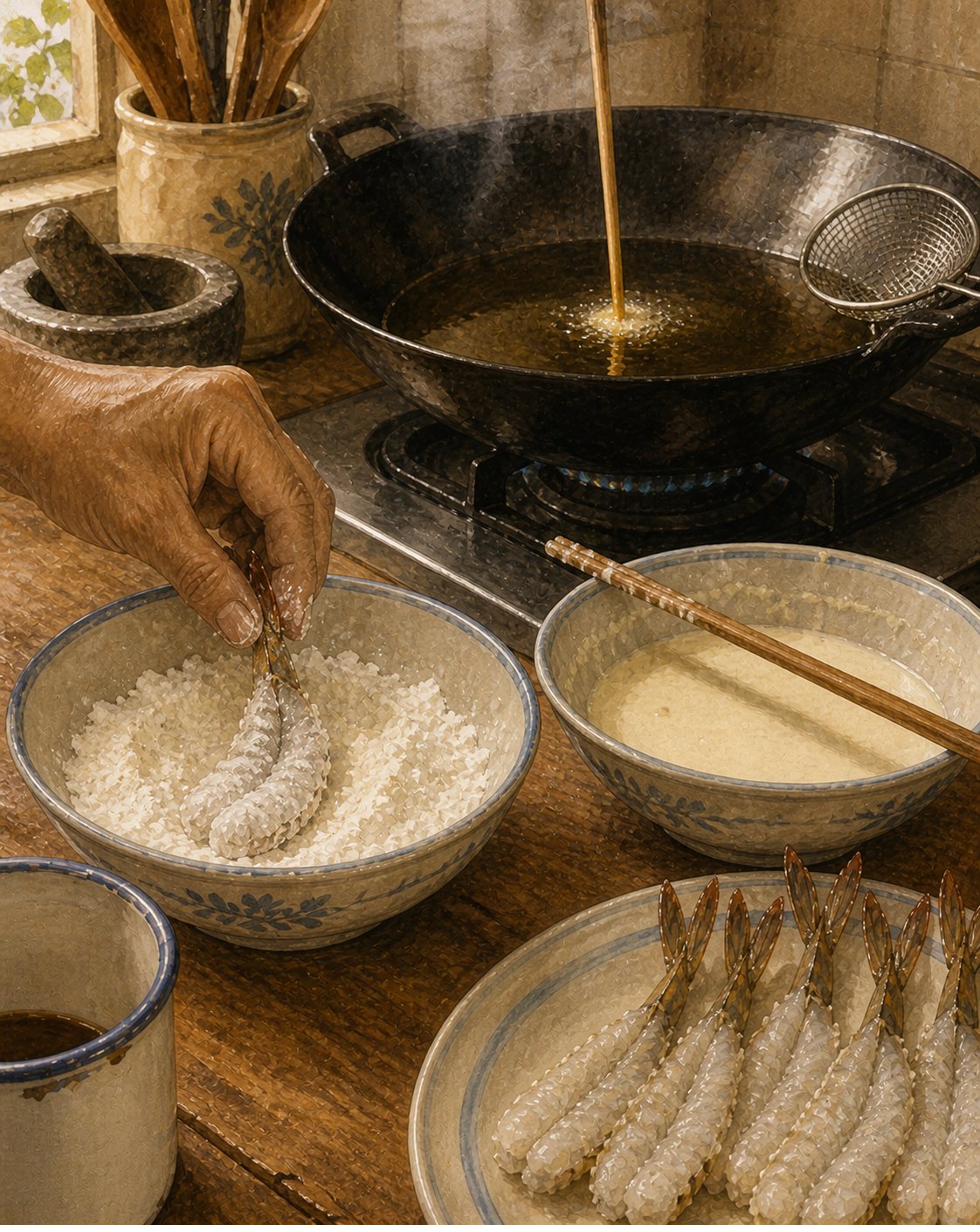
While the batter rests, spread the cornstarch dredge on a flat plate. Set the rested salt-rubbed prawns beside the dredge plate. Position the wok over the gas stove with the deep-frying oil. Do NOT heat the oil yet.
Oil-Test, Dredge, Batter, Fry the cartouche moment — TAIL FAN
Heat the deep-frying oil over medium-high heat to 170°C. Verify with the heritage chopstick test: dip a clean dry wooden chopstick vertically into the oil — the oil is at temperature when fine vigorous bubbles erupt around the tip but NOT large rolling boils. If the bubbles are sluggish, the oil is below 170°C and the batter will absorb too much oil. If the bubbles are violent and the chopstick smokes, the oil is above 180°C and the batter will burn before the prawn cooks through.
Stir the rested batter gently with the wooden chopstick. Stir in the 1 tbsp neutral oil now (heritage discipline — see Rule Two). The batter is ready.
The choreography for each prawn is exact:
- Hold the prawn by the tail-fan between thumb and forefinger of one hand. The tail-fan stays in your fingers throughout — never released until the prawn is in the oil.
- Dredge the body in the cornstarch — body face-down, then face-up, then a gentle shake to drop excess. The tail-fan stays held UP and OUT of the dredge, dry.
- Dip the body in the batter — body face-down, lift, let excess drip back into the bowl, body face-up, lift, let drip. The batter coats the body in a thin clinging layer. The tail-fan stays held UP and OUT of the batter, dry.
- Lower the prawn body-first into the hot oil, keeping the tail-fan held above the oil surface — held up in your fingers, dry and proud above the rising oil-shimmer. The body submerges; the tail-fan does not.
- Hold for 3-4 seconds as the batter sets around the body and the prawn floats. Then release the tail-fan. The prawn now floats in the oil, body submerged, tail-fan held proud above the surface by its own buoyancy — this is the heritage signature of phoenix-tail.
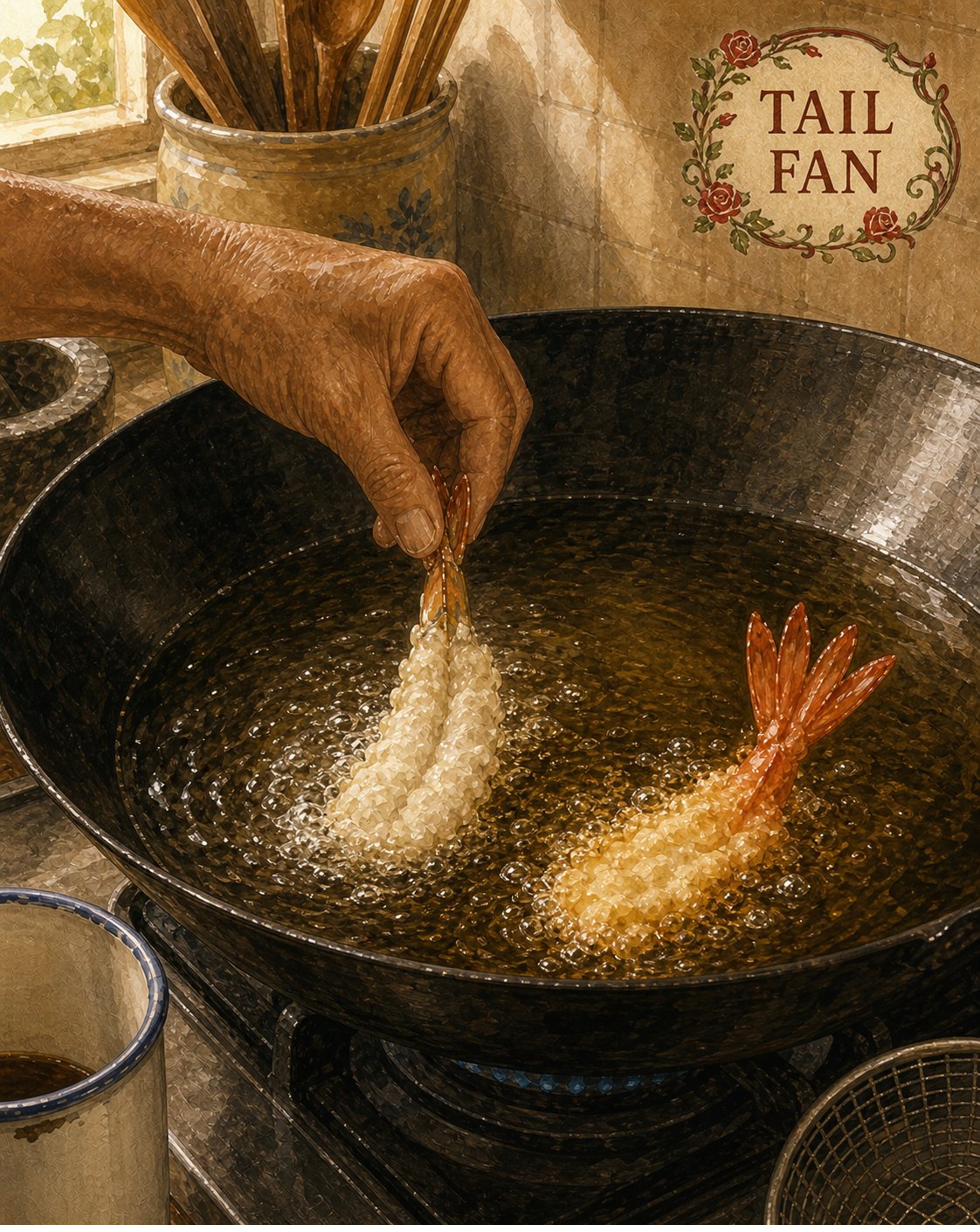
Cook in batches of 3-4 prawns at a time — never crowd the wok, or the oil temperature drops and the batter goes greasy.
Fry for 60-90 seconds, turning gently with a long wooden chopstick or a wire-mesh strainer once, until the batter is light golden and the prawn body has visibly puffed. Lift out with the strainer, drain over the wok for a few seconds, and place on a wire rack over a sheet tray. Let the oil rebound to 170°C (verify with the chopstick test) — about 30 seconds between batches.
The heritage two-stage fry — Rule Three: when all prawns have been fried once and rested on the rack for 2-3 minutes, return them to the oil at 170°C for a second 20-second fry, in batches. The crust seizes into its permanent puffed-and-craggy form — this is what makes the prawn travel-resistant for the tiffin.
Drain a final time on the wire rack. Serve immediately, OR pack into a tiffin within 5 minutes of the second fry while the crust is still at peak crispness.
Plate and Serve 5 min
Arrange the prawns in a fan on a cream-and-pale-blue dinner plate, tail-fans held proud and upward — the heritage visual signature must be visible in the plating. Place a small bowl of sambal-chilli at the upper-right of the plate. Garnish with a wedge of cucumber and a sprig of coriander or curry-leaf at the plate edge. Serve immediately, with rice or as part of a Saturday-morning home-table.
🎯The Three Tips
Heritage. Master's. Mistake.
🏛 Heritage Note
The Banquet Becomes the Tiffin
The heritage Cantonese-banquet phoenix-tail prawn was historically a banquet-display dish — the proud upright tail-fans on the platter were a visual flourish that signalled the host's care, the chef's discipline, and the auspicious hā = laughter pun. The Singapore home-kitchen form descends from the Cantonese-restaurant adaptation that travelled overseas as "fantail shrimp" on mid-twentieth-century Pu Pu platters and returned to Singapore as a home-table item.
The transformation from banquet-display to home-table is a quiet one: the technique survived intact (tail-on-tail-dry, cold-rested batter, two-stage fry); the register relaxed (cream-and-pale-blue plate instead of carved jade platter; sambal-chilli instead of sweet-and-sour Cantonese sauce; daughter's tiffin instead of round banquet table). The dish carried its discipline forward and let the occasion become whatever the family needed it to be on a Saturday morning.
👨🍳 Master's Tip
The Tail-Pinch Stays Steady
The single technique-anchor that separates a careful home-cook from a hurried one is the steadiness of the tail-pinch through the entire frying choreography. Hold the tail-fan firmly enough that it does not slip from your fingers during the dredge, the batter dip, and the lower-into-oil — but gently enough that you do not crush the fan or pull it from the body.
Heritage Cantonese-restaurant practice uses the right-hand thumb-and-forefinger pinch on the tail-fan with the body hanging downward below, fully relaxed — let gravity do the body-coating work; let your fingers do the tail-protection work. If your tail-pinch is tense, the prawn body twists and the batter applies unevenly. If your tail-pinch is loose, the tail submerges in the oil and the dish fails Rule One.
⚠ Common Mistake
Three Failure Modes
The three failure modes correspond exactly to the three rules.
- The tail submerged. The cook releases the tail-fan too early, or holds the prawn at the wrong angle, and the tail-fan dips into the oil. Within 5 seconds, the bright orange-pink darkens to charred-brown, the fan curls inward, and the prawn loses its phoenix register. The fix: hold the tail-pinch firm for the full 3-4 seconds of body-immersion; release only when the batter has visibly set and the body floats by its own buoyancy.
- Greasy heavy crust. The cook skips the batter rest, or uses room-temperature water instead of ice-cold, and the batter absorbs oil from the moment of contact. The finished prawn looks dull-yellow rather than light-golden, feels heavy in the hand, and tastes oily rather than crisp. The fix: rest the batter 30 minutes minimum in the refrigerator; ice-cold water only; stir the 1 tbsp neutral oil into the batter ONLY at the moment of frying.
- Soft-by-lunchtime crust. The cook does the single fry only, drains on kitchen paper, packs the tiffin within minutes of the fry. The crust softens within 30 minutes from below (paper-trapped steam) and from within (un-locked crust structure). The fix: the heritage two-stage fry locks the crust; drain on a wire rack over a sheet tray, NEVER on paper; let the second-fry prawns rest 5 minutes on the rack before tiffin-packing.
📈 Scaling for Hawker Service
The dish is a home-table dish; Hock Ko did not sell it at his stall
Reportedly a few Singapore Cantonese-banquet restaurants and zi-char stalls do offer phoenix-tail prawns as a banquet dish — the technique scales to commercial volume by running parallel batter-dredge-fry stations with two cooks, but the per-prawn handling time (the tail-pinch discipline) is the bottleneck and the dish does not become a high-volume hawker item. The home-table register is its natural register.
- Family-meal scale-up: triple the recipe (36-48 prawns, 1.5 kg) and run the two-stage fry in 6-8 batches; the second fry can be done in sequence after all prawns have been single-fried and rested.
- Tiffin form: the heritage Singapore working-parent-and-school-child register; pack within 5 minutes of the second fry while the crust is still at peak crispness.
- Family-table form: the Saturday-morning Cantonese-home-cooking register; serve immediately on a cream-and-pale-blue plate with rice and sambal.
Both are home-tables. Both are why the chapter is called what it is.
When my daughter opens her tiffin at school, the tail-fan tells her who packed her lunch. That is what the rule is for.