Mee Hoon Kueh
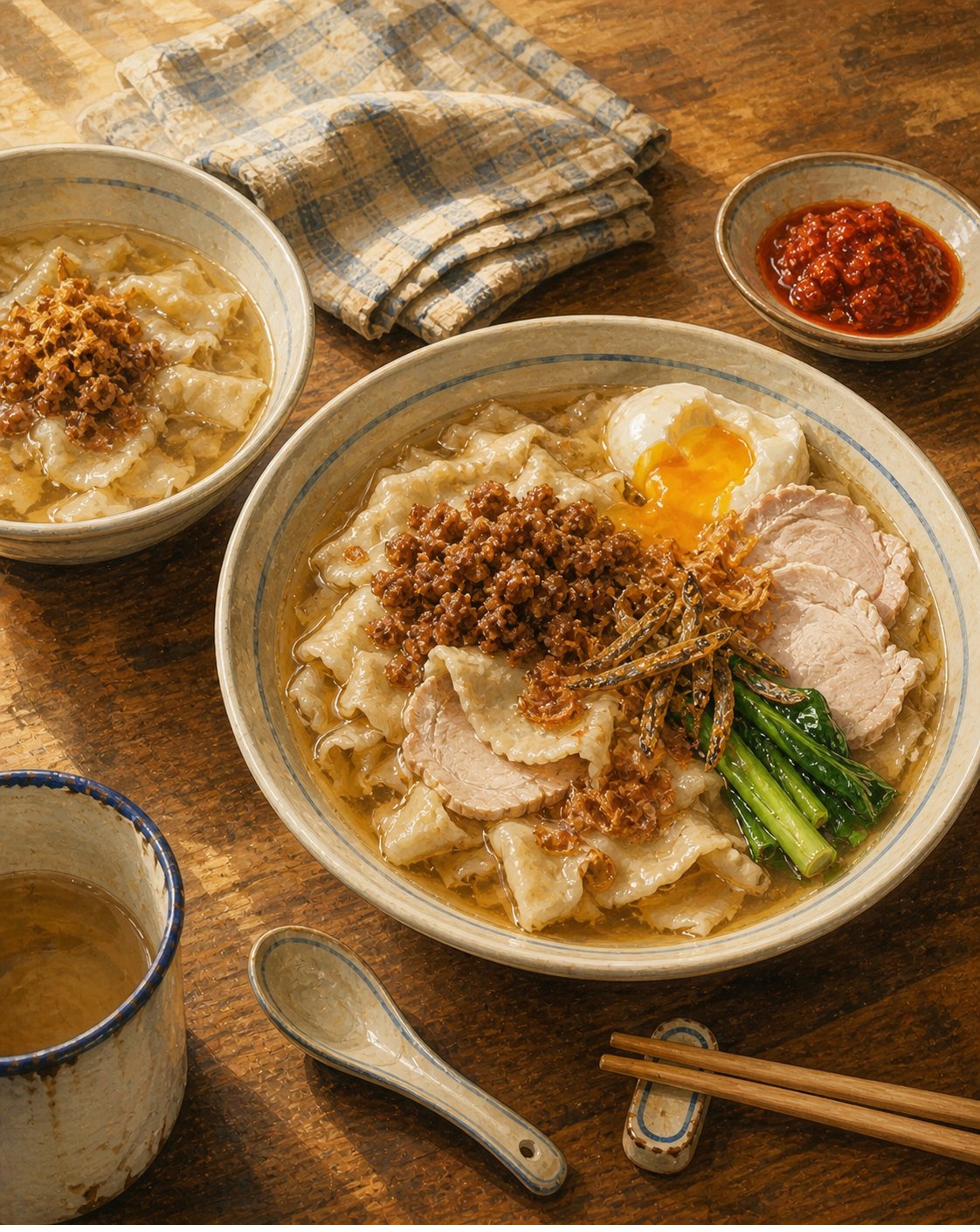
This is the bowl I make on weeknights. The kind of evening where you have come home from the wet market or the stall or wherever, and the family is hungry, and you have an hour to put something in front of them that tastes like it took longer. The dough rests while you fry the shallots. The broth simmers while you knead. Everyone tears their own pieces if they want to — the children think it is a game. By the time the noodles float, the bowls are warm, and the working day has stopped following you home.
Mee hoon kueh — 麵粉粿, miàn fěn guǒ in Mandarin, mee hoon kueh in Hokkien — is the heritage Hokkien hand-torn wheat-flour-cake noodle dish. Mee hoon means wheat flour (Hokkien); kueh (also rendered kway) means cake. The literal heritage name is wheat-flour-cake — the dough is rolled or pinched flat, hand-torn into bite-size irregular pieces, and dropped into a savoury anchovy-and-pork-bone broth to cook through. The dish is the chapter's weeknight register — the home-table form of a discipline that lives at hawker stalls but belongs in homes.
A note on heritage worth establishing carefully. Mee hoon kueh sits at a complicated dialect-and-form intersection. Three parallel forms exist; all three are heritage; all three are real.
Form A — Mee hoon kueh (麵粉粿, Hokkien hand-torn). The form below. Heritage Hokkien practice rolls or pinches the rested dough flat, then hand-tears irregular bite-size flat pieces directly into the simmering broth. The signature is the irregularity — each piece is a different shape, a different thickness; some pieces are slightly translucent at the edges, some thicker in the middle. Reportedly the Hokkien hand-tear technique descends from heritage Fujian wheat-flour-cake practice that travelled to Singapore and Penang with the Hokkien migrations of the 1830s-1930s.
Form B — Pan mee (板麵, Hakka board-cut). A parallel heritage form. Hakka practice rolls the rested dough into a flat sheet and board-cuts uniform flat strands using a wooden cutting block — pan = board, mee = noodle. The signature is the uniformity — even-width flat strands, all the same shape. (Source note: per Wikipedia, "the Hakka initially made the noodle by shaving off a dough, whilst the Hokkien would roll the dough into a flat piece then hand-tear into bite-size." The two forms are distinct heritage practices.) In Singapore, pan mee is the cousin form sold at the same stalls as mee hoon kueh, and many heritage stalls offer both.
Form C — Ban mian (Mandarin convergence umbrella). Modern Singapore-and-Malaysia hawker practice uses ban mian as the umbrella Mandarin term that covers both Form A (hand-torn) and Form B (board-cut), often serving both forms from the same stall and letting customers choose at order. (Synthesis note: heritage Singapore-Malaysia stall practice has merged the two heritage forms under the ban mian umbrella to the point that many younger eaters use the terms interchangeably; heritage cookbook practice maintains the distinction.) The recipe below gives Form A specifically, because that is the form Hock Ko's mother taught him, and the form he teaches his daughter.
The dish has THREE heritage technical-discipline rules. Each one is non-negotiable, and each one prevents a specific failure-mode.
Rule one — clear-amber broth, NOT milky-white emulsion. Heritage Hokkien-Singapore mee hoon kueh broth is built on dried ikan bilis (anchovies) and pork bones simmered together over low heat for at least 90 minutes, producing a clear pale-amber stock with crustacean-and-porcine umami balance. Reportedly the heritage Hokkien convergence point with Xiamen prawn-noodle traditions sits exactly here — the same anchovy-and-pork-bone foundation, the same clear-stock discipline. Heritage Hokkien stock practice keeps the soup CLEAR; the Cantonese-style milky-white emulsion is a separate dish family — see Recipe 12 (Wat Tan Hor) for the Cantonese emulsion register. The failure-mode prevented: a milky-white broth reads as Cantonese rather than heritage-Hokkien and loses the clear-amber visual signature that lets the irregular hand-torn pieces show through the broth like submerged stones.
Rule two — the dough must be SOFT-AND-PLIABLE, never firm-and-springy. Heritage Hokkien mee hoon kueh dough is mixed at a higher hydration than typical pasta dough — all-purpose flour + 1 large egg + 1 tsp salt + 1 tbsp neutral oil + 60-65% water by flour weight — and kneaded only until smooth-and-cohesive (8 minutes), then rested at least 1 hour so the gluten relaxes fully. The dough at the hand-tear stage must feel pinchable without resistance — if you have to pull hard against the dough, it is too dry or under-rested, and the torn pieces will be tough-and-chewy rather than silky-and-bouncy. The failure-mode prevented: tough-chewy noodle pieces that lose the heritage silky-bouncy texture and feel like under-cooked dumpling skin.
Rule three — tear pieces THIN and IRREGULAR, drop directly into rolling broth. Heritage Hokkien practice holds a fist-sized portion of rested dough in the non-dominant hand, pinches off thin flat pieces with thumb-and-forefinger of the dominant hand, stretches each piece thin between the fingers (about 1.5-2mm thickness, 4-5cm across, irregular flat shape), and drops it directly into the rolling broth to cook. The heritage signature is the visible thickness-variation across pieces in a single bowl — some pieces silky-thin and translucent at the edges, some thicker and chewy in the middle — and this variation IS the heritage register, NOT a fault. The failure-mode prevented: uniform-shape noodles that read as Hakka pan mee or modern machine-cut, and lose the heritage Hokkien hand-tear identity.
Two final notes. The heritage stall lineage matters. Heritage hand-torn mee hoon kueh stalls in Singapore include Seletar Sheng Mian Mee Hoon Kway (Toa Payoh Lor 8), which keeps the pure-bare-hand technique; Legacy Ban Mian (Boon Keng/Geylang, second-generation Tan cousins, opened May 2025); L32 Hand Made Noodles (Geylang Lor 32); and Bossi Ban Mian (Serangoon Garden Way). The lineage is shorter than that of Hainanese curry rice or hae mee — partly because mee hoon kueh has historically been a home dish first, a stall dish second.
The home-table register has a specific time-discipline. Heritage home practice rests the dough first (minimum 1 hour, ideally 2-3), then uses the rest-time to build the broth (90 minutes for ikan bilis-and-pork-bone) and prep the toppings. When the broth is ready and the dough has rested, the actual hand-tear-and-cook stage takes only 5-7 minutes. The dish reads to the eater as a slow-cooked weeknight bowl; the actual active hand-tear time is fast. This is the heritage Singapore home-cook intelligence: load the slow work into rest-and-simmer time, and let the fast work happen at the table.
This is the bowl I cook on weeknights because it is the bowl that asks me to do the right work in the right order. The dough rests; the broth simmers; the hands tear; the bowl arrives warm. The kitchen quietens. The working day stops following us home.
🛒Ingredients
Three rules. The dough rests. The broth simmers. The hands tear.
For the Heritage Anchovy-and-Pork-Bone Broth makes ~2.5 litres
| Pork bones (rib bones, neck bones, or marrow bones) | 800g | Heritage register; produces porcine sweetness without dominating. Heritage Singapore wet-market practice asks the butcher to chop the bones into 5cm pieces. |
| Dried ikan bilis (anchovies, head-on) | 100g | Heritage Singapore-Malay anchovy-stock foundation. Toast briefly in a dry pan before adding to the broth — this deepens the umami foundation. |
| Yellow onion (small) | 1, halved | Heritage aromatic. |
| Fresh ginger | 3 thick slices | Heritage Hokkien register; cuts the porcine richness. |
| Spring onion white | 2 stalks (knotted) | Heritage aromatic. |
| Dried shiitake mushroom | 4 medium (rehydrated, water reserved) | Soak in 200ml hot water for 30 min; both the mushrooms AND the soaking liquid go into the broth — the liquid is heritage flavour-anchor. |
| Water | 3 litres | Cold water at the start; heritage practice brings to slow boil and reduces. |
| Fine sea salt | to taste at end | Season AFTER the broth has reduced, not at the start — heritage discipline. |
For the Heritage Soft-Pliable Dough
| All-purpose plain flour | 400g | Heritage Hokkien register; bread flour is too high in gluten and will produce tough noodles. |
| Large egg | 1 | Heritage Singapore home-kitchen practice; produces richness and pale-yellow noodle colour. For vegetarian form, omit and increase water by 30ml. |
| Fine sea salt | 1 tsp | For dough seasoning. |
| Neutral oil | 1 tbsp | Heritage pliability anchor; the oil helps the dough hand-tear cleanly without sticking to fingers. |
| Water (room temperature) | 240-260ml | Heritage 60-65% hydration. Start at 240ml; add the rest gradually only if the dough feels dry. Hokkien-Singapore home register: the dough should feel soft-and-tacky-but-not-sticky. |
For the Toppings
| Minced pork | 300g | Heritage Singapore home-kitchen practice; alternatively sliced lean pork (200g) for the classic heritage form. Hock Ko makes both — minced for the daily register, sliced for special occasions. |
| Light soy sauce | 1 tbsp | Pork marinade. |
| Dark soy sauce | 1 tsp | For the caramel-brown register. |
| Oyster sauce | 1 tbsp | Heritage Singapore-home register. |
| Sesame oil | 1 tsp | Pork marinade. |
| Cornstarch | 1 tsp | Pork marinade — gives the heritage glossy-cling texture. |
| White pepper | ¼ tsp | Heritage Hokkien register, NOT black pepper. |
| Shallots, thinly sliced | 6 medium | For the fried-shallot heritage anchor — Hock Ko's mother fried them in advance and kept them in a clean dry jar; they hold for 2 weeks. The shallot-oil that remains is heritage gold; reserve and use to finish the bowls. |
| Fresh ikan bilis (or extra-large dried, head-on) | 80g | For pan-frying separately as the heritage crispy garnish. |
| Choy sum or sayur manis (ma ni cai) | 1 small bunch (200g) | Heritage Hokkien register prefers sayur manis for its faintly-bitter sweetness; choy sum is the accessible substitute. Cut into 4cm lengths. |
| Eggs (for soft-poached / onsen) | 4 | One per bowl, heritage Singapore-stall service signature. |
| Fresh prawns (medium, peeled-but-tail-on) | 4 | One per bowl, heritage Singapore home addition. Optional but Hock Ko includes them on Saturday-morning bowls. |
| Sambal-chilli for service | 4-6 tbsp | Heritage Singapore-home register; see Recipe 43 for Hock Ko's home sambal belacan. Commercial sambal acceptable. |
🌶️Shifu's Lift
choose one path- Old-school path: Build the broth from scratch with ikan bilis + pork bones over 90 minutes; hand-tear the dough from a fist-sized portion directly into the broth. This is the heritage register; this is what Hock Ko's mother taught him.
- Modern hawker path: Replace the from-scratch broth with a heritage-quality commercial Hokkien-style anchovy-and-pork stock paste at 1:1 dilution, simmered 15 minutes with fresh aromatics; hand-tear the dough as per heritage. The convenience-form delivers ~80% of the heritage broth-register; the noodle-form is unchanged.
- Heritage purist path: Soak the rested dough in cold water for 4-5 hours before tearing — the immersion removes some of the gluten and produces a SILKIER more-translucent noodle (heritage Penang Nyonya mee-hoon-kueh-and-pan-mee technique). The form is more delicate, more time-consuming, and produces a noodle closer to heritage Penang-stall texture.
👨🍳Method
Five stages. The slow work runs in parallel; the fast work happens at the table.
Heritage Anchovy-and-Pork-Bone Broth 15 min active + 90 min simmer
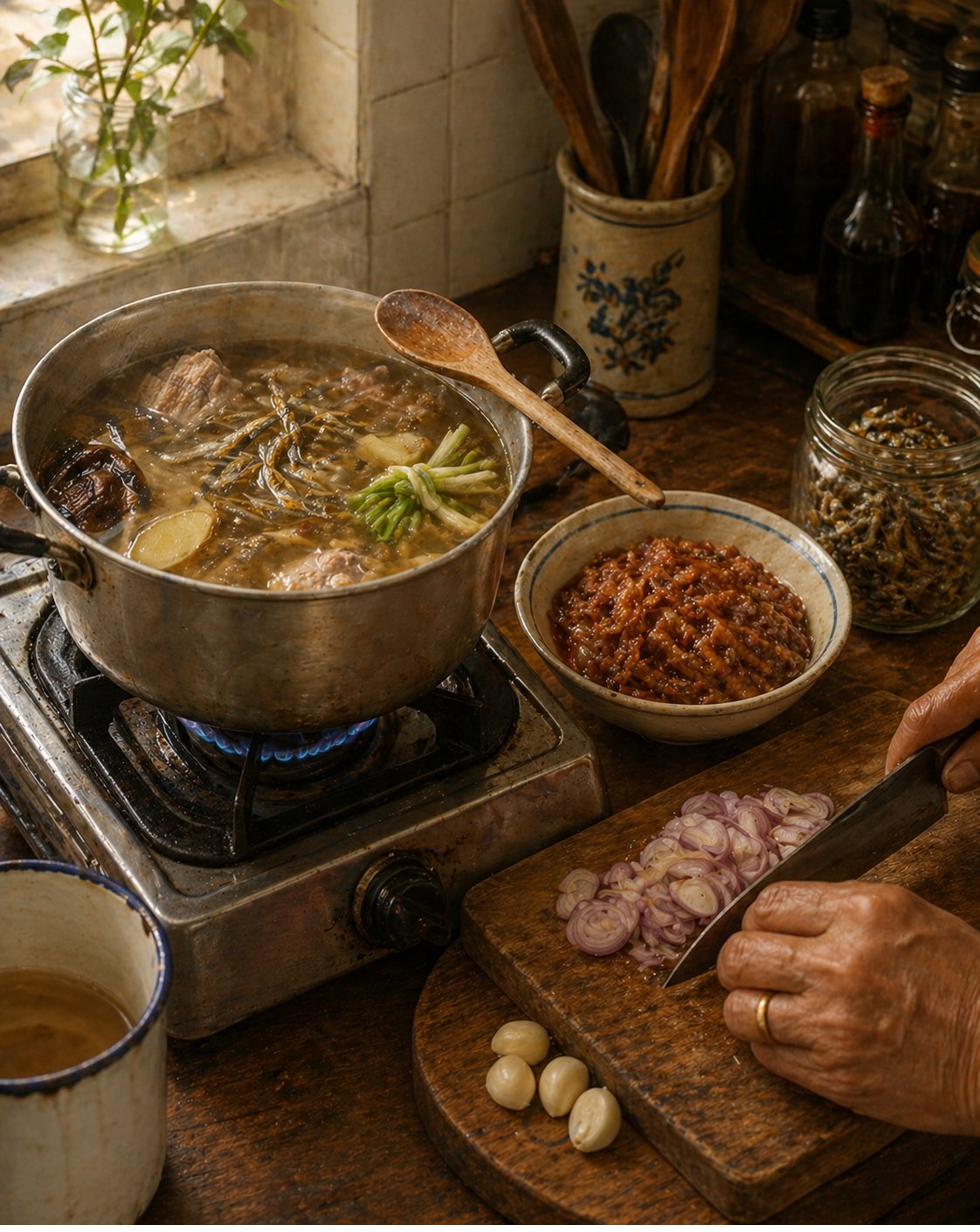
Start the broth FIRST — it must simmer for 90 minutes minimum, and the dough rest happens in parallel.
- Blanch the pork bones: bring a pot of water to a boil, add the bones, simmer 5 minutes (skim foam vigorously), drain, rinse the bones under cold water. Heritage discipline — this removes the surface scum that would otherwise cloud the broth.
- Toast the ikan bilis: in a dry pan over medium heat, toast the dried anchovies for 3-4 minutes, swirling, until fragrant and lightly golden. Heritage practice — toasting deepens the umami foundation.
- Build the broth: in a 4L stockpot, combine the blanched bones, toasted ikan bilis, yellow onion, ginger slices, knotted spring-onion white, rehydrated shiitake mushrooms AND their soaking liquid, and 3 litres cold water. Bring to a gentle boil over medium-high heat, then reduce to LOW SIMMER — heritage Rule One discipline. Simmer 90 minutes, uncovered, skimming any foam every 15-20 minutes. Do NOT boil hard — boiling hard emulsifies the fat and clouds the broth.
- Strain at the end: pour the broth through a fine-mesh strainer into a clean pot; reserve the bones for picking-meat-off if desired (the marrow is heritage cook's reward), discard the spent ikan bilis and aromatics. Season with fine sea salt to taste — heritage register is gently-seasoned, NOT aggressive.
- Hold the broth at low simmer until ready to cook the noodles.
Heritage Soft-Pliable Dough 15 min active + 1 hr rest
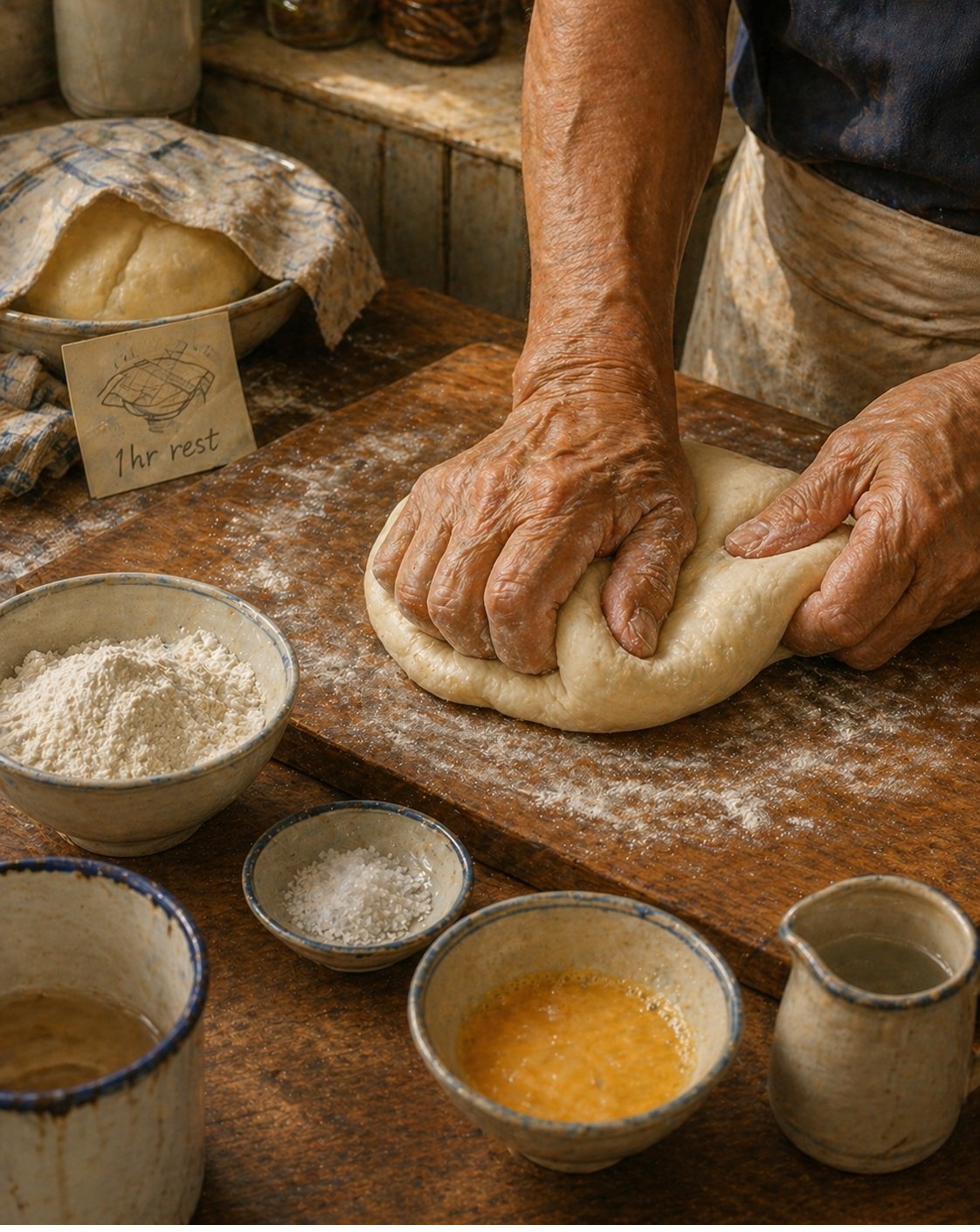
While the broth simmers, make the dough. The dough rest happens in parallel with the broth simmer; this is the heritage time-discipline.
- Mix dry: in a large bowl, whisk together the 400g all-purpose flour and 1 tsp fine sea salt.
- Mix wet: in a separate bowl, lightly beat the 1 large egg, then whisk in the 1 tbsp neutral oil and 240ml room-temperature water.
- Combine: pour the wet into the dry. Mix with chopsticks first, then transfer to the work surface and knead by hand. Add the remaining 20ml water gradually only if the dough feels dry — heritage hydration is soft-and-tacky-but-not-sticky.
- Knead 8 minutes until smooth and elastic. Heritage practice: pick the dough up and throw it down onto the work surface 10 times in between kneading rounds — the throwing helps develop elasticity faster than kneading alone (heritage Singapore home-kitchen technique).
- Rest at least 1 hour, covered with a damp cloth, at room temperature. The dough must rest fully — heritage Rule Two. If you need to wait longer, refrigerate the dough up to 24 hours and bring back to room temperature 1 hour before tearing.
Toppings Prep parallel with dough rest, 15 min
While the dough rests, prepare the toppings. Heritage Singapore home practice fries the shallots and ikan bilis FIRST and reserves them — the shallot-oil that remains is heritage gold and finishes the bowls.
- Marinate the minced pork: combine the 300g minced pork with 1 tbsp light soy + 1 tsp dark soy + 1 tbsp oyster sauce + 1 tsp sesame oil + 1 tsp cornstarch + ¼ tsp white pepper. Mix until cohesive. Cover and rest in the refrigerator at least 30 minutes.
- Fry the shallots: heat 4 tbsp neutral oil in a small pan over medium-low heat. Add the 6 thinly-sliced shallots. Fry slowly, stirring often, until light-golden-brown and crisp — about 8-10 minutes. Watch carefully; they go from golden to burnt in under a minute. Drain on a wire rack over paper, reserve the SHALLOT OIL in a clean jar (heritage gold).
- Fry the ikan bilis: in the same pan with the residual shallot oil over medium heat, fry the 80g ikan bilis until crisp and golden — about 2-3 minutes. Drain on the same rack.
- Cook the minced pork (just before serving): heat 1 tbsp shallot-oil in a wok over medium heat; add 2 cloves minced garlic, stir 10 seconds; add the marinated minced pork, break apart with a spatula, stir-fry 4-5 minutes until cooked-through and slightly caramelised. Set aside warm.
- Blanch the choy sum (just before serving): drop into the simmering broth for 30-45 seconds until bright-green-tender; lift out with a slotted spoon.
The Hand-Tear Cook 5-7 min — the dying art
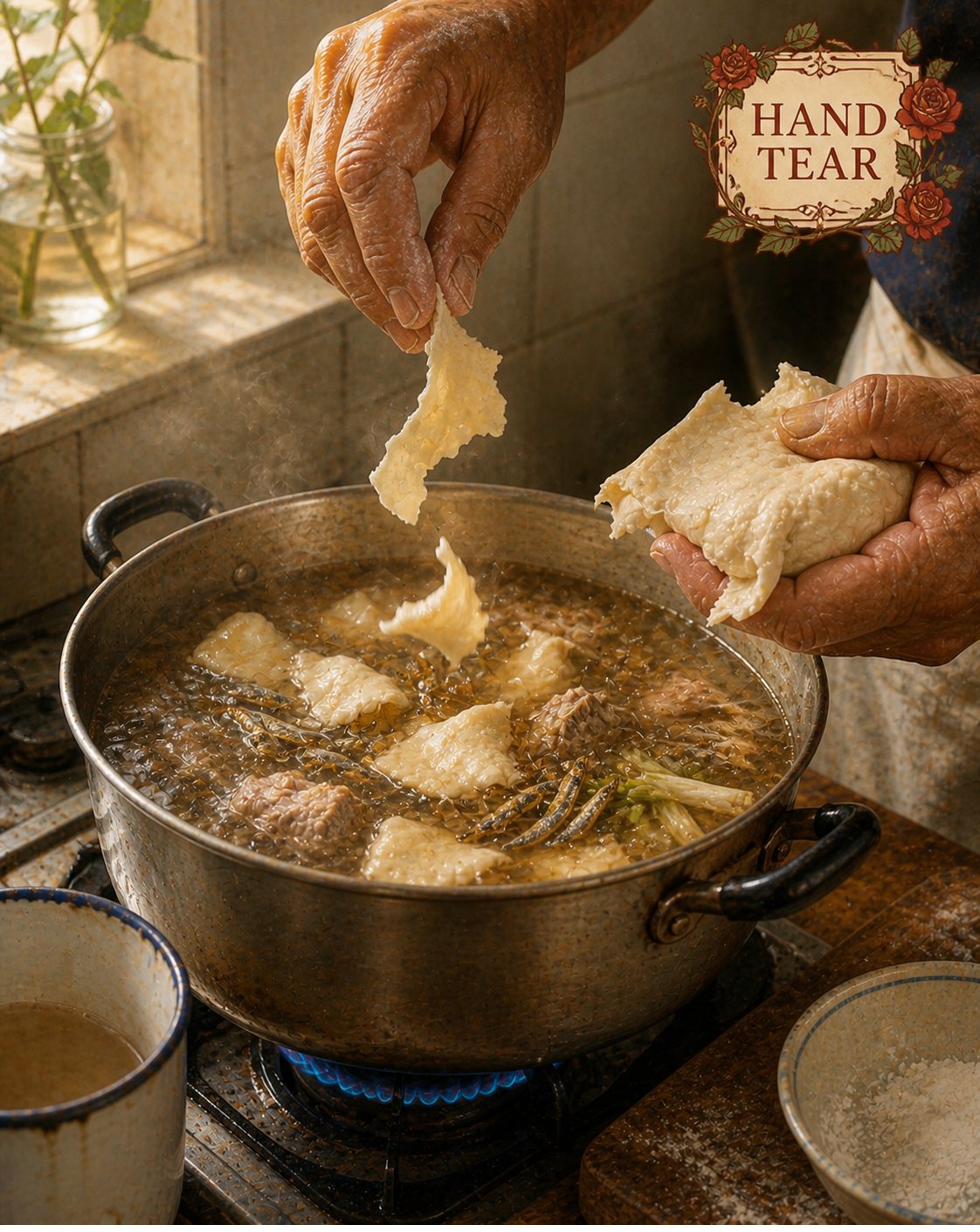
Bring the broth back to a gentle rolling boil — heritage Rule Three requires actively rolling water for the hand-tear cook.
The choreography for each portion:
- Hold a fist-sized portion of rested dough in your non-dominant hand (left hand if right-handed). The rest of the dough stays covered under the damp cloth.
- With the dominant hand's thumb-and-forefinger, pinch off a thin flat piece from the edge of the dough mass. Heritage practice: lightly oil or wet your fingers first to prevent dough sticking.
- Stretch the piece between the fingers — pull gently to thin the centre to about 1.5-2mm thickness, irregular flat shape, 4-5cm across. The piece should be slightly translucent at the thinned edges. If the piece tears, that is fine — drop both halves into the pot. If the piece is too thick in the middle, pinch it thinner before dropping.
- Drop the piece directly into the rolling broth. Do not pile pieces on a board first — the heritage practice goes from hand to broth in one motion.
- Continue tearing-and-dropping for the full portion (about 100g of dough per bowl). The first pieces will float-and-puff within 60-90 seconds — the heritage cooking signature.
- Cook 1-2 minutes after the last piece floats. Test one piece — cut it in half with a spoon edge; the centre should be uniformly cooked-through, no white-flour streak.
- Add the prawns (if using) in the last 90 seconds — they should turn opaque-pink and curl.
- Crack the eggs into individual ladles and slip them into the broth surface — they will soft-poach in 90 seconds; heritage practice keeps the yolk runny.
Assembly 3 min per bowl
For each bowl:
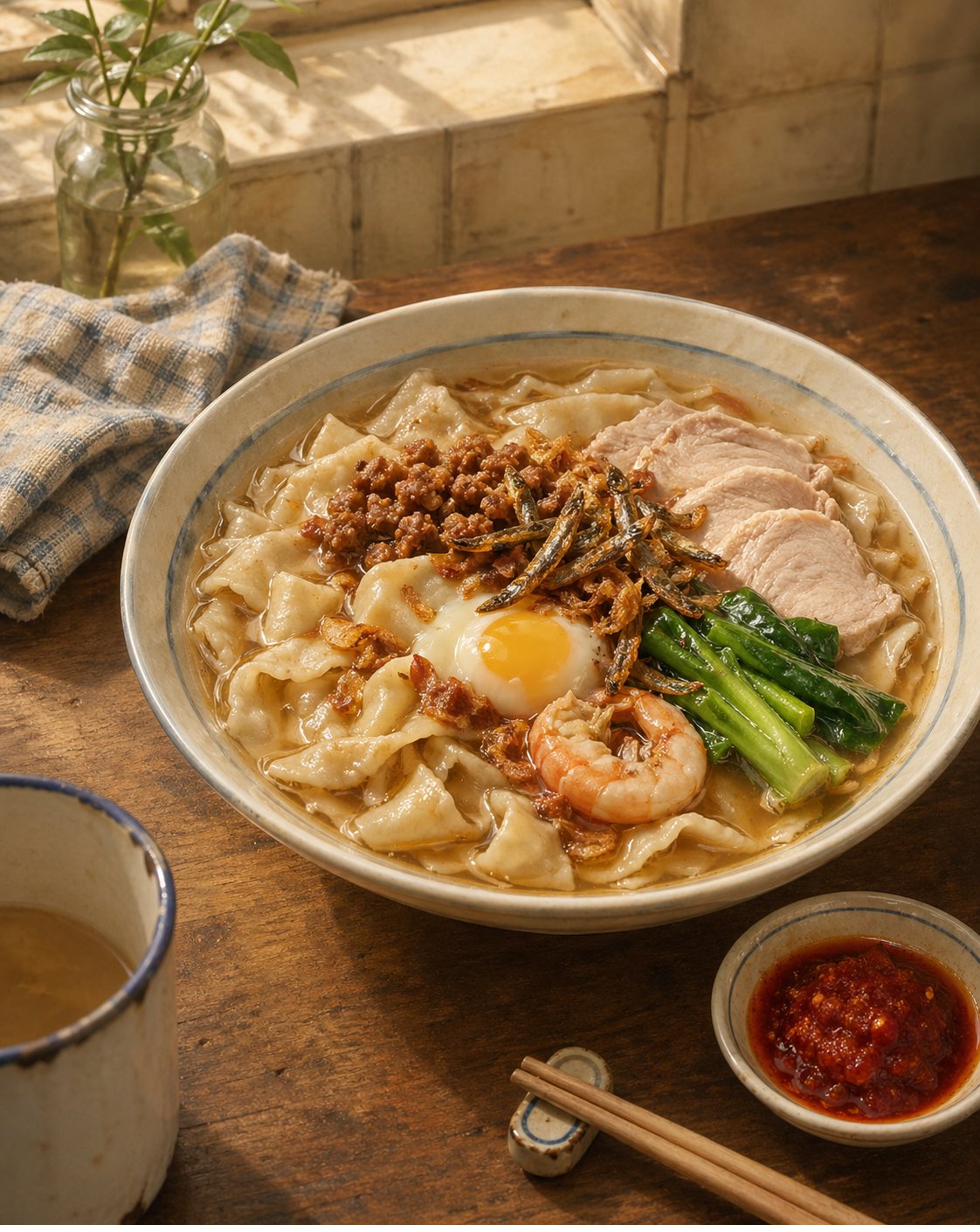
- Ladle the noodles, broth, choy sum, prawn (if using), and one soft-poached egg into a deep cream-and-pale-blue Singapore-everyday soup bowl.
- Top with a generous mound of the cooked seasoned minced pork at centre.
- Add three thin slices of lean pork (if using sliced-pork form) radiating from the mound.
- Drizzle 1 tsp of the reserved heritage shallot-oil over the surface — this is the heritage finishing flourish that lifts the bowl from comfort to memory.
- Scatter generously with crispy fried ikan bilis and fried shallots.
- Place a small dish of sambal-chilli at the bowl edge.
- Serve immediately, with chopsticks and a ceramic spoon.
🎯The Three Tips
Heritage. Master's. Mistake.
🏛 Heritage Note
The Dying Art Lives at Home
The heritage Hokkien hand-torn mee hoon kueh form has — per the HungryGoWhere profile of Legacy Ban Mian's second-generation hawkers — become the dying art in Singapore's hawker scene. Most stalls have shifted to Form C (the ban mian umbrella with machine-rolled flat strands) for speed and consistency, and the genuine bare-hands-from-the-mass technique survives at a handful of heritage stalls.
The home-kitchen register is, ironically, where the heritage hand-tear form is most reliably preserved. Every Singapore Hokkien household with a grandmother who taught the dough-rest-and-hand-tear discipline has the heritage form alive at its weeknight table. This is one of the dishes where heritage survives at home rather than at the stall — which is why it sits on Hock Ko's Bonus Table as a home-table item rather than a hawker-stall recipe.
👨🍳 Master's Tip
The Pinch-Stretch-Drop Rhythm
The single technique-anchor that makes the difference between a beginner's mee hoon kueh and a heritage one is the rhythm of pinch-stretch-drop. Heritage practice does all three motions in roughly two seconds — pinch off, stretch thin, drop into broth, repeat.
Hock Ko's heritage advice: count the rhythm out loud the first three times you do this — "one-two-drop, one-two-drop, one-two-drop" — and the hands will start to know the rhythm without the count by the fourth or fifth piece. The dough is forgiving; you can always pinch a thick piece thinner, or pinch a too-large piece in half, before dropping. The only actual mistake is hesitation — if you hold the piece too long in the air, the dough warms in your fingers and gets sticky-and-harder-to-handle.
⚠ Common Mistake
Three Failure Modes
- Milky-white broth. The cook boils the bones-and-ikan-bilis hard rather than at low simmer; the fat emulsifies and the broth turns cloudy. The bowl reads as Cantonese-style emulsion rather than heritage Hokkien clear stock. The fix: keep the broth at LOW SIMMER for the full 90 minutes; skim foam every 15-20 minutes; never let the broth roll-boil during the simmer (only at the noodle-cook stage). If the broth has already gone cloudy, strain through a coffee filter or muslin-cloth-lined sieve to recover clarity.
- Tough-chewy noodles. The cook under-rests the dough (less than 30 minutes), or uses too little water (dry firm dough), or kneads too hard (overdeveloped gluten). The torn pieces cook into tough chewy fragments that feel like under-cooked dumpling skin. The fix: rest the dough 1 hour minimum; use 60-65% hydration; knead only until smooth-and-elastic (8 minutes), never longer. If the dough is already too firm, knead in an additional 1-2 tbsp water and rest another 30 minutes.
- Uniform pieces. The cook rolls the dough flat with a rolling pin and cuts uniform squares with a knife or pizza-wheel for tidiness. The bowl reads as Hakka pan mee or modern machine-cut, not heritage Hokkien hand-tear. The fix: abandon the rolling pin and the knife. Pinch directly from the dough mass; let each piece be its own irregular shape. Heritage practice values the variety — some thin pieces, some thick pieces, some long-and-narrow, some square-ish, all in the same bowl. The variety is the heritage register, not a fault.
📈 Scaling for Hawker Service
The hand-tear is the bottleneck
The heritage hand-tear technique is the bottleneck at hawker-stall scale — a single cook can hand-tear 3-4 bowls per minute at peak rhythm, which is why heritage stalls like Seletar Sheng Mian queue long during peak hours. Modern stalls scale by switching to Form B (board-cut pan mee) or Form C (machine-rolled flat strands), losing the heritage Form A irregularity for throughput.
- Home double-batch: double the dough (800g flour, 480-520g water) and the broth (2x ingredients, 5L stockpot). The same cook can serve 8 bowls in one batch with the dough hand-torn over 7-8 minutes total.
- Beyond 8 bowls: a second pair of hands at the tearing station is heritage practice — the family member or neighbour who tears while the cook handles toppings is the heritage Singapore-Hokkien-home choreography.
- Hawker-stall scale-out (40+ bowls per service hour): two parallel hand-tear cooks plus one broth-and-toppings cook; this is the configuration Legacy Ban Mian and Seletar Sheng Mian operate at.
Every hand-tear stall has a slightly different rhythm because every cook's hands tear slightly differently — heritage stalls hold to this as a feature, not a bug.
The bowl arrives warm. The kitchen quietens. The working day stops following us home.